Trends & Insights
What Manual Influencer Campaign Management Costs Your Fitness App
2026
.
3
.
25
By
Team Airbridge


A fitness app partners with 15 influencers across Instagram and TikTok. Each influencer gets a unique promo code, a UTM link, and a shared Google Sheet row. By week two, three links are broken, two influencers posted with the wrong code, and the spreadsheet has duplicate entries that no one can reconcile.
The campaign report says 4,200 installs. RevenueCat says 89 paid subscribers. No one can connect the two numbers.
This gap between install counts and subscription revenue is not a reporting inconvenience. It is the single largest source of wasted influencer spend for subscription apps. When you cannot attribute a paying subscriber back to the influencer who drove the install, every partnership decision is a guess. Renewing a $5,000/month creator because "the engagement looked good" is how growth budgets disappear.
Key Takeaways
Influencer campaign management looks simple on paper: find fitness creators, negotiate terms, distribute links, track results. In practice, the tracking step alone consumes more time than every other step combined.
Every influencer partnership generates a chain of manual work:
Each step requires a different tool. None of them talk to each other. A team managing 10 influencers repeats this loop 10 times. A team managing 50 influencers either hires someone full-time to manage the spreadsheet or accepts that the data will be incomplete.
Industry data shows that 60% of brands still struggle to manage campaigns efficiently, relying on spreadsheets and manual processes for influencer campaign management. That ratio holds across team sizes, but the absolute cost scales dramatically. A two-person growth team managing 10 partnerships loses one full workday per week to spreadsheet maintenance. A five-person team managing 40 partnerships may lose two to three full-time equivalent days per week.
The work is not difficult. It is relentless. Every hour spent copying UTM parameters into a spreadsheet is an hour not spent analyzing which influencers actually drive paying subscribers.
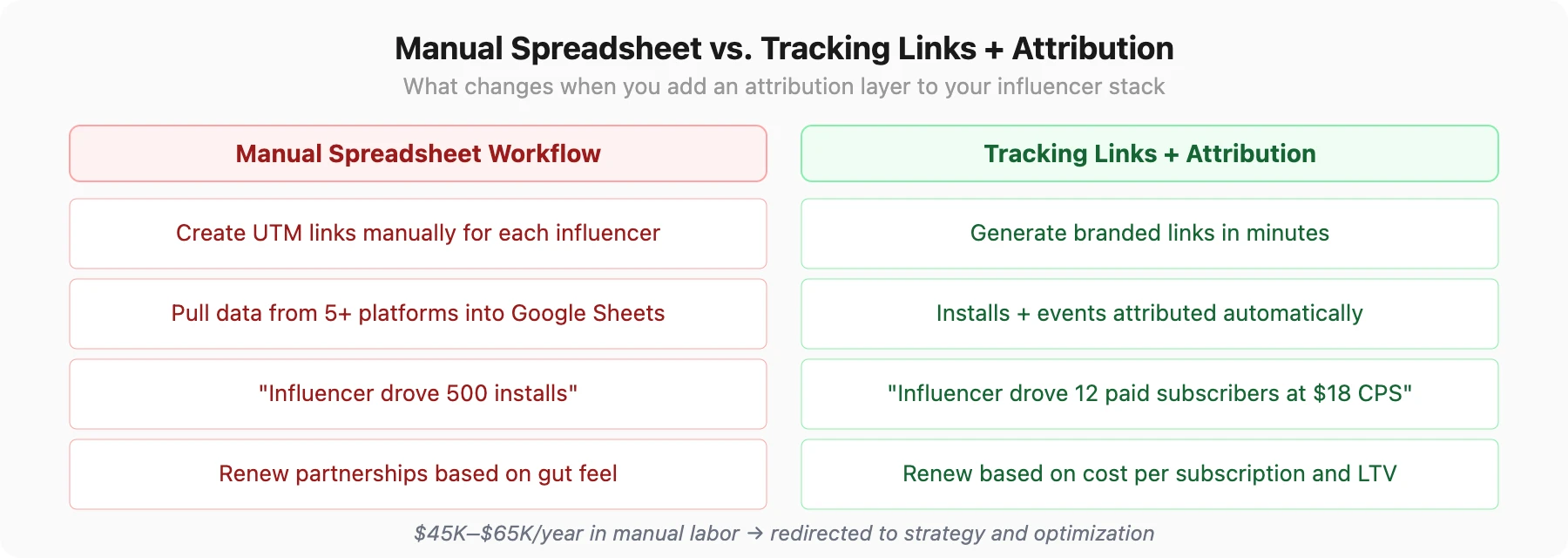
The spreadsheet problem is not just an operational headache. It has a specific dollar cost that most teams never calculate.
Estimates place the annual cost of manual influencer tracking labor between $45,000 and $65,000 per brand. This figure covers everything from link creation and distribution to cross-platform data aggregation, weekly report generation, and error correction across broken links and conflicting numbers. These costs assume a mid-market team running 10 to 30 influencer partnerships per quarter, and they do not account for the opportunity cost of misattributed spend or delayed optimization decisions that compound over each campaign cycle.
Spreadsheets work for a handful of partnerships. They stop working reliably as the roster grows. The failure mode is not dramatic. It is gradual:
The result is a tracking system that feels functional but produces numbers no one fully trusts. When your campaign performance data is unreliable, you cannot make confident decisions about which influencers to renew, which platforms to prioritize, or how to allocate next quarter's budget.
Influencer campaign management tools exist precisely to replace the spreadsheet workflow. Platforms like CreatorIQ, Grin, and Aspire handle content approval, contract management, communication, and basic performance tracking in a single interface.
The operational layer is where these tools deliver clear value. Instead of juggling email threads, Slack messages, and shared drives, teams can manage influencer relationships, review content drafts, and track deliverables in one place. For teams drowning in coordination overhead, this alone justifies the investment.
Dedicated influencer campaign management tracking automation tools can reduce tracking overhead by 60 to 75% compared to manual spreadsheet workflows. Automated link generation, centralized dashboards, and platform API integrations eliminate the most time-consuming parts of the reporting loop.
Here is where the category falls short. Most influencer campaign management tools track engagement metrics: likes, comments, shares, clicks, and installs. Some integrate with app stores to show install counts.
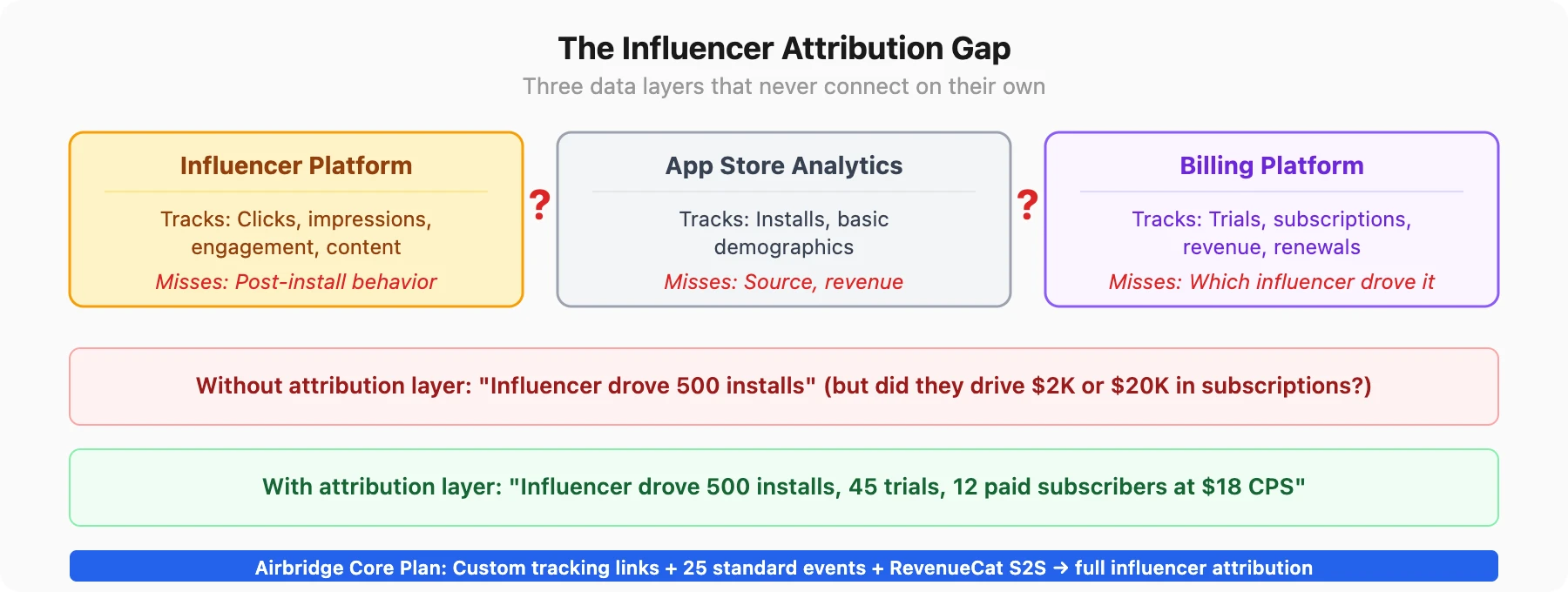
But install counts are not revenue. A fitness app needs to know which influencer drove installs that converted to paid subscribers. That requires connecting platform engagement data, mobile app attribution, and billing platform revenue into a single view. Influencer management tools handle the first layer. They do not touch the second or third. This creates a gap where teams can see that an influencer "drove 500 installs" but cannot answer whether those installs produced $2,000 or $20,000 in subscription revenue.
The attribution gap is not a minor data quality issue. It is a structural problem that affects the majority of brands running influencer programs.
Most brands running influencer programs cannot accurately attribute more than half of their influencer-driven revenue back to specific creators or campaigns. The installs show up in app store dashboards, and revenue shows up in billing platforms, but the line connecting a specific influencer link to a specific paying subscriber is missing. This disconnect means growth teams are making renewal and budget decisions based on vanity metrics rather than actual revenue contribution.
The gap is architectural, not operational. Install attribution and revenue attribution live in entirely different systems, and no single platform in the typical influencer technology stack connects the click on an influencer link to the subscription payment that happens days or weeks later. The table below illustrates where each system's visibility ends and the data blind spot begins:
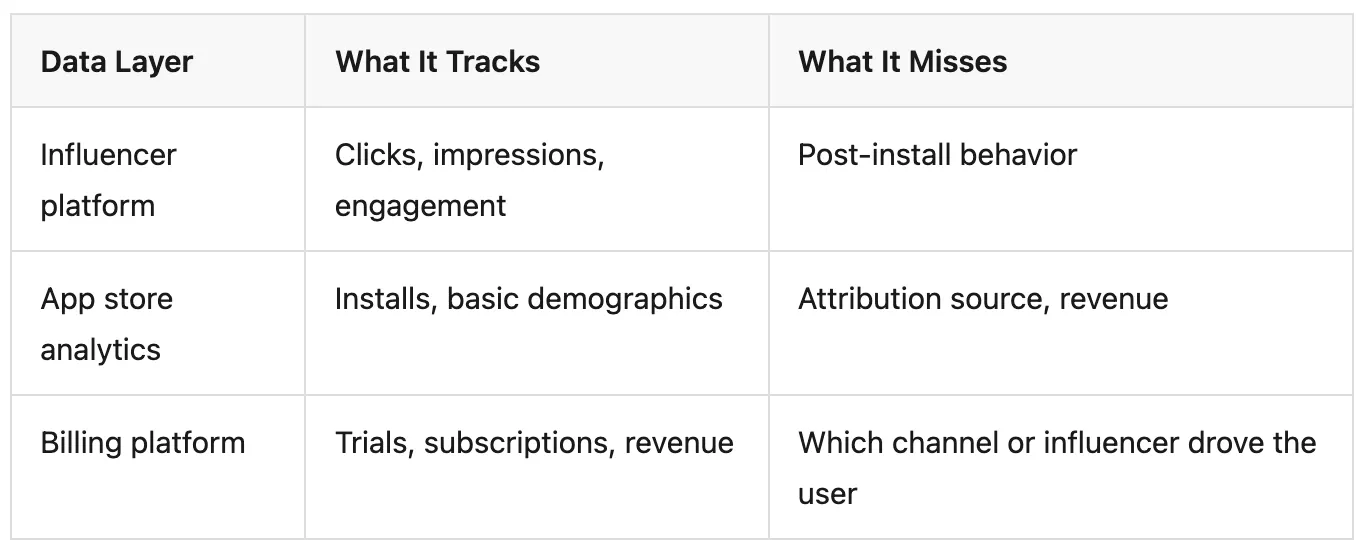
No amount of spreadsheet work bridges this gap. The data simply does not exist in any single system. Closing this gap requires a Mobile Measurement Partner (MMP) that can attribute installs to specific links and then connect those installs to downstream subscription events.
Airbridge Core Plan includes custom tracking links, subscription attribution, and RevenueCat integration in one stack. Get Started with Airbridge Core Plan →
The solution to the influencer attribution problem is not a better spreadsheet or a more expensive influencer platform. It is adding an attribution layer that connects influencer-driven installs to subscription revenue.
The foundation is a unique tracking link per influencer. Instead of relying on UTM parameters that break across redirects, custom domain tracking links maintain attribution through the entire install flow from click to app open. Each influencer gets a branded link (e.g., yourbrand.link/jane) that carries attribution data from click to install, persisting even when the user does not have the app installed at the time of the click. This eliminates the manual link-creation-and-spreadsheet-logging loop entirely; links are generated centrally, each one tied to a specific influencer and campaign, and attribution happens automatically when the user installs the app through deep linking.
Tracking the install is only the first step. To connect influencer installs to revenue, you need event-level attribution that follows the user through the subscription funnel: install, sign-up, start trial, subscribe, renew, or unsubscribe.
Standard events use predefined event names (Start Trial, Subscribe, Unsubscribe, and others) that map directly to the subscription lifecycle. Customers still need to log these events in their app code, but the event names and parameters are predefined, reducing schema design work. When paired with a server-to-server (S2S) integration with billing platforms like RevenueCat or Adapty, subscription events are captured regardless of whether the user has the app open.
Airbridge Core Plan provides the tracking link and attribution layer that influencer platforms lack:
The pricing model removes the barrier that keeps most subscription apps from adopting proper attribution. Core Plan starts with 15,000 free attributed installs and charges $0.05 per install after that, with no annual contract. For context, traditional MMP plans typically require minimum contracts of $2,000 to $5,000 per month, which prices out most early-stage fitness apps running influencer campaigns.
What Core Plan intentionally does not include: custom events, non-SAN ad network support, raw data export, and fraud detection. These are features designed for mature teams with complex analytics needs. For fitness apps focused on influencer attribution, the 25 standard events and GMAT channel integrations (Google, Meta, Apple Search Ads, TikTok) cover the core measurement requirements.
Every fitness app running influencer partnerships faces the same question: which creators actually drive paying subscribers? Spreadsheets cannot answer it. Influencer platforms alone cannot answer it. The answer requires an attribution layer that follows the user from the influencer link through the install, the trial, and the subscription.
Get Started with Airbridge Core Plan — connect influencer installs to subscription revenue with custom tracking links, 25 standard events, and RevenueCat integration. 15,000 free attributed installs, no annual contract.
The gap between influencer installs and subscription revenue is not a data problem you solve later. It is the measurement foundation you build now, before scaling the partnerships that depend on it.