Deferred Deeplink Benefits for App Installs
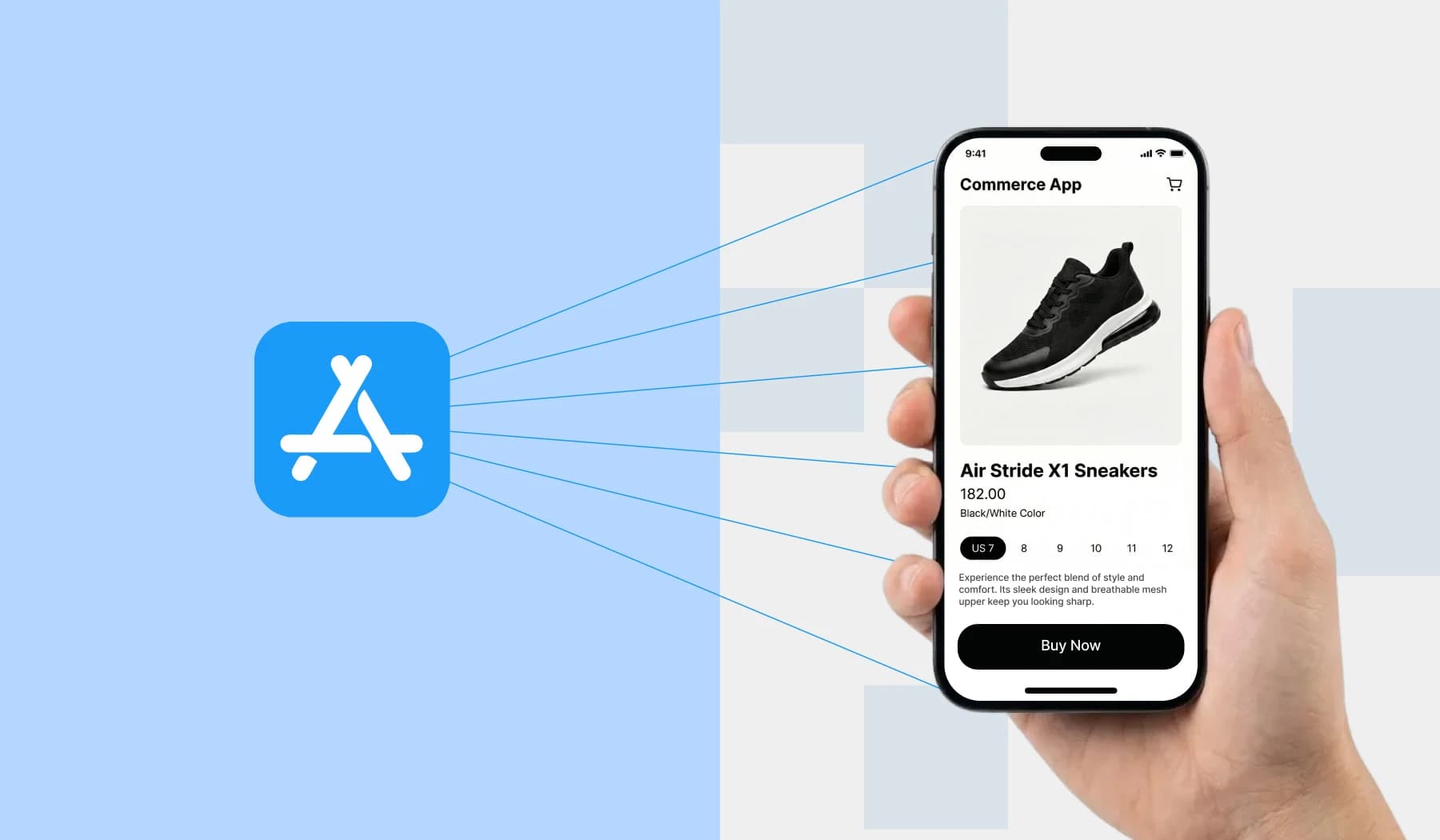
Paid user acquisition is expensive. If you send a user to the App Store and they land on a generic home screen after install, you’ve likely lost them.
Understanding deferred deeplink benefits is the first step toward fixing this broken funnel. By maintaining context from the initial ad click through the installation process, deferred deep links ensure your users find exactly what they were promised, significantly reducing churn.
This article breaks down how deferred deep linking works, why it impacts growth metrics, and how teams use it to improve conversion from paid installs.
📌Key Takeaways
- Deferred deep linking preserves intent through install. It ensures users land on the exact in-app content promised in the ad, not a generic home screen.
- It fixes the biggest paid UA leak. By maintaining context from click → install → first open, deferred deep links reduce early drop-off and “ghost installs.”
- Faster time-to-value drives better retention. Routing users directly to high-intent experiences shortens activation paths and improves Day 7 and Day 30 retention.
- Paid acquisition becomes more efficient. Campaigns optimize for engagement and conversion quality (CPE), not just installs (CPI), improving ROI.
- Critical for subscription and AI apps. From paywalled previews to pre-filled AI workflows, deferred deep links turn installs into immediate, value-driven sessions.
What is Deferred Deeplink?
Deferred deeplink is a feature that allows mobile apps to direct users to specific content within an app, even if the user doesn't have the app downloaded.
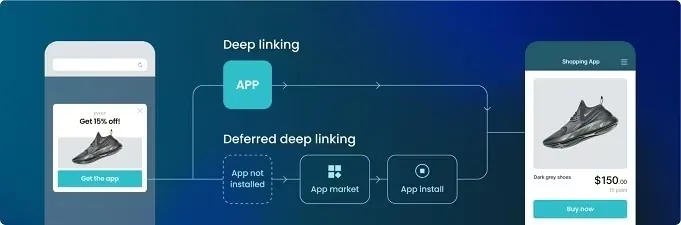
A deferred deeplink saves the in-app destination data in the server until the user finishes the app download. It differs from standard deep links, which only work on already-installed apps, by "deferring" the action until post-install.
When a user clicks on a deferred deeplink but does not have the app, they will be directed to the App Store to download it. Once the download is complete, and the user launches the app, they will then be sent to the final in-app destination.
Why is deferred deeplink important?
App marketers can reach users across more channels than ever: websites, social platforms, SMS, and even offline touchpoints like QR codes. Reach, however, is only half the job. What matters is what happens after the click.
Every extra step between a campaign and the in-app destination introduces drop-off. Users get distracted. They hesitate. They leave. small delays or unclear navigation can materially reduce conversion rates.
User acquisition is even more complex. Prospective users don’t have the app installed, so a standard deep link breaks the journey. This is where deferred deep linking becomes essential.
Deferred deeplinks route new users through the app store first. After installation, the app opens to the original intended destination, not a generic home screen. The context is preserved, the experience feels continuous, and the user lands exactly where they expected to be.
How does deferred deeplink work?
A Deferred deep link saves the in-app destination data in the server until the user finishes the app download. When the download is complete, and the user opens the app, the deferred deep link then matches the data with the user ID to take the user to the app page.
Here's the step-by-step flow:
- Click: A user clicks an ad or promotional link (e.g., ‘10% off discount for monthly subscriptions’).
- Intent Capture: The attribution provider (like Airbridge) captures the user's device parameters or a unique click ID.
- App Store Redirect: Since the app isn't installed, the user is sent to the official store.
- The Install & First Open: App SDK pings server on launch.
- Match & Redirect: Server links install to click, delivers deep link data – straight to product page or offer, skipping home screen.
This whole process seems complicated, but it is quite similar to the logic that is used in an MMP. With an MMP like Airbridge, marketers can set step-by-step details of deferred deep linking scenarios with ease.
Deferred Deeplink Benefits That Directly Impact Growth Metrics
As app ecosystems become more competitive and AI-powered apps raise user expectations, the margin for post-install friction keeps shrinking. Growth teams can no longer rely on installs alone. What matters is how quickly users reach value after install.
Below are the deferred deep linking benefits that performance marketers actively optimize for in 2026.
1) Higher Install-to-First-Open Rates
A common mistake marketers make is ignoring the "Ghost Install" phenomenon – where a user downloads an app but forgets why they did so by the time the icon appears on their home screen.
Deferred deep linking solves this by providing an immediate "Reason to Stay”.
By serving the exact content promised in the ad, you eliminate the cognitive load that causes users to bounce before the first session even begins.
2) Better Post-Install Activation
Activation happens the moment a user realizes the app's value. In 2026, activation benchmarks are rising, especially for subscription and AI-powered apps, where users expect immediate, tangible value right after install.
When a campaign promotes an “AI Photo Filter,” sending users through a generic tutorial creates friction. Instead, the deferred deeplink should bypass onboarding and drop the user directly into the camera interface with that filter pre-selected.
This is where deferred deep linking plays a critical role. By routing new users into pre-configured, high-intent experiences – like saved AI prompts, unlocked previews, or contextual onboarding paths – it shortens the path to the “Aha!” moment.
The faster users experience value, the more likely they are to stay. In practice, shorter activation paths are strongly correlated with higher Day 7 and Day 30 retention.
Learn more about how Playio optimized the user journey toward the ‘aha moment’, achieving a 30% D30 retention rate for ad-acquired users here.
3) Improved Conversion from Paid Installs
Paid install conversion measures how efficiently ad spend turns into revenue or qualified users.
Here's where deferred deep linking transforms your unit economics: users who click promotional content are already demonstrating high intent and are "likely to be of higher quality" than broad-based acquisition efforts.
By preserving that intent through the install process, you're optimizing for engagement quality, not just download quantity.
This translates directly to better ROI on paid acquisition campaigns. Instead of measuring success purely on cost-per-install (CPI), you can focus on cost-per-engagement (CPE) – a metric that actually correlates with lifetime value and revenue generation.
| Metric | Without Deferred DL | With Deferred DL | Improvement |
|---|---|---|---|
| Install-to-Open | Baseline | +20-30% | Seamless routing |
| Day-30 Retention | 1x | 2.5x (Source: Adapty) | Personalized activation |
| Paid Conversion | Baseline | +30-40%+ (Source: scn.st) | Direct to offers |
Want to see how Deep linking works with your data?
Get hands-on with Airbridge and see real results.
Try It Free →Common Use Cases for Deferred Deeplinks in Subscription & AI Apps
1) Paywalled Content Previews
Use case: User clicks an ad for premium content but doesn’t have the app installed.
With deferred deep linking:
- User installs the app
- Lands directly on the locked article, feature, or tool
- Sees the value before being asked to subscribe
Without it, users hit a generic home screen and often fail to understand what they installed the app for.
This approach consistently improves trial starts and subscription intent.
2) Personalized Subscription Offers
Use case: Campaigns promoting discounts, free trials, or plan-specific messaging.
Deferred deep links allow marketers to:
- Route users to a campaign-specific paywall
- Pre-select plans or pricing tiers
- Match messaging from ad to in-app offer
Mismatch between ad copy and paywall content is a silent conversion killer. Deferred deep linking removes that inconsistency.
3) AI App Templates and Pre-Filled Workflows
Use case: AI tools promoting specific outputs (e.g., “Generate a resume,” “Summarize a PDF”).
With deferred deep linking:
- Users install the app
- Open directly into a pre-filled prompt or workflow
- See output immediately or after minimal input
This shortens time-to-value dramatically, which is critical for AI apps competing on perceived intelligence and speed.
4) Re-Engagement After Install Delays
Use case: Users install but don’t open immediately.
Deferred deeplinks can be reused in:
- Install reminder emails
- Push notifications
- Retargeting ads
Because the destination remains intact, users return to the exact context they originally wanted, not a generic restart point.
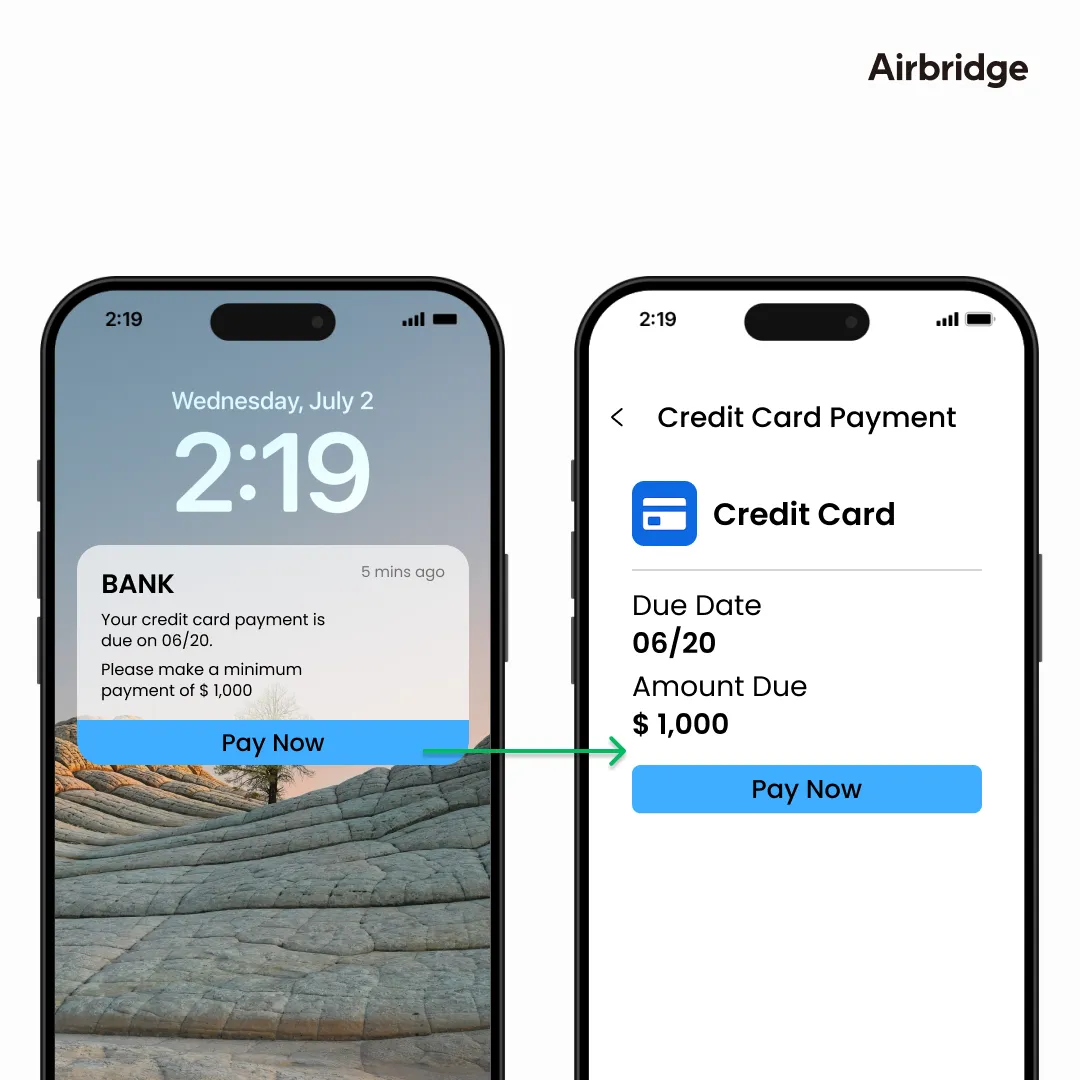
Airbridge DeepLink: Built for 2026 Performance Marketers
As we move through 2026, the complexity of the "Privacy-First" era means standard attribution often loses the thread.
While deferred deep linking delivers clear benefits, implementation complexity often becomes the bottleneck. Performance marketers need solutions that integrate seamlessly with existing attribution and analytics workflows while providing the granular measurement capabilities required for optimization.
Airbridge DeepLink addresses these challenges with privacy-first attribution that connects deferred deep link performance to broader campaign analytics.
It’s designed not just to create links, but to own the entire deeplinking workflow.
Features of Airbridge deeplink
- Unified deeplink management: Manage deeplinks in one place instead of spreading link logic across campaigns, channels, and tools.
- Intent-preserving routing across user states: Ensure users are routed to the correct in-app destination regardless of whether the app is installed or not.
- Consistent behavior across channels and touchpoints: Apply the same deeplink logic across paid media, CRM, web-to-app journeys, and offline entry points.
- Operational scalability without manual overhead: Support high volumes of campaigns and links without relying on custom engineering work for each use case.
- Reliable measurement tied to attribution: Connect deeplink interactions with install, conversion, and post-install events to maintain data continuity.
Outro.
Deferred deep links aren't optional – they're the fix for post-install drop-off. They boost install-to-open rates by 20-30%, lift D30 retention 2.5x, and sharpen paid conversion by 30-40% by landing users on promised content, not home screens.
In practice, subscription and AI apps thrive with them: previews before paywalls, pre-filled workflows, personalized offers. Skip this, and your CPI budget funds ghost installs.
Airbridge DeepLink Plan scales it all – unified management across channels, privacy-safe attribution, no engineering headaches.
Start Your Free Trial of Airbridge DeepLink and turn installs into revenue today.
👉 Explore how real teams are scaling deeplinking with Airbridge:
How Dabang cut deep link management time by 90% with Airbridge
How Fizz achieves ZERO performance loss with Airbridge API deeplinks
Ready to transform your mobile growth?
Learn how Airbridge helps leading brands measure and optimize every touchpoint.