The MMP "Success Tax": Why Per-Conversion Fees Kill Fitness App ROI at Scale

Your fitness app hit 50,000 installs last month. Your team scaled Meta and Google campaigns. Trials are converting. MRR is climbing.
Then you open the MMP invoice: $3,500.
Next month, installs hit 75,000. The invoice: $5,250. The month after that, 100,000 installs. The invoice increased to $7,000. Your MMP bill is growing at the same rate as your success — and unlike UA spend, it does not generate any additional revenue. It is a tax on growth.
This is the structural problem with per-conversion MMP pricing. The better your campaigns perform, the more you pay for the tool that measures them. And for fitness apps where average ARPU is $25.78, every dollar of attribution cost directly compresses the margin between acquisition cost and subscriber value.
Key Takeaways
- Per-conversion MMP pricing creates a "success tax." The more installs your campaigns generate, the higher your attribution bill — with no additional value delivered per conversion.
- At $0.07/conversion, attribution costs reach $42K–$84K/year at 50K–100K monthly installs — a significant line item for fitness apps with $25.78 average ARPU.
- The pricing structure is regressive. Startups and growth-stage apps pay the highest per-unit rate ($0.07), while enterprises negotiate down to $0.03–$0.05. The companies with the least budget pay the most per conversion.
- Add-on fees compound the base rate. Fraud detection, audience segmentation tools, and premium support are priced separately — adding $10K–$50K/year on top of per-conversion charges.
- Airbridge Core Plan charges $0.05/install with no add-ons. 15K free attributed installs. Same rate at any volume. Attribution cost stays below 0.2% of subscriber LTV.
How Per-Conversion MMP Pricing Works
Most traditional MMPs charge per attributed conversion — typically per install or per engagement" class="glossary-link" title="Re-engagement">re-engagement. The rate depends on your scale, but the direction is always the same: more success, higher bill.
The standard structure:
- Growth tier: ~$0.07 per conversion. This is the rate most early-stage and growth-stage apps pay. No volume discount. No ceiling.
- Enterprise tier: $0.03–$0.05 per conversion. Available at 1M+ annual conversions, typically requiring a 12–24 month commitment.
- Free tier: limited. Often capped at 12,000 lifetime conversions — roughly one month of moderate UA activity.
The regressive dynamic: a startup generating 20,000 installs/month pays $0.07 each. An enterprise generating 200,000 installs/month negotiates to $0.04. The company with 10x the volume pays 43% less per unit. The pricing penalizes the exact stage where companies are most budget-constrained.
And the base rate is only the beginning. Traditional MMPs layer additional costs on top:
- Fraud detection: $10K–$30K/year as a premium add-on
- Audience segmentation tools: Custom pricing, often a "significant part of an Enterprise contract"
- Premium support: Additional fee for dedicated CSM access
The total cost of attribution at 50K monthly installs is not $42K/year. It is $42K + $10K–$50K in add-ons — potentially $52K–$92K/year for a fitness app that may be generating $500K–$1M in total annual revenue.
The Math: What $0.07/Conversion Costs a Fitness App
The [fitness app market generated $3.4B in revenue in 2025
 ](https://www.businessofapps.com/data/fitness-app-market/), with average ARPU of $25.78. For subscription fitness apps, the unit economics are straightforward — and per-conversion attribution fees take a meaningful bite.
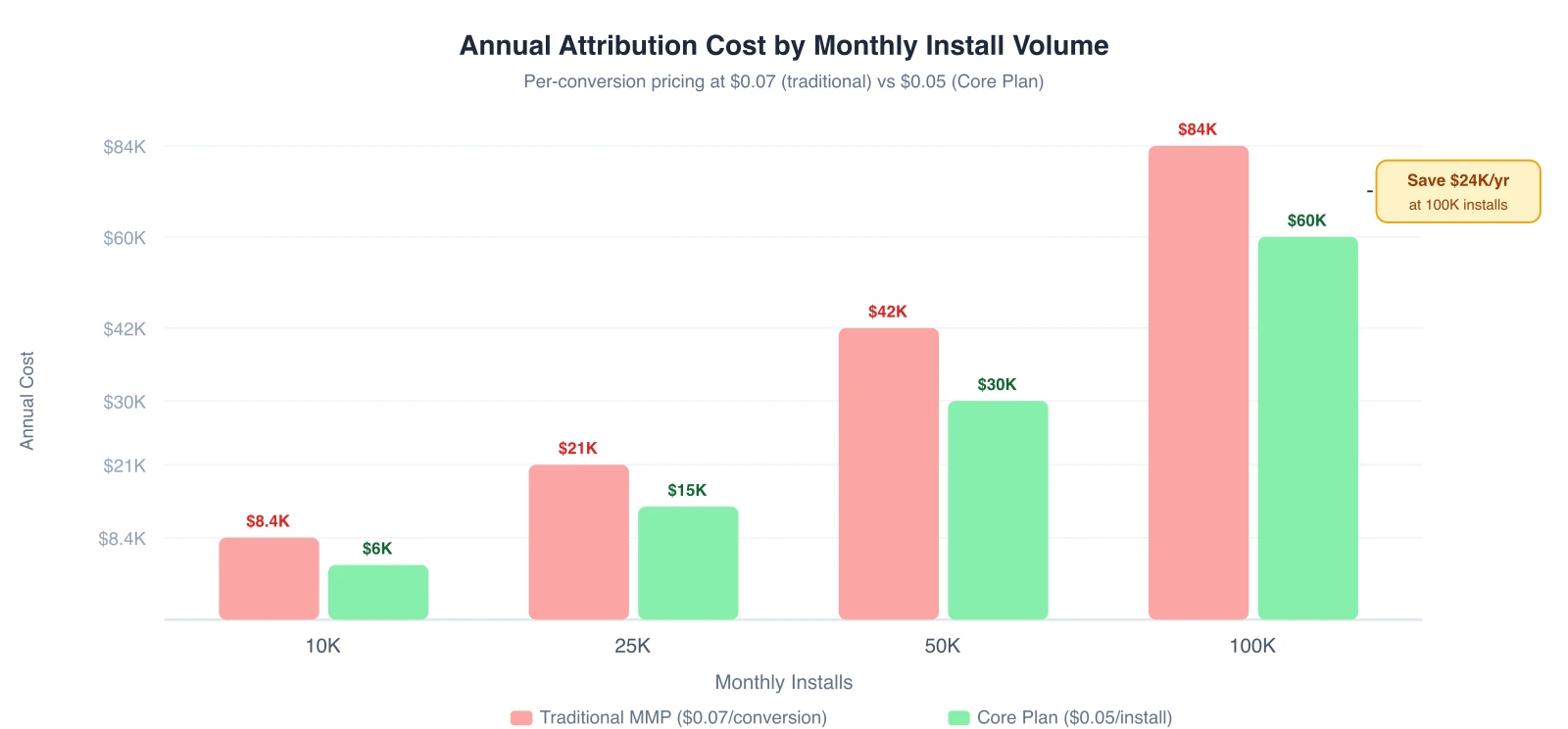
At $0.07/conversion (standard growth tier):
| Monthly Installs | Monthly MMP Cost | Annual MMP Cost |
|---|---|---|
| 10,000 | $700 | $8,400 |
| 25,000 | $1,750 | $21,000 |
| 50,000 | $3,500 | $42,000 |
| 100,000 | $7,000 | $84,000 |
At $0.05/conversion (Core Plan):
| Monthly Installs | Monthly MMP Cost | Annual MMP Cost |
|---|---|---|
| 10,000 | $500 | $6,000 |
| 25,000 | $1,250 | $15,000 |
| 50,000 | $2,500 | $30,000 |
| 100,000 | $5,000 | $60,000 |
At 10% install-to-subscribe and $25.78 ARPU, attribution consumes 3.2% of subscriber revenue at $0.07 — and 2.3% at $0.05. This ratio is constant regardless of volume.
The difference at 50K installs: $12,000/year. At 100K installs: $24,000/year. And these numbers exclude the add-on costs that traditional MMPs layer on top.
Start measuring what matters — for free
Airbridge Core Plan gives growing teams real attribution, deep linking, and audience tools at no cost.
Get Started Free →Why This Kills Scaling Confidence
The math problem is clear. But the operational problem is worse: per-conversion fees make attribution costs unpredictable.
When you plan a UA budget, you can estimate CPI, set daily spend caps, and control channel allocation. But attribution costs are a function of campaign success — which is exactly what you cannot predict in advance.
This creates a specific psychological barrier:
- Fear of scaling. If a campaign is working, scaling it means increasing both UA spend and MMP costs simultaneously. The attribution bill becomes an uncontrolled variable.
- ROI calculation breaks. You can calculate ROAS against UA spend. But when attribution costs scale proportionally, the effective CAC includes a hidden component that changes every month.
- Budget defense becomes harder. Explaining to leadership why the measurement tool costs $84K/year — for a fitness app — is a conversation most growth leads would rather avoid.
As a growth marketer at a fitness app shared with our team: "You can't scale out when your MMP charges on every conversion. The bill grows faster than you can prove the ROI."
What Affordable Attribution Should Cost
Attribution is infrastructure. Like hosting or analytics, it should scale with your business without becoming a growth constraint. The question is not whether to pay for attribution — you need an MMP because platform dashboards cannot deduplicate conversions. The question is what percentage of revenue attribution should consume.
A reasonable benchmark:
- Below 2.5% of attributed subscriber revenue. If your attribution tool costs more than 2.5% of the revenue it helps you measure, the measurement layer is too expensive relative to the insight it provides.
- Flat rate regardless of volume. The same per-unit cost at 10K installs and 100K installs. No regressive pricing that penalizes growth-stage companies.
- No add-on costs above the base rate. Reports, integrations, and attribution rules included. The per-unit price should be the total price.
How Core Plan Keeps Attribution Below 2.5% of Revenue
Core Plan charges $0.05 per attributed install. This is a per-conversion fee — the same model traditional MMPs use. The difference is in the rate, the structure, and what is included.
Why $0.05 works for fitness apps:
At 10% install-to-subscribe conversion and $25.78 ARPU, every 1,000 installs generates ~100 subscribers producing ~$2,578 in revenue. Attribution cost for those 1,000 installs: $50 — or 1.9% of subscriber revenue. At scale, this ratio stays constant because the rate does not change.
What makes it structurally different:
- Same rate at any volume. No enterprise tier required for a lower rate. A startup at 10K installs and a growth-stage app at 100K installs pay the same $0.05.
- 15K free attributed installs. This effectively covers the first months of UA testing — before the team has enough data to know whether scaling is justified.
- Funnel, Retention, and Revenue reports included. Native RevenueCat and Adapty S2S integration. 25 standard events. Meta, Google, Apple Search Ads, and TikTok pre-integrated. Everything in the base rate.
- No annual contract. If the math does not work at your scale, you can leave. No 12-month commitment trapping you with a tool that caps your growth.
Airbridge Core Plan vs Traditional MMP
The rate difference is only part of the equation. Here is what changes when the total cost structure is compared side by side.
| Capability | Traditional MMP(Typical) | Airbridge Core Plan |
|---|---|---|
| Per-conversion rate | $0.07/conversion(growth tier) | $0.05/install |
| Free tier | 12K lifetime conversions | 15K free attributed installs.All features included |
| Add-on costs | Fraud, audience segmentation,support priced separately($10K–$50K/yr) | No add-ons.All features included |
| Onboarding | General-purpose onboarding | Subscription-app focused onboarding,25 standard events |
| Contract requirement | 12–24 month commitmentfor enterprise rate | No annual contract.Pay-as-you-go |
| Attribution cost as% of subscriber revenue | ~3.2%(before add-ons) | ~2.3%(all features included) |
Your MMP Should Not Be Your Biggest Line Item After UA
Attribution exists to help you spend UA budget more efficiently. When the measurement tool itself becomes a significant cost center, the economics are inverted. Your MMP bill should be a rounding error on your revenue — not a line item that competes with your ad spend.


Ready to see what Core Plan can do?
Free attribution, deep linking, and audience tools — built for teams that are ready to grow.