

Trends & Insights
MMP SDK Setup Takes Longer Than Your First Campaign — Something Is Wrong
2026
.
3
.
14
By
Team Airbridge


The ad budget is approved. The creatives are ready. The campaigns launch next week. There is just one problem — the MMP is not live yet. The SDK is half-integrated. The event schema is still being debated. The one engineer on the team is splitting time between product work and tracking setup.
For Seed-to-Series A subscription app teams, this is not an edge case — it is the default MMP setup experience. By the time attribution is running, 2-4 weeks of ad spend have already gone out the door with no measurement. The campaigns that needed data the most ran completely blind.
Key Takeaways
Most teams expect MMP setup to take a few days. In practice, it takes 2-4 weeks — and the delay comes from three places that are easy to underestimate.
Before a single line of SDK code is written, the team needs to decide what to track. For subscription apps, this means defining events for installs, trial starts, subscriptions, renewals, cancellations — plus properties like revenue, currency, plan type, trial duration.
Traditional MMPs require custom event schemas. The team designs event names, property structures, and naming conventions from scratch. For a 5-person team without a dedicated data engineer, this phase alone can take a week of back-and-forth between the marketer who knows what to measure and the developer who needs to implement it.
Once the schema is defined, the SDK needs to be integrated. For a subscription app supporting iOS and Android, that means:
For a team with one engineer splitting time between product and SDK work, each of these steps competes with feature development. A task that takes a dedicated engineer 2-3 days stretches to 1-2 weeks when it is not the only priority.
The marketer knows which channels to track and which metrics matter. The developer knows how to implement the SDK. But these are different people with different priorities — and the handoff between them is where MMP setup stalls.
The marketer writes a tracking spec. The developer has questions. The marketer clarifies. The developer implements. The marketer tests and finds missing events. Another round begins. For Seed-to-Series A teams, this handoff is not a process — it is a series of Slack messages squeezed between other work.
MMP setup and campaign launch operate on different timelines. Marketing teams face pressure to start spending immediately. The result: campaigns go live while the MMP is still being configured.
Without attribution, the team cannot see which channels drive installs, which drive trial starts, and which drive paying subscribers. Ad platform dashboards show self-reported numbers — but these are not independent measurement. Meta counts conversions Meta's way. Google counts conversions Google's way. Neither tells you the truth about cross-channel performance.
For a team spending $5K-$10K per month on UA, weeks of setup delay means thousands of dollars in ad spend with no independent attribution. Budget decisions during this period are based on each platform's self-reported numbers — the exact data you got an MMP to verify.
RevenueCat's State of Subscription Apps report found that 55% of 3-day trial cancellations happen on Day 0 — the same day the trial starts. Users decide fast. If the first campaigns run without attribution, the team cannot see which channels drive Day 0 cancellations versus qualified trials.
The first campaigns are not just any campaigns — they are the ones that set the algorithm's learning foundation. Meta and Google use early conversion signals to build audience profiles. If those signals are contaminated by unmeasured, unfiltered data, the algorithm learns the wrong patterns from day one.
Once a campaign runs without attribution, that data is gone. You cannot retroactively attribute installs that were never tracked. The users who installed, started trials, and subscribed during the setup period exist in your billing platform — but disconnected from the channels that drove them. That gap in your attribution history permanently affects LTV-by-channel calculations.
Reducing MMP setup from weeks to hours means eliminating the three bottlenecks — not just speeding them up. Airbridge Core Plan is an MMP built for subscription apps designed to do exactly that. The goal: attribution is live before your first campaign launches — not weeks after.
For subscription apps, the events that matter are known. Core Plan provides them as pre-defined standard events — Start Trial, Subscribe, Unsubscribe, Order Complete, Order Cancel — eliminating the schema design phase entirely. No naming convention debates. No property structure decisions. No back-and-forth between marketing and engineering. Native RevenueCat, Adapty, and Superwall integration is built in, so subscription data flows automatically without custom backend work.
Onboarding Pilot replaces the marketer-to-developer handoff with an AI-guided setup flow — the marketer initiates the process and invites the developer directly.
The result: what traditionally takes 1-2 weeks of coordination is completed in a single focused session.
Traditional MMP setup assumes a team with dedicated engineering resources and weeks of runway before campaigns launch. For Seed-to-Series A subscription app teams, that assumption rarely holds.
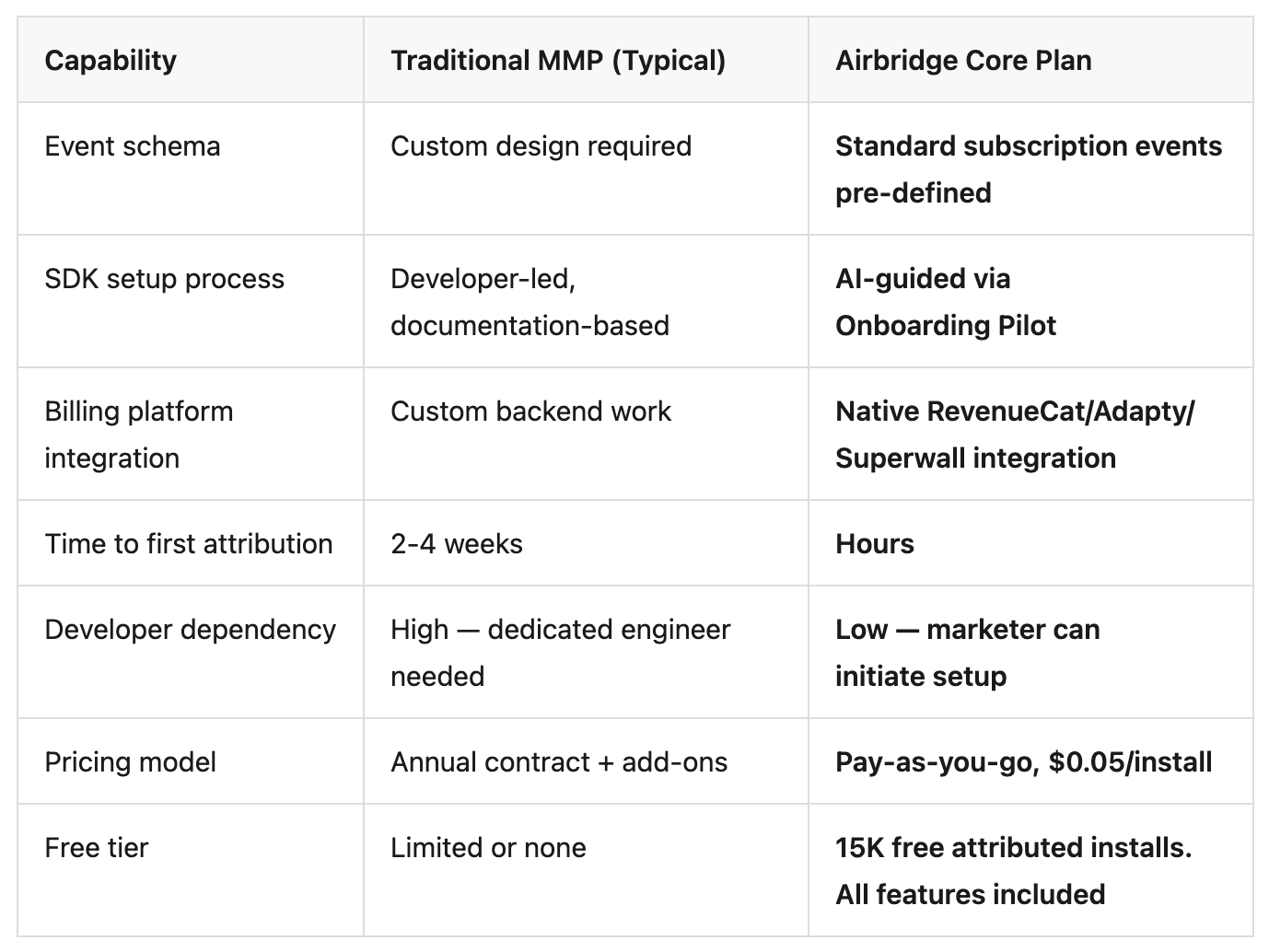
For subscription apps where users decide in hours — not weeks — the cost of slow MMP setup is not just time. It is the attribution data you can never recover, the algorithm learning you can never redo, and the budget decisions you made on numbers you could not trust.
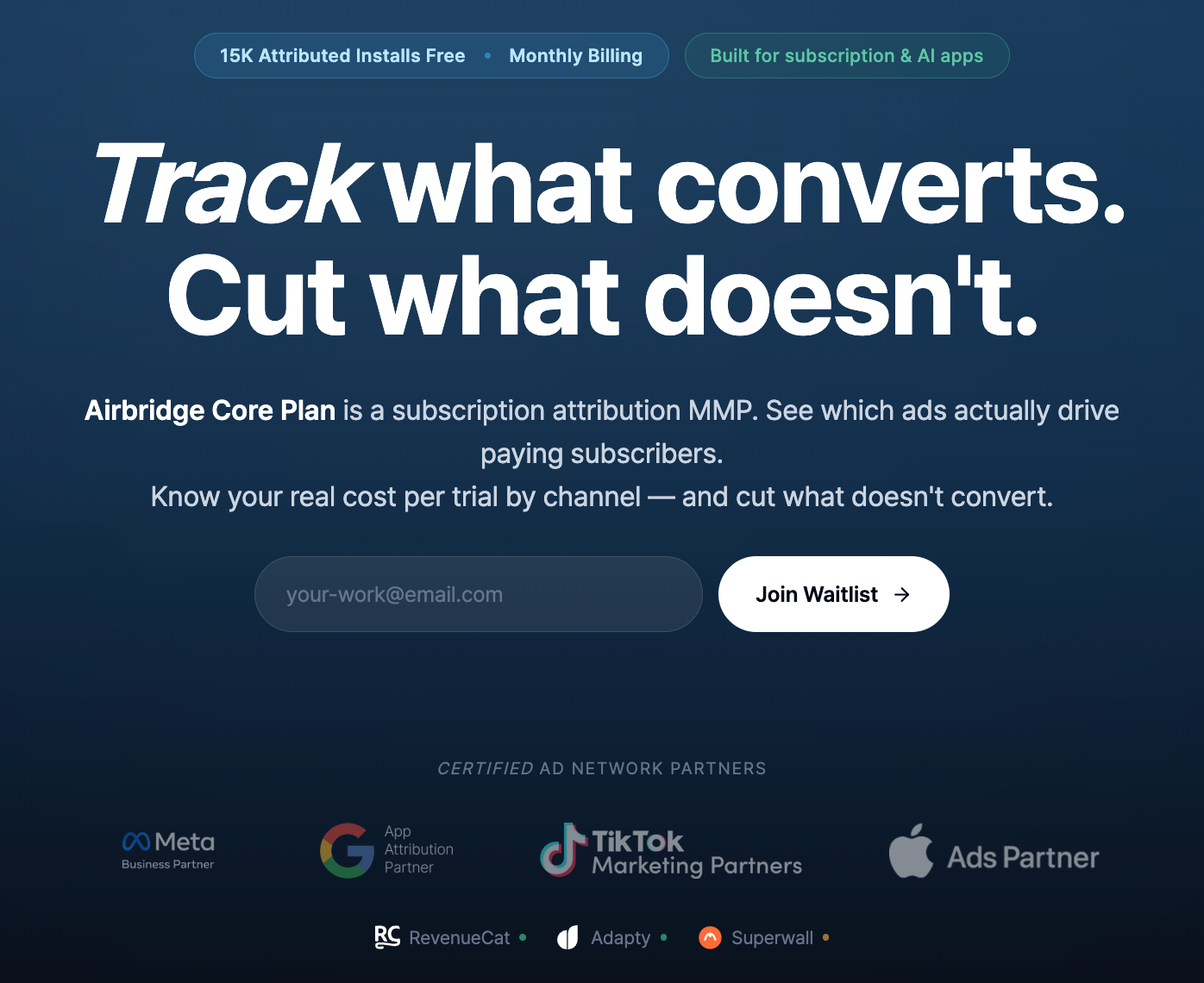
Get attribution live before your first campaign — start with 15K free attributed installs on Airbridge Core Plan.



.webp)
