Best Singular Alternatives in 2026: Key Features to Evaluate Before You Switch

Singular is a well-known MMP, but many growth teams start to feel its limits as they scale. Slow query speeds, short data retention, and rigid reporting can turn everyday optimization into friction, especially when user journeys span both web and app.
If you’re evaluating a Singular alternative for 2026, this guide breaks down what to look for and why performance-led teams are increasingly choosing Airbridge for unified measurement, native deep linking, and faster access to insights.📌Key Takeways
-
Singular works, but shows limits at scale. Slow queries, short data retention, and rigid reports reduce day-to-day efficiency.
-
User journeys are no longer app-only. Web-to-app and cross-device flows require unified measurement, not stitched-together tools.
-
Deep linking is core infrastructure. Singular supports the basics. Airbridge handles deferred and contextual routing natively.
-
Most leading MMPs deliver similar attribution accuracy. Differences emerge in flexibility, operational overhead, and cost efficiency.
-
Performance-led teams are favoring adaptable platforms. Tools that unify measurement, linking, and data access are gaining momentum as growth stacks mature.
What Is Singular ?
Singular is a Mobile Measurement Partner (MMP) that helps marketers attribute installs, measure campaign performance, and consolidate data across paid media channels.
Teams use Singular to understand where users come from, how campaigns perform, and which channels drive revenue rather than just installs. The platform offers attribution tracking, fraud prevention, and reporting capabilities that have attracted mobile marketers seeking an attribution solution.
1) Why are teams looking for Singular alternatives?
However, real-world implementation often reveals performance gaps that impact day-to-day operations. Based on competitive analysis and user feedback, reasons why people look for Singular alternatives are below:
-
Slow query performance: Delays in data processing make it harder for teams to react quickly, especially during high-impact campaign launches or rapid market shifts.
-
Limited historical data depth: One-year cohort analysis restricts long-term LTV insights and strategic planning for products with longer user lifecycles.
-
Inflexible reporting: Rigid report structures and fixed definitions make it difficult to customize KPIs, attribution models, or non-standard conversion events.
What you should consider to choose the best MMP for your teams
Probably, you’ve already started researching alternatives to Singular. But with so many vendors promising better attribution, deeper analytics, cleaner data, and privacy-safe measurement, it’s easy to feel overwhelmed. should prioritize several key capabilities that directly impact campaign success:
1) Attribution trust and data consistency
An MMP should provide stable, explainable attribution across paid channels, SKAN, and organic traffic. During migrations, teams often discover gaps between dashboards and raw data exports, and the right MMP reduces this risk through transparent attribution logic, deterministic fallback methods, and clear documentation for edge cases.
2) Real-Time Data Processing and Query Speed
Modern marketing relies on fast access to insights. Slow query processing delays optimization and weakens a team’s ability to respond to performance changes. Strong MMPs deliver complex attribution and performance reports in seconds and maintain speed as data volume scales.
3) Comprehensive Data Retention and Historical Analysis
Long-term growth decisions require access to deep historical data. An effective MMP should support year-long cohort analysis so teams can track long-term user behavior, calculate accurate lifetime value, and uncover seasonal trends that shape future acquisition and retention strategies.
4) Unified Web-App & Cross platforms Measurement
User journeys increasingly span web and app touchpoints, making unified measurement essential. MMPs that fully integrate web-app, and cross platform tracking provide a clearer view of attribution, while platforms that treat web measurement as secondary risk creating blind spots that lead to inefficient budget allocation and missed optimization opportunities.
Here Are Top Singular Alternatives & Competitors in 2026
Below are the most commonly evaluated Singular competitors among subscription apps, AI service providers, and performance teams managing multi-channel growth.
1) AppsFlyer
Appsflyer is often the first name that comes up in MMP comparisons. It offers strong attribution reliability, broad ad network integrations, and deep experience with SKAN. For teams operating at large scale, AppsFlyer delivers consistency and ecosystem maturity.
However, many marketers report similar challenges to Singular around pricing tiers, operational complexity, and limited flexibility when adapting attribution logic to custom growth models.
2) Airbridge
Airbridge is increasingly evaluated as a direct Singular alternative because it combines enterprise-grade attribution with a more flexible data and linking architecture.
Airbridge is positioned for teams that need accurate measurement without treating web, app, and deep linking as separate systems. That’s why Airbridge is the strongest among brands that have outgrown install-only measurement and now optimize for revenue, retention, and lifecycle performance.
3) Adjust
Adjust is another established MMP known for solid attribution and fraud prevention. It performs well for mobile-first businesses that prioritize campaign measurement and compliance.
That said, teams running web-to-app funnels often find Adjust’s web measurement capabilities less intuitive, requiring additional configuration or parallel analytics tools to fully understand cross-platform journeys.
4) Branch
It appears frequently in evaluation conversations, particularly when deep linking is a priority. Its strength lies in link management and routing logic rather than full-funnel attribution.
As a result, Branch is often paired with an MMP rather than replacing one entirely. For teams trying to simplify their stack, this creates an additional integration layer rather than a true Singular replacement.
To make these differences clearer, experienced teams often compare tools across a small set of criteria that actually affect day-to-day performance.
| Criteria | Singular | AppsFlyer | Adjust | Airbridge |
|---|---|---|---|---|
| Core attribution accuracy | Strong | Strong | Strong | Strong |
| Web-to-app measurement | Limited | Moderate | Limited | Native & unified |
| Deep linking flexibility | Basic | Moderate | Basic | Advanced (deferred & contextual) |
| Operational complexity | High | High | Medium | Low–Medium |
| Cost efficiency at scale | Low–Medium | Medium | Medium | High |
| Best fit | Large enterprises | Large enterprises | Mobile-first apps | Subscription & hybrid growth teams |
Want to see how Deep linking works with your data?
Get hands-on with Airbridge and see real results.
Try It Free →Singular vs Airbridge: Why Performance Marketers Are Switching
Especially, Airbridge solves the same core problem which Singular can—attribution—but they approach modern growth very differently.
1) Difference 1: Web-to-app measurement capabilities
Both platforms can measure installs, conversions, and revenue across major ad networks. However, the gap appears once teams move beyond install-centric optimization.
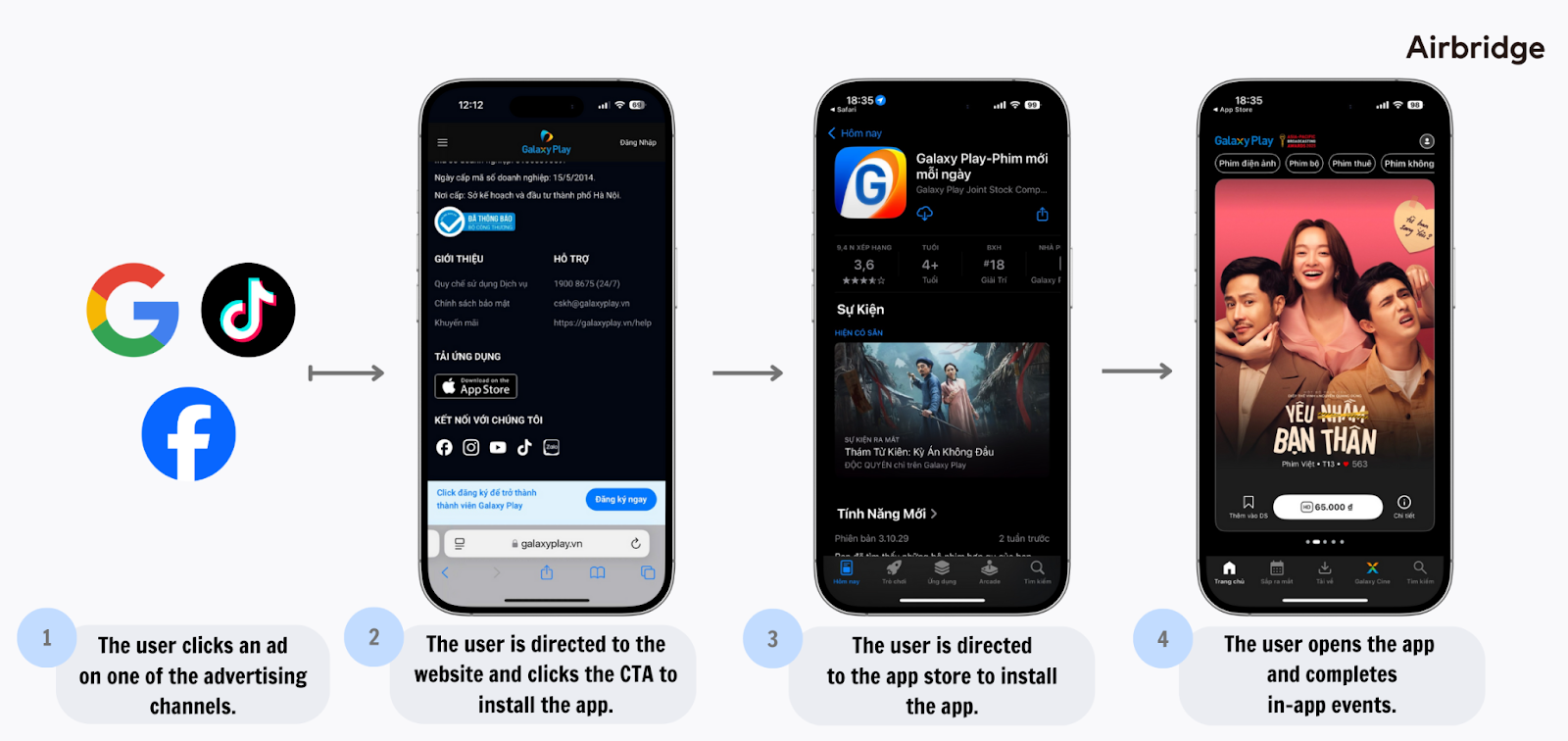
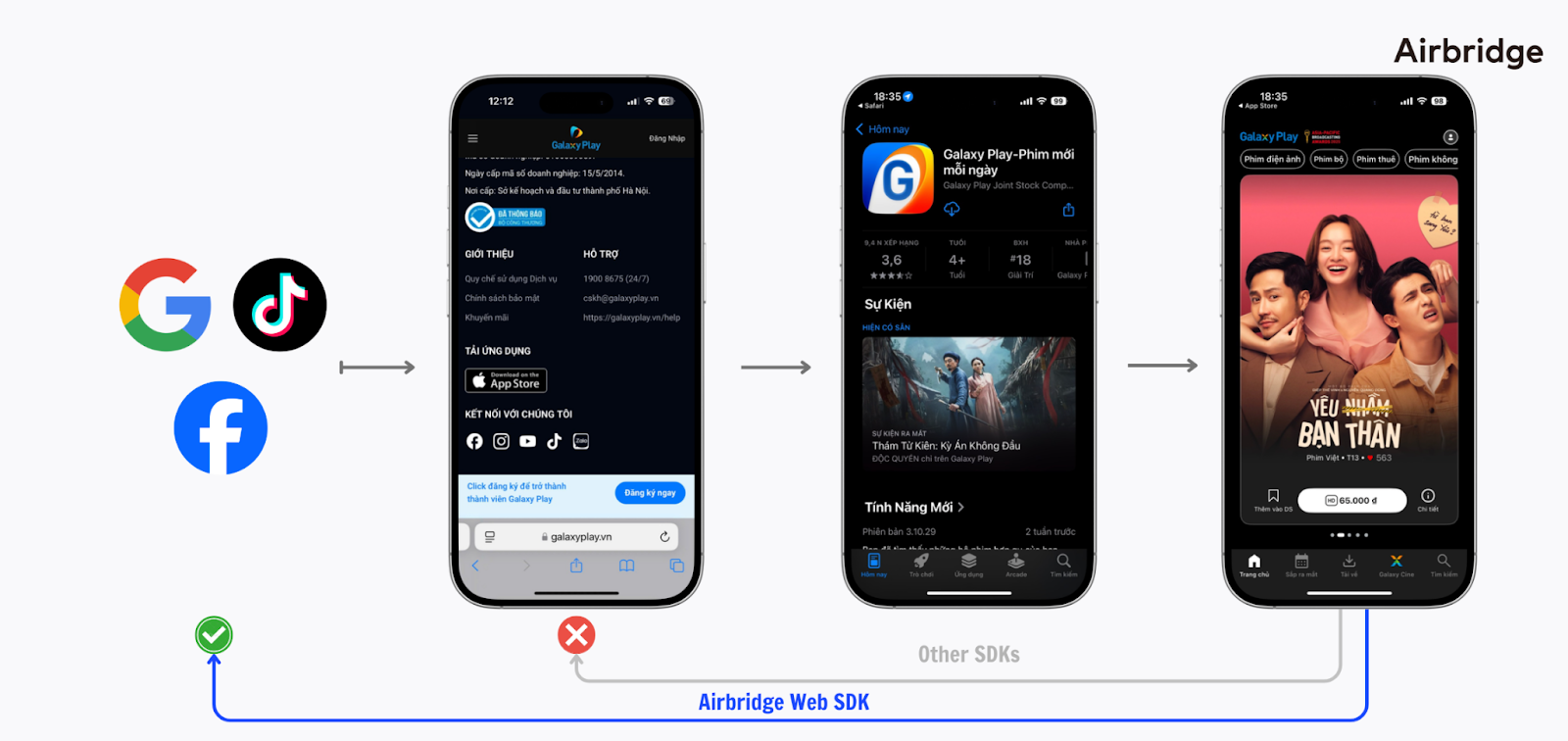
One of the clearest differences shows up in web and app unification. Singular remains app-first, with web data often handled as a separate layer. For businesses running subscription sign-ups on web or onboarding flows that start in a browser, this creates blind spots.Airbridge treats web and app as one attribution surface, allowing teams to follow users across environments without stitching together multiple tools or reports.> Airbridge’s take
Galaxy Play used Airbridge’s web-to-app measurement to track revenue generated both inside and outside the app, connecting web purchases and in-app conversions into a single attribution view.
This eliminated blind spots that other MMPs couldn’t cover and helped them to achieve a 22% revenue increase alongside over 50% improvement in MMP cost efficiency.👉 Learn How Galaxy Play achieved a 22% revenue increase powered by Airbridge Web-to-App tracking.
2) Difference 2: Deep linking tools
Deep linking capability is another major divergence. Singular’s deep links handle standard routing but struggle with advanced scenarios. Deferred deep linking for new users, campaign-based contextual routing, and predictable fallback behavior often require custom logic or external tools.
Airbridge’s deep linking engine is built to handle these flows natively, which reduces engineering overhead and eliminates inconsistent user experiences across channels.> Airbridge’s take
Fizz successfully migrated from Firebase Dynamic Links to Airbridge API-powered deep links, ensuring all of its referral, sharing, and campaign links continued to work without disruption despite deprecated Firebase’s service.
By using Airbridge’s API deep links to automate link creation at scale, Fizz maintained zero performance loss and 100% attribution continuity across its high-volume content sharing and user acquisition flows.
👉 Learn How Fizz achieves ZERO performance loss with Airbridge API deeplinks.
3) Difference 3: Pricing Cost is often the final catalyst. Singular’s pricing reflects its enterprise positioning, which can feel misaligned for high-growth subscription and AI-driven products.
Airbridge’s pricing model is typically easier to map to actual usage and ROI, especially for teams scaling channels without wanting their measurement costs to scale at the same rate.
Who Should Choose Airbridge Over Singular?
Of course, Airbridge is not designed to replace Singular for every company. The strongest fit appears where flexibility, web coverage, and operational efficiency matter as much as raw attribution accuracy.
1) Subscription-based apps
These teams optimize for trials, renewals, churn reduction, and lifetime value—not just CPI. When acquisition starts on the web and converts in-app,
2) ROI-focused teams
Airbridge’s unified web and app measurement removes the need for parallel analytics stacks or manual reconciliation. This makes it easier to evaluate true channel ROI across the entire subscription lifecycle.
3) AI service providers and SaaS-like mobile products
Their user journeys are rarely linear. Users may discover the product on the web, test features before installing, or switch devices during onboarding.
Singular can measure parts of this journey, but Airbridge is designed to follow the user across touchpoints without fragmenting attribution logic or reporting.
From an execution standpoint, performance teams managing multiple channels often prefer Airbridge when speed matters. Launching new campaigns, testing creative variations, or adjusting deep link behavior can be done without repeated engineering involvement.
A common mistake growing teams make is assuming that attribution tools should require constant developer support. Airbridge reduces that dependency by design.
For developers and data teams, predictability is a deciding factor. Airbridge offers clearer SDK behavior, consistent event handling, and easier integration with data warehouses and BI tools. This matters for organizations that treat attribution data as production data rather than marketing-only reporting.
FAQ: Singular Alternatives, Cost, and Replacement Considerations
1) Can Airbridge fully replace Singular without losing attribution quality?
Yes. Airbridge provides comparable attribution accuracy while offering better web coverage and simpler operations.
2) Which MMP is best for unified web and app attribution?
Airbridge is frequently selected by teams that need web and app measured as a single user journey rather than separate funnels.
3) Does Airbridge support deferred and contextual deep linking?
Yes. Airbridge supports both deferred deep linking and contextual routing natively, without extra tools or heavy engineering.
4) How does Airbridge compare in deep linking capabilities?
Airbridge provides native deep linking fully integrated with attribution, enabling seamless routing from ads to in-app content across web and mobile. Unlike solutions that require separate tools or complex setup, Airbridge connects deep linking and measurement in a single system, reducing technical overhead and improving user journey tracking accuracy.
5) Which MMP is better for startups and mid-market teams?
Airbridge is often preferred by startups and mid-market companies due to faster setup, clearer pricing, and lower operational overhead.
Conclusion: Prioritizing Performance Over Brand Recognition
The MMP landscape continues to evolve, with performance capabilities becoming increasingly important differentiators.
While Singular maintains market presence, marketers who prioritize real-time optimization, sophisticated measurement, and flexible reporting are finding superior value in alternatives like Airbridge.
The key to successful MMP selection lies in evaluating platforms based on actual performance requirements rather than market perception.
For teams that need fast query processing, comprehensive incrementality testing, and unified cross-platform measurement, the choice becomes clear: performance-focused platforms consistently deliver better results than those relying primarily on brand recognition.
Ready to transform your mobile growth?
Learn how Airbridge helps leading brands measure and optimize every touchpoint.