AI Fitness App Attribution: You Built the App in a Weekend — Why Does MMP Setup Still Take Weeks?
2026
.
3
.
18
By
Team Airbridge
Trends & Insights
AI Fitness App Attribution: You Built the App in a Weekend — Why Does MMP Setup Still Take Weeks?
2026
.
3
.
18
By
Team Airbridge
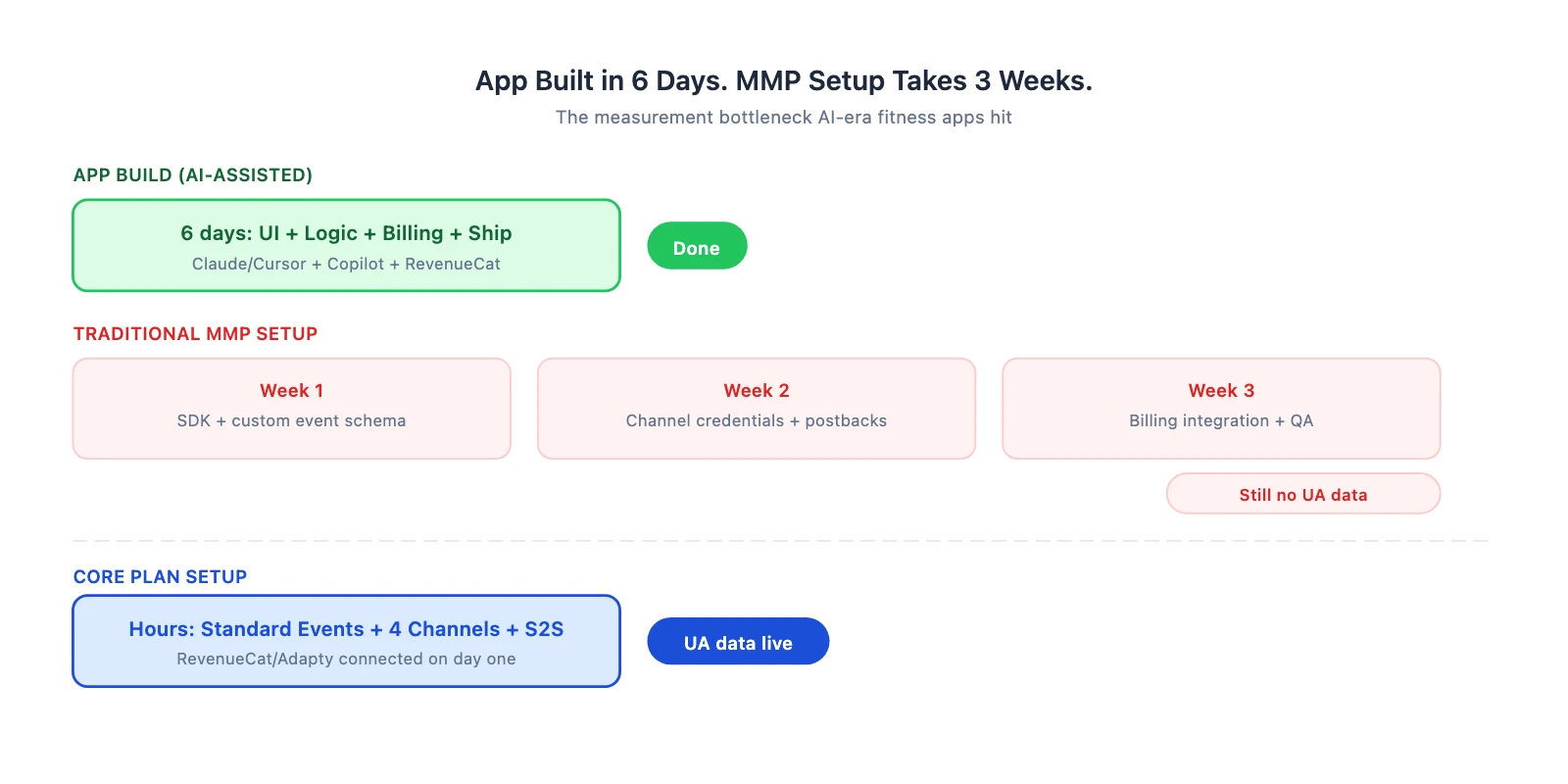
You built your AI fitness app in six days. Claude or Cursor scaffolded the UI. GitHub Copilot wrote the workout logic. RevenueCat handled subscriptions. You shipped to the App Store before the week was over.
Then you turned on paid UA — Meta, Google, maybe TikTok. Installs started coming in. Now you need to know which channel is actually producing subscribers. So you sign up for an MMP.
And the setup takes longer than building the app.
SDK integration. Event schema design. Channel credential configuration. Postback setup. Billing integration. Testing and QA. A process that can stretch to weeks — for a team that may be one or two people.
This is the bottleneck AI-era fitness apps hit. The app development cycle compressed from months to days. The measurement infrastructure did not.
Key Takeaways
AI compressed fitness app development from months to days. Solo founders ship MVPs in under a week. But MMP setup — especially custom event schema design — can take longer than the app build itself.
Custom event schemas are the biggest time sink for small teams. Designing event names, defining parameters, and documenting naming conventions assumes a level of infrastructure most AI-era teams do not have.
AI fitness apps need attribution with minimal schema design: pre-defined event names for the standard subscription funnel, so small teams can start logging events without designing a custom schema from scratch.
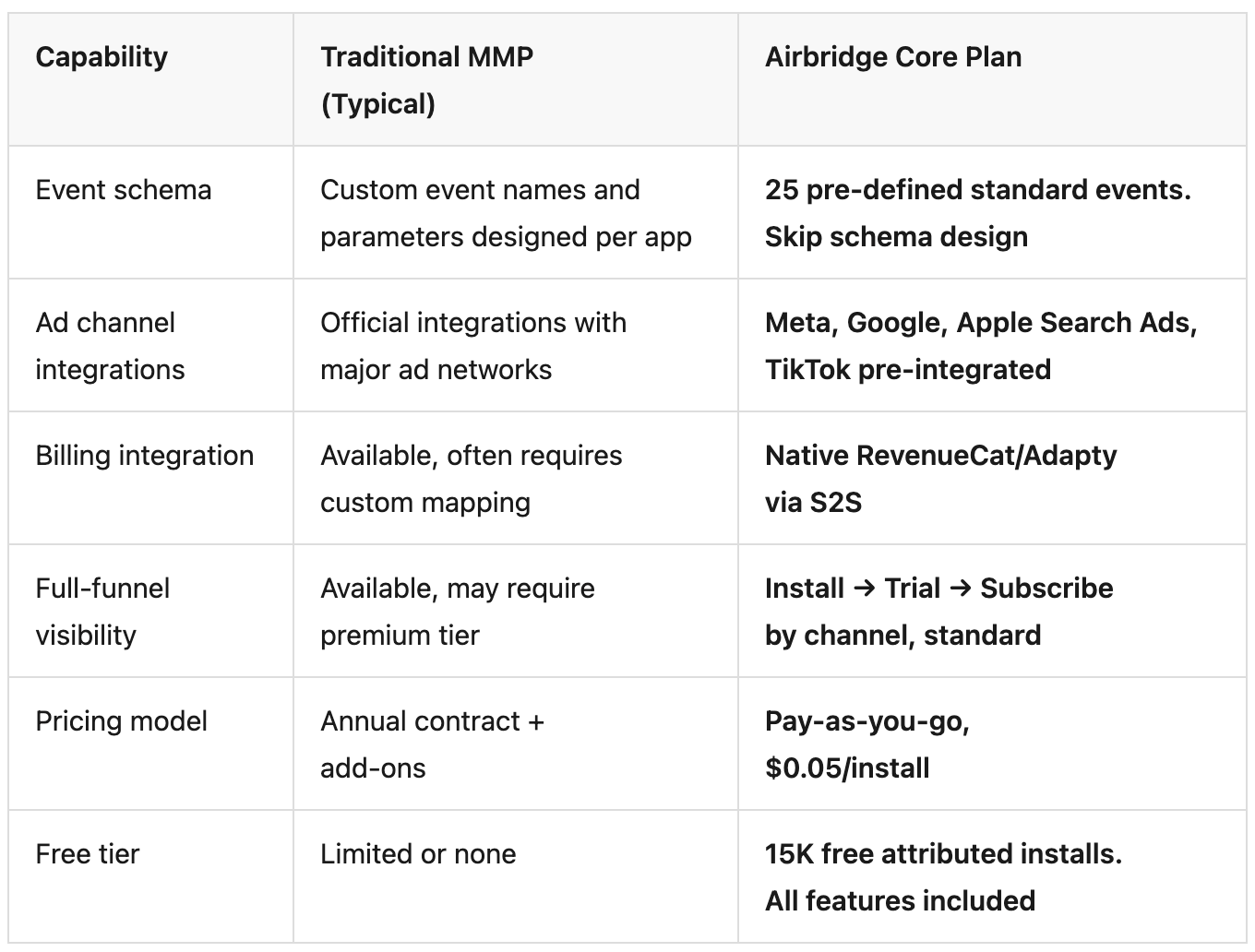
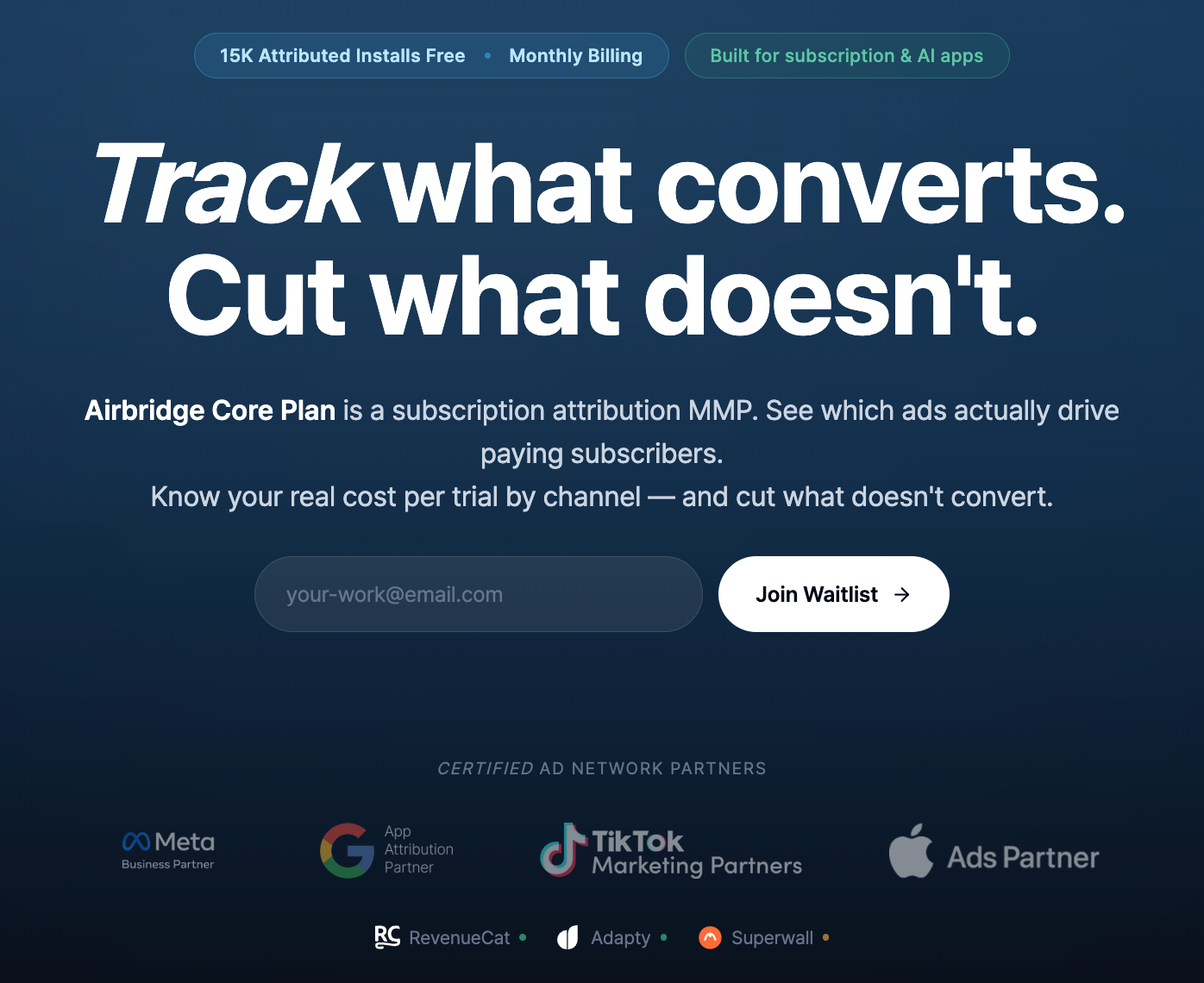
Airbridge Core Plan is built for this profile. 25 pre-defined standard events, RevenueCat/Adapty S2S, $0.05/install with no annual contract. Start with 15K free attributed installs.
What MMP Setup Actually Involves
Every MMP — regardless of provider — requires the same core integration steps. The process was designed for mobile teams with dedicated engineers, QA environments, and multi-month launch timelines:
Step 1: SDK integration and event logging
Install the SDK in your app (iOS + Android)
Decide which events to track and implement event calls in your codebase
If the MMP requires custom event schema design, you also need to define event names, parameters, and naming conventions from scratch
Set up a testing environment to validate events fire correctly
Step 2: Channel integration and credential setup
Connect each ad network (Meta Business Manager, Google Ads, TikTok Ads Manager)
Configure postbacks — which events get sent back to which platform
Set up cost data ingestion from each channel
Validate that attribution is working end-to-end for each channel
Step 3: Billing integration and QA
Connect RevenueCat or Adapty for subscription event tracking
Map billing events to attribution events
Validate the full funnel: ad click → install → trial → subscription
Resolve edge cases, test deeplinking, debug misattribution
For a team of 10+ with a mobile engineer, this is manageable. For a solo founder who built the app with AI in six days, the process — especially designing a custom event schema from scratch — can take longer than the app build itself. The biggest variable is Step 1: how much schema design the MMP requires before you can start logging events.
These teams have a different measurement profile than traditional mobile app companies:
No dedicated mobile engineer. The founder writes code with AI assistance. There is no one to spend two weeks configuring an MMP SDK and designing custom event schemas.
Standard subscription funnel. AI fitness apps follow the same pattern: Install → Trial → Subscribe → Renew. The core funnel fits pre-defined event names — reducing the schema design that slows down setup.
Fast iteration cycles. When you can ship a product update in a day, waiting three weeks for attribution setup means missing multiple iteration cycles of UA learning.
Budget constraints.AI-era startups launch with smaller UA budgets on 2-4 channels (Meta, Google, Apple Search Ads, TikTok). They do not need 50+ ad network integrations — they need the four that matter.
Billing-first architecture. RevenueCat or Adapty is already integrated from day one — it was part of the AI-assisted build. The MMP needs to connect to it, not replace it.
The gap: when an MMP requires custom event schema design, extensive configuration, and annual contracts before a team can start measuring, it creates friction that does not match how AI-era teams work.
How Airbridge Core Plan Reduces the Setup Burden
Core Plan was designed for exactly this profile: small teams running subscription apps on major ad channels, using billing platforms like RevenueCat or Adapty. The key difference is how much schema design is required before you can start logging events.
Event schema: pre-defined event names. 25 standard events including Install, Start Trial, Subscribe, and Unsubscribe — event names and parameters are already defined, so you skip the schema design step and go straight to logging. You still implement event calls in your codebase, but you do not need to design naming conventions or parameter structures from scratch.
Billing integration: S2S out of the box. Native RevenueCat and Adapty integration via server-to-server connection. Subscription events flow into attribution automatically.
Funnel, Retention, and Revenue reports by channel — see which channels produce subscribers who stay, not just installers.
Attribution rules and SKAN Conversion Value Settings — configured, not built from scratch.
The result: the steps that every MMP requires (SDK install, channel connection, billing integration, QA) still apply. But the schema design step — the part that slows down small teams the most — is handled by pre-defined event names.
AI compressed the fitness app build cycle from months to days. The measurement layer should not be the bottleneck. Every MMP requires SDK integration, channel connection, and QA — but the schema design step does not have to slow you down.
The question is not whether you need an MMP — you do, because platform dashboards cannot show cost per subscriber by channel. The question is whether your MMP makes you design a custom event schema before you can start, or gives you pre-defined event names so you can go straight to logging.
By clicking “Accept All Cookies”, you agree to the storing of cookies on your device to enhance site navigation, analyze site usage and assist in our marketing efforts.
By clicking “Accept All Cookies”, you agree to the storing of cookies on your device to enhance site navigation, analyze site usage and assist in our marketing efforts.





.webp)
.webp)
%20vs.%20multi-touch%20attribution%20(MTA)%20Which%20is%20right%20for%20you_11zon.webp)