Trends & Insights
MMP Pricing Goes Up. Support Quality Goes Down. Something Has to Give.
2026
.
3
.
15
By
Team Airbridge

You reported a data accuracy issue to your MMP. The install numbers in the dashboard exceeded your app's total lifetime installs on the App Store. Something was clearly wrong. You submitted a detailed ticket with screenshots and expected a technical investigation.
Instead, the team dismissed your concern, insisted the data was accurate — and then shifted the conversation toward upgrading you to a more expensive package.
This is not a hypothetical. It is a real G2 review of a leading traditional MMP. And it captures a pattern that subscription app teams encounter more often than any vendor would admit: when MMP support stops solving problems and starts selling packages, the relationship is no longer a partnership.
Key Takeaways
The G2 quote above is not an isolated incident. Review platforms reveal a consistent pattern across traditional MMPs — and it goes beyond slow response times.
The pattern behind this G2 experience is not a one-off support failure. It is a business model. Acknowledging a data accuracy problem risks undermining confidence in the product. Reframing the issue as a feature gap — something a premium tier would solve — shifts accountability from the vendor to the customer's plan level.
On Trustpilot, another reviewer of the same leading MMP went further:
"The sales methods employed during negotiations violate professional ethical standards."
When support conversations become sales conversations, the customer loses trust — not just in the support team, but in the data itself. If the vendor dismisses a measurement problem instead of investigating it, how can you trust any number in the dashboard?
One Trustpilot reviewer described the experience directly:
"They started to make almost all free features as Premium features, and suddenly made a standard report feature as Premium."
This is a post-sale price increase that does not require renegotiating the contract. Features the team built workflows around — reports, analytics tools, audience segments — get moved behind a paywall. The choice: pay more to keep what you had, or restructure your workflows around the downgrade.
For subscription app teams running paid UA, losing access to a report you used for weekly budget decisions is not an inconvenience. It is a disruption to the decision-making process that your ad spend depends on.
Enterprise customers with dedicated account managers report responsive, technical support. Smaller teams on standard plans experience a different reality: slower responses, less technical depth, and questions routed through general queues instead of dedicated contacts.
This two-tier experience is well-documented across MMP customer support reviews. The problem is not that premium support exists — it is that basic support is so inadequate that upgrading feels like the only way to get help. That is not a support model. It is a conversion funnel.
The upsell behavior does not exist in isolation. It is enabled by a pricing model designed to extract more revenue from existing customers at every stage.
Most traditional MMPs require annual contracts with monthly minimums — often in the thousands of dollars — before usage costs begin. For a Seed-to-Series A subscription app spending $5K-$20K per month on UA, committing to an annual MMP contract means locking in costs before you understand what features you actually need.
The contract creates lock-in. Once signed, switching costs — re-integration, data continuity, team retraining — make it expensive to leave even when the experience deteriorates. The vendor knows this. The upsell leverage comes from the switching cost, not from the product value.
Fraud detection. Advanced analytics. Audience segmentation. Creative-level reporting. In many traditional MMPs, these are not included — they are sold as add-ons on top of the base contract.
For subscription apps, the features you need most — revenue attribution, funnel analysis, channel-level LTV — are often the ones behind the paywall. The base plan gives you installs and clicks. The metrics that actually matter for subscription decisions cost extra.
Volume-based pricing is not inherently a problem — paying for what you use makes sense. The problem is volume-based pricing locked into annual contracts with monthly minimums. Your costs spike with installs, but your revenue lags behind — a user who installs today might not subscribe for 7-14 days and might not generate meaningful LTV for months.
When you cannot adjust your commitment as your needs change, the pricing model works against you instead of with you.
The word "partner" appears in every MMP sales deck. But a partnership requires aligned incentives — and the traditional MMP model misaligns them at every level. A partner investigates your data issues; a vendor reframes them as feature gaps. A partner's pricing rewards your growth; a vendor's pricing taxes it.
Either problem alone is manageable. Expensive pricing is tolerable if support is excellent. Mediocre support is tolerable if pricing is fair. But expensive pricing AND dismissive support creates a compound effect: the team is paying premium prices for a sub-premium experience.
This compound effect changes how teams evaluate their MMP. It is no longer about whether the product works — it is about whether the relationship is worth the cost. When support conversations feel like sales calls and pricing punishes growth, the answer becomes clear. The only thing keeping teams from switching is the re-integration burden they already committed to avoiding.
Airbridge Core Plan is an MMP built for subscription apps that addresses both sides of the compound problem — pricing that aligns with your growth and support that solves problems instead of selling packages.
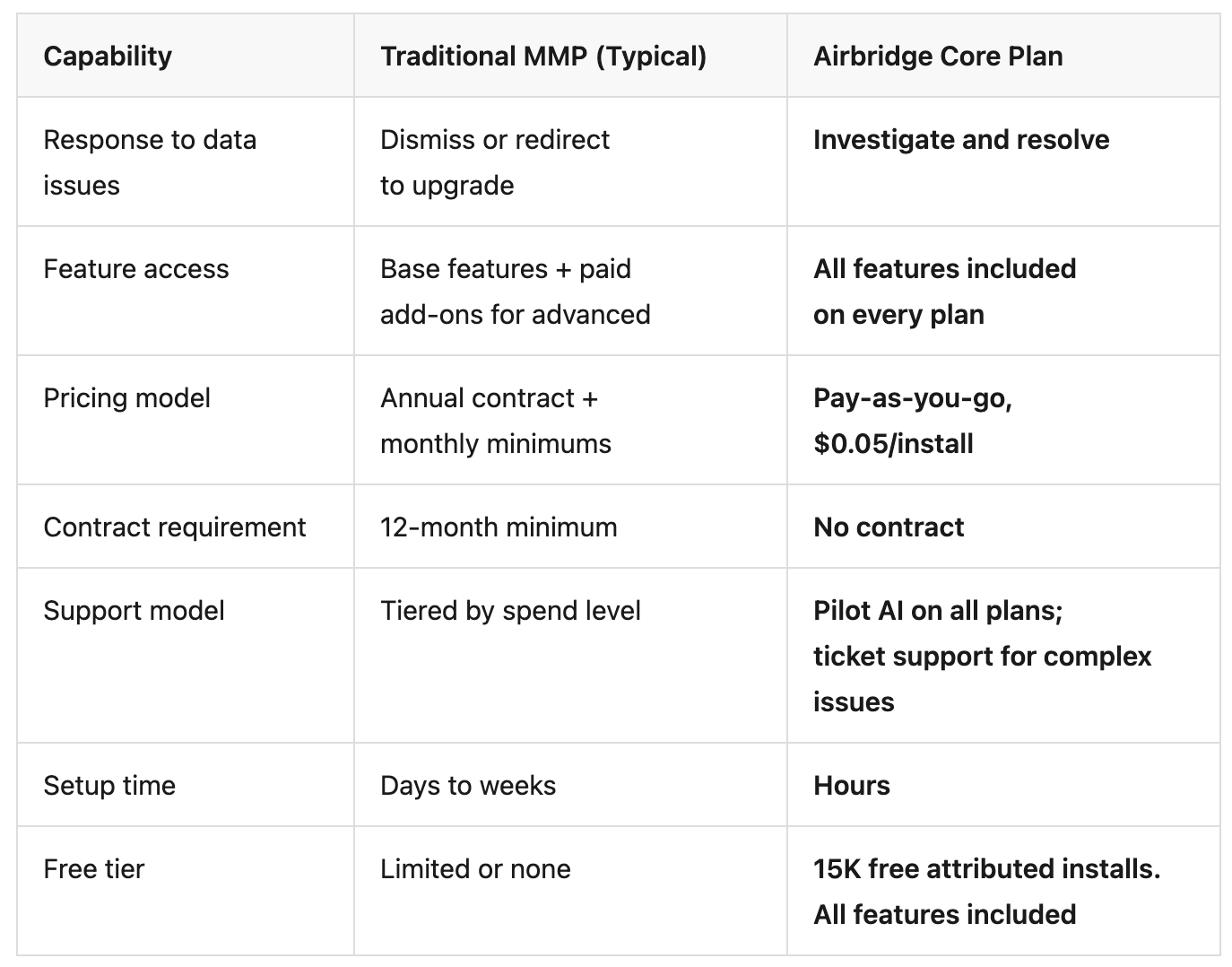
Core Plan pricing is simple: $0.05 per attributed install, with 15K free attributed installs. No annual contract. No monthly minimums. No overage surprises.
If the product does not meet your expectations, you leave. No contract negotiation, no cancellation fees. The incentive is aligned: Airbridge succeeds when you keep using the product — not when you are locked into a contract.
Every feature available on Core Plan is available on day one. Attribution, funnel reports, revenue reports, retention analysis, standard subscription events, channel integrations — Meta, Google, Apple Search Ads, TikTok. No premium tiers. No add-on costs. No features that disappear behind a paywall after you start relying on them.
Airbridge Pilot is an AI assistant embedded in the dashboard that answers product questions instantly — tracking links, attribution rules, report configuration, SKAN setup. Available on every plan including Core Plan, with no daily limit.
When you have a question, you get an answer in seconds — not a ticket queue that takes days. Pilot does not replace human support for complex issues, but it eliminates the wait for the questions that should never require a ticket.
The traditional MMP model assumes that restricting features and support creates upgrade pressure. Airbridge takes the opposite approach: make everything available and let the product earn continued use.
MMP pricing and support quality should move in the same direction. If you are paying more every year while the response to your problems is "upgrade," the relationship is not a partnership — it is a transaction where only one side benefits.
Start with an MMP that aligns pricing and support — 15K free attributed installs on Airbridge Core Plan.