

Trends & Insights
The MMP Support Trap: Fast Answers During Sales, Silence After the Contract
2026
.
3
.
13
By
Team Airbridge

You submitted a support ticket on Monday. It is now Thursday. The reply you finally received could have been copied from a help center article you already read — and it does not address the specific integration issue you described in detail.
This is not a one-off experience. For many subscription app teams, this is what MMP customer support looks like after the contract is signed. The demo was responsive. The sales engineer answered every question. The onboarding calls were scheduled promptly. Then the contract closed — and the support experience changed.
Key Takeaways
MMP customer support failures follow a predictable pattern. The complaints on G2 reviews across major MMPs surface the same themes repeatedly.
One G2 reviewer of a leading MMP put it directly:
"The customer support is by far a big weakness. I feel like they just copy a candid response and send it over. Even when I provide a detailed outline of what I am trying to achieve."
A canned response is worse than a delayed response. A delayed response at least promises a real answer eventually. A canned response closes the ticket — forcing you to reopen, re-explain, and re-enter the queue. Two rounds of canned responses can turn a 2-day wait into a 10-day resolution cycle.
Some MMPs promise a dedicated CSM during the sales process. After the contract is signed, the reality is different: your "dedicated" CSM manages dozens of accounts and only surfaces for quarterly reviews or urgent escalations. Day-to-day questions go to a general ticket queue.
This is not a service failure — it is a pricing model. Truly dedicated CSMs are typically reserved for enterprise contracts. Teams on standard or mid-tier plans receive shared resources marketed as dedicated. The gap between the sales-stage promise and the post-sale reality is one of the most common MMP customer service complaints.
The onboarding phase is when MMP support is at its best — scheduled calls, proactive check-ins, setup assistance. Once the SDK is live and the first reports are running, the support structure changes. Proactive outreach stops. Response times lengthen. The team that helped you set up is no longer the team answering your tickets.
For subscription app teams, this timing is particularly bad. The hardest questions — trial-to-paid conversion discrepancies, report configuration for subscription metrics, cross-channel comparison issues — emerge weeks or months after onboarding, exactly when support quality drops.
Slow MMP customer support is not just an inconvenience. It has direct revenue impact — because your MMP is the system that tells you where to spend your acquisition budget.
The initial SDK setup might go smoothly with onboarding support. But SDK issues do not stop after day one. App updates, new event definitions, platform OS changes, and billing integration adjustments all require SDK-level work — and by then, the onboarding team is gone.
When an MMP SDK issue hits post-onboarding, the team is stuck in the general ticket queue. A 3-5 day support delay means 3-5 days of broken or missing attribution data. For subscription apps running paid UA, that is 3-5 days of ad spend with no visibility into which channels are working.
Attribution numbers that do not match — discrepancies between ad platforms and your MMP — require investigation. Is it a configuration issue? A data delay? An actual measurement problem?
When the answer takes days, the team has two options: pause campaigns and lose momentum, or keep spending and hope the numbers are close enough. Neither option is acceptable — but both happen regularly when MMP support is slow. For subscription apps with 7-14 day free trials, the stakes are even higher — a 5-day support delay can mean an entire cohort's trial-to-paid data is misattributed or missing, compounding the cost into the following week's budget decisions.
The complaints about MMP customer support are real. But the deeper issue is not that support teams are bad — it is that the support model itself is wrong for how teams actually use their MMP.
Think about the last 10 support tickets your team submitted to your MMP. How many were genuinely complex, novel problems? And how many were variations of:
The majority of MMP support interactions are product usage questions — not technical emergencies. These questions have known answers, documented in help centers. The bottleneck is not knowledge — it is access and format.
A ticket-based support system is designed for complex, case-specific issues that require human investigation. Routing a standard product question through the same queue means it competes for priority with genuine technical escalations.
The result: a question that should take 30 seconds to answer takes 2-3 days to resolve. Not because the answer is hard, but because the delivery mechanism is slow.
The fix is not faster human support — it is self-serve tools that make human support unnecessary for standard product questions. Documentation alone is not enough. Help center articles assume you know which article to find and how to translate generic instructions to your specific setup.
What works: an AI-powered assistant embedded directly in the product — one that answers immediately, not after a 3-day ticket cycle.
Airbridge's approach to MMP customer support is built on a simple principle: the best support experience is one where you do not need to submit a ticket.
Airbridge Pilot is a multi-turn AI assistant embedded directly in the Airbridge dashboard. It answers product questions instantly — tracking links, reports, attribution rules, SKAN configuration — based on Airbridge's official help center documentation.
Pilot solves the specific problem this article describes: routine product questions that should never require a ticket. It does not replace human support for complex, account-specific issues — it eliminates the wait for the questions that have known, documented answers.
SDK installation is where most MMP onboarding stalls. Onboarding Pilot guides the process through an AI conversation interface — step-by-step, platform-specific, with real-time verification.
The onboarding bottleneck — waiting for support to help with SDK issues — is replaced by an AI-guided workflow that verifies each step in real time.
Pilot and Onboarding Pilot are available on every plan — including Core Plan. For teams that need deeper, strategic support, Airbridge's higher-tier plans include dedicated Customer Success Managers who focus on the problems that actually require human expertise:
Because Pilot handles routine product questions instantly, CSMs are free to focus entirely on attribution strategy, data pipeline architecture, and growth optimization — not on answering "how do I create a tracking link?" Core Plan users without a dedicated CSM still get instant answers through Pilot and ticket-based support for complex issues — a fundamentally different experience from waiting days for a canned response.
Most MMP support models are built around ticket queues and tiered access — the more you pay, the faster you get answers. Airbridge takes a different approach: make the most common support interactions instant and self-serve for everyone.
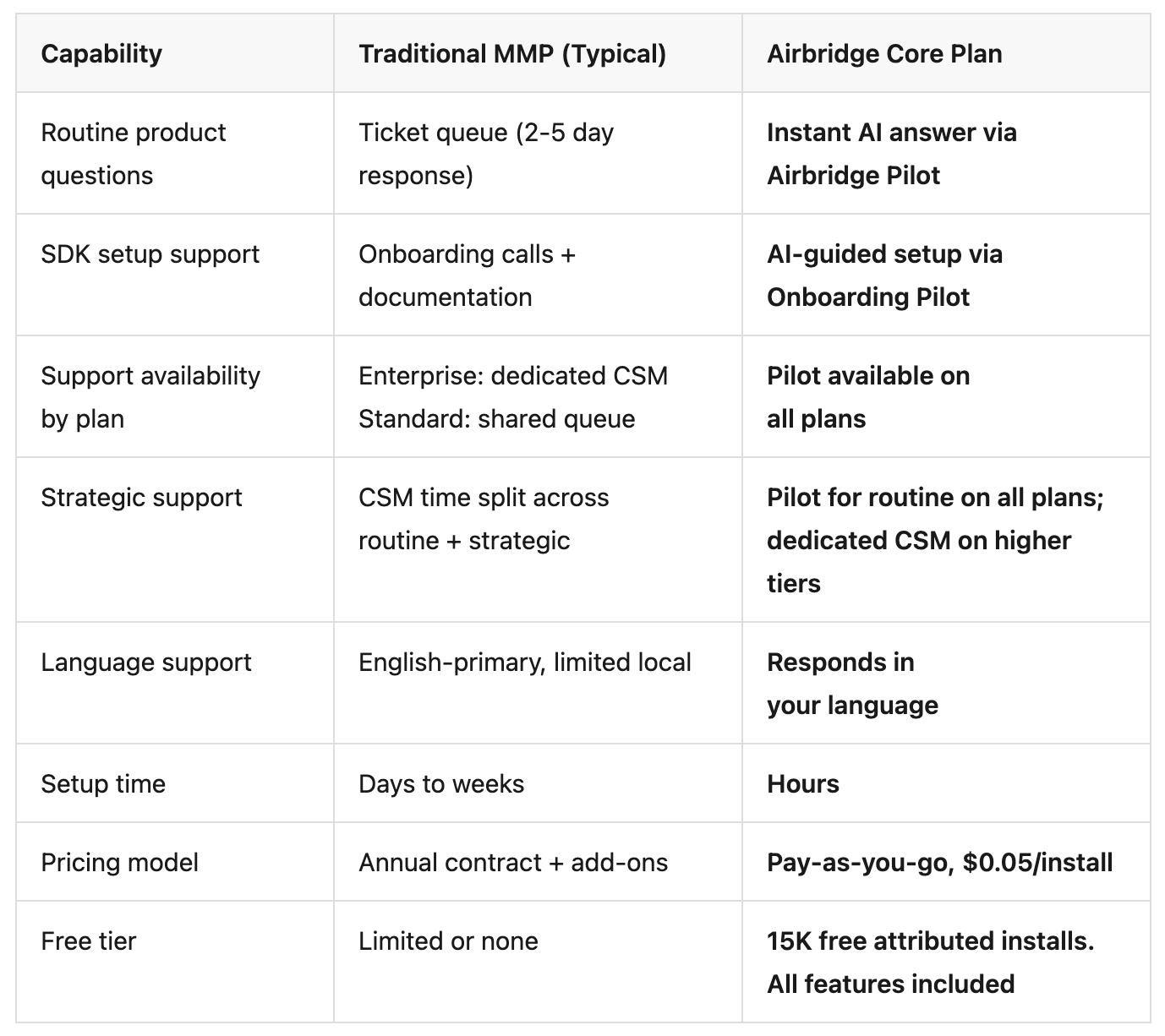
Features get you to sign. Support determines whether you can actually use those features. Before choosing an MMP for your subscription app, ask what support looks like after onboarding — not during the sales process. And ask whether routine questions require a ticket, or whether the product is built to answer them instantly.
Stop waiting days for answers — try Airbridge Pilot inside the dashboard with 15K free attributed installs on Core Plan.


.webp)
