Trends & Insights

Free MMP for Fitness App Startups: 1 Year of Attribution Without the Financial Risk

2026
.
3
.
22
By
Team Airbridge
Trends & Insights
Free MMP for Fitness App Startups: 1 Year of Attribution Without the Financial Risk
2026
.
3
.
22
By
Team Airbridge

Free MMP for Fitness App Startups: 1 Year of Attribution Without the Financial Risk

Your fitness app has $5,000/month in UA budget and a CAC around $30. You are spending $60,000 a year to acquire users. An MMP contract at $15,000–$50,000/year would consume 25–80% of that budget — on measurement, not acquisition.

So you skip the MMP. You run Meta and Google campaigns, check RevenueCat for subscriber counts, and hope the channel that gets the most installs is also the one producing paying users. That hope is the most expensive assumption in your budget.

For a fitness app startup at this stage, the question is not whether you need attribution. It is whether you can access it without the financial risk of an annual contract before you know which channels work.

Key Takeaways

  • Traditional MMP contracts ($15K–$50K/year) do not fit startup unit economics. A fitness app with a $30 CAC and $90 LTV cannot justify spending 25%+ of UA budget on measurement tools.
  • Without channel-level attribution, every budget decision is a guess. You cannot tell whether Meta or Google is producing subscribers — you only see aggregate installs and aggregate revenue.
  • 15K free attributed installs ≈ 1 year of attribution for an early-stage fitness app. At $5K/month spend and $4 CPI, you generate ~1,250 installs/month. 15,000 ÷ 1,250 = 12 months at $0.
  • Free tiers exist in the MMP market. The question is whether the free tier includes subscription-specific features — RevenueCat S2S, funnel reports, revenue attribution — or only basic install counting.
  • Pay-as-you-go after the free tier means no commitment before proof. You see which channels work first. You pay only when scale justifies it.

The MMP Cost Problem for Startups

The economics of traditional MMP pricing are built for established teams, not early-stage startups.
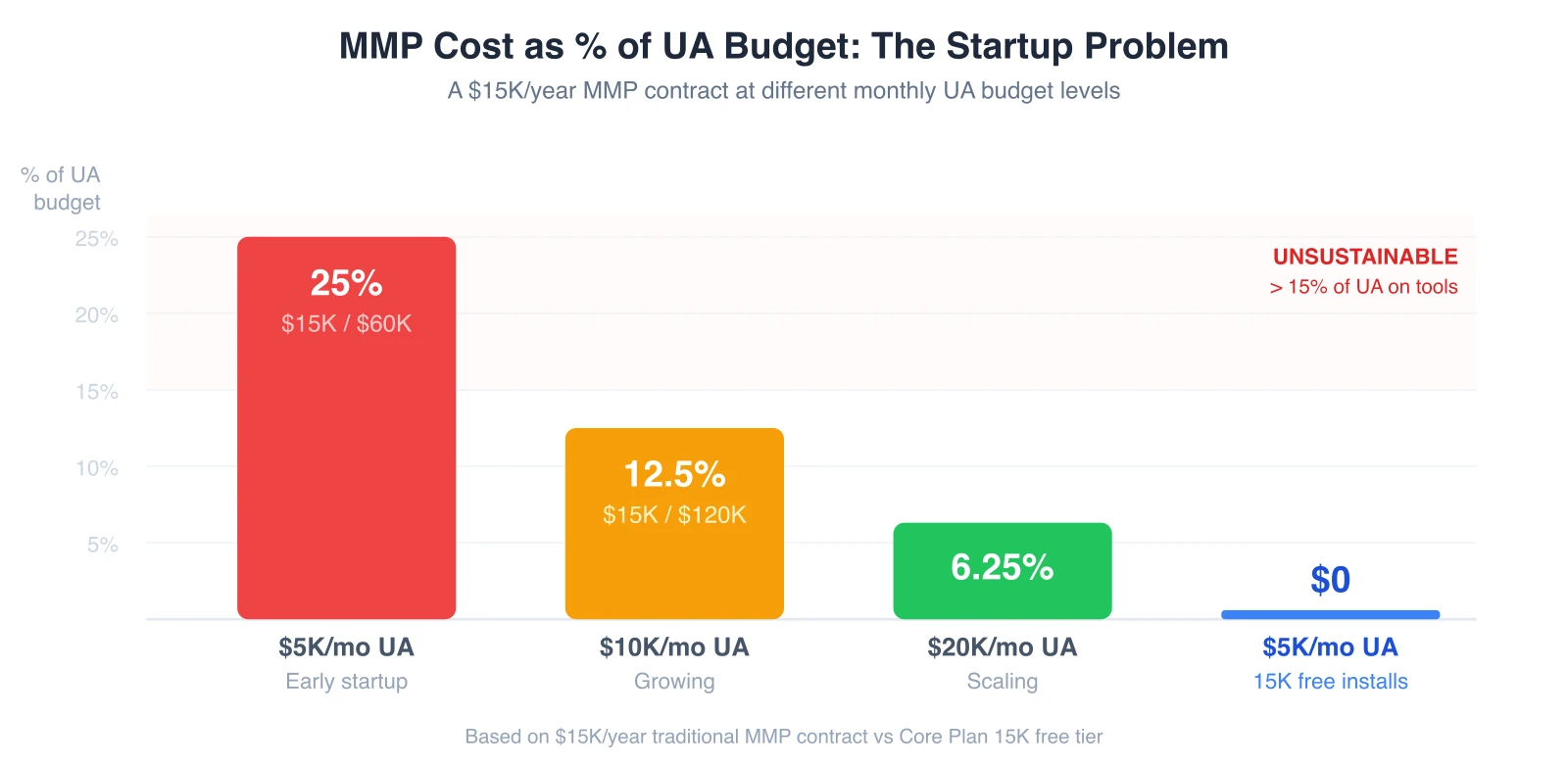
Fitness app unit economics set the constraints:

  • CAC is ~$30projected to drop toward $20 by 2030, but in 2026 the benchmark holds.
  • LTV must be ≥ $90 (3x CAC) to justify UA spend. With ~80% contribution margins and Pre-revenue startups have $0–$150/month for tools. An MMP at $15K–$50K/year is not in this budget. It is not even in the conversation.

The result: startups that need attribution the most are the ones least able to afford it. They run campaigns without channel-level data and make budget decisions based on CPI alone — which, as any subscription app team learns, does not predict subscriber quality.

What Happens Without Attribution

Without an MMP, a fitness app startup has two data sources that never connect.

  • Ad platforms show installs, CPI, and click-through rates — by channel, by campaign, by creative. But they do not show which installs became subscribers.
  • RevenueCat shows subscribers, revenue, trial-to-paid rates, and churn. But it does not show which ad channel produced each subscriber.

You see installs from Meta. You see subscribers in RevenueCat. You cannot see subscribers from Meta. The connection is missing.

This means:

  • Budget allocation is based on install volume, not subscriber quality. The channel with the cheapest CPI gets more budget — even if its trial-to-paid rate is half that of a more expensive channel.
  • You cannot kill underperforming campaigns early. Without channel-level subscription data, a campaign that produces installs but no subscribers runs for weeks before you notice — burning budget a startup cannot afford to waste.
  • You cannot prove channel ROI to investors. "We spent $30,000 on Meta and got 180 subscribers" is a fundable story. "We spent $30,000 on ads and got subscribers" is not.
Connect your fitness app's ad channels to RevenueCat. Native S2S. Funnel and Revenue reports by channel. $0.05/install, 15K free.

The 1-Year Free Math

The fear of MMP cost assumes you pay from day one. With a 15K free attributed installs tier, the math changes entirely.

A fitness app startup at $5,000/month UA spend with a $4 CPI generates approximately 1,250 installs per month.

  • Month 1–12: 1,250 × 12 = 15,000 installs. All attributed. All free.
  • Month 13+: At $0.05/install, you pay $62.50/month — 1.25% of your UA budget.
  • If UA scales to $10K/month: ~2,500 installs/month = 6 months free, then $125/month.

In the first year, you get the same channel-level attribution that an enterprise team pays $15K–$50K for — at zero cost. By the time you start paying, you already know where your paying users come from, which campaigns to kill, and whether your Meta spend outperforms your Google spend.

This is not a trial. There is no feature gate. Every report — funnel, revenue, retention — is available during the free tier. The only limit is volume, not capability.

What a Startup MMP Actually Needs

Enterprise MMPs bundle features that startups do not use — fraud detection, raw data export, agency access, dozens of ad network integrations. A fitness app startup running Meta, Google, Apple Search Ads, and TikTok needs four things.

  • Attribution across GMAT channels. Meta, Google, Apple Search Ads, TikTok — these four cover 80–90% of startup UA spend. Integrations with 50+ ad networks are unnecessary at this stage.
  • RevenueCat or Adapty S2S integration. Subscription events need to flow from your billing platform to your MMP without SDK-only limitations. S2S ensures Start Trial, Subscribe, and Renew events are captured even when the user does not open the app.
  • Subscription funnel and revenue reports. Install → trial → paid → renewal, broken down by channel. Not just installs by channel and subscribers in aggregate.
  • No annual contract. A startup's UA budget changes month to month. Committing to a 12-month contract before knowing which channels work is a financial risk that a pay-as-you-go model eliminates.

How Core Plan Fits Startup Economics

Core Plan is built for exactly this profile — early-stage subscription apps running paid UA across major channels, with a team that cannot design custom event schemas or justify an enterprise MMP contract.

Native S2S integration with RevenueCat and Adapty is included in the base offering. 25 predefined subscription-optimized standard events eliminate the event naming decisions that slow down setup. The features that matter for a fitness app startup — funnel reports, revenue attribution, retention by channel — are not locked behind a higher tier.

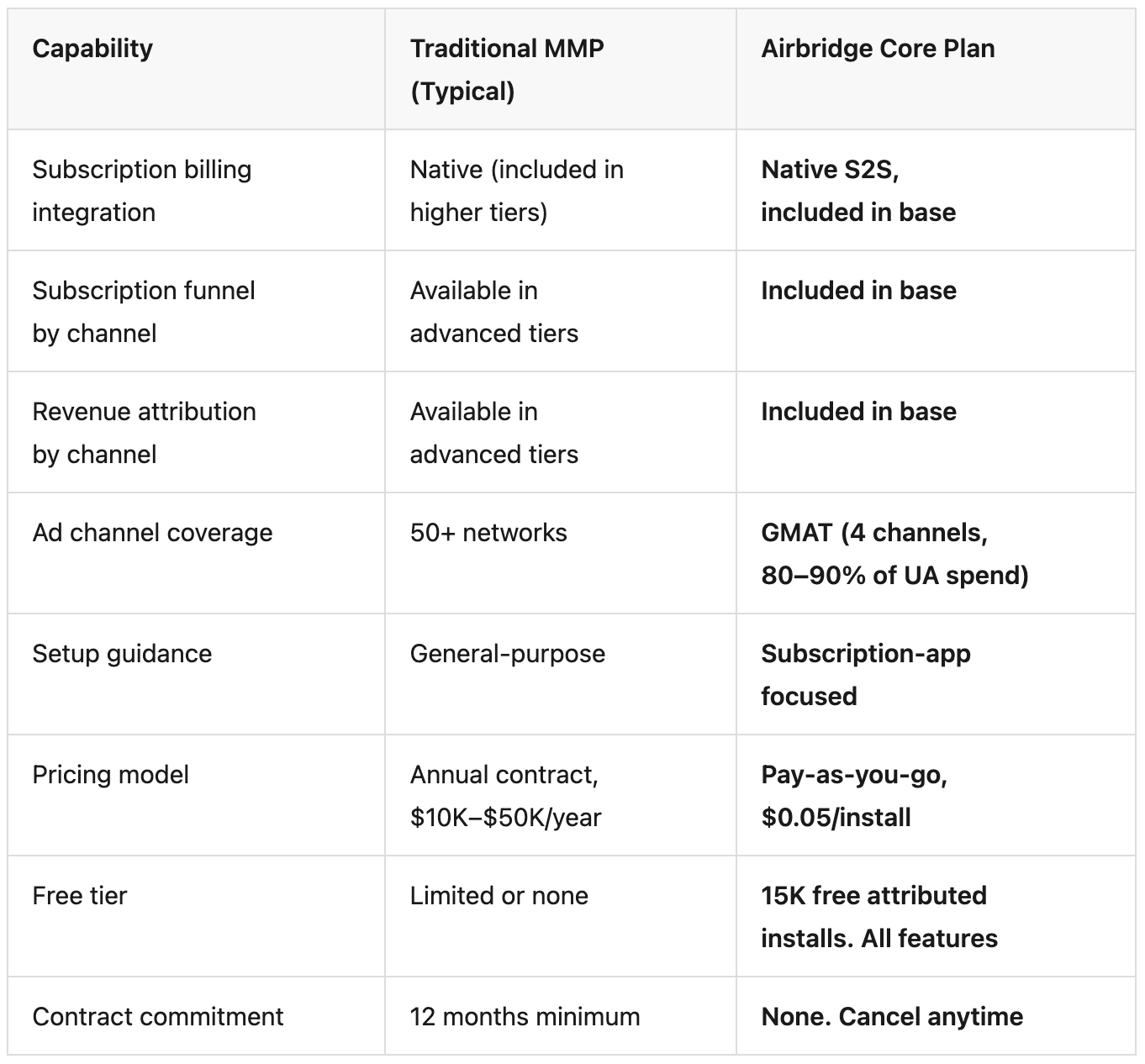
Core Plan vs Traditional MMP: Startup Fit

The difference is not capability — it is accessibility. Both can attribute installs and connect billing data. The question is whether the pricing and packaging fit a startup's constraints.
Start Measuring Before You Start Paying

A fitness app startup cannot afford to spend $60,000/year on UA without knowing which channels produce subscribers. But it also cannot afford to spend $15,000/year to find out.

The 15K free installs tier removes this tradeoff. You get channel-level subscription attribution for up to a year. You see which channels work. You prove ROI. You pay only when scale makes $0.05/install trivial compared to the budget you are optimizing.
Airbridge Core Plan
See which channel drives your fitness app's subscribers. 15K free installs. No contract. $0.05/install after. Start on Airbridge Core Plan.
Want to get more insights?
Get a mail whenever a new article is uploaded.
Thank you! Your submission has been received!
Oops! Something went wrong while submitting the form.
Check out our all-in-one package that fits every stage of your growth.
Team Airbridge
Airbridge Team
Subscribe to the newsletter for marketing trends, insights, and strategies.
Get a mail whenever a new article is uploaded.
Thank you! Your submission has been received!
Oops! Something went wrong while submitting the form.

Talk to us!

Ready to accelerate your app's growth?
The expertise and tools you need are just a chat away.