Mobile Marketing Deeplink Strategy: Where and When to Use Deeplinks
Most marketers treat the "click" as the finish line, but in mobile growth, it’s just the starting blocks. If your mobile marketing deeplink strategy consists of simply driving traffic to your app’s home screen, you are effectively throwing away over half of your acquisition budget.
High-performing campaigns rely on continuity. When a user clicks an ad for a specific pair of sneakers, they expect to see those sneakers – not a generic welcome banner. Bridging this "context gap" is the difference between a loyal customer and a bounced session.
This blog explores the critical role of deeplinking in reducing friction and increasing conversions, from understanding basic mechanics to deploying advanced strategies across UA, CRM, and retargeting channels.
What Is a Deeplink in Mobile Marketing?
A deeplink is a specific URL that bypasses a mobile website or app store to send users directly to a designated location inside an app.
Below is an example of a deeplink in mobile marketing:
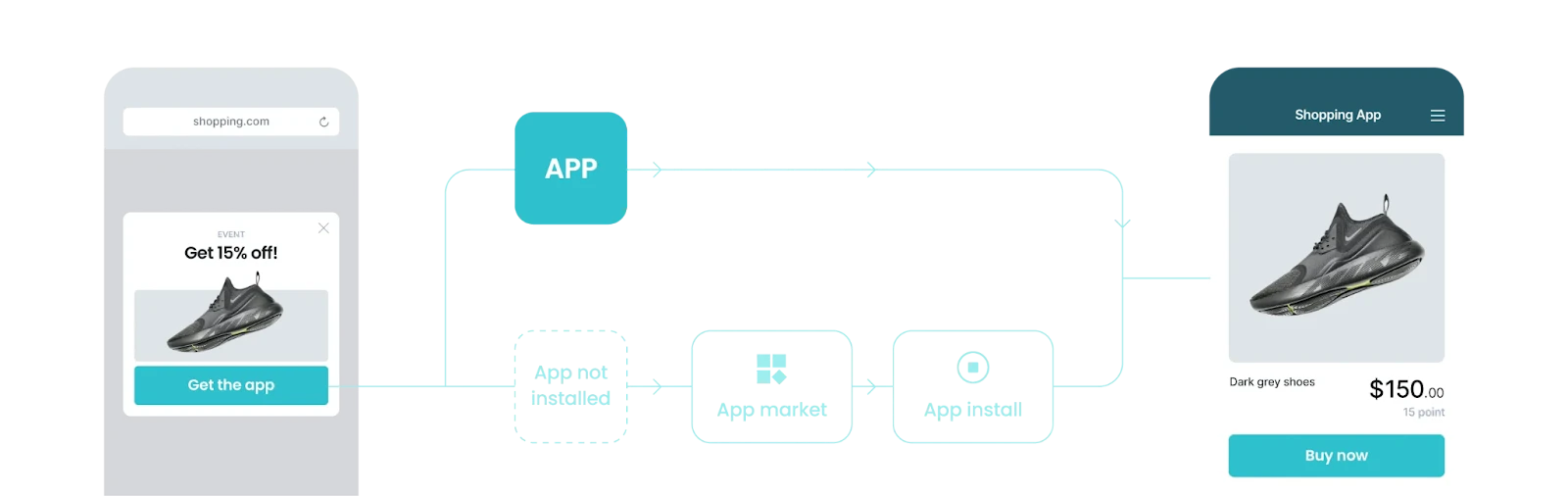
Unlike standard web links, deeplinks use unique protocols to ensure users land on specific product pages, articles, or promotional offers, significantly reducing journey friction.
In practice, a deeplink acts as a digital bridge. While a standard URL points to a domain (e.g., website.com), a deeplink points to a specific piece of content within the app's architecture.
From a tactical standpoint, there are three primary types of links that every marketer must distinguish between to avoid technical debt:
- Basic Deeplinks: These only work if the app is already installed. If it isn't, the user usually hits a "Page Not Found" error.
- Deferred Deeplinks: These are the "gold standard" for UA. If the user doesn't have the app, they are sent to the App Store; once installed, the link "remembers" where they were going and takes them to the specific page.
- Universal Links (iOS) / App Links (Android): OS-level standards that provide a seamless transition between web and app without annoying "Open in App?" pop-ups.
Learn more about how different types of deeplinks work here.
A common mistake marketers make is assuming these links "just work" out of the box. Without a centralized management system, these links often break during OS updates or browser changes, leading to high drop-off rates seen in unoptimized campaigns.
Why Are Deeplinks Critical for App Growth Today?
From a growth perspective, every extra step between a click and value creates drop-off. Deeplinks remove those steps. Here is why they are non-negotiable for modern growth:
Shortened Path from Click to Value
Every extra screen a user must navigate is an opportunity for them to quit. In a standard flow, a user journey might be like these 3 steps:
- See an ad
- Go to the App Store, and open the app, and be dumped onto the home screen.
- Then, they have to search for the product they just saw.
Deeplinks, specifically deferred deeplinks, remove these steps, taking the user from "Install" straight to "Checkout."
Reduced Friction and Cognitive Load
A homepage forces users to think. Where should I go next? What was I looking for?
That pause is friction. Multiple sources show 21–72% of users abandon during onboarding when it’s frictiony.
Deeplinks eliminate decision-making by placing users exactly where they expect to be. From a behavioral standpoint, fewer choices mean fewer exits. This is especially critical on mobile, where attention is limited and interruptions are common.
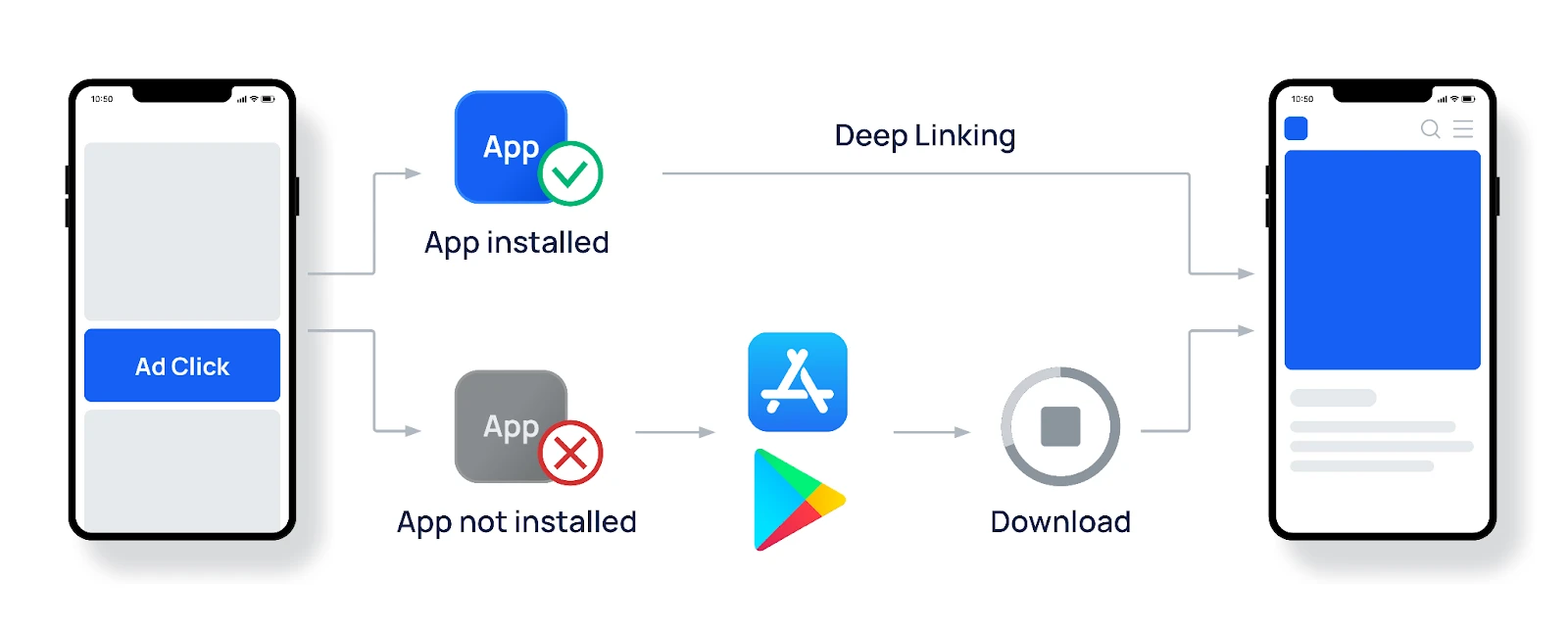
Improved User Experience Across Install and Non-Install States
Modern deeplinks handle both scenarios:
- If the app is installed, users go straight to the content.
- If not, they install first and land on the same destination.
This continuity matters. Breaking the journey during install is one of the fastest ways to lose users before they ever activate. Deeplinks keep the experience intact from first click to first action.
How Deeplinks Reduce Drop-Off and Increase Conversions
Every unnecessary step between intent and fulfillment multiplies your drop-off rate. Traditional app onboarding requires users to:
- land on homepage → navigate to the right category → search for the promised item → remember why they came → complete their action.
That's at least four opportunities for users to get distracted, confused, or simply give up.
Frictionless onboarding through strategic deeplinking eliminates these unnecessary steps entirely. In fact, reducing the number of onboarding steps by 30% can increase completion rates by up to 50%.
- Result: 2-3x higher conversions and better retention. To understand the ROI, compare the two typical user journeys:
Generic Web Link
Smart Deeplink
New User Path
Click → Store → Home Screen → Search
Click → Store → Specific Product Page
Existing User Path
Click → Mobile Web Browser → Login
Click → App Opens Instantly
User Friction
High (User must navigate manually)
Zero (Automated routing)
Avg. Conversion
Baseline (1x)
2.5x - 3x Higher
Attribution
Often lost at the App Store
Preserved across the install
The compound effect is significant. Better initial experiences lead to higher retention rates, increased lifetime value, and more positive app store reviews.
Users who successfully complete their first intended action are more likely to return, engage deeper, and become brand advocates.
It's not just about saving one conversion – it's about optimizing the entire user lifecycle.
Want to see how Deep linking works with your data?
Get hands-on with Airbridge and see real results.
Try It Free →Deeplink Best Practices: Where and When to Deploy
Where to Use Deeplinks in Mobile Marketing Campaigns
Deeplinks aren’t something you “set once and forget.” They only work when they’re used in the right places, at the right moments, with a clear job to do.
In mobile marketing, the highest returns come from deploying deeplinks where user intent is already clear and the next step should feel obvious:
- User Acquisition (UA) & Social Media: Use Deferred Deeplinks for Instagram, TikTok, or YouTube ads. This ensures that even if a user doesn't have your app, they are routed to the store and then immediately to the specific product they saw in the ad.
- Retargeting & Re-engagement: Target "Cart Abandoners" via programmatic display. These links should bypass the home screen and land the user directly back into their shopping bag.
- CRM Channels (Email, Push, SMS): This is the most common use case. A push notification about a "Flash Sale" should never just open the app; it should link to the specific sale category.
- Organic & Owned Channels: QR codes on physical packaging or "Refer-a-Friend" links shared via WhatsApp should be deeplinked to credit the referral and show the reward immediately upon app open
When to Use Deeplinks (And When Not To)
Use Deeplinks When:
- Action-Oriented: Campaign success depends on completing a specific in-app action. If your goal is getting users to make a purchase, sign up for a service, or complete onboarding, deeplinks are non-negotiable. Generic app entry points create too much friction between intent and action.
- Contextual: You are running a personalized promotion where the landing page content must match the ad copy.
- Conversion-Focused: You are optimizing for conversion, not just installs. Vanity metrics like install numbers mean nothing if users don't engage meaningfully with your app. If your KPIs focus on revenue, retention, or engagement depth, deeplinks are essential for hitting those targets.
- Lifecycle-Driven: You run retargeting or lifecycle campaigns. These campaigns target users with established interest or previous app experience. They expect personalized, relevant experiences that acknowledge their history with your brand.
Avoid or Rethink When:
- Deeplinks are unmanaged or inconsistent. Broken deeplinks are worse than no deeplinks. If you can't guarantee that users will land where you promise, default to standard app links and invest in proper implementation before trying again.
- You lack fallback handling for non-installed users. Deeplinks to non-installed users should gracefully handle the installation process and then redirect to the intended content. Without proper fallback mechanisms, you'll lose users during the install process.
- Measurement and attribution are not connected. If you can't measure the performance difference between deeplinked and non-deeplinked campaigns, you can't optimize effectively. Proper attribution setup is a prerequisite for strategic deeplink deployment.
Why Managing Deeplinks at Scale Is Hard Without the Right Tool
The Complexity Crisis of Deeplinks in Today App Marketing
Deeplinks start simple. One campaign. One destination. One team. Then growth happens.
Suddenly, deeplinks exist across paid ads, CRM, referral programs, QR codes, influencer campaigns, and organic channels.
Each one may point to a different in-app screen, behave differently for installed vs non-installed users, and rely on separate tracking logic. Marketers often underestimate the technical maintenance required for links to stay "healthy."
At Airbridge, we see growth teams succumb to three primary “growth-killers” when they lack a centralized management system:
- Broken Redirection Logic: OS updates (like iOS 14.5+ or the recent Android changes) frequently break traditional URL schemes. If your links don't have a dynamic fallback, users land on a 404 page or a dead-end web view.
- The "Walled Garden" Problem: Platforms like Instagram, Facebook, and WeChat often try to keep users within their own in-app browsers. Standard links fail here. You need specialized "Web-to-App" logic to break out of these browsers and into your app.
- Attribution Silos: If your deeplink tool doesn't talk to your measurement tool, you might know a user arrived in the app, but you won't know which specific ad campaign drove that high-value purchase.
At scale, unmanaged deeplinks don’t just underperform – they create blind spots. Partnering with a specialized provider like Airbridge can take a lot of that weight off your shoulders.
A Scalable Approach to Deeplinking: Introducing Airbridge DeepLink Plan
When deeplinks become mission-critical across campaigns, managing them with spreadsheets and piecemeal tools simply doesn’t scale. That’s where the Airbridge DeepLink Plan steps in.
It’s designed not just to create links, but to own the entire deeplinking workflow:
- Unified deeplink management: Manage deeplinks in one place instead of spreading link logic across campaigns, channels, and tools.
- Intent-preserving routing across user states: Ensure users are routed to the correct in-app destination regardless of whether the app is installed or not.
- Consistent behavior across channels and touchpoints: Apply the same deeplink logic across paid media, CRM, web-to-app journeys, and offline entry points.
- Operational scalability without manual overhead: Support high volumes of campaigns and links without relying on custom engineering work for each use case.
- Reliable measurement tied to attribution: Connect deeplink interactions with install, conversion, and post-install events to maintain data continuity.
Ready to perfect every link and scale every campaign?
👉Talk to us!
👉 Explore how real teams are scaling deeplinking with Airbridge:
How Dabang cut deep link management time by 90% with Airbridge
How Fizz achieves ZERO performance loss with Airbridge API deeplinks
Ready to transform your mobile growth?
Learn how Airbridge helps leading brands measure and optimize every touchpoint.