Trends & Insights
Why Influencer Marketing Drives Views But Not App Installs for Fitness Apps
2026
.
3
.
23
By
Team Airbridge

A fitness trainer you partnered with posts a 45-second workout video. It goes viral — 500,000 views, 12,000 likes, hundreds of comments asking "what app is this?" You check your dashboard the next morning. 200 new installs.
You re-check the numbers. The video is real. The engagement is real. But somewhere between "what app is this?" and the App Store download button, 499,800 people vanished. And your analytics cannot tell you where they went.
This is not a content quality problem. The video performed. It is a funnel and measurement problem — and most fitness app teams cannot see where the drop-off actually happens.
Key Takeaways
Before diagnosing what is broken, it helps to understand what "normal" looks like.
The global median IPM (installs per mille) is 4.27 — meaning for every 1,000 ad impressions, roughly 4 people install. Influencer content is not a paid ad, but the conversion physics are similar: most people who see your app mentioned will not install it. That is true even when the content is excellent.
The App Store page conversion rate averages about 25%. Google Play is slightly higher at 27.3%. This means even among users who actively navigate to your app's store listing, three out of four leave without installing.
For a 500K-view fitness video, the funnel math works like this:
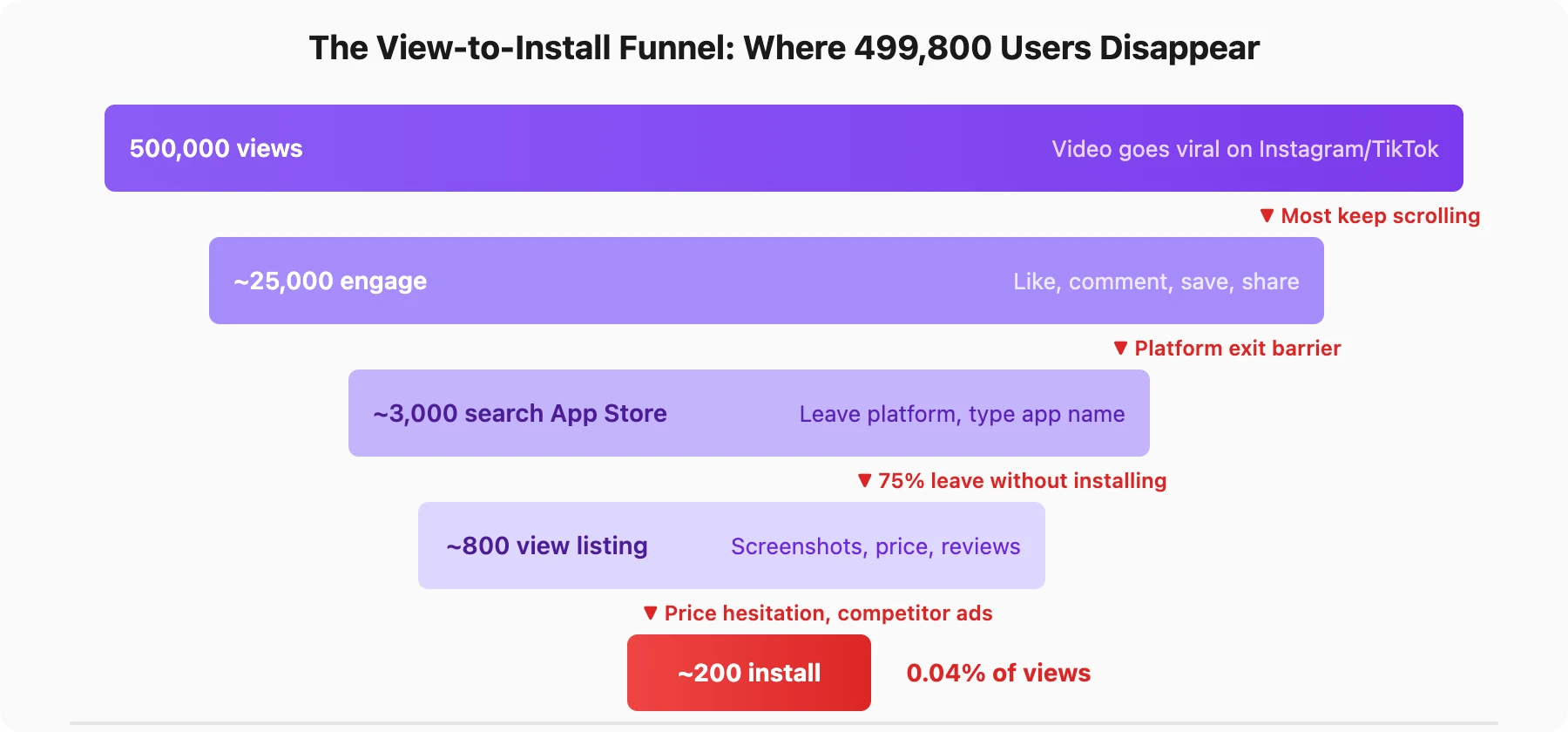
Each step is a multiplier that shrinks the number. The gap between 500K views and 200 installs is not a mystery — it is compounding drop-off across 4–5 steps that you probably cannot see individually.
The journey from "watched a trainer's video" to "installed the app" is longer than it looks.
Step 1: Platform exit. The user sees the video on Instagram or TikTok. To install your app, they must leave the platform. Most do not. Social platforms are designed to keep users scrolling — every swipe-up, link-in-bio tap, or App Store search requires the user to actively interrupt their feed behavior. Most users save the video and move on.
Step 2: Search friction. Users who do leave the platform rarely click a link. Instead, they search your app name in the App Store. If your app name is generic ("FitPro," "WorkoutPlus"), they may find competitors first. If the search does not return your app in the first 2–3 results, you lose them.
Step 3: App Store page conversion. The user finds your listing. Now they evaluate — screenshots, ratings, reviews, app size, subscription price. For fitness apps, a visible subscription price ($9.99/mo or $59.99/yr) on the listing page causes additional hesitation. Even users who reach this step — the ones who left the platform and searched — convert at only ~25%.
These three steps are where users actually leave the funnel. But there is a second category of drop-off that is harder to see — not because users leave, but because your tracking cannot follow them.
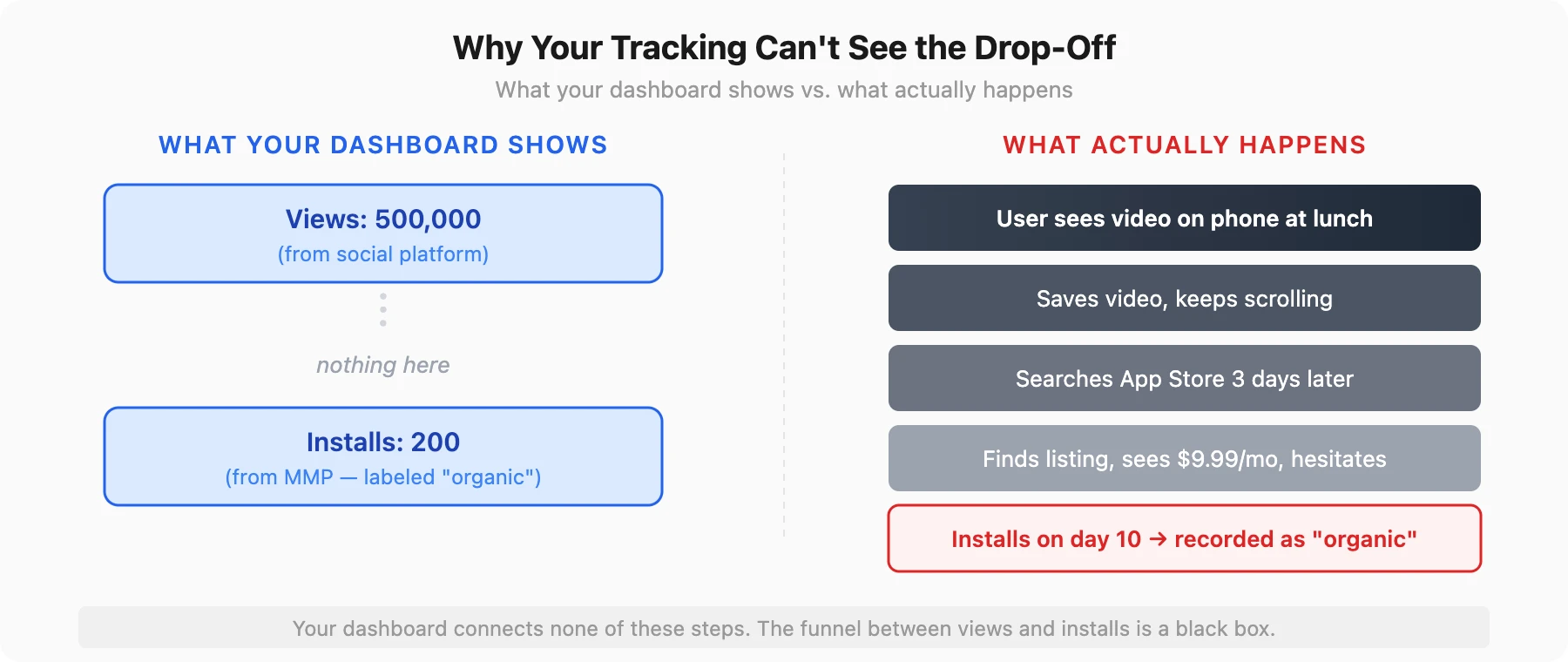
Users who convert later are invisible. The user saw the video on their phone at lunch. They plan to install later. By evening, they have forgotten the app name, cannot find the saved video, or install a competitor's app that appeared in an App Store ad. Workout decisions are often made at different moments than content consumption — and this delayed, cross-device behavior is where fitness apps lose the most users without knowing it.
Click-based attribution misses impression-driven behavior. Influencer marketing works through awareness, not clicks. A user watches a video, does not click anything, and searches your app three days later. Most attribution systems are built around clicks — if there is no click, there is no data point. The most valuable influencer-driven installs are the ones your tracking is structurally designed to miss.
Privacy features block cross-app tracking. iOS App Tracking Transparency requires users to opt in to cross-app tracking — and most decline. When a user watches a TikTok video and later installs your app from the App Store, those two events cannot be connected on most iOS devices. The user journey exists. The data trail does not.
Delayed conversions fall outside attribution windows. A user discovers a trainer's "12-week transformation" series, follows along for a month, then installs the app. Standard attribution windows are 7–28 days. By the time they convert, the window has closed and the install appears organic — even though the influencer clearly drove it.
You see totals, not the funnel. Most dashboards show views (from the social platform) and installs (from the MMP). Everything in between — platform exits, App Store page visits, search queries, delayed decisions — is a black box. You cannot optimize a funnel you cannot see.
Close the view-to-install gap. Deep links, view-through attribution, unified reporting. $0.05/install, 15K free.
The gap between views and installs has two causes: too many steps, and too little visibility. Fixing it means addressing both.
Use deep links from content directly instead of link-in-bio CTA. A deep link can take the user directly to a specific page in your app once they open the app after installing. A trainer promoting a "30-day ab challenge" should link directly to that program — not send users to a generic link-in-bio page. Every tap you eliminate between video and install recovers users who would have dropped off.
Optimize your App Store listing for influencer traffic. Users arriving from influencer content have different expectations than paid ad traffic. They saw a specific workout, a specific trainer, a specific result. If your App Store screenshots show generic features instead of the content they just watched, you lose them at the biggest remaining drop-off point. Consider creating custom product pages (Apple) or store listing experiments (Google) aligned with your top influencer campaigns.
Use view-through attribution, not just click-through. An MMP with view-through attribution can connect an ad impression (via influencer whitelisting) to a later install — even if the user never clicked. This captures the users who saw the content, did not click, but installed later.
Extend attribution windows for influencer campaigns. Fitness content has a longer conversion cycle than paid ads. A user may follow a trainer for weeks before installing the app they recommend. Standard 7-day windows miss these conversions. Configure longer windows for influencer sources — 14 to 30 days — to capture the delayed installs that are currently showing as organic.
Measure organic lift during campaign windows. Compare your organic install rate during an influencer campaign to your baseline. If your daily organic installs jump from 50 to 120 during a campaign, the lift is likely influencer-driven. This is not per-user attribution, but it quantifies aggregate impact that click-based tracking misses entirely.
Airbridge Core Plan connects these measurement layers in a single stack — without requiring enterprise contracts or custom implementations.
Before launching or scaling influencer partnerships, test your measurement setup against these:
If your setup cannot answer these, the framework above shows where to start.
93% of marketers already use influencer marketing. 86% of consumers make influencer-inspired purchases. The channel works. The issue is not that influencer content fails to drive interest — it is that the path from interest to install has too many steps and too little visibility.
For fitness apps, the gap is especially wide. Your audience discovers content on Instagram and TikTok, but installs happen in the App Store — a completely separate platform with no native connection to social engagement data. Every user who crosses that gap does so invisibly unless your measurement stack is built to see it.
The views are real. The interest is real. The question is whether you can see where 499,800 people went — and bring more of them to the other side.
See where users drop off between content and install. Deep links + view-through attribution + unified reporting. $0.05/install. 15K free. Start on Airbridge Core Plan.