Hard Paywall vs Soft Paywall vs Freemium: Which Converts Best?
Hard paywalls convert at 10.7%. Freemium converts at 2.1%. Case closed?
Not quite. If hard paywalls were universally better, 90% of App Store apps would not still be using freemium. The headline number hides a more important question: which model is right for your app — and how do you know if it is working?
Key Takeaways
- Hard paywalls convert 5x better than freemium (10.7% vs 2.1%) — but they self-select for high-intent users. The conversion-rate" class="glossary-link" title="Conversion Rate">conversion rate reflects who stayed, not who left.
- Soft paywalls balance reach and revenue — metered access or feature-gating lets users build habits before paying, which can improve long-term retention.
- Freemium dominates by volume — 90% of App Store apps use it. It works when free users generate value beyond subscriptions (network effects, word-of-mouth, adjacent revenue).
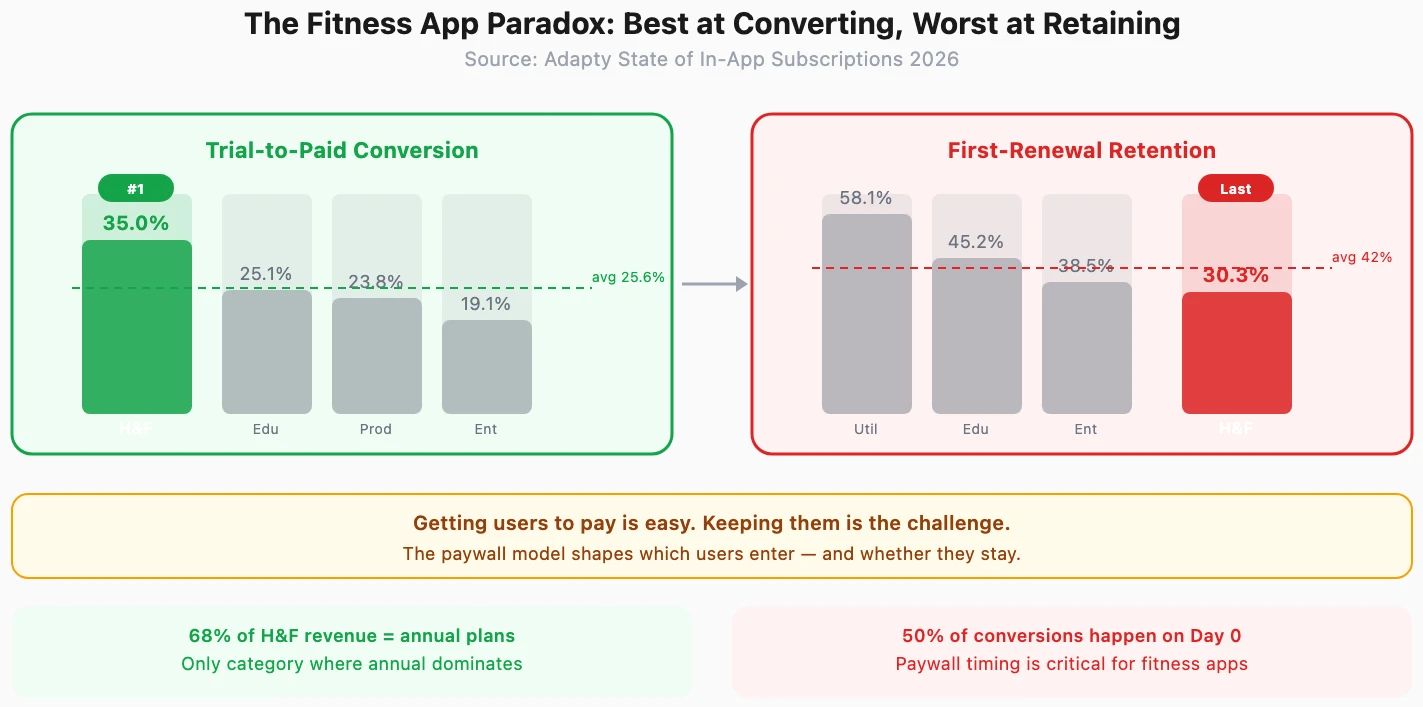
- Fitness apps face a unique challenge: highest trial-to-paid (35.0%) but lowest first-renewal retention (30.3%). The paywall model directly shapes which users enter the subscription funnel.
- Airbridge Core Plan shows trial-to-subscription conversion rates by channel — so you can validate whether your paywall model is converting across all acquisition channels, not just in aggregate. Start with 15K free attributed installs.
Hard Paywalls Convert 5x Better — So Why Do 90% of Apps Use Freemium?
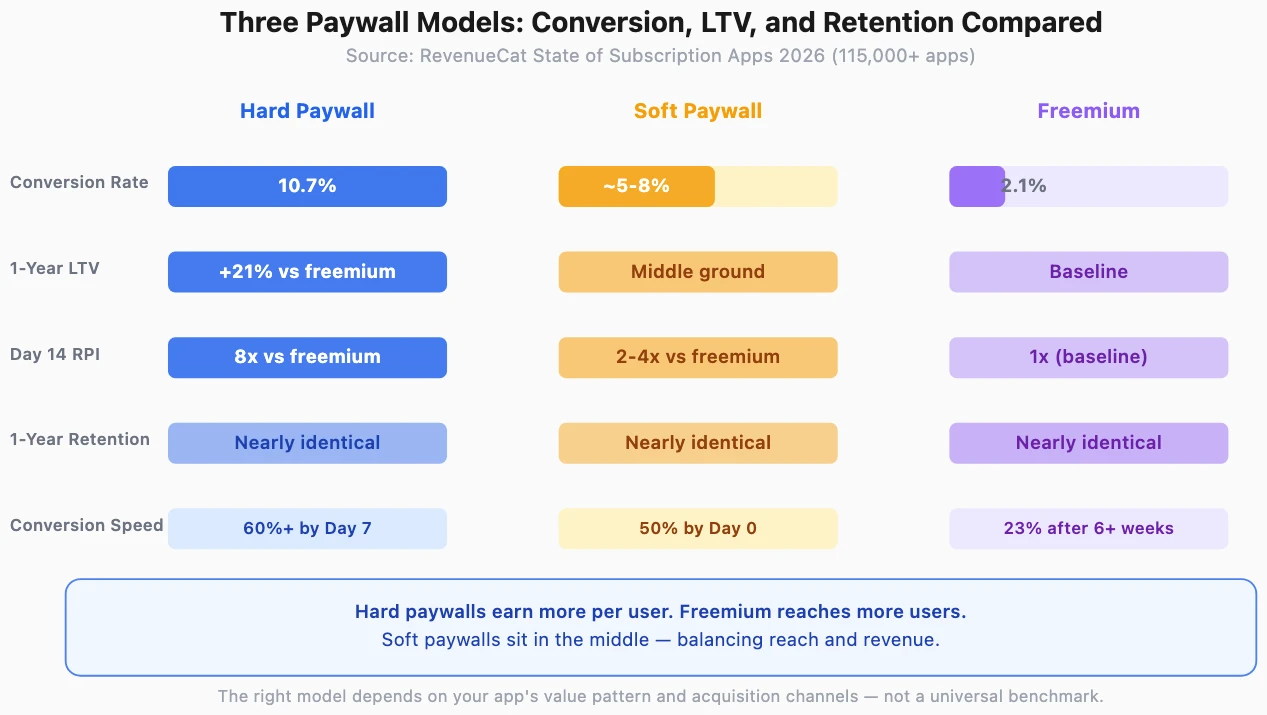
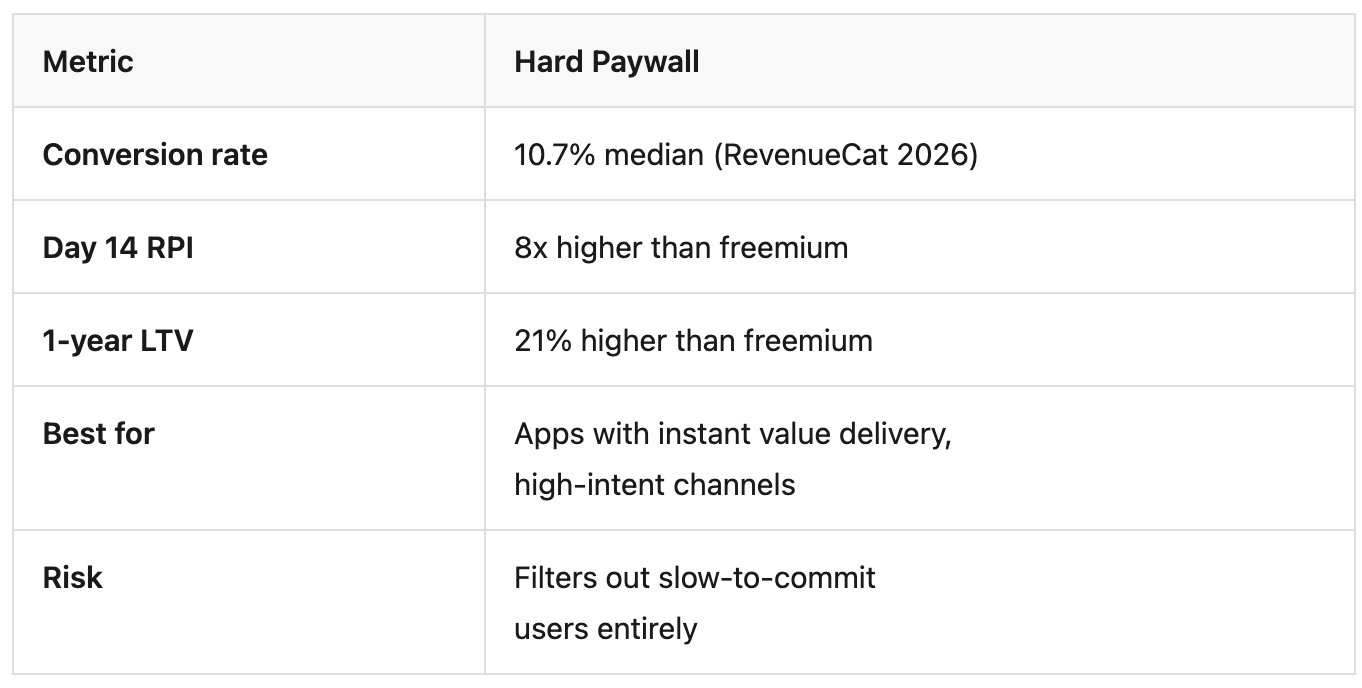
RevenueCat's 2026 report (115,000+ apps, $16B in revenue) puts the gap in stark terms: hard paywalls convert at 10.7%, freemium at 2.1%. The top 10% of hard paywall apps reach 38.7%.
The Data That Seems to Settle the Debate
The numbers go beyond conversion rate. Hard paywall users generate 21% higher 1-year LTV and 8x higher Revenue Per Install at Day 14. After one year, retention between the two models is nearly identical — meaning hard paywalls get more revenue without sacrificing long-term retention.
Why the Headline Number Is Misleading
Hard paywalls do not convert better — they filter harder. Users who hit a hard paywall and leave are never counted. The 10.7% conversion rate reflects the behavior of users who chose to stay despite the gate. That is survivorship bias, not proof of superiority.
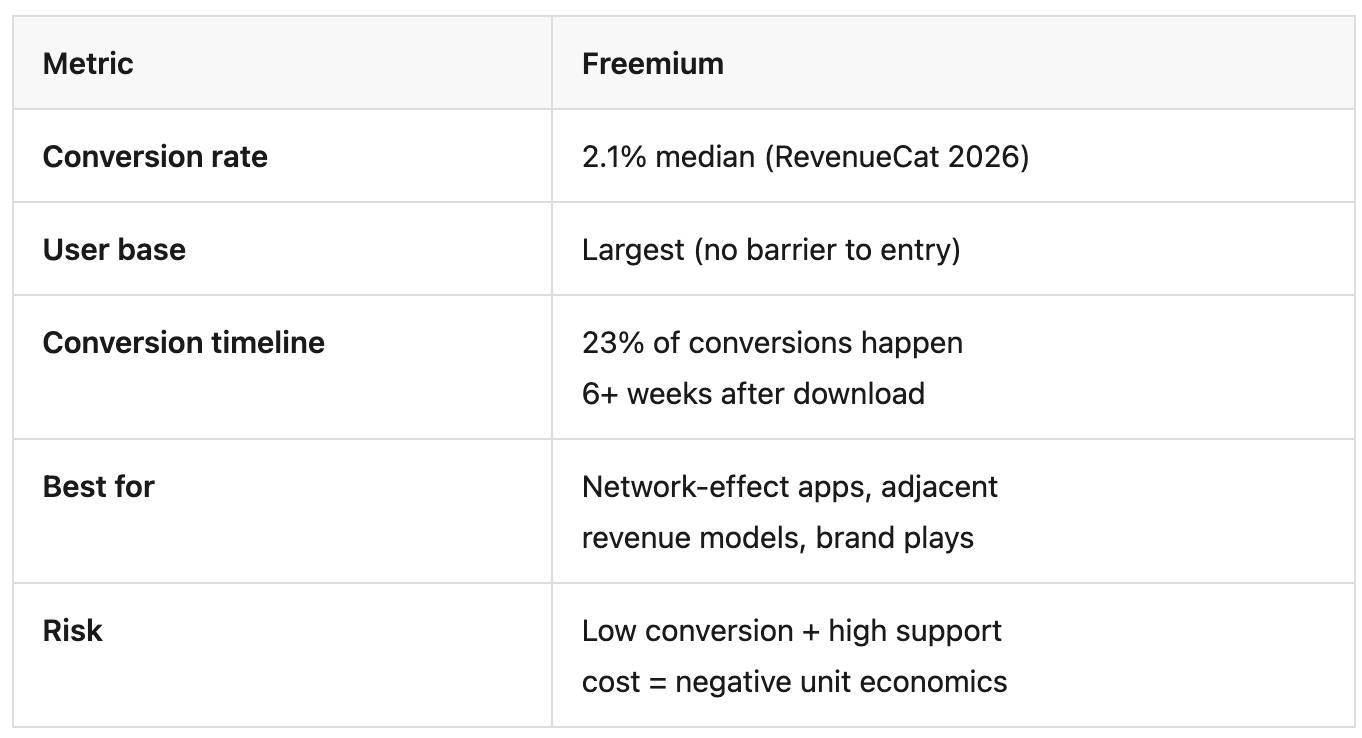
Freemium tells a different story when you look at the timeline. 23% of freemium conversions happen 6+ weeks after download. These are users who would never have paid on Day 0 — they needed time with the product before committing. A hard paywall would have lost them entirely.
The real question is not which model has the higher conversion rate. It is which model captures the right users from your specific acquisition channels.
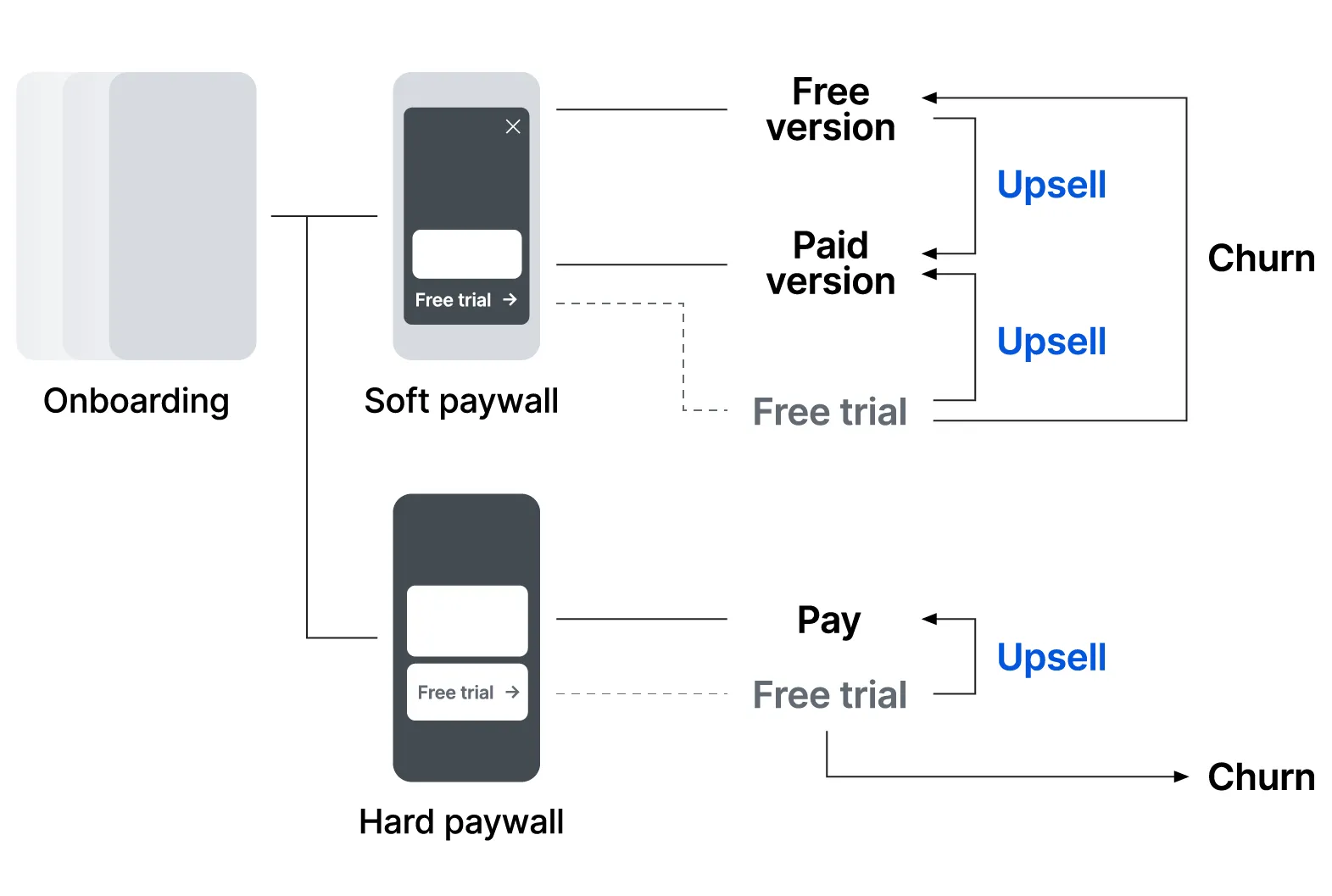
Three Paywall Models, Three Different Bets
Hard Paywall: Pay Before You Play
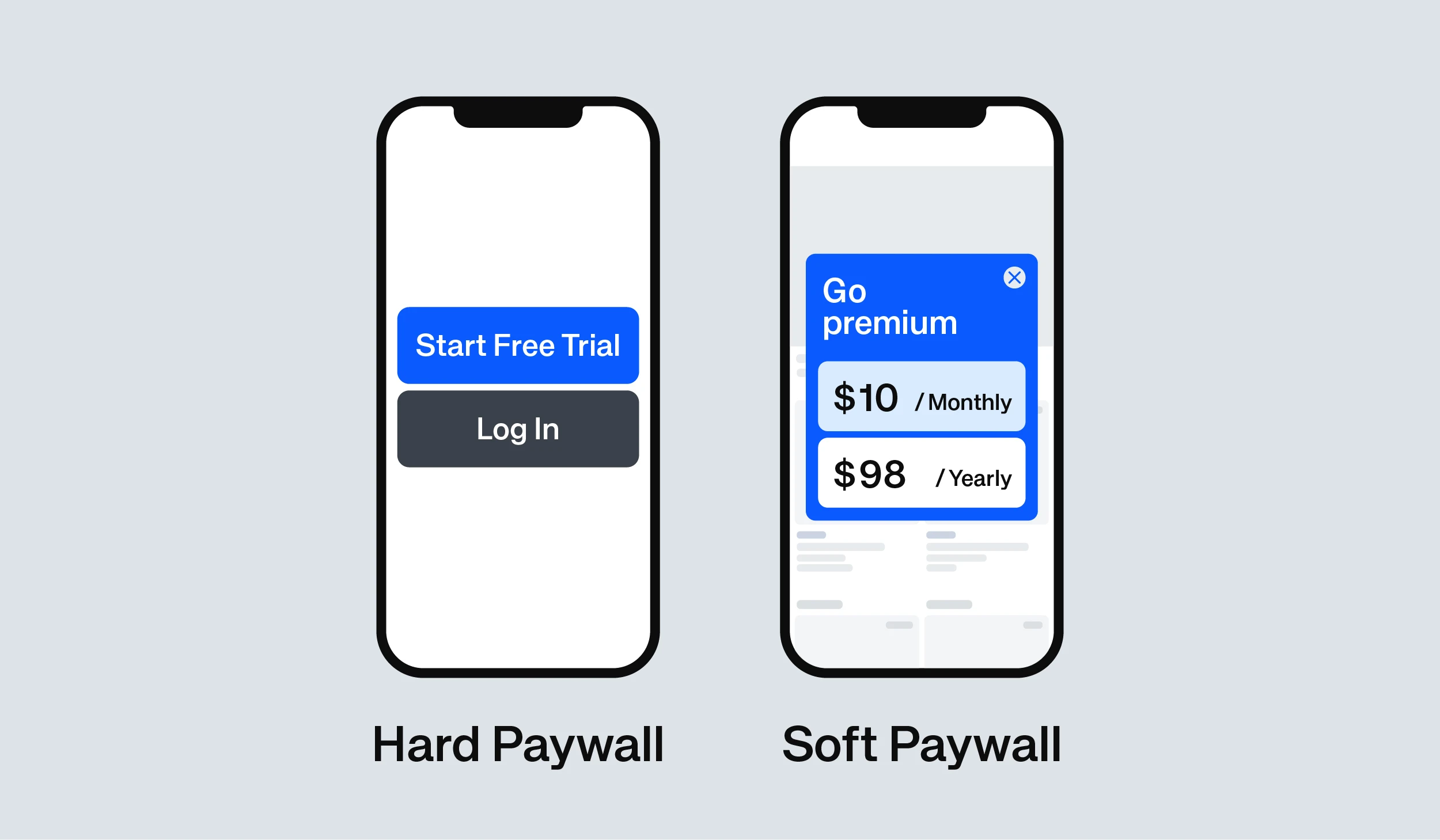
The user must subscribe before accessing any content. No free tier, no trial browsing, no limited access.
When it works: When core value is immediately clear. Headspace progressively tested locking content from 20% free down to 100% locked — and saw double-digit conversion lifts at each stage. Users encountered more paywall touchpoints, and the concept was familiar enough from Spotify and Netflix that friction was accepted.
The tradeoff: You lose every user who needs to experience the product before paying. For acquisition channels that bring discovery-driven users (TikTok, Instagram), hard paywalls can filter out users who would have converted after engagement.
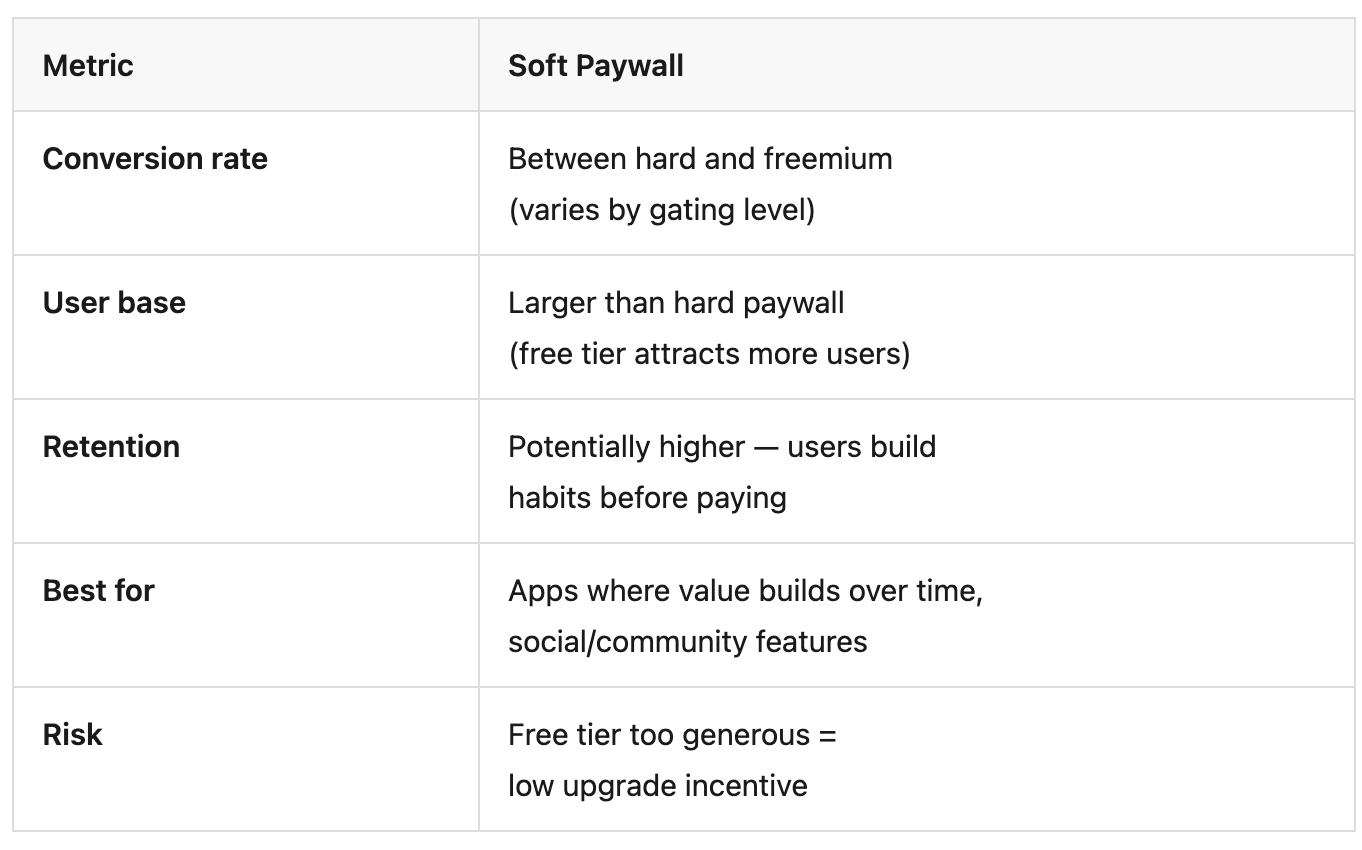
Soft Paywall: Try Some, Pay for More
The user accesses limited content for free. Premium features, advanced content, or extended usage requires a subscription. Variations include metered access (X free sessions/month), feature-gating (basic free, advanced paid), and time-limited trials.
When it works: When free usage builds a habit that makes premium compelling. Strava offers free GPS tracking and basic activity logging — but locks training plans, route planning, and detailed analytics behind a $11.99/month subscription. Users build a running habit with the free tier, then upgrade when they want deeper insights. Result: 180M registered users, $415M revenue in 2025.
The tradeoff: Requires more product complexity — you need to design both a free experience worth using and a premium experience worth paying for. If the free tier is too generous, users never upgrade. If too restrictive, it feels like a hard paywall with extra steps.
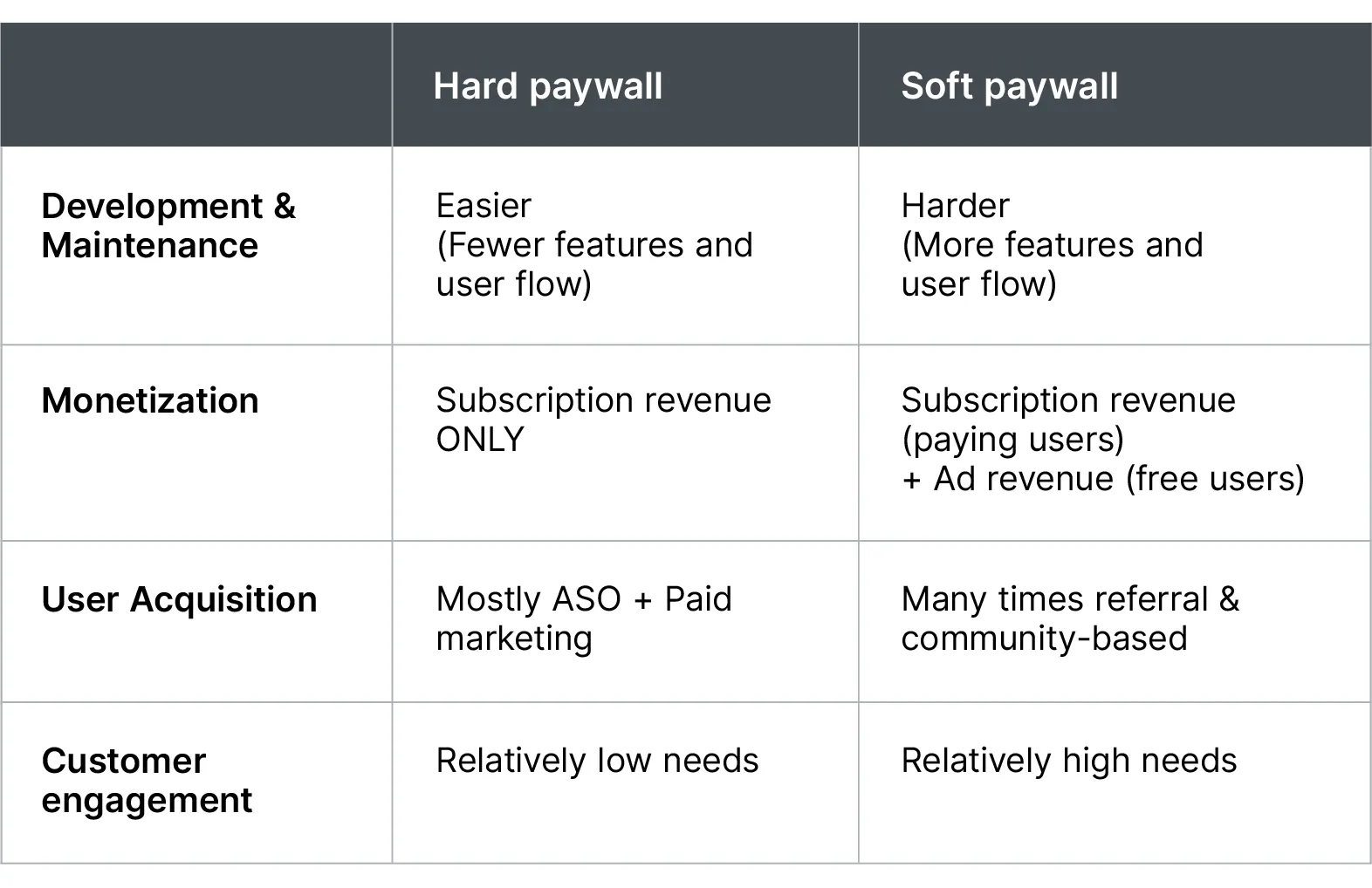
Freemium: Free Forever, Premium Optional
The core product is free. Premium features exist but are not required for the primary use case.
When it works: When free users generate value beyond their own subscription. Nike Training Club eliminated its $14.99/month premium tier entirely in 2020 — making all workouts free. The strategy: use the free app to build brand affinity and drive downstream sportswear revenue. MyFitnessPal uses freemium with 220M registered users and 30M+ monthly actives — monetizing through both premium subscriptions ($9.99/month) and the massive free user base.
The tradeoff: Conversion rates are low — 2.1% median. You need scale to make the economics work. And the algorithm learns from your largest user segment (free users), which can dilute ad signal quality if conversion events are not carefully managed.
%%CTA|Try It Free|https://app.airbridge.io/signin?from=blog-inline|Test which paywall model converts best — with real channel-level data.%%
Want to see how Subscription app works with your data?
Get hands-on with Airbridge and see real results.
Try It Free →Why Fitness Apps Face a Unique Paywall Decision
The Fitness Paradox: Highest Trial Conversion, Lowest Renewal Retention
Adapty's 2026 benchmark data reveals a pattern unique to Health & Fitness:
- Trial-to-paid conversion: 35.0% — highest of any app category
- First-renewal retention: 30.3% — lowest of any category (Utilities leads at 58.1%)
- Install LTV: $1.20 — also highest
Fitness apps are great at getting users to pay. They are terrible at keeping them. This means the paywall model does not just affect initial conversion — it shapes the quality of the subscription cohort that enters. A hard paywall that converts 10% of high-intent users may produce better 12-month revenue than a soft paywall that converts 20% of mixed-intent users — because the hard paywall cohort renews.
Annual Plans Dominate — But Only If Users Commit Early
Health & Fitness is the only app category where annual plans dominate revenue — 68% of H&F revenue comes from annual subscriptions (RevenueCat 2026). This is significant because:
- Annual subscribers retain at 19.9% after Day 380 (vs monthly at 14.2%, weekly at 5.5%)
- 50% of all paid conversions happen on Day 0
- Users who complete 2+ workouts during trial are far more likely to convert
The paywall model determines how quickly users reach the conversion moment. Hard paywalls force an immediate decision — which works for users arriving from high-intent channels (Search, ASO). Soft paywalls and freemium let users experience workouts first — which may convert more discovery-channel users (TikTok, Instagram) but delays the conversion window.> Which channels convert through your paywall — and which ones don't? See trial-to-subscription rates by channel with 15K free attributed installs.
How to Choose: A Framework Based on Your App's Value Pattern
There is no universally correct paywall model. But there are three factors that narrow the decision:
1. Time-to-value: How quickly does the user experience core value?
- Instant (guided meditation, single workout class) → Hard paywall works. The value proposition is clear before the gate.
- Progressive (fitness tracking, habit building, personalized plans) → Soft paywall or freemium. Users need time with the product to understand what they would pay for.
2. Network effects: Does user value increase with more users?
- Yes (social features, leaderboards, community challenges) → Freemium builds the network. Strava's free tier fuels the social graph that makes premium valuable.
- No (individual content consumption, guided programs) → No need to subsidize free users. Hard or soft paywall captures more revenue per user.
3. Revenue model: Is subscription the only revenue source?
- Subscription-only → Hard paywall maximizes revenue per install. Every free user is a cost center.
- Hybrid (ads + subscriptions, commerce + subscriptions) → Freemium funds the free tier through adjacent revenue. Nike Training Club and MyFitnessPal both monetize free users.
Whichever model you choose, the decision is a hypothesis — not a conclusion. The same paywall performs differently across acquisition channels. A hard paywall might convert well for Google Search users (high intent) but poorly for TikTok users (discovery-driven). Without channel-level measurement, you are testing blind.
Choosing a Paywall Without Channel Data Is Guessing
What to Measure When Testing Your Paywall Model
Paywall A/B tests run at the app level. But the results vary by acquisition channel:
- Trial-to-subscription rate by channel — the primary indicator. If Meta converts at 8% through your hard paywall while Google converts at 25%, the paywall is not the problem — the channel fit is.
- Time-to-conversion by channel — how many days from install to subscription. If TikTok users take 14 days while Search users convert on Day 0, a hard paywall penalizes TikTok disproportionately.
- CPS by channel over time — track weekly for 4-8 weeks after a paywall change. Watch for divergence between channels, not just aggregate improvement.
This measurement requires an attribution system that connects paywall events to subscription outcomes at the channel level.
How Airbridge Core Plan Connects Paywall Decisions to Channel Performance
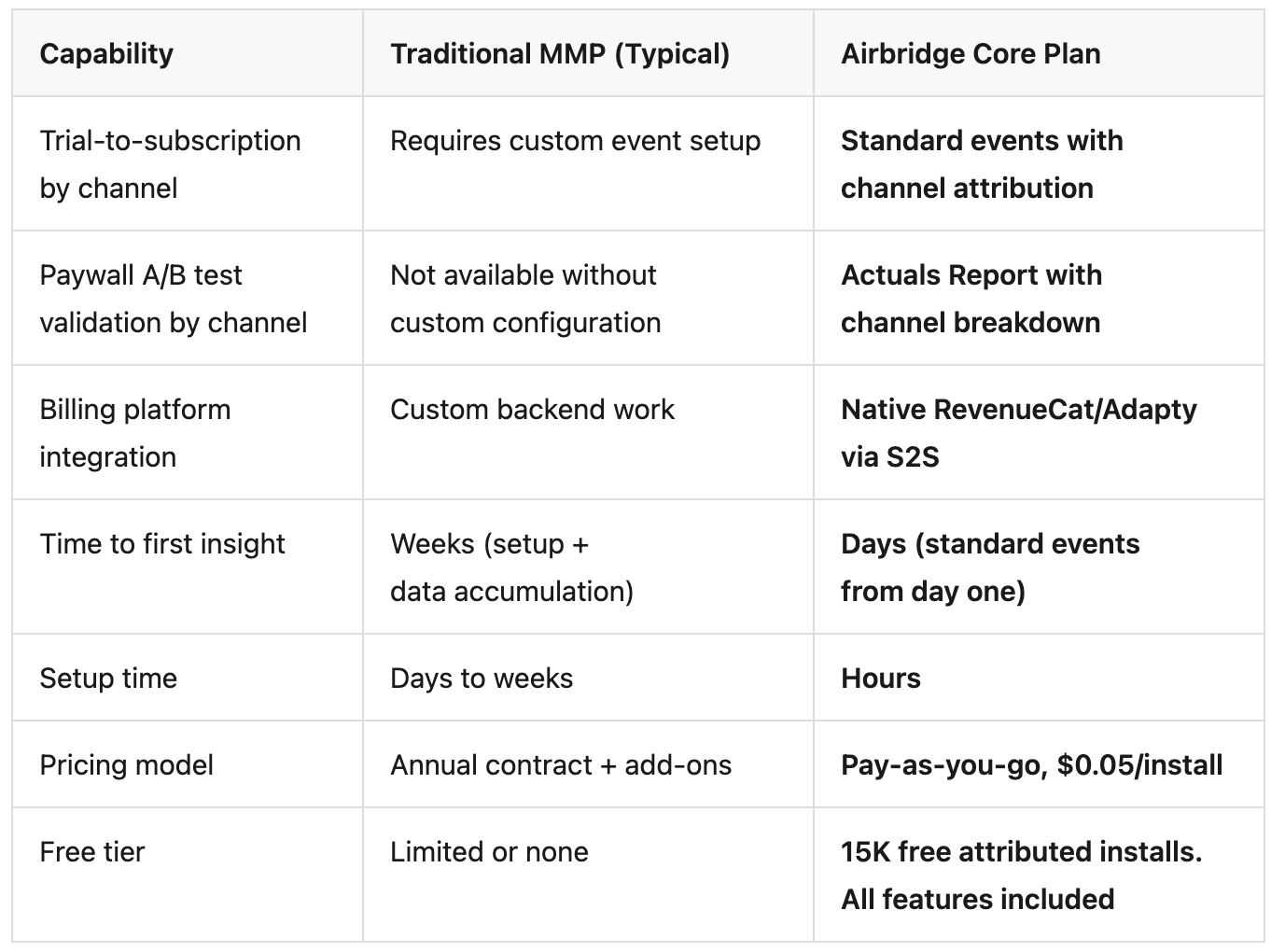
Core Plan tracks Start Trial and Subscribe as standard events with attribution across Meta, Google, Apple Search Ads, and TikTok. The Actuals Report breaks down trial-to-subscription conversion rates by channel — so you can see whether your paywall is converting differently across channels, not just in aggregate.
With native RevenueCat and Adapty integration via S2S, subscription events flow into the attribution system automatically. Before changing your paywall model, this data diagnoses which channels have the widest conversion gap. After the change, it validates whether the new model improved CPS across all channels or just some.
Airbridge Core Plan vs Traditional MMP
The Paywall Is a Hypothesis. Channel Data Is the Proof.
Hard, soft, or freemium — each model attracts a different user profile from each acquisition channel. The paywall that converts best in aggregate may be losing your highest-value channel. The paywall that looks worst overall may be your best performer on the channel that drives annual subscribers.
The only way to know is to measure the full funnel — install to trial to subscription — by channel.


Ready to transform your mobile growth?
Learn how Airbridge helps leading brands measure and optimize every touchpoint.