TikTok Q5 Ads for Subscription Apps: How to Tell If They Bring Payers

On this page
What is Q5 on TikTok, and is it worth it for a subscription app?
TikTok Q5 is the stretch after the holiday shopping peak, December 1 to January 31 in TikTok's own playbook, when TikTok says ad costs (CPMs) come down. For a subscription app, cheaper reach is only half the answer. The other half is whether the people you reach start free trials and keep paying, and you can only see that if your measurement is set up before December 1.
Tools that do this
-
Free: TikTok Ads Manager for cost per trial, once your trial start is sent to TikTok as an event; your subscription platform for trial-to-paid.
-
One view by campaign and creator, through to paid: an MMP. Airbridge Core ties TikTok spend, trials and renewals from RevenueCat, Adapty or Superwall to each campaign and creator link. Try it free for 30 days, then from $40 per month.
What TikTok says about Q5
In a November 2026 post, TikTok describes the post-holiday period as Q5 and says "TikTok's global CPMs decline through the Q5 window compared with the November peak." It also reports that 12% of mobile ad spend shifts into January, above the 10.5% average for February through December, and a 169% increase in "New Year, New Me" content within 30 days of Christmas. TikTok's mobile apps playbook, as reported by PPC Land, puts the window at December 1, 2026 to January 31, 2027.
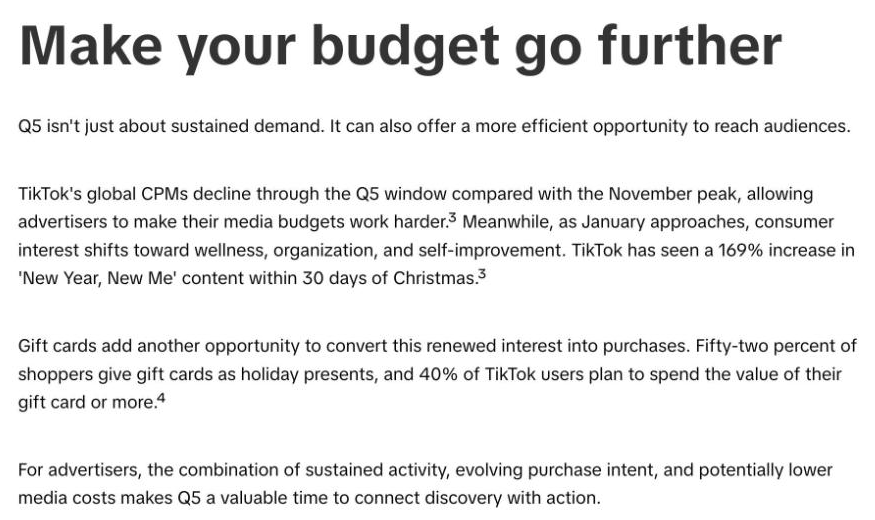
TikTok says its global CPMs decline through Q5 compared with the November peak, and that interest shifts toward wellness and self-improvement as January approaches. Source: TikTok For Business blog
TikTok also says that as January approaches, interest shifts toward wellness, organization and self-improvement. For fitness, habit, learning and finance apps, that is when people go looking for a fresh start. Lower prices and higher intent in the same weeks is a good setup. It also makes it easy to mistake a busy January for a profitable one.
Why Q5 makes measurement more important, not less
Three things make December and January harder to read than an ordinary month:
-
Trials and payments land in different months. A 7-day trial started on December 28 pays on January 4. Read December by when trials start and you'll undercount it; read January by revenue and you'll overcredit it.
-
Cheaper reach can mean a different audience. Lower costs are good news only if the new people pay at a similar rate. Watch trial-to-paid, not just cost per install.
-
Everything runs at once. Holiday promos, creator posts, App Store features and organic New Year searches all spike together, so the platform dashboard and your revenue chart move for many reasons at the same time.
Before December 1: five things to set up
-
Take a baseline. Write down your last two weeks of November: cost per trial on TikTok, trial-to-paid rate and the share of annual plans. Every Q5 number gets compared with this.
-
Send the trial start to TikTok. Optimize for a trial start, not installs, so TikTok looks for people likely to try the app (why trial starts beat installs).
-
Plan the budget around the learning phase. For Smart+ campaigns, TikTok's playbook advises letting a campaign run for at least seven days to pass the learning phase, without changing the budget or target CPA and without pausing it. For app event optimization (AEO) campaigns, it suggests a daily budget of at least 10 times the target bid.
-
Give every creator and Spark Ads post its own link, so a January spike can be traced to the post behind it (Spark Ads for subscription apps).
-
Set your read dates now. Decide when you will judge each step: cost per trial after 7 days of delivery, trial-to-paid after the trial ends, and refunds two weeks after that.
Want to see how TikTok Q5 works with your data?
Get hands-on with Airbridge and see real results.
Try It Free →A week-by-week plan
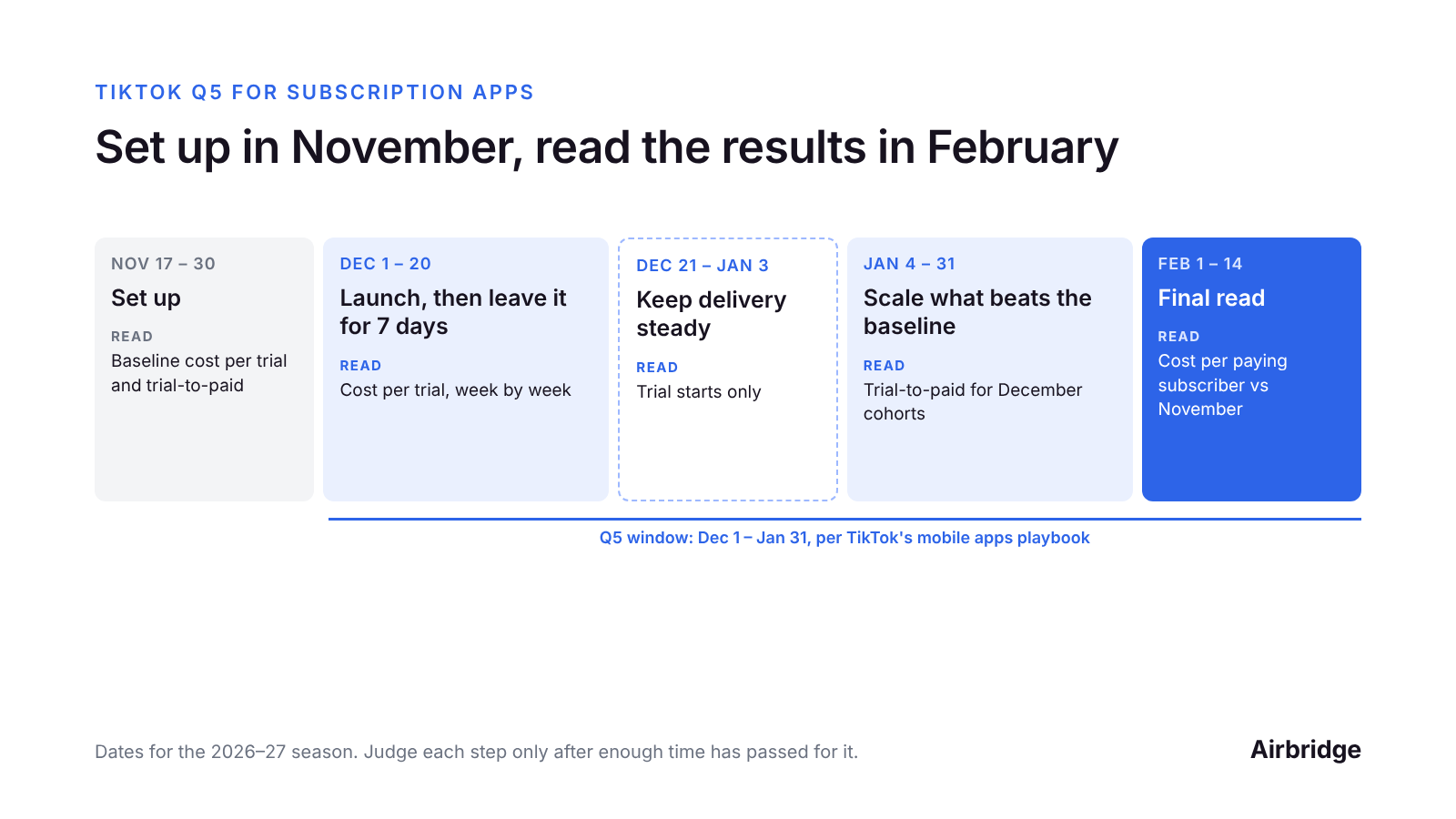
Set up before Q5 opens, read trial starts in December, and judge payers only once December's trials have ended.
| Dates | What to do | What to read |
|---|---|---|
| Nov 17 – 30 | Set up events, links and the baseline | Your November cost per trial and trial-to-paid |
| Dec 1 – 20 | Launch, then leave campaigns alone for 7 days | Cost per trial, week by week |
| Dec 21 – Jan 3 | Keep delivery steady through the holidays | Trial starts; don't judge payments yet |
| Jan 4 – 31 | Scale what reaches your baseline cost per trial | Trial-to-paid for December's trial cohorts |
| Feb 1 – 14 | Final read | Cost per paying subscriber for Q5 vs your November baseline, after refunds |
How to read your Q5 results in January
Group users by the week their trial started, not by the week they paid. Then compare each Q5 cohort with your November baseline on three numbers: cost per trial, trial-to-paid rate, and cost per paying subscriber.
-
Cost per trial down, trial-to-paid steady: Q5 worked. Keep the winning campaigns and creators running into February.
-
Cost per trial down, trial-to-paid down: you bought cheaper, less committed trials. Check which creatives and audiences drove them before scaling.
-
Annual plans: one annual subscriber can be worth a year of monthly ones. Count the plan mix in each cohort, or a good week of annual sales can look like a slow one (payback math for trial-to-annual apps).
Common questions
What is Q5 in advertising?
Q5 is the period right after the holiday peak, roughly late December through January. TikTok uses the name for December 1 to January 31 and says its CPMs decline through that window compared with the November peak.
Are TikTok ads cheaper in January?
TikTok says its global CPMs fall after the November peak, but it doesn't publish a percentage. Your own cost per trial is the number that matters, so compare it with your November baseline.
Should I pause ads over Christmas?
Not by default. Pausing and restarting can send campaigns back into the learning phase. If you keep delivery steady, judge the holiday weeks on trial starts and wait for trial-to-paid until the trials end.
How do I measure trials that start in December and pay in January?
Group users by trial start week and follow each group to its first payment. Your subscription platform shows the payment; an MMP connects it back to the campaign and creator that brought the user.
The bottom line
Q5 may be the cheapest stretch of TikTok reach this year, right when many people look for a fresh start. Set up your trial event, links and baseline before December 1, read results by trial cohort in January, and you'll know whether Q5 brought paying subscribers or just a busy month.
Airbridge connects TikTok, Meta, Google and Apple Ads with RevenueCat, Adapty or Superwall, syncs ad spend automatically, and ties every trial and renewal to the campaign and creator that drove it. The Core Plan is built for subscription apps: try it free for 30 days, then from $40 per month.

Ready to transform your mobile growth?
Learn how Airbridge helps leading brands measure and optimize every touchpoint.
“We went with them because their tech is better. It's best-in-class, for sure, but the real difference for us was the people.”