Subscription App Payback Period: What to Do When CAC Beats the First Payment

On this page
Subscription app payback period, in plain math
One founder running Meta campaigns for an iOS subscription app summed up a common worry: "I'm struggling to understand how to make the campaigns profitable when the cost of acquiring a paying subscriber is higher than the revenue from their first payment."
That situation is normal for monthly plans and often fine. What matters is when the campaign pays back, and whether you can afford to wait that long.
The math at a glance
-
Work out four numbers: cost per subscriber, net revenue per payment after store fees, retention by month, and how long you can afford to wait.
-
Annual plans usually pay back on the first payment.
-
Monthly plans pay back over several months, so payback depends on churn.
-
A campaign is healthy if it pays back within the time your cash allows.
Step 1: Cost per subscriber, not cost per install
Start from what you pay for each subscriber, not each install:
Cost per subscriber = cost per trial ÷ trial-to-paid rate
If a trial costs $8 and 35% of trials convert, each subscriber costs about $22.86.
Step 2: Net revenue per payment
Use what you actually receive, after store fees and taxes collected by the store. For many subscription apps the store fee is 15%: Google Play charges 15% on subscriptions, and Apple charges 15% to members of its Small Business Program. Check the rate that applies to your account and region.
At a 15% fee:
| Plan | List price | Net per payment |
|---|---|---|
| Monthly | $7.99 | $6.79 |
| Annual | $39.99 | $33.99 |
Step 3: Annual plans: payback on the first payment
With a $22.86 cost per subscriber and $33.99 net from the first annual payment, the campaign pays back immediately, with $11.13 left over per subscriber. The real question for annual plans is renewal rate at month 12, which decides long-term value.
Step 4: Monthly plans: payback depends on retention
For a monthly plan, the first payment ($6.79 net) covers less than a third of the $22.86 cost. Payback depends on how many subscribers keep paying. Here is an illustrative retention curve:
| Month | Still paying | Net revenue per original subscriber | Cumulative |
|---|---|---|---|
| 1 | 100% | $6.79 | $6.79 |
| 2 | 70% | $4.75 | $11.54 |
| 3 | 58% | $3.94 | $15.48 |
| 4 | 50% | $3.40 | $18.88 |
| 5 | 45% | $3.06 | $21.93 |
| 6 | 42% | $2.85 | $24.78 |
Numbers are illustrative.
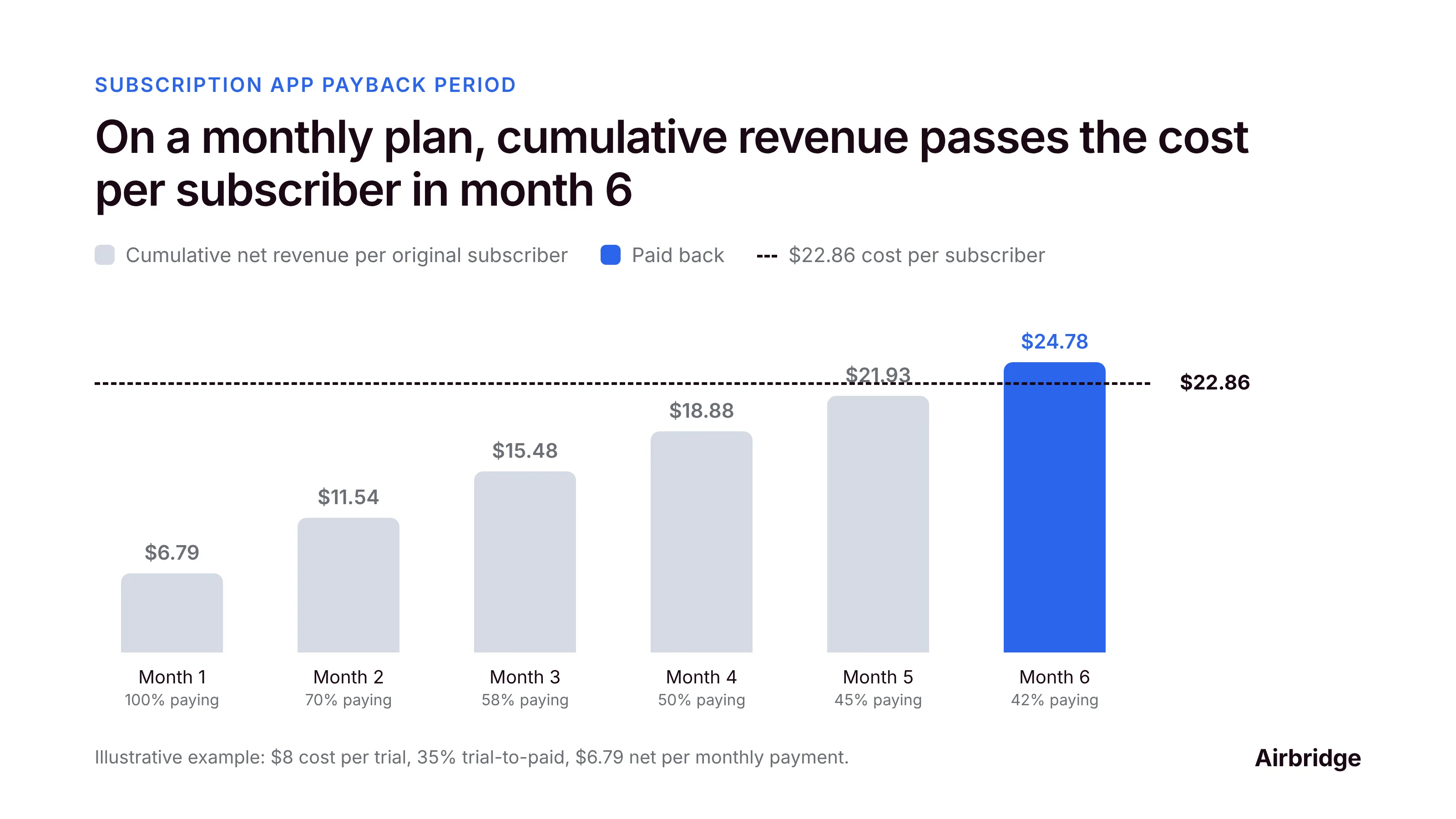
The campaign pays back in month 6. Whether that's good depends on your cash: if you can wait six months, it's a profitable campaign; if you need money back in 30 days, it isn't yet.
Want to see how Subscription app payback period works with your data?
Get hands-on with Airbridge and see real results.
Try It Free →Step 5: Decide what to change
If payback is too slow, you have four levers:
-
Lower cost per trial: optimize campaigns for trial starts, test creatives, cut channels with high cost per subscriber.
-
Raise trial-to-paid: improve onboarding and the paywall moment, remind users before the trial ends.
-
Shift the plan mix: promote annual plans, which collect more up front.
-
Improve early retention: months 2 and 3 matter most for monthly payback.
One founder coming from ecommerce asked whether a €4.99 subscription could work with Meta ads, "or is it a trap at this stage?" The math above answers it: low prices can work, but only with a low enough cost per subscriber, a good annual mix, or strong retention.
Read payback by channel
Payback differs a lot by channel and campaign. A channel with a higher cost per trial but better retention can pay back faster than a cheap one. Track cost per subscriber and retention for each channel, not just across the whole app.
Payback period FAQ
Is it bad if my cost per subscriber is higher than the first payment?
Not necessarily. For monthly plans, payback usually takes several months. It's only a problem if payback takes longer than your cash allows, or never happens because subscribers churn too fast.
How do I calculate payback for a subscription app?
Divide cost per trial by trial-to-paid rate to get cost per subscriber. Then add up net revenue per original subscriber month by month, using your retention curve, until it exceeds that cost.
Should I push annual or monthly plans?
Annual plans usually pay back faster because more revenue arrives up front. Test the plan mix on your paywall and compare payback and long-term retention.
Do store fees change payback?
Yes. Always use net revenue after store fees. A 15% fee on a $7.99 plan means $6.79 per payment, which adds weeks to payback.
What payback period is good for a subscription app?
It depends on your cash and growth goals. Many small teams aim to pay back within a few months; teams with funding may accept longer. Decide your limit first, then judge campaigns against it.
The takeaway
A subscriber who costs more than their first payment isn't a loss if they keep paying. Calculate cost per subscriber, use net revenue, model retention, and judge each channel on whether it pays back in time.
Airbridge connects trials, payments, renewals and refunds from RevenueCat, Adapty or Superwall to the campaigns that drove them, so you can see cost per subscriber and revenue over time by channel. The Core Plan is built for subscription apps, and you can try it free for 30 days, then from $40 per month.
Ready to transform your mobile growth?
Learn how Airbridge helps leading brands measure and optimize every touchpoint.
“Airbridge understands the essence of what it has to offer as an MMP. Its objective, transparent, and accurate performance analysis allows marketers to realize the true impact of their efforts.”