Small Ad Budget? Optimize for Trial Starts, Not Installs

Install campaigns vs. trial start optimization: the short answer
You launch your first app install campaign. The cost per install looks great. A week later, RevenueCat shows almost no new trials, and even fewer subscribers.
This is one of the most common problems we see from small subscription app teams running paid ads. One founder wrote that "raw install campaigns are crushing my unit economics." Another, about to launch Google App campaigns in the US, told us: "i have no idea because usa installs are coming very expensive."
The ad platform did its job. It found people who install. As one indie founder put it after testing Google App campaigns: "Google gets exactly what it's asked for." The fix is to ask for something closer to what you actually want.
TL;DR: If your app has a free trial, optimize your campaigns for trial starts, not installs. A trial start is the earliest event that clearly predicts payment, and it usually happens often enough for the ad platform to learn from, even on a small budget. Purchases are a better signal but often too rare to optimize for at first. Then judge results on cost per trial within days and cost per subscriber once trials end.
Why cheap installs and paying users are often different people
Ad platforms optimize for the event you choose. When you choose installs, the system looks for people who are likely to install at the lowest cost. That is exactly what it's built to do, and it does it well.
The catch is that the people most likely to install cheaply are not always the people most likely to pay for a subscription. Some install out of curiosity, open the app once, and never see the paywall. Others are in regions where your price is a harder sell. On a cost-per-install report, they all look the same.
For a subscription app, the path to revenue has several steps:
-
Install
-
Open the app and finish onboarding
-
Start a free trial
-
Convert to paid when the trial ends
-
Renew
Each step filters out people. An install campaign only sees step 1. If most of your installers drop out before step 3, a low cost per install can still mean a high cost per subscriber.
That is why cost per install (CPI) is a weak success metric for subscription apps. The number that matters is what you pay for each person who starts a trial and, later, each person who pays.
Why not optimize for purchases right away? The event volume problem
If paying subscribers are the goal, it's tempting to optimize straight for purchases. The problem is volume. Ad platforms learn from examples, and a small budget produces very few purchases.
Both Meta and Google publish guidance on how much data their systems need:
-
Meta: an ad set leaves the learning phase after roughly 50 optimization events within about a week. Until then, delivery is less stable.
-
Google: for App campaigns that bid on in-app actions, Google recommends a daily budget of at least 10 times your target cost per action, and avoiding major changes before the first 100 conversions.
Here is what that means for a small app spending $50 a day ($350 a week). The costs are illustrative:
| Event you optimize for | Example cost per event | Events per week at $350 | Enough to learn? |
|---|---|---|---|
| Install | $2 | 175 | Yes, but it's the weakest signal of payment |
| Trial start | $7 | 50 | Around Meta's threshold |
| Purchase (first payment) | $35 | 10 | Rarely, at this budget |
One founder running Meta ads described the purchase problem simply: "I don't have enough downstream events."
So the choice is a trade-off between signal quality (how well the event predicts revenue) and signal volume (how often it happens). For most trial-based subscription apps on a small budget, the trial start is where those two meet.
How to pick your optimization event
Use one simple rule: optimize for the earliest event that predicts payment and still happens about 50 times a week at your budget.
In practice, that rule gives you a short decision path:
-
You offer a free trial and can get ~50 trial starts a week: optimize for trial start. This fits most indie subscription apps.
-
You offer a free trial but get far fewer than 50 a week: raise the budget on one campaign instead of splitting it, or test an earlier event that strongly predicts trials, such as finishing onboarding. Check that people who reach that event really do start trials more often.
-
You don't offer a trial (direct purchase): optimize for the first purchase if you have the volume, or for a key activation event that predicts purchase if you don't.
-
You get well over 50 purchases a week: you've outgrown trial optimization. Test purchase or value-based bidding, which lets the platform look for higher-paying users.
Whatever you pick, use one event per campaign. Google advises against targeting several in-app actions with one target cost, because it turns your target into a blended number. Meta's app event campaigns also optimize toward a single event per ad set.
Finally, make sure the event is clean. A trial start should fire once per person, when the trial actually begins, not when someone views the paywall. If it fires twice, or fires for people who cancel the system dialog, the ad platform learns from the wrong people.
Want to see how Optimize for trial start works with your data?
Get hands-on with Airbridge and see real results.
Try It Free →How to set up trial start optimization on Meta and Google
The setup is similar on both platforms: send a clean trial start event, then tell the campaign to optimize for it.
Before you launch (both platforms)
-
Track the trial start as an in-app event. Send it from your app, your subscription platform (such as RevenueCat, Adapty or Superwall) or your mobile measurement partner (MMP). Name it clearly, for example
start_trial. -
Test it. Start a sandbox trial and confirm the event shows up once, with the right timestamp, in each ad platform's event tools.
-
Map it for iOS privacy measurement. On iOS, some results reach ad platforms in aggregated form through SKAdNetwork. Include the trial start in your conversion value setup so it's counted there too.
-
Write down your baseline. Note your current cost per install, install-to-trial rate and trial-to-paid rate, so you can compare after the switch.
On Meta
-
Create a campaign with the App promotion objective.
-
At the ad set level, set the performance goal to maximize the number of app events, and pick your trial start event (Meta's standard event is
StartTrial). -
Keep one ad set with enough budget to reach roughly 50 trial starts a week, instead of several small ones.
-
Avoid big edits while the ad set is in the learning phase.
On Google
-
Import your trial start as a conversion action from Google Analytics for Firebase or your MMP.
-
Create an App campaign for installs and set the bidding focus to in-app actions, with your trial start as the only action.
-
Set a target cost per action close to your current cost per trial, and a daily budget of at least 10 times that target.
-
Avoid major changes until the campaign has recorded about 100 conversions.
Give each campaign one to two weeks before judging it. Early days are noisy on both platforms.
How to read the results: cost per trial, then cost per subscriber
When you switch from install to trial start optimization, your cost per install will usually go up. That is expected. You are paying more for people who are more likely to start a trial. Judge the switch on what happens further down.
Here is an illustrative week at $350 for each approach:
| Metric | Optimized for installs | Optimized for trial starts |
|---|---|---|
| Installs | 175 | 100 |
| Cost per install | $2.00 | $3.50 |
| Trial starts | 20 | 50 |
| Cost per trial | $17.50 | $7.00 |
| Paid subscribers (after trial) | 6 | 18 |
| Cost per subscriber | $58.33 | $19.44 |
Numbers are illustrative.
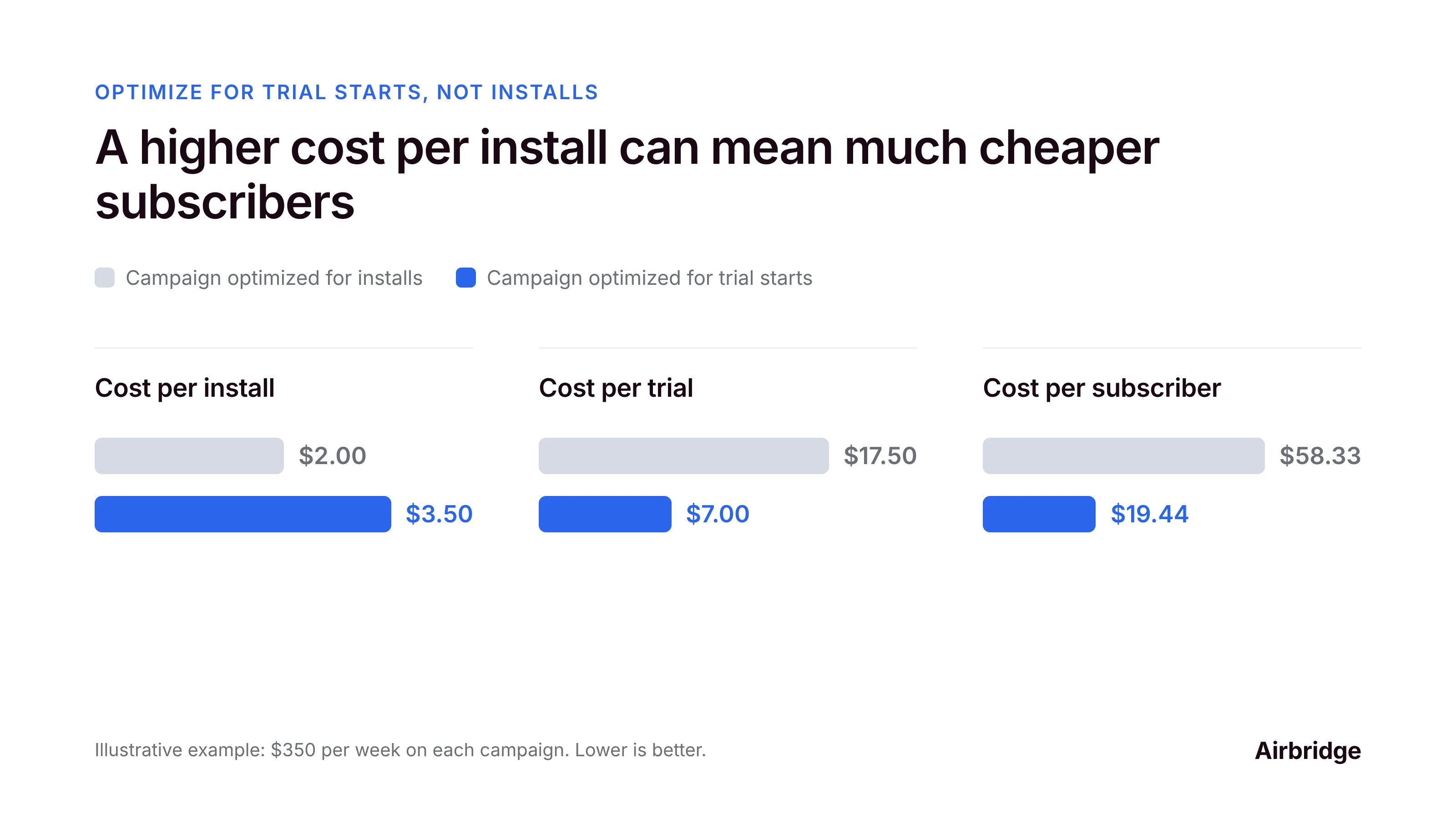
The install campaign wins on CPI and loses on everything that pays the bills.
Read your own results in two steps:
-
Within a week: cost per trial. This is your early signal. If it drops compared with your install campaign, the platform is finding better people.
-
After the trial ends: cost per subscriber. This is the final answer. Compare it with what a subscriber is worth to you in their first year. If cost per subscriber is lower, the campaign pays back.
Keep both numbers per campaign and per channel, so you can see which network brings the cheapest subscribers, not just the cheapest installs. We cover the same idea for creators in Paying Creators on CPM? Track Cost per Subscriber, Not Just Views.
FAQ
Should a subscription app optimize ads for installs or trial starts?
If the app has a free trial, optimize for trial starts. Install campaigns find people who install at the lowest cost, and many of them never start a trial. A trial start is a much stronger sign that someone may pay, and it usually happens often enough for the platform to learn.
How many conversions does an ad campaign need to optimize for an in-app event?
Meta's guidance is roughly 50 optimization events per ad set within about a week to leave the learning phase. Google recommends a daily budget of at least 10 times your target cost per action for App campaigns bidding on in-app actions, and avoiding major changes before about 100 conversions.
Why did my cost per install go up after switching to trial start optimization?
Because the platform is now looking for people who are more likely to start a trial, and they cost more to reach. Judge the switch on cost per trial and cost per subscriber, not cost per install.
When should I optimize for purchases instead of trial starts?
When your budget brings in about 50 or more first purchases a week from one campaign. Below that, the platform usually doesn't have enough examples to learn from purchases alone.
What if my app doesn't have a free trial?
Optimize for the first purchase if you have the volume. If you don't, choose an activation event that strongly predicts purchase, such as finishing onboarding, and confirm that people who reach it buy more often.
What is a good cost per trial for a subscription app?
It depends on your trial-to-paid rate and what a subscriber is worth to you. Work backward: multiply the most you can pay per subscriber by your trial-to-paid rate. That is the most you can pay per trial and still break even.
The bottom line
Ad platforms deliver what you ask for. Ask for installs, and you get people who install. For a subscription app on a small budget, the better ask is usually the trial start: early enough to happen often, close enough to payment to matter.
Track one clean trial start event, point one well-funded campaign at it, give it a week or two, and judge it on cost per trial and cost per subscriber, not cost per install.
If you'd like those numbers in one place, Airbridge connects trial starts and subscriptions from RevenueCat, Adapty or Superwall to each campaign, so you can see cost per trial and cost per subscriber by channel across iOS and Android. The Core Plan is built for subscription apps, and you can try it free for 30 days, then from $40 per month.

Ready to transform your mobile growth?
Learn how Airbridge helps leading brands measure and optimize every touchpoint.