Small-Budget Incrementality: What You Can Test Without an MMM Team


On this page
How do I know if my ads are really adding trials?
Run a test where some people (or some weeks, or some regions) don't see the ads, and compare total trial starts with and without them. On a small budget, start with a two-week pause test on one channel, move to a geo holdout when you can split regions, and use the ad platform's own lift test when you qualify. Read every result in total trial starts or payers from your subscription data, not in conversions the platform reports for itself.
Tools that do this
-
Free: your subscription data for total trial starts, a calendar for the test window, and the lift tests built into some ad platforms.
-
Per-channel trials and revenue next to spend, before and after each test: an MMP, so you can compare the weeks yourself. Airbridge Core ties trials and renewals from RevenueCat, Adapty or Superwall to each campaign, with spend synced from Meta, Google, Apple Ads and TikTok. Try it free for 30 days, then from $40 per month.
What does "incremental" mean?
An ad platform reports the conversions it can link to its ads. Some of those people would have found you anyway: through search, a friend, or another channel. Incremental trials are the ones that happened only because of the ad.
Marketing mix modeling (MMM) estimates this from months of data across every channel. It's useful, but it needs history, volume and someone to run it. At $1k–$5k a month, a simple test answers a narrower question faster: "What happens to total trials if I turn this off?"
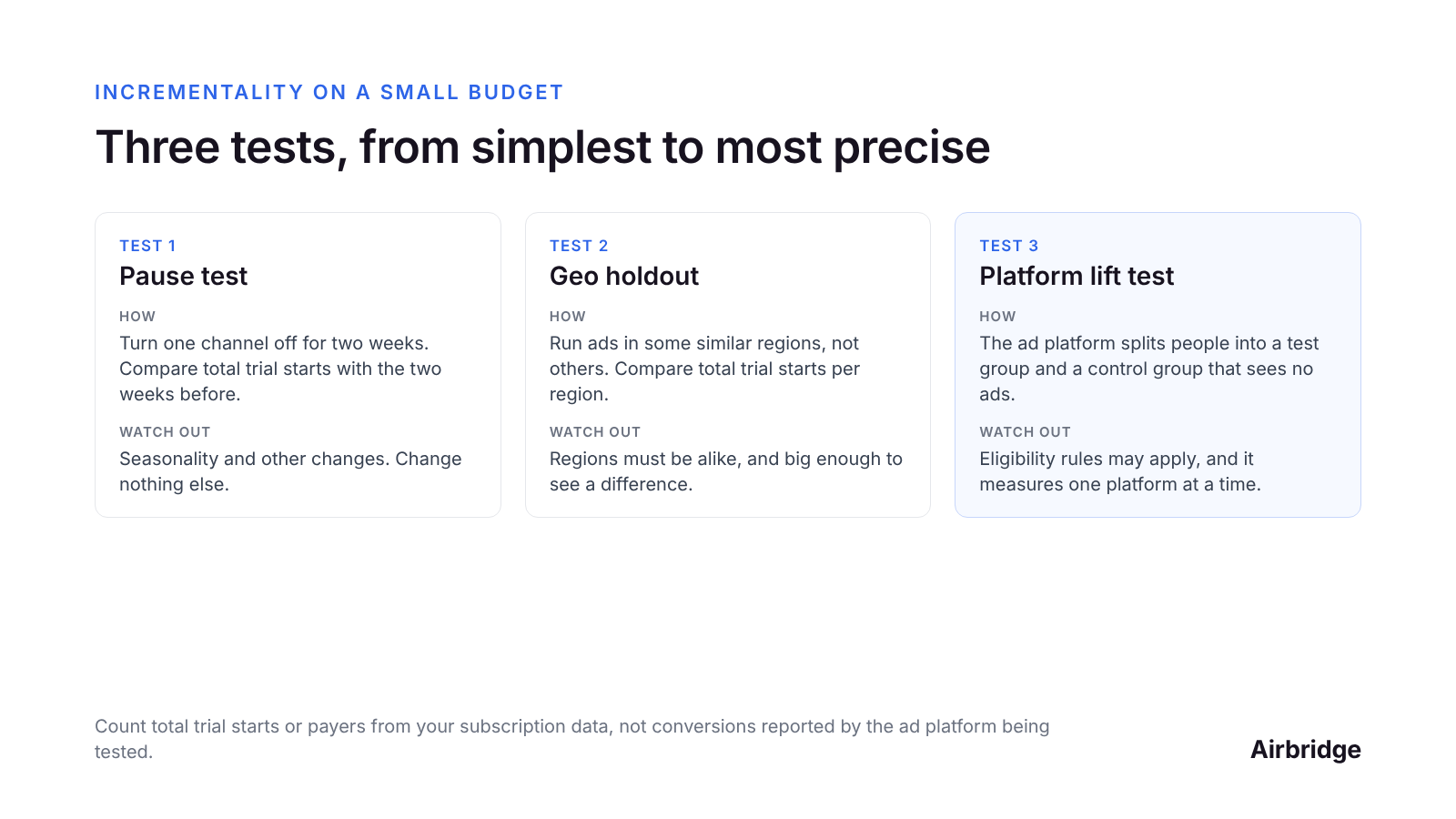
Three tests you can run without a data team, from simplest to most precise.
Test 1: The pause test
The simplest test: turn one channel off and see what happens to the total.
-
Pick one channel, ideally the one you're least sure about.
-
Write down total trial starts per week for the last two to four weeks.
-
Pause that channel for two weeks. Keep everything else the same: other channels, prices, app version.
-
Compare total trial starts during the pause with the weeks before.
If total trials barely moved, much of what that channel claimed would have happened anyway. If they dropped by about as much as the channel reported, its numbers were close to the truth.
The weakness: anything else that changes during those two weeks, such as a holiday, a feature on the App Store or a viral post, gets mixed into the result. Avoid big seasonal moments.
Test 2: The geo holdout
A geo holdout runs the ads in some regions and not in others at the same time, so seasonality hits both groups.
-
Pick regions that are alike in size and past behavior (for example, US states or similar countries).
-
Split them into two groups. Run ads in one group only.
-
After two to four weeks, compare total trial starts per region in each group with their own baseline.
This works best when you have enough trials per region to see a difference. With very small numbers, combine regions into bigger groups.
Want to see how Incrementality testing small budget works with your data?
Get hands-on with Airbridge and see real results.
Try It Free →Test 3: The platform's lift test
Some ad platforms run this kind of test for you. Meta's Experiments tool includes a Conversion Lift test, which creates "a test group that has the opportunity to view your ads and a control group that does not see your ads" and compares them (Meta Business Help Centre).
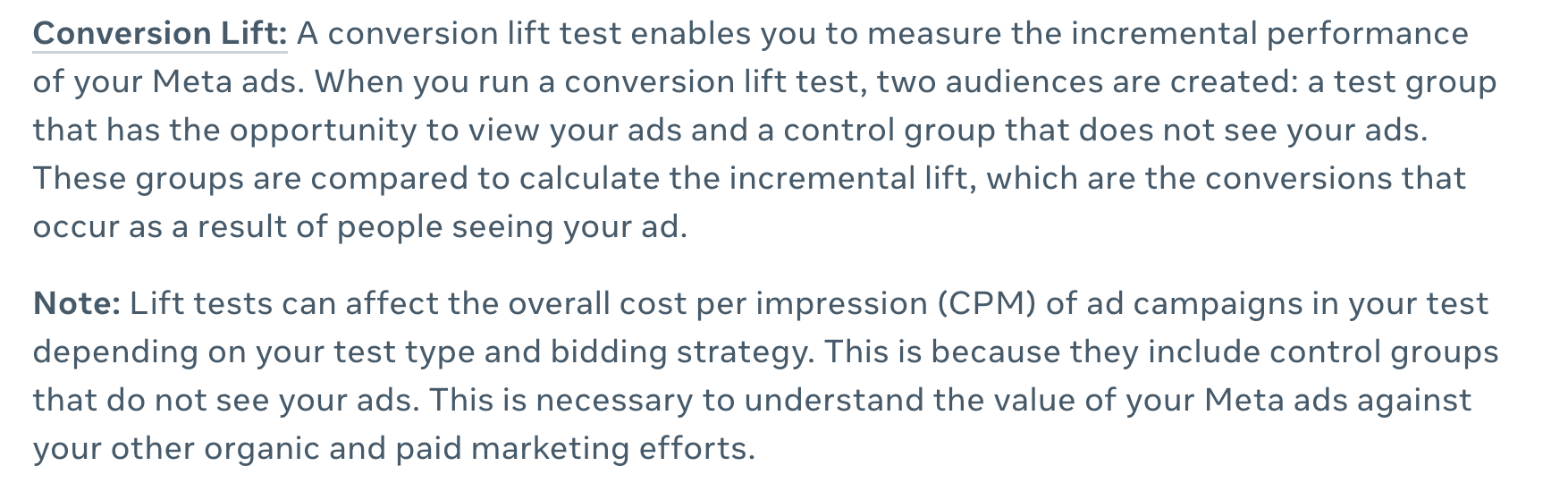
How Meta describes its Conversion Lift test. Source: Meta Business Help Centre.
Google Ads offers Conversion Lift too, measured either by users or by geography (Google Ads Help).
Two things to know before you start: eligibility rules can apply, so check in your account whether your campaign qualifies; and each platform's test measures that platform only. It won't tell you how channels compare with each other.
How do you read the results?
-
Use one source for the result. Count total trial starts and payers from your subscription data. Don't judge a channel by conversions that channel reports for itself.
-
Look at the size of the change, not just the direction. A small dip during a pause may be noise. Repeat the test before you cut a channel.
-
Write down what you'd do with each answer before the test starts. "If total trials drop less than half of what the channel reports, I'll cut its budget by half."
-
Re-test after big changes. A new creative or a new country can change the answer.
Common questions
What is incrementality in mobile marketing?
The share of installs, trials or purchases that happened only because of an ad, rather than ones that would have happened anyway.
Do I need MMM to measure incrementality?
No. MMM helps when you spend across many channels with plenty of history. On a small budget, a pause test or geo holdout answers the main question faster.
How long should an incrementality test run?
Usually two to four weeks, plus a baseline before. For subscription apps, run it at least as long as your free trial if you want to measure payers, not just trial starts.
Can I run a lift test with a small budget?
Sometimes. Platforms set their own eligibility rules. If your campaign doesn't qualify, a pause test or geo holdout still works.
The bottom line
You don't need a data team to ask whether your ads add trials. Pause one channel, or hold out some regions, and count total trials from your subscription data. Use a platform lift test when you qualify.
To see per-channel trials and revenue next to spend before and after each test, Airbridge ties trials and renewals from RevenueCat, Adapty or Superwall to each campaign. The Core Plan is built for subscription apps: try it free for 30 days, then from $40 per month.



Ready to transform your mobile growth?
Learn how Airbridge helps leading brands measure and optimize every touchpoint.
“Braze is a powerful tool on its own, but when paired with Airbridge, it creates synergies for retargeting campaigns, saving resources and enhancing performance.”