Your 7-Day Trial Ends When Meta's Click Window Does: Should You Change Trial Length?

On this page
Should you change your trial length to fit Meta's attribution window?
Usually not. A 7-day free trial pays at the edge of Meta's 7-day click attribution window, so Meta misses some first payments, but changing the trial to fix that trades a product decision for a reporting one. A shorter trial moves payments inside the window and may change who subscribes; a longer one moves them out completely. The better fix is to optimize Meta for the trial start, which happens right after the click, and to read payments from your own subscription data.
Tools that do this
-
Free: your subscription platform for trial-to-paid by weekly cohort; Meta Ads Manager for cost per trial once the trial start is sent as an event.
-
Payments tied to the campaign whenever they land: an MMP. Airbridge Core ties trials, first payments and renewals from RevenueCat, Adapty or Superwall to the campaign that drove the install. Try it free for 30 days, then from $40 per month.
The question came from a reader of our earlier piece on reading ROAS when your trial and Meta's window are the same length: "Would a 6-day or 8-day trial move the first payment away from the edge, or does an odd trial length cut trial starts?" Here is the full answer.
When does a free trial actually pay?
Apple doesn't charge for a free trial until it ends: the App Store tries to renew in the last 24 hours of the trial, and if the payment fails, it keeps retrying. Google Play trials also charge when the trial ends. So the first payment arrives at the end of the trial, or later if a retry is needed.
Meta's standard attribution setting can count conversions up to 7 days after a link click, plus 1 day after a view or an engagement (Meta Business Help Centre). For iOS app install campaigns that use Meta's own attribution, Meta reports with a 1-day or 7-day click window, depending on the setting you chose. With a 7-day trial and a 7-day click window, the first payment lands right at the end of that window.
Can you set a 6-day or 8-day trial on iOS?
On the App Store, free trials come in fixed lengths. App Store Connect lists the options as "3 Days. 1 or 2 Weeks. 1, 2, 3, or 6 Months. 1 Year." Google Play is more flexible: its help center says free trial phases can range from 3 days to 3 years.
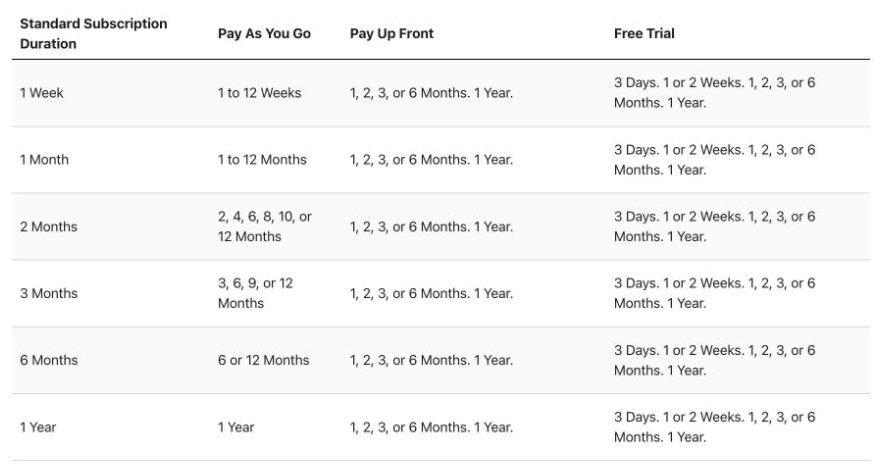
On the App Store, a free trial can be 3 days, 1 or 2 weeks, 1, 2, 3 or 6 months, or 1 year, whatever the subscription length. Source: App Store Connect Help
So for an iOS app, the realistic choice is between 3 days, 1 week and 2 weeks.
Want to see how Meta attribution window free trial works with your data?
Get hands-on with Airbridge and see real results.
Try It Free →How does each trial length change what Meta sees?
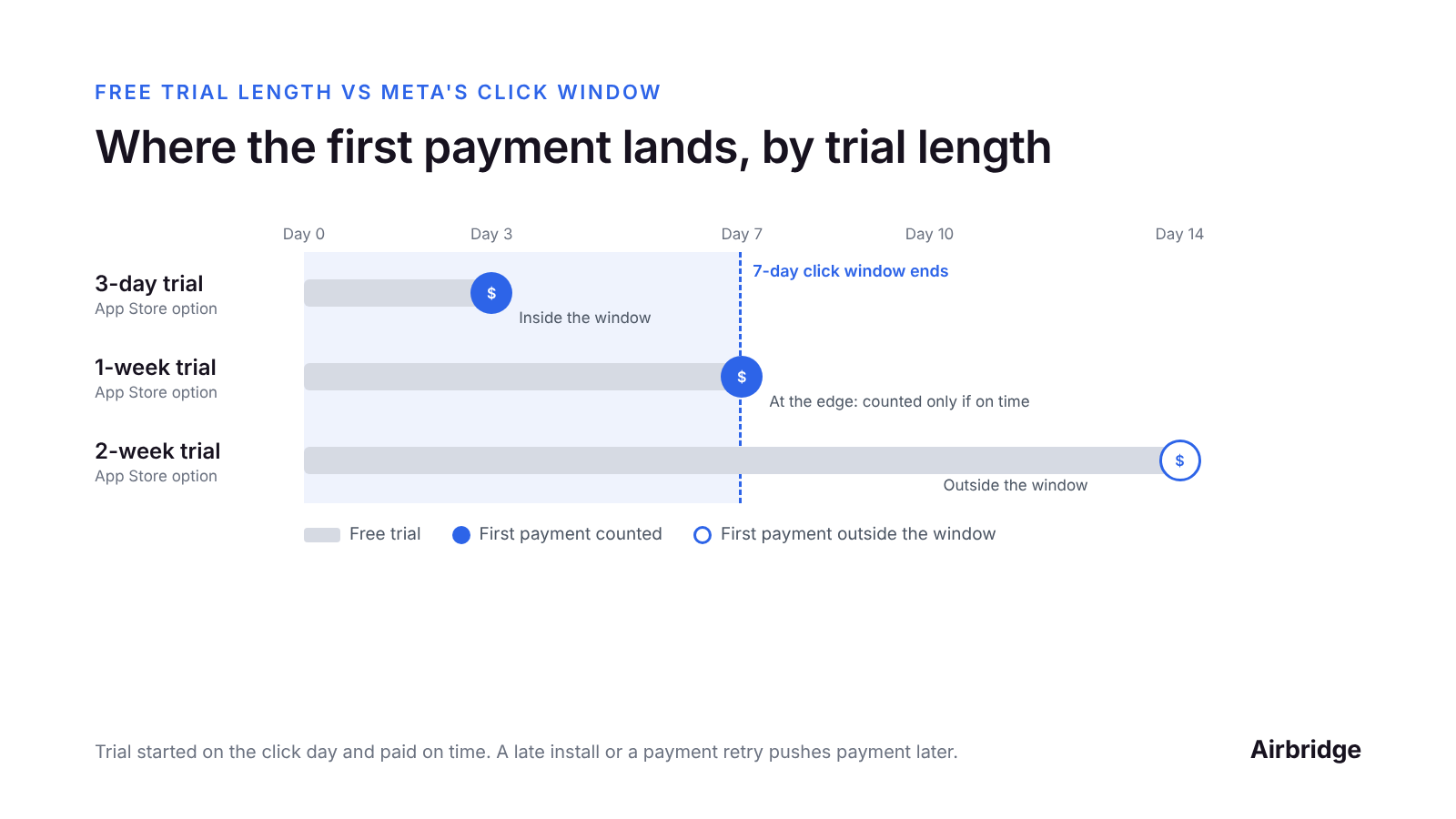
With a trial started on the click day and paid on time, only the 3-day trial pays comfortably inside Meta's 7-day click window.
| Trial length | When the first payment lands | Inside Meta's 7-day click window? | What else changes |
|---|---|---|---|
| 3 days | Day 3, or later after a retry | Usually yes | Less time to reach the "aha" moment; the trial-to-paid rate may change |
| 1 week | Day 7, or later | Only when the trial starts on the click day and the payment goes through on time | The common default |
| 2 weeks | Day 14, or later | No | Meta never sees the first payment as a click-through conversion |
A shorter trial makes Meta's purchase count more complete, but the number that matters is how many people pay, and that depends on whether the trial gives them enough time to see value. A longer trial gives people more time, but Meta will never see those payments inside its window.
What should you do instead?
-
Keep the trial length your product needs. Test trial length as a pricing experiment, judged on trial-to-paid and revenue per install, not on what Ads Manager shows.
-
Optimize Meta for the trial start. It happens minutes after the click, well inside the window, and often enough for Meta to learn (why trial starts beat installs).
-
Keep sending purchases to Meta anyway. They still help reporting and, later, value-based optimization. Make sure each one is sent once (sending trial starts from RevenueCat to Meta).
-
Read payments by trial cohort. Group users by the week their trial started and follow each group to its first payment and first renewal in your subscription data.
-
Estimate each campaign's revenue yourself: trials from the campaign × your trial-to-paid rate × first payment, compared with spend.
Common questions
Can I set a 6-day or 8-day free trial on the App Store?
No. App Store Connect offers free trials of 3 days, 1 or 2 weeks, 1, 2, 3 or 6 months, or 1 year. Google Play allows free trial phases from 3 days to 3 years.
Does a 3-day trial get more purchases counted in Meta?
Usually, because the first payment lands inside the 7-day click window. Whether it brings more paying subscribers is a separate question that only a test on trial-to-paid can answer.
Will a 14-day trial hurt my Meta campaigns?
It means Meta won't see first payments as click-through conversions. If you optimize for the trial start, Meta still has a timely signal to learn from, and you read payments in your own data.
Does an odd trial length reduce trial starts?
We haven't seen public data that answers this. On iOS the question is moot because trial lengths are fixed. On Android, if you test it, compare trial starts per install and trial-to-paid against your current length.
The bottom line
Meta's 7-day click window and a 7-day trial line up badly, but the trial length is not the thing to fix. Choose the trial your product needs, optimize Meta for the trial start, and read payments by cohort in your own subscription data.
Airbridge ties trials, first payments and renewals from RevenueCat, Adapty or Superwall to the campaign that drove each install, so a payment on day 9 or day 15 still lands on the right campaign. The Core Plan is built for subscription apps: try it free for 30 days, then from $40 per month.

Ready to transform your mobile growth?
Learn how Airbridge helps leading brands measure and optimize every touchpoint.
“Airbridge understands the essence of what it has to offer as an MMP. Its objective, transparent, and accurate performance analysis allows marketers to realize the true impact of their efforts.”