Sending Trial Starts From RevenueCat to Meta: A Setup Checklist

On this page
Why does Meta show fewer trial starts than RevenueCat?
Usually because some trial starts were never sent, some were sent but haven't appeared yet, and some arrived but couldn't be matched to an ad. RevenueCat sends trial starts to Meta server-to-server as StartTrial, but only for customers with the identifiers Meta needs, and on iOS only for users who allowed tracking unless you change a setting. Work through the six checks below in order.
Tools that do this
-
Free: RevenueCat's Meta Ads integration plus the Meta SDK; Events Manager to confirm what arrives.
-
The same trial event sent to every network, tied to each campaign: an MMP. Airbridge Core connects RevenueCat, Adapty or Superwall, ties trials and renewals to the campaigns that drove them, and sends conversions back to Meta, Google, Apple Ads and TikTok. Try it free for 30 days, then from $40 per month.
A typical week looks like this (illustrative): RevenueCat shows 40 trial starts, Meta Ads Manager shows 3. Both tools are working. They just aren't counting the same thing yet.
How do trial starts reach Meta?
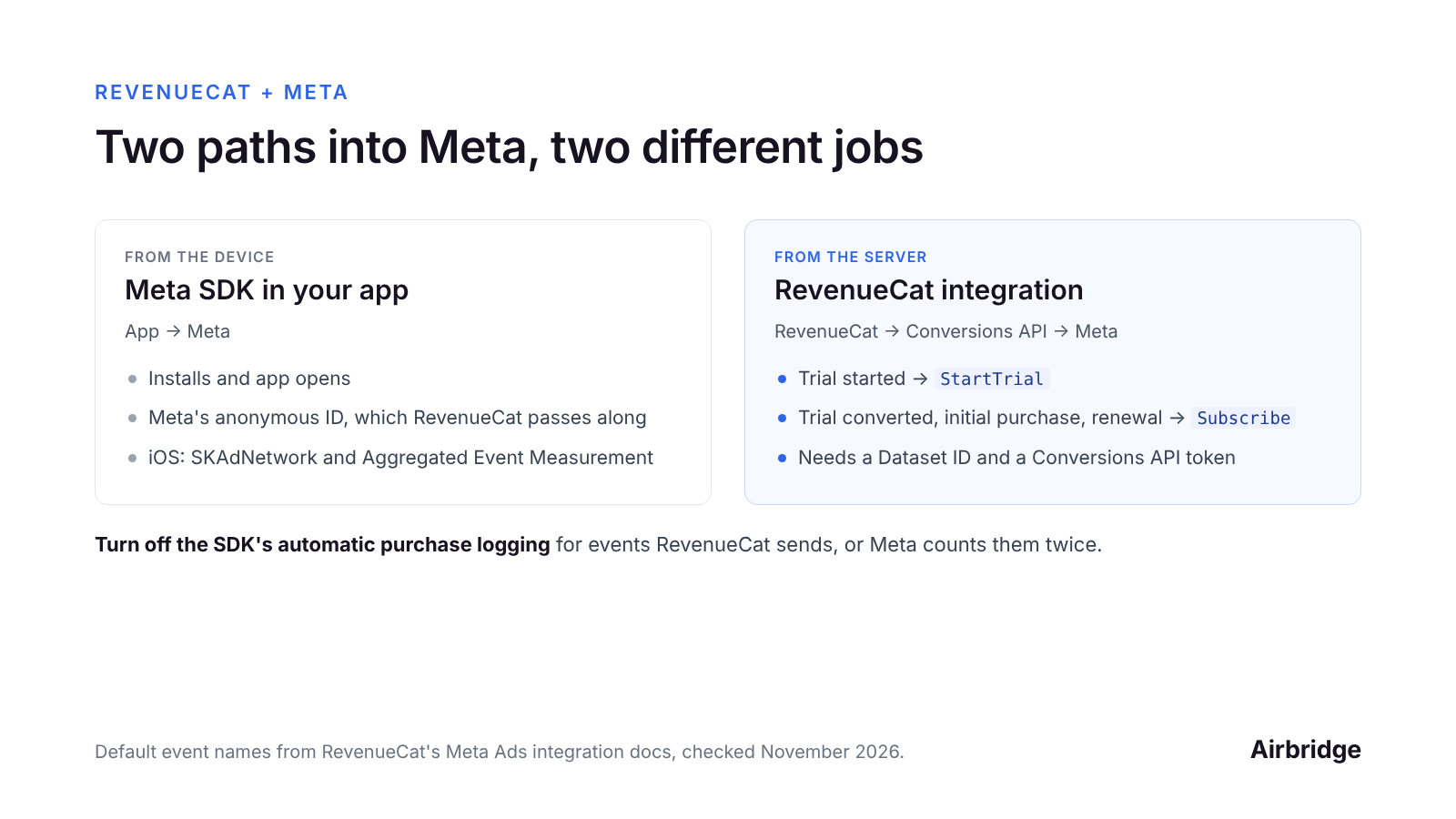
The Meta SDK and RevenueCat each send different events to Meta. Source: RevenueCat Meta Ads integration docs.
-
The Meta SDK in your app handles installs, app opens and on-device iOS measurement through SKAdNetwork and Aggregated Event Measurement.
-
RevenueCat sends subscription events server-to-server. The recommended path is Meta's Conversions API, which needs a Dataset ID and a Conversions API access token from Events Manager.
By default, RevenueCat sends Trial started as StartTrial, and Trial converted, Initial purchase and Renewal as Subscribe (RevenueCat docs). So the trial start and the payment that follows are two Meta events, sent days apart.
Want to see how Revenuecat meta trial start works with your data?
Get hands-on with Airbridge and see real results.
Try It Free →How do you find the missing trial starts?
1. Did RevenueCat send the event?
Open a customer who started a trial and check their Customer History for a Meta Ads delivery row on the trial event. The request and response show what was sent and what Meta answered.
-
No delivery row: go to step 2.
-
An error: go to step 3.
-
Delivered: go to step 4.
2. Does the customer have the identifiers Meta needs?
RevenueCat only sends an event when the customer has the required attributes:
-
App Store, through the Conversions API: $fbAnonId or $idfa, plus an ATT consent status of authorized, unless you turn on "Send events when ATT consent is not authorized" in the integration settings.
-
Google Play: $fbAnonId or $gpsAdId.
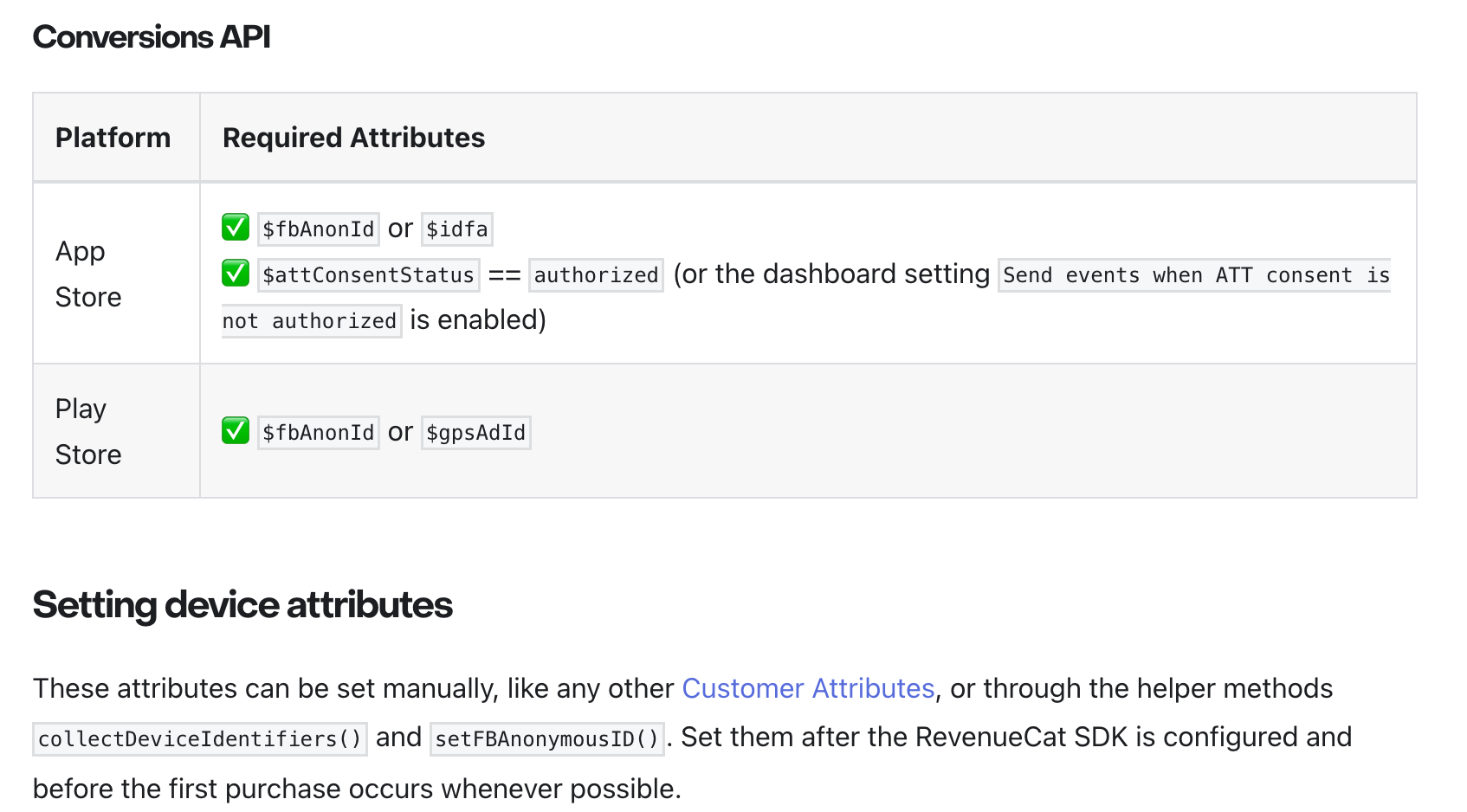
Required attributes for sending events to Meta through the Conversions API. Source: RevenueCat docs, November 2026.
If they're empty, the app isn't collecting them. Call collectDeviceIdentifiers() right after configuring RevenueCat, pass Meta's anonymous ID with setFBAnonymousID, and call collectDeviceIdentifiers() again after the user allows tracking.
On iOS, many people decline the tracking prompt. With the default setting, their App Store events aren't sent through the Conversions API, which alone can explain a large gap. Whether to turn on "Send events when ATT consent is not authorized" is a privacy decision: talk to whoever owns privacy on your team and read Apple's and Meta's rules first.
3. Is the integration pointed at the right dataset?
-
The dataset is linked to your app. Meta requires a linked app before it accepts app events.
-
The token belongs to that dataset.
-
Sandbox vs. production. If you set a sandbox Dataset ID and token, sandbox purchases go there, not to production.
Test with a sandbox purchase from a brand-new customer, then check that customer's attributes and history.
4. Meta accepted the event. Why isn't it in the campaign?
Delivery means Meta received the event; Meta still has to match it to a person and credit it to an ad.
-
Give it time. RevenueCat's docs note that Events Manager can take up to 24 hours to show accepted events.
-
Compare Events Manager with Ads Manager. If StartTrial is in the dataset but not in campaign results, the setup works; what's left is matching and attribution on Meta's side.
-
iOS campaigns measure on the device. SKAdNetwork and AEM rely on the Meta SDK in your app. If your app updates SKAdNetwork conversion values, use one tool to do it. We cover the device side in fixing "conversion data is missing or partial" on Meta.
5. Are purchases counted twice?
If Meta shows more purchases than RevenueCat, the Meta SDK may be logging purchases automatically while RevenueCat also sends Subscribe. RevenueCat's docs say to turn off Meta SDK purchase or revenue tracking for the events RevenueCat sends. In Swift, Settings.shared.isAutoLogAppEventsEnabled = false turns off automatic logging; then call AppEvents.shared.activateApp() so app activations are still logged.
6. Are you judging before the money exists?
StartTrial arrives at the start of the trial; Subscribe arrives only when the trial converts. With a 7-day trial, that's about a week after the click, right where Meta's default 7-day click window ends. If you optimize for Subscribe and judge after three days, there's little to judge. Many small apps optimize for StartTrial and read trial-to-paid in their subscription data (should you change your trial length?).
Copy-paste checklist
[ ] Customer History shows a Meta Ads delivery row for the trial event
[ ] Customer has $fbAnonId (setFBAnonymousID is called) and/or $idfa / $gpsAdId
[ ] collectDeviceIdentifiers() runs after configure AND after tracking is allowed
[ ] Team has decided on "Send events when ATT consent is not authorized"
[ ] Dataset is linked to the app; production and sandbox IDs and tokens are right
[ ] Waited 24 hours before judging Events Manager
[ ] iOS: SKAdNetwork / AEM set up with the Meta SDK; one tool updates conversion values
[ ] Meta SDK automatic purchase logging is off for events RevenueCat sends
[ ] Campaign optimizes for an event that arrives in time (StartTrial vs Subscribe)
Common questions
Does RevenueCat send trial starts to Meta?
Yes. By default, RevenueCat sends a trial start to Meta as StartTrial, server-to-server, when the customer has the required identifiers.
Why does Meta show fewer trials than RevenueCat?
Some events weren't sent (missing identifiers, or iOS users who didn't allow tracking with the default setting), some haven't appeared yet (up to 24 hours), and some arrived but weren't attributed to an ad.
Why does Meta show more purchases than RevenueCat?
Usually double counting: the Meta SDK logs the purchase automatically while RevenueCat sends Subscribe for the same purchase.
Do I still need the Meta SDK if RevenueCat sends events?
Yes. RevenueCat sends subscription events; the Meta SDK still handles installs, app opens, the anonymous ID RevenueCat passes along, and on-device iOS measurement.
The bottom line
Most "Meta shows fewer trials" cases come down to identifiers, the iOS tracking setting, the dataset, or timing. Set up both paths, decide the ATT setting on purpose, and optimize for the event that arrives in time.
When you run more than Meta, Airbridge sends the same trial and purchase events to every network and ties each one, plus renewals from RevenueCat, Adapty or Superwall, to the campaign that drove it. The Core Plan is built for subscription apps: try it free for 30 days, then from $40 per month.

Ready to transform your mobile growth?
Learn how Airbridge helps leading brands measure and optimize every touchpoint.
“While working with Airbridge, we have learned that MMM is a crucial attribution model for post-privacy era marketing to predict future performance and optimize the budget.”