Why Most of Your Subscribers Show "No Source" (and How to Shrink Unattributed)

On this page
Why do most of my app purchases have no attribution source?
When most of your paying subscribers show no source, it's rarely one bug. "No source" (often called unattributed or organic) mixes real organic users with paid and creator users who lost their source somewhere between the click and the purchase: links that skip tracking, iOS users who are measured only in aggregate, an Apple Ads token your app never requests, or a source that never reaches your subscription platform. You can't get unattributed to zero, but you can usually find the one or two causes behind most of it and fix those first.
Tools that do this
-
Free checks: App Store Connect's source types, Play Console's acquisition reports, your subscription platform's attribution fields, and Apple's AdServices attribution token.
-
One source per subscriber across channels: a mobile measurement partner (MMP). Airbridge Core attaches a source at install and connects trials and payments from your subscription platform, such as RevenueCat or Adapty. Try it free, then from $40 per month.
One founder put the problem in one line after looking closely at their data: "382 of my 528 first purchases since July have no source attached, so I couldn't credit users to channels." That's 72% of paying users with no channel. When you can't credit them, every channel looks weaker than it is, and the one you cut may be the one that's working.
Is "no source" the same as organic?
Not quite. Organic means someone found your app without a paid or tracked touch: App Store search, browse, word of mouth. Unattributed means your tools don't know where the user came from. The unattributed bucket always holds some real organic users, plus users from ads, creators or posts whose source got lost. Airbridge, for example, calls this group the Unattributed channel, which other tools call Organic. The goal is to move lost sources out of the bucket, not to make it empty.
Want to see how Unattributed app subscribers works with your data?
Get hands-on with Airbridge and see real results.
Try It Free →What are the usual causes of "no source"?
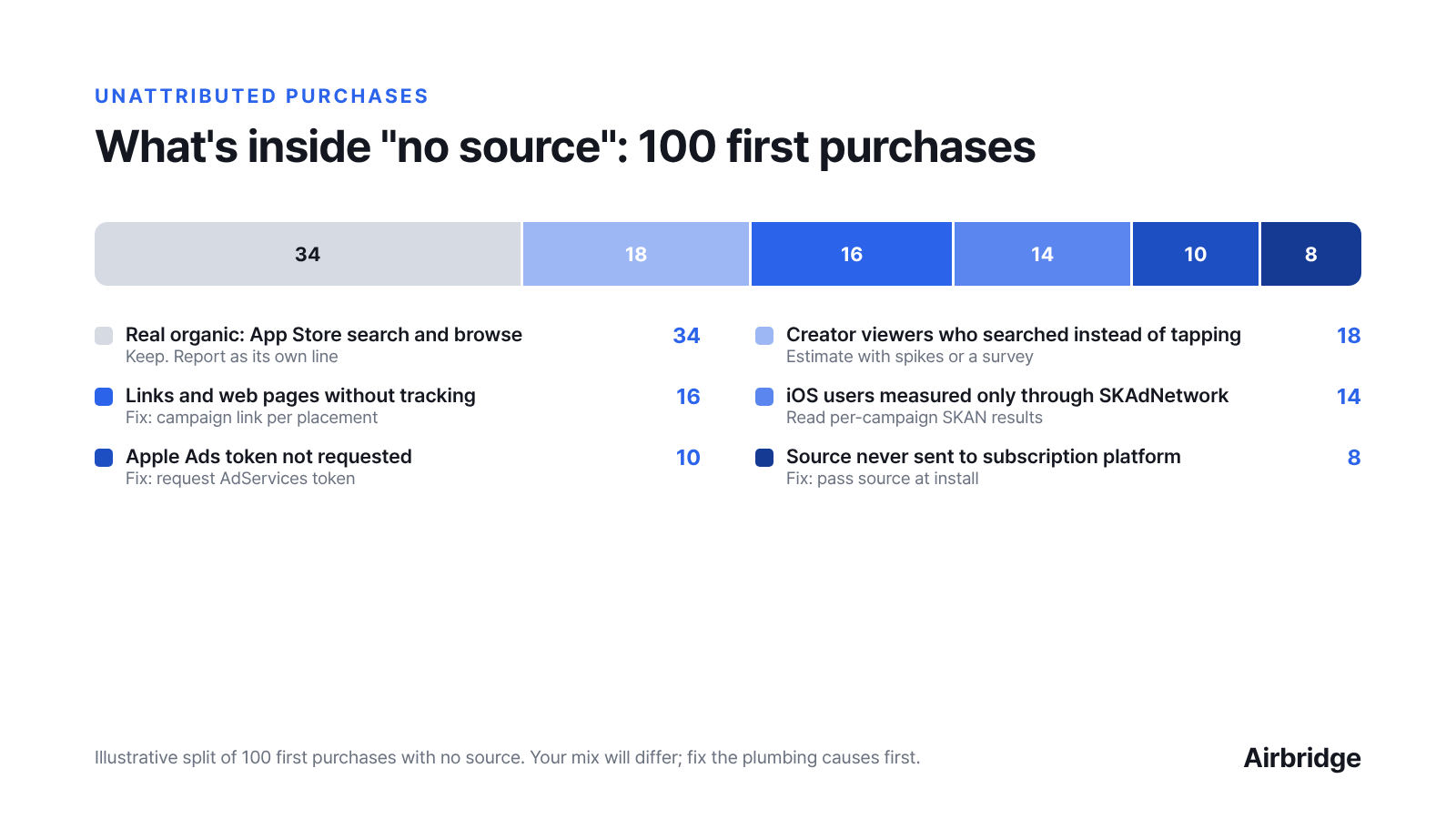
Illustrative example: "no source" usually mixes real organic users with paid and creator users whose source was lost.
| # | Cause | How to check | Fix |
|---|---|---|---|
| 1 | Real organic search and browse | App Store Connect shows App Store search and browse as source types | None needed. Report it as its own line |
| 2 | Viewers search instead of tapping | App Store search rises on the day a creator posts | Estimate with spikes or a "how did you hear about us?" question |
| 3 | Links go straight to the store with no tags | Check the links in bios, posts and your website | Give every placement its own campaign link |
| 4 | Web pages drop the parameters | Tap your landing page button and look at the store URL | Pass campaign parameters through to the store link |
| 5 | iOS users measured only in aggregate | Share of iOS users who didn't allow tracking | Read SKAdNetwork results per campaign, not per user |
| 6 | Apple Ads token not requested | Apple Ads downloads show up as organic | Request the AdServices token on first launch |
| 7 | Android referrer not read | Android installs from UTM links still show no source | Read the Play Install Referrer on first launch |
| 8 | Source never reaches your subscription platform | Attribution fields are empty in your subscription dashboard | Send the source to your subscription platform at install |
1–2. Real organic and "search instead of tap"
App Store Connect groups downloads by source type: App Store search, App Store browse, app referrer, web referrer and campaigns. A jump in App Store search on the day a creator posts is often their audience, not organic demand. We cover ways to estimate it in creator attribution when viewers search the App Store.
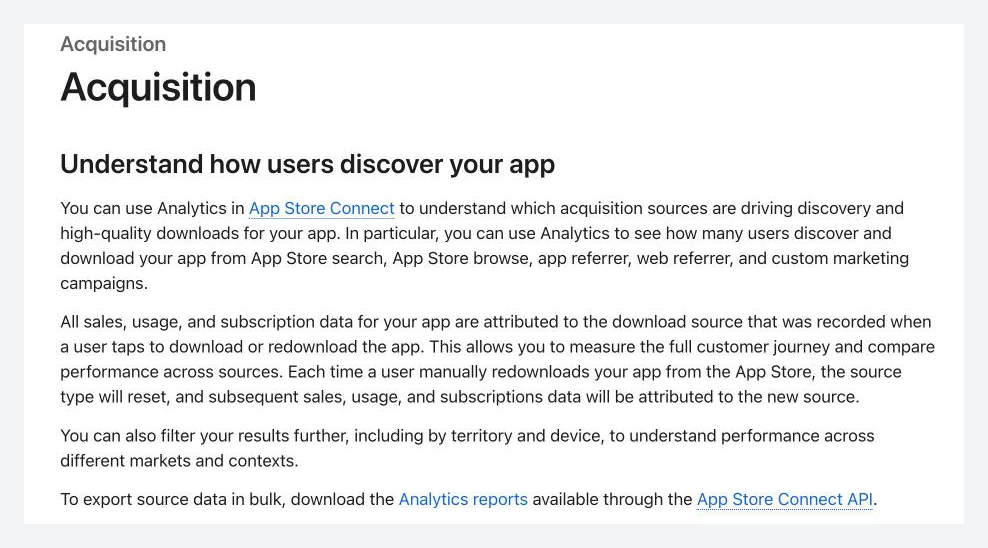
App Store Connect attributes downloads, sales and subscriptions to the source recorded at download. Source: App Store Connect Analytics Help, Apple Developer
3–4. Links without tracking
A link-in-bio that points straight at your App Store page carries no campaign, and neither does a landing page whose button links to the store without passing on the tags it received. Fixing this is free: give each placement its own campaign link. See how to track creators without an SDK. For Reddit, Indie Hackers and blog posts, see how to track community posts.
5. iOS users measured only in aggregate
When an iOS user doesn't allow tracking under App Tracking Transparency (ATT), ad networks measure them through SKAdNetwork (SKAN), which reports conversions per campaign without saying which user they were. At the user level these installs can show as organic, even though the campaign got credit in aggregate. Compare per-campaign SKAN totals with your user-level data before deciding a campaign "didn't work". Also check the order of events in your app: if the ATT prompt appears after your SDK has already sent the install event, the install can be recorded as unattributed even when the user allows tracking.
6. Apple Ads token not requested
Apple Ads attribution uses Apple's AdServices framework: your app requests a token on first launch and sends it to Apple's attribution API. If nobody requests the token, Apple Ads downloads land in organic. It's a common gap, covered in Apple Ads attribution vs organic.
7. Android referrer not read
On Android, the Play Install Referrer carries your UTM tags into the app, but only if the app reads it on first launch. If nothing reads it, the tags stay in Play Console's aggregate reports and never attach to the user.
8. Source never reaches your subscription platform
Your subscription platform knows who paid. It only knows where they came from if something sends it the source. If the attribution fields in your subscription dashboard are empty, the payment can't be tied to a channel, however good your links are. This gap is behind most ad platform vs subscription data mismatches.
How far can you shrink unattributed?
It depends on how much of your growth is truly organic. A simple way to set a target:
- Measure your baseline: the share of first purchases with no source this month.
- Fix causes 3, 4, 6, 7 and 8 first. They're plumbing, and once fixed they stay fixed.
- Re-measure after two weeks of normal spend.
- Treat what's left as organic plus "search instead of tap", and estimate that part with spikes or a survey.
If the unattributed share barely moves after the plumbing fixes, most of it is likely real organic. That's good news: people are finding your app.
FAQ
Why are most of my app installs showing as organic?
Usually because some installs lose their source: links without campaign tags, landing pages that drop parameters, an Apple Ads token your app never requests, or an Android install referrer nobody reads. Some of it is real organic search too. Check each cause before deciding your ads aren't working.
What's the difference between organic and unattributed?
Organic means the user found your app without a paid or tracked touch. Unattributed means your tools don't know where the user came from. Unattributed always includes some organic users, plus users whose source was lost.
Why does my subscription platform show no attribution source?
Your subscription platform only shows a source if something sends it one, usually your app at install or an attribution tool. If those fields are empty, nothing is passing the source along.
Can unattributed ever be zero?
No. Some people will always find your app by searching or hearing about it from a friend. The aim is to move paid and creator users out of the unattributed bucket, then estimate the rest.
The bottom line
"No source" is a mix, not a mystery. Separate real organic from lost sources, fix the plumbing first (untagged links, dropped parameters, the ATT prompt order, the Apple Ads token, the Android referrer, the hand-off to your subscription platform), and re-measure after two weeks.
If you'd like one source per subscriber across Meta, Google, Apple Ads, TikTok and creators, try the Airbridge Core Plan free, then from $40 per month.
Ready to transform your mobile growth?
Learn how Airbridge helps leading brands measure and optimize every touchpoint.
“Braze is a powerful tool on its own, but when paired with Airbridge, it creates synergies for retargeting campaigns, saving resources and enhancing performance.”