Why Your Ad Platform and Subscription Dashboard Never Match (and How to Reconcile Them)

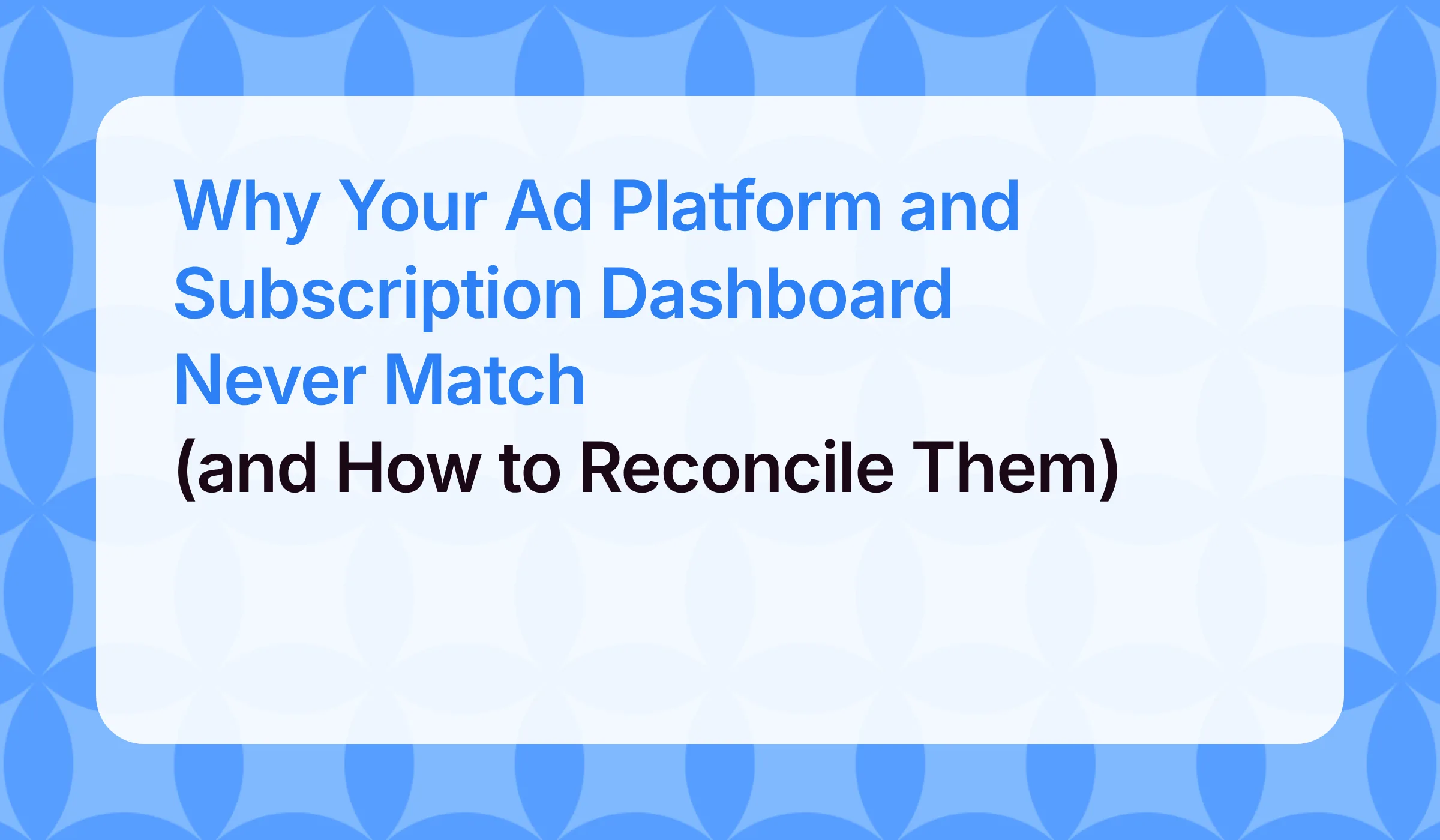
Ad platform vs. subscription dashboard: why the numbers never match
You check your ad dashboard: 80 trial starts this week. You check your subscription dashboard: 55. Finance checks store payouts: different again. Many teams we talk to see the same gap and wonder which number to trust.
This is normal. Each tool is built to answer a different question, so each counts conversions differently.
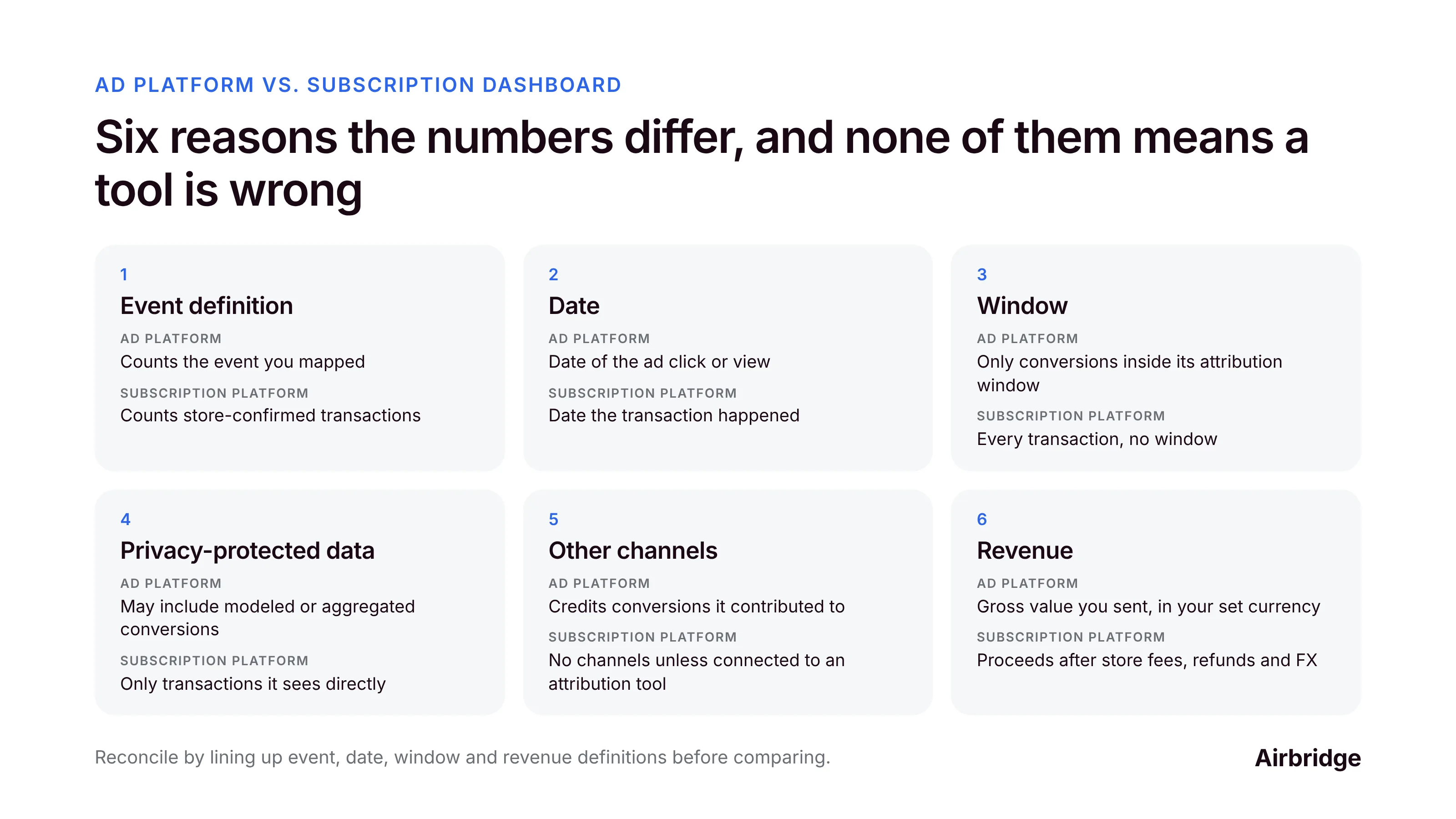
Six reasons the numbers differ
| Reason | Ad platform usually... | Subscription platform usually... |
|---|---|---|
| 1. Event definition | Counts the event you mapped, e.g. a trial start fired by your app | Counts store transactions, e.g. a trial that the store confirmed |
| 2. Date | Credits the conversion to the date of the ad click or view | Records the date the transaction happened |
| 3. Window | Counts conversions within its attribution window after a click or view | Has no attribution window; counts every transaction |
| 4. Privacy-protected data | May include modeled or aggregated conversions where user-level data isn't available | Counts only transactions it can see directly |
| 5. Other channels | Credits conversions it contributed to, even if another channel also did | Doesn't assign channels unless connected to an attribution tool |
| 6. Revenue | May show gross value you sent, in the currency you set | Shows proceeds after store fees, refunds and currency conversion |
1. Event definition
Check exactly which event each tool counts. A trial start sent from your app the moment someone taps "Start trial" can fire before the store confirms it, or fire twice. Your subscription platform only counts the confirmed transaction.
2. Date
Ad platforms usually credit a conversion to the day of the ad interaction. If someone clicks on Monday and starts a trial on Wednesday, the ad dashboard may show it on Monday, while your subscription dashboard shows it on Wednesday. Weekly totals shift between weeks.
3. Attribution window
Each platform counts conversions within its own window after a click or view. Change the window and the count changes. A subscription dashboard has no window: it counts every transaction, whatever brought the user.
4. Privacy-protected data
When user-level data isn't available, for example on iOS for people who don't allow tracking, ad platforms use privacy-preserving methods such as aggregated or modeled reporting. Those numbers are designed for campaign optimization and trend reading, so they won't line up user by user with transactions.
5. Several channels claim the same user
A person might see a Meta ad, then a TikTok video, then search Apple Ads. Each platform may report that conversion in its own dashboard. Add up all your ad dashboards and you can easily count more conversions than your subscription platform has.
6. Revenue values
Ad platforms show the value you sent with the event. Your subscription platform shows proceeds after store fees, refunds and currency conversion. The two will differ even when the event counts match.
Want to see how Ad platform conversions don't match works with your data?
Get hands-on with Airbridge and see real results.
Try It Free →How to reconcile them
-
Pick a source of truth for each question. Revenue and subscriber counts come from your subscription platform. "Which channel brought them" comes from one combined attribution view across channels. Each ad platform's own dashboard is best for optimizing inside that platform.
-
Align the event. Make sure the trial start you send to ad platforms fires once per person, when the trial really begins.
-
Align dates and windows. Compare the same date basis and the same attribution window, or compare by cohort (users acquired in week X) instead of by calendar day.
-
Compare ratios, not raw counts. Track the ratio between the ad platform's trial count and your confirmed trials over time. A stable ratio means things are working. A sudden change means something broke, such as an event firing twice.
-
Deduplicate across channels. Use one attribution tool that assigns each user to one source, so channels don't double-count.
In summary
-
Ad platforms count conversions to optimize and report on their own campaigns. Subscription platforms count transactions to report revenue.
-
They differ in what counts as a conversion, which date it's counted on, which window applies, how privacy-protected data is handled, and whether other channels also claim the same user.
-
Don't look for one right number. Pick a source of truth for each question, align dates and windows, and compare ratios instead of raw counts.
Questions we hear about mismatched numbers
Why are my ad platform conversions higher than my subscription dashboard?
Usually because of attribution windows, conversions credited to the ad click date, modeled or aggregated conversions, events firing before the store confirms them, and several channels claiming the same user.
Which number should I trust?
Use your subscription platform for revenue and subscriber counts, a combined attribution view to compare channels, and each ad platform's dashboard to optimize campaigns inside that platform.
How big a difference is normal?
It depends on your setup, platforms and share of privacy-protected traffic. What matters more is whether the gap is stable over time. A sudden jump usually points to a tracking change or an event firing twice.
How do I stop the same conversion being counted by several platforms?
Add them up only in a tool that assigns each user to one source. Each ad platform will still show its own view, which is fine for optimizing inside that platform.
Should ad platforms and my subscription platform get the same events?
They should get the same definition of the event, sent once per person. That keeps optimization and reporting consistent, even if totals still differ.
What to do next
Your ad dashboards and subscription dashboard aren't arguing. They're answering different questions. Decide which tool answers which question, align events, dates and windows, and watch the ratio between them instead of chasing one perfect number.
Airbridge gives you one combined view across your ad channels and connects trials, renewals and refunds from RevenueCat, Adapty or Superwall, so each subscriber is credited to one source. The Core Plan is built for subscription apps, and you can try it free for 30 days, then from $40 per month.


Ready to transform your mobile growth?
Learn how Airbridge helps leading brands measure and optimize every touchpoint.