Best Google UAC Attribution for News App
On this page
A news app that runs Google App campaigns (formerly UAC) needs attribution that counts both subscription revenue and ad revenue, and that stays affordable when readers open the app every day. Look at how each tool handles frequent opens, lapsed readers, and spikes you did not pay for. Airbridge makes one of the tools compared, and its data point billing is a real cost question for this app type.
What news apps need from Google App campaigns
News apps do not behave like most subscription apps. Four differences shape your measurement.
Two kinds of revenue. Many news apps show ads to free readers and sell subscriptions to loyal ones. A reader who never pays can still earn you money. If you judge Google App campaigns on subscriptions alone, you undercount that reader. If you judge on installs alone, you miss who pays.
A registration wall in the middle. Publishers often ask a reader to create a free account after a few stories, then offer a trial later. Sign Up is the step between a casual reader and a paying one. It happens more often than a subscription, which makes it a useful signal to watch.
The news itself moves your numbers. An election, a storm, or a big match can lift installs with no change in your spend. Google App campaigns are automated. You supply assets and a goal, and Google chooses placements across its surfaces. So when installs jump, ask whether the campaign improved or the news cycle did.
Very high frequency. A loyal reader may open the app several times a day after push alerts. That is good for the business. It also means your app sends many more events than a weekly-use app with the same audience, which matters under some billing models.
Lapsed readers matter too. News habits fade between big stories, so winning back a past reader can cost less than finding a new one.
What the data shows
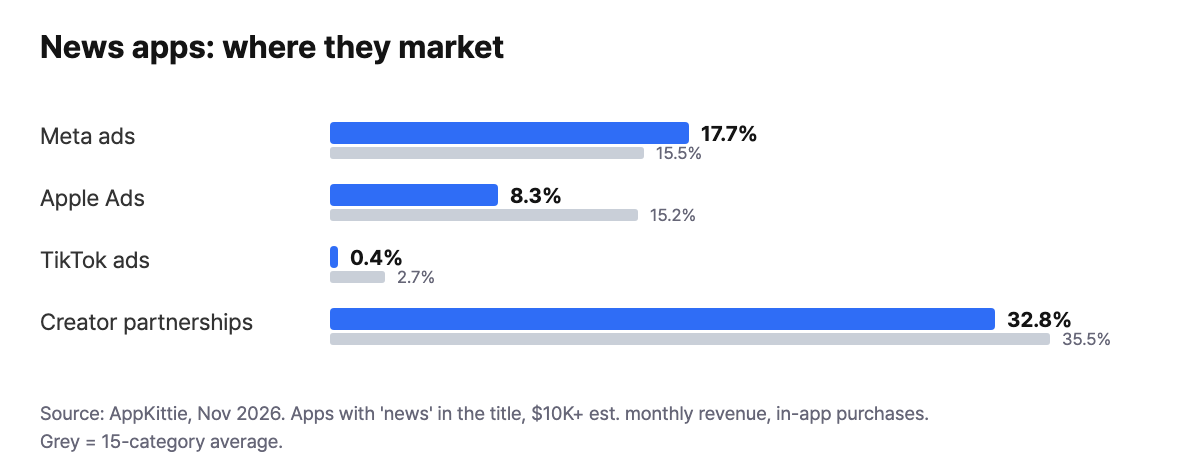
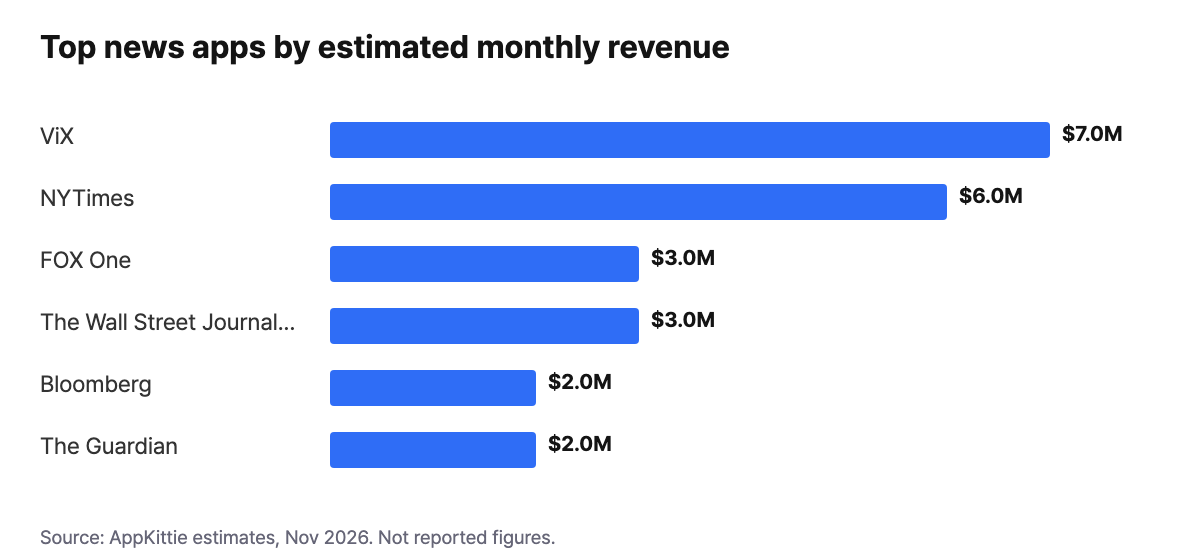
We matched 265 apps with "news" in the title, $10K+ estimated monthly revenue, and in-app purchases, using AppKittie data from November 2026. This data has no Google signal, so it cannot say how many of these apps run Google App campaigns; it shows Meta at 17.7%, Apple Ads at 8.3%, TikTok at 0.4%, and creator partnerships at 32.8%. Revenue figures are estimates, the in-app purchase filter leaves out ad-only apps, and the title match adds streaming products such as ViX ($7M) and FOX One ($3M) beside publishers like NYTimes ($6M).
How to choose
| Criterion | The question for a news app | The tradeoff |
|---|---|---|
| Revenue view | Can I see ad revenue and subscription revenue? | Subscription-only tools undervalue free readers |
| Billing unit | What happens to my bill when readers open daily? | Data point billing follows engagement, per-conversion billing follows acquisition |
| Spike reading | Can I look at conversions with no clear source? | Fewer unknowns help you judge a news-driven surge |
| Win-back | Does the tool credit a returning reader? | Without it, a returning reader looks like organic use |
| Campaign depth | How deep does Google data go? | Campaign name and ID always show, creative names do not |
Do the billing math first. For most apps it is a side issue. For a daily news app it can decide the choice.
Want to see how Best google uac attribution for news apps works with your data?
Get hands-on with Airbridge and see real results.
Try It Free →Tools compared
| Airbridge Core | AppsFlyer | Adjust | Branch | Singular | Kochava | |
|---|---|---|---|---|---|---|
| Starting price | $40+/mo | Zero plan free (12,000 conversions in first 12 months); Growth $0.07 per conversion | Check vendor pricing page | Not listed on pricing page | Free plan (15,000 paid conversions); Growth $0.05 per conversion | Free App Analytics (10K conversions/month); Foundation from $500/mo |
| Self-serve signup | Yes | Yes | Check vendor pricing page | Yes on Basics | Yes on Free | Yes |
| Billing model | Data points | Per conversion | Check vendor pricing page | Not stated on pricing page | Per conversion | Conversions or MAU, by plan |
| Free trial | 30 days | Free Zero plan instead | Check vendor pricing page | Yes, on Basics | Free plan instead | Yes, on paid plans |
| RevenueCat integration | Yes | Yes | Yes | Yes | Yes | Yes |
Competitor details come from each vendor's public pages as of November 2026. AppsFlyer says its Zero plan is not suitable for apps with paid activities.
- Airbridge Core may suit a small news app with moderate daily use. A heavy-open app should estimate its data points first.
- AppsFlyer may suit a publisher whose readers open often but convert rarely, since billing is per conversion.
- Adjust may suit a publisher that can request current terms, as the table has no price to weigh.
- Branch may suit a team that wants a self-serve look on Basics before it talks price.
- Singular may suit a similar high-open app at a lower Growth rate of $0.05 per conversion.
- Kochava may suit a large publisher that wants to choose conversion or MAU billing by plan.
How to set this up in Airbridge
- Start the trial. It needs no card and has no usage limit, so you can measure your real event volume before you pay.
- Install the SDK, which takes about 5 minutes for a basic install, and connect Google Ads. Core covers app campaigns and web campaigns on Google Ads. Register your Link ID so events reach Google through postbacks.
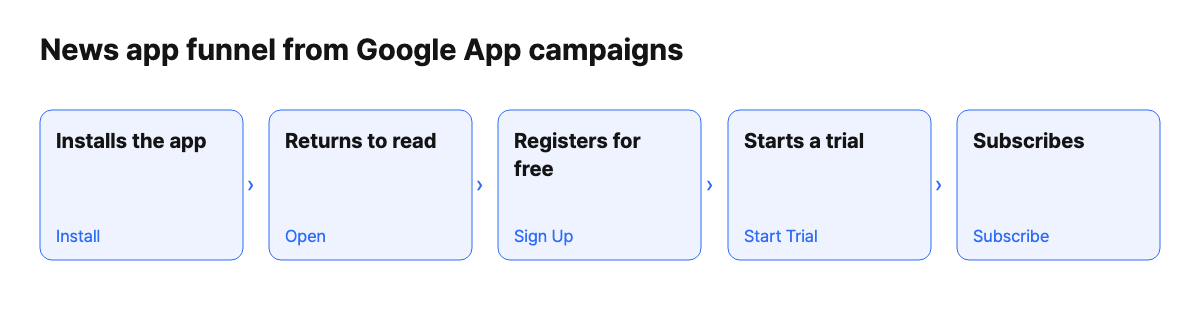
- Track standard events: Install, Open, Sign Up, Start Trial, and Subscribe. Core does not take custom events, so "read three articles" cannot be an event.
- Connect your ad mediation for ad revenue and your subscription tool for subscription revenue.
- Check the Funnel Report, and use Unattributed Conversion Analysis during news spikes. The funnel guide has the basics.
What Airbridge Core does not do here
- Reporting stops above the creative. Campaign name and ID always show, so you can check whether a spike lines up with a campaign. Ad group names appear only for ACi, ACe, and ACpre (Google's install, engagement, and pre-registration campaign types), and creative names are not provided. Google cost data reaches campaign or ad group level, and Performance Max stays at campaign level.
- No organic referrer attribution or web event measurement. Both are on Growth. Core's Web SDK is web-to-app only. A publisher with a large website audience, or one that needs to know which search engine or referrer sent a reader, should pick Growth or another tool.
- No paywall or article events. Core has no standard event for a paywall view or a story read. You see Sign Up and Start Trial, not the metered screen before them.
- Costs rise with opens. Every app open is an event, and there is no spending cap. Core also includes 2 third-party integrations. A very large daily audience may fit a contract better than Core.
FAQ
Should a news app optimize for installs, sign ups, or subscriptions?
Each choice has a cost. Installs give Google plenty of signal but say little about value. Subscriptions show value but happen rarely, and a thin signal is hard for an automated campaign to learn from. Sign Up sits between them, so many news apps may find it a sensible middle step to test.
Do push-driven opens count as data points?
Yes. An app open counts as one event, whatever caused it. Core includes 500K data points a month, then charges $0.0001 for each extra one. That comes to $100 for each extra million. Clicks and impressions on tracking links do not count.
Can I win back lapsed readers and measure it?
Yes. Core includes retargeting and re-engagement attribution, so a returning reader from a paid campaign does not simply look organic. Reactivation attribution needs activation through a CSM, and Core has no dedicated CSM, so do not count on it. For the setup path, read how to start without a sales call.


Ready to transform your mobile growth?
Learn how Airbridge helps leading brands measure and optimize every touchpoint.
“While working with Airbridge, we have learned that MMM is a crucial attribution model for post-privacy era marketing to predict future performance and optimize the budget.”