The January Spike: How Health and Fitness Subscription Apps Should Read New Year Installs

On this page
How should a fitness app plan ads for New Year and read January results?
For many health and fitness subscription apps, early January brings the biggest wave of installs and trials of the year. The opportunity is real, but January users behave differently: more people try, and more of them may stop by February. Set up tracking per channel and per creator in December, judge January on cost per paying subscriber rather than cost per install, and compare January cohorts with each other over 30 to 90 days before deciding what worked. Don't compare January's day-7 numbers with December's and cut the channel that looks worse.
Tools that do this
-
Free: App Store Connect campaign links and Google Play UTM tags per channel and creator, your subscription platform's cohort charts, and a cost-per-paying-subscriber sheet.
-
Cohorts by channel and creator, with spend: a mobile measurement partner (MMP). Airbridge Core ties trials and payments from your subscription platform, such as RevenueCat or Adapty, to the campaign that brought each user. Try it free, then from $40 per month.
The pattern is familiar to anyone who runs a workout, diet, sleep or habit app. Interest jumps around January 1, ad auctions shift as holiday retail spend fades, and creators post their own "new year, new routine" content. The risk is reading all of that through the same lens you use in March.
What usually changes in January?
| What | Typical direction | Why it matters |
|---|---|---|
| Interest in health and fitness apps | Up in the first weeks | More organic and paid installs at the same time |
| Ad costs | Often lower in early January than in late Q4 | Cheaper reach, but more fitness advertisers competing |
| Trial starts | Up | More people try; intent varies more |
| Trial-to-paid and early retention | Can dip | Some resolution-driven users stop early |
| Annual plan share | Can rise | "Commit for the year" fits the moment |
Typical patterns, not guarantees. Check your own data from last January.
What should you set up in December?
- A tracking link per channel and per creator, live before January 1. See how to track creators without an SDK.
- Your optimization event checked: trial starts, or a better trial signal, not installs. See optimize for trial starts, not installs.
- Creative submitted early, so ad reviews over the holidays don't hold you up.
- A January offer decided, such as a discounted annual plan, and tested on a small audience in December.
- Last January's cohorts pulled, if you have them, so you know your own curve.
- A weekly budget plan, with a rule for when to scale up (below).
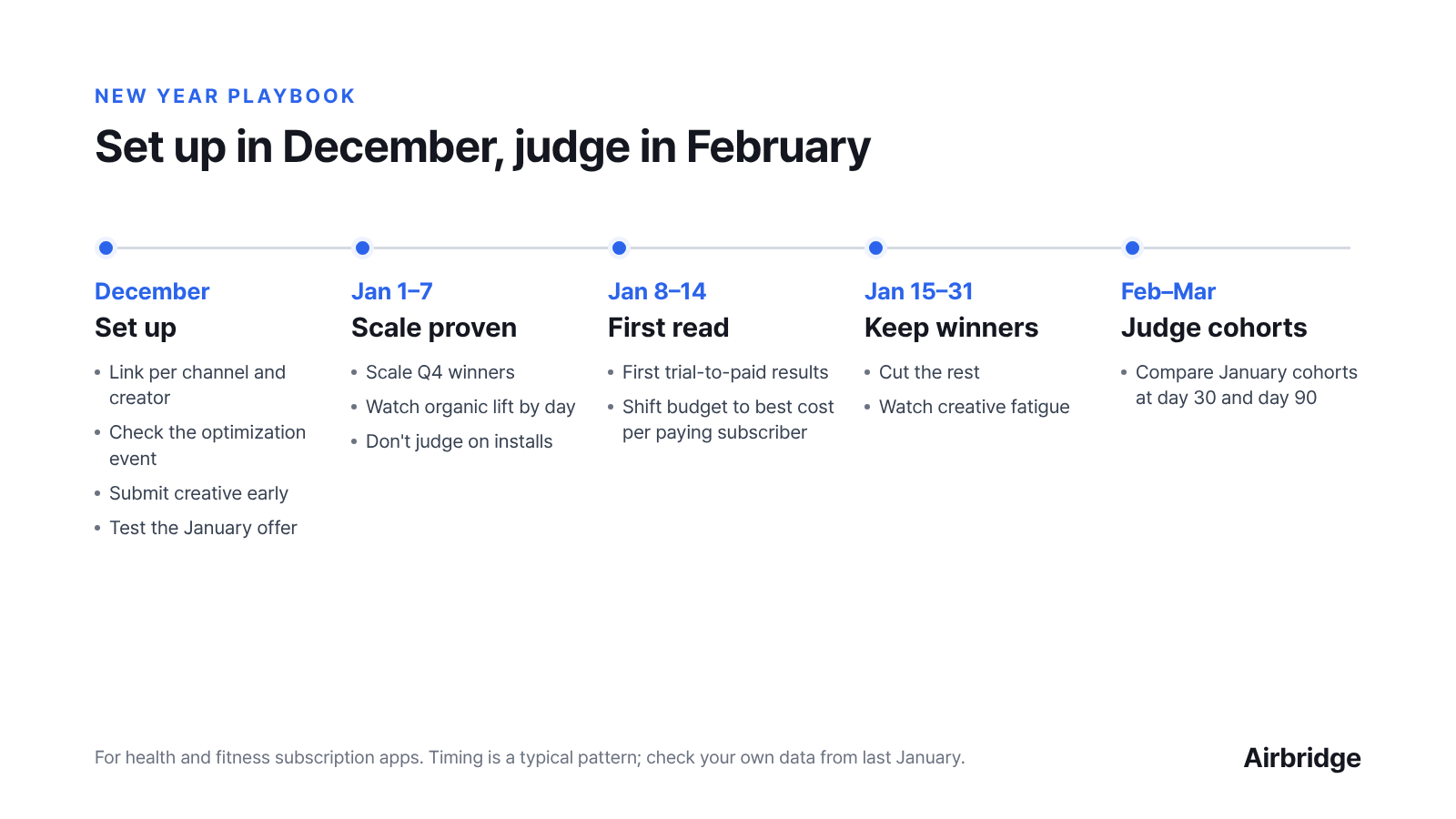
Set up in December, read trials in week two, and judge cohorts in February and March.
Want to see how January install spike works with your data?
Get hands-on with Airbridge and see real results.
Try It Free →How do you read January results honestly?
- Compare January cohorts with each other, week by week, not with December.
- Use cost per paying subscriber, not cost per install. Installs will look great in January. See the cost per paying subscriber template.
- Wait for trials to end. With a 7-day trial, January 1 installs only start telling you about payment from January 8.
- Follow cohorts to day 30 and day 90 before final calls, because some users subscribe later. See subscribers who pay months later.
- Separate organic lift from paid. If organic installs double, paid campaigns can look better or worse than they are. Watch organic installs by day.
How should you pace budget across January?
- Days 1–7: scale the channels and creators that already worked in Q4, on your usual optimization event.
- Days 8–14: first trial-to-paid results from week one arrive. Shift budget toward the best cost per paying subscriber.
- Days 15–31: demand often cools. Keep the winners, cut the rest, and watch for creative fatigue.
FAQ
When is the New Year peak for fitness apps?
Typically the first two to three weeks of January, starting around January 1. Your own data from last year is the best guide.
Are January users worse subscribers?
Not necessarily, but they vary more. More people try, and some stop quickly. Judge January cohorts on cost per paying subscriber over 30 to 90 days, not on installs or day-7 numbers.
Should I offer a discount in January?
Many health and fitness apps promote annual plans in January. Test the offer in December on a small audience, so you know its effect on trial-to-paid before the peak.
Is TikTok worth it in January for a fitness app?
It can be. Compare cost per paying subscriber by channel, and see TikTok ads for subscription apps after Black Friday for the late-Q4 view.
The bottom line
January is the busiest month for many health and fitness apps, and the easiest one to misread. Set up links and events in December, judge on cost per paying subscriber, compare January cohorts with each other, and give trials time to end before you cut anything.
If you'd like January cohorts by channel and creator, with spend next to revenue, try the Airbridge Core Plan free, then from $40 per month.

Ready to transform your mobile growth?
Learn how Airbridge helps leading brands measure and optimize every touchpoint.
“We went with them because their tech is better. It's best-in-class, for sure, but the real difference for us was the people.”