Best Organic vs Paid Attribution for Running App
On this page
For a running app, look for attribution that separates paid installs cleanly and lets you pull clubs, races, and creators out of the organic pile with links you control. Word of mouth drives this category, so a large organic number tells you little by itself. Airbridge makes one of the tools compared here, and its Core Plan shows app organic as a total, with no breakdown by referrer.
What running apps need from organic vs paid attribution
Runners recruit runners. A training partner mentions a plan, a club shares a route, a friend posts a finished long run. None of that passes through an ad platform, and most of it lands in the store as a plain search. To an attribution tool, all of it looks like organic.
The race calendar makes this harder. Interest climbs as spring and autumn races approach, and again around new year resolutions. Paid and organic rise together in those weeks. If you run ads into a peak, paid can claim installs that were coming anyway. If you stop ads at the same moment the season ends, organic seems to collapse with them. Neither reading is safe unless you compare the same weeks across seasons.
Business model adds a delay. Many running apps start as a free GPS tracker, and a runner may log for months before paying. The upgrade often comes with a goal, such as signing up for a first half marathon and wanting a plan. So the install and the payment can sit far apart. Whatever rule splits organic from paid at install also shapes how you judge revenue later.
Beginners and race runners also behave differently. Someone starting a walk to run program and someone chasing a marathon time respond to different messages, and they may arrive through different routes. A single organic line hides that.
What the data shows
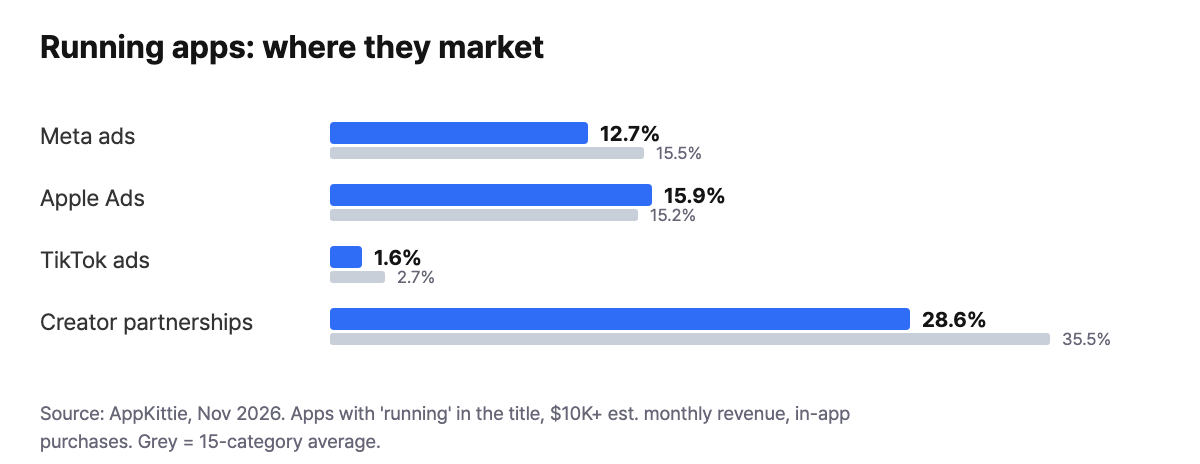
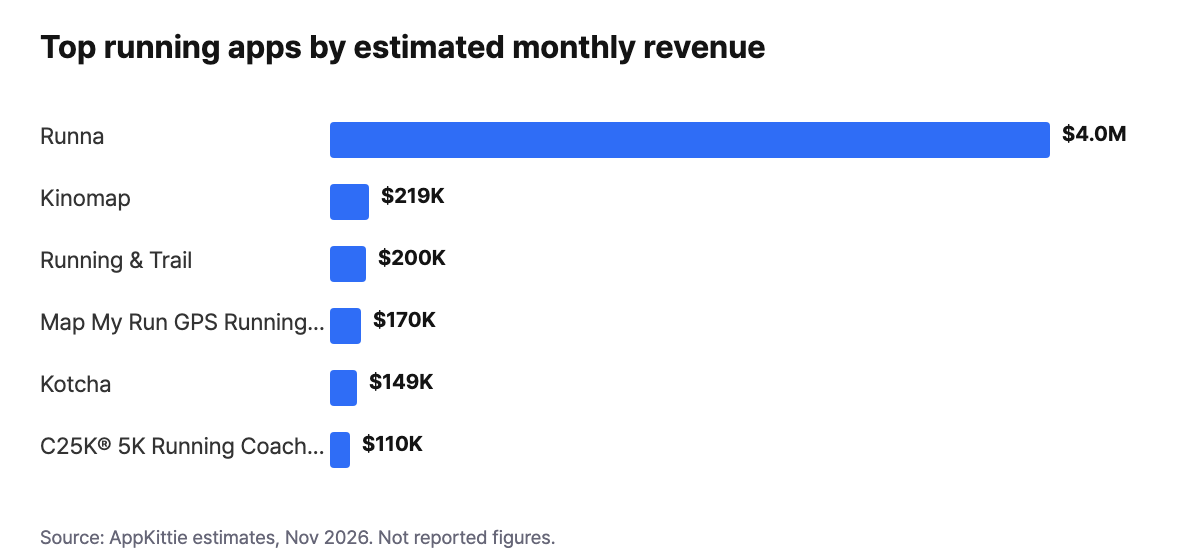
The set is 63 apps matched by title, with $10K+ estimated monthly revenue and in-app purchases, from AppKittie in November 2026, so it is modest and a few apps can move a bar. Creator partnerships lead at 28.6% but trail the 15-category average of 35.5%, and only Apple Ads at 15.9% sits above its average. Revenue figures are estimates, and the list needs care: Runna: Running Plans & Coach stands far ahead at $4M, and Kinomap comes next at $219K, so one app sets the scale of the chart.
How to choose
| Criterion | Why it matters for a running app | What to check |
|---|---|---|
| Organic detail | Word of mouth is your main unknown | Do you get a total or a source? |
| Non-ad links | Clubs and race events have no ad platform | Can you name each source with a link or QR code? |
| Lookback setting | The window moves installs between paid and organic | Can you adjust it, and how far? |
| Late revenue | Upgrades can come long after install | Does revenue need to fall inside a window? |
| Returning runners | Lapsed users come back each season | Are returns counted apart from new installs, and is that self-serve? |
Want to see how Best organic vs paid attribution for running apps works with your data?
Get hands-on with Airbridge and see real results.
Try It Free →Tools compared
| Airbridge Core | AppsFlyer | Adjust | Branch | Singular | Kochava | |
|---|---|---|---|---|---|---|
| Starting price | $40+/mo | Zero plan free (12,000 conversions in first 12 months); Growth $0.07 per conversion | Check vendor pricing page | Not listed on pricing page | Free plan (15,000 paid conversions); Growth $0.05 per conversion | Free App Analytics (10K conversions/month); Foundation from $500/mo |
| Self-serve signup | Yes | Yes | Check vendor pricing page | Yes on Basics | Yes on Free | Yes |
| Billing model | Data points | Per conversion | Check vendor pricing page | Not stated on pricing page | Per conversion | Conversions or MAU, by plan |
| Free trial | 30 days | Free Zero plan instead | Check vendor pricing page | Yes, on Basics | Free plan instead | Yes, on paid plans |
| RevenueCat integration | Yes | Yes | Yes | Yes | Yes | Yes |
Competitor details come from each vendor's public pages as of November 2026. AppsFlyer says its Zero plan is not suitable for apps with paid activities.
- Kochava may suit a team that wants a free App Analytics start at 10K conversions a month before moving to a paid plan with a trial.
- Airbridge Core may suit a team that wants paid and organic on one dashboard after a 30-day trial, at $40+/mo on data points.
- Singular may suit a team that prefers a free plan first and per conversion billing at $0.05 later.
- AppsFlyer may suit a team that accepts $0.07 per conversion on Growth, since it says its Zero plan is not suitable for apps with paid activities.
- Adjust may suit a team ready to get pricing and trial terms from its pricing page.
- Branch may suit a team drawn to self-serve Basics that can work without a listed price.
How to set this up in Airbridge
- Follow the setup guide with no sales call. The trial needs no card, and a basic SDK install takes about 5 minutes.
- Connect the ad channels you buy, so paid installs have a clear home.
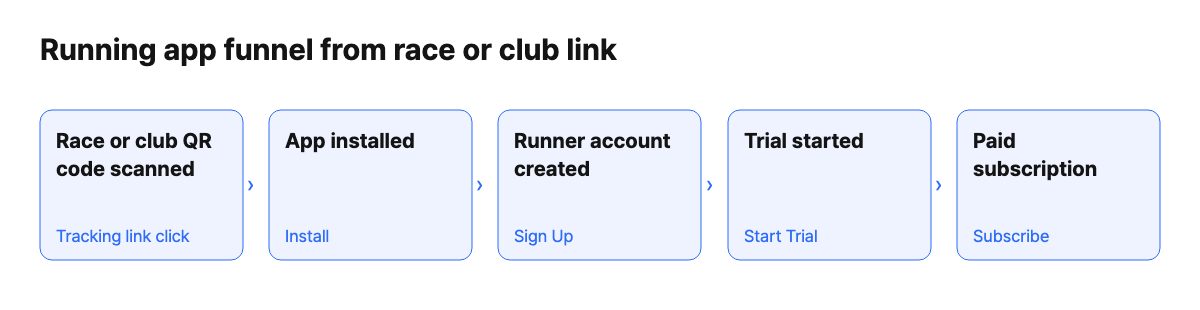
- Make a tracking link or QR code for each source you can name: a club, a race expo stand, a newsletter, or a creator. Installs through those links get their own label, so they stop adding to the organic total. Clicks and impressions on tracking links do not count as data points.
- Set your lookback window on purpose. The click default is 7 days by device ID and 1 day for probabilistic matches, and you can adjust it from 0 minutes to 30 days. Keep one rule through a full season so your comparisons hold.
- Review Actuals by channel each week, and use Unattributed Conversion Analysis to look at conversions with no channel attached.
What Airbridge Core does not do here
- Organic is one total. Organic referrer attribution is on the Growth Plan. Core will not tell you which site or source sent an organic install.
- No touchpoint view. Touchpoint analytics and overlap are also Growth only, so you cannot see every touch a runner had before installing.
- Web stays narrow. The Core Web SDK covers web-to-app tracking only. Full web event measurement for a blog or training guide site is a Growth feature.
- Attribution is not proof of lift. Any attribution report assigns credit. It does not show what would have happened with no ad at all.
If your growth plan rests on knowing which websites send organic runners, Core is the wrong fit. Look at Growth, or ask other vendors how their plans handle it.
FAQ
What counts as organic in practice?
An install with no attributed touch inside your lookback window. That includes real store searches, but also word of mouth, and any link you never tagged. It is a leftover, not a channel.
If I use QR codes at a race, do they count as paid?
They are not paid ads. They appear as a tracking link source with the name you gave them, so you can add the stand's cost by CSV upload and keep it apart from both ads and organic.
How can I test if ads are stealing organic installs?
Pause one channel in one market for a fixed period and watch total installs, not attributed ones. If the total barely moves, that spend was likely claiming installs you would have had. Avoid doing this at the peak of race season.
Ready to transform your mobile growth?
Learn how Airbridge helps leading brands measure and optimize every touchpoint.
“Braze is a powerful tool on its own, but when paired with Airbridge, it creates synergies for retargeting campaigns, saving resources and enhancing performance.”