Best Apple Search Ads Attribution for Running App
On this page
For a running app, look for a tool that ties an Apple Ads install to what the runner does next, including a plan purchase weeks later and a cancellation after race day. It should also cover your Android users, because Apple Ads never reaches them. Airbridge makes one of the tools compared below.
What running apps need from Apple Ads
Someone who searches the App Store for a running app usually has a goal in mind. A first 5K. A half marathon in spring. A way to log weekend miles. That intent is why Apple Ads fits this category, and it is also why install counts mislead. Two people can install the same app for very different reasons.
Running apps fall into two broad types, and they earn money differently:
- Plan and coach apps. Runna, C25K, and Campus Coach sell guidance toward a goal. The subscription is the product.
- Trackers. Map My Run and Joyrun record runs. Many users stay free for a long time, and the paid step comes much later, if at all.
Race dates shape the whole lifecycle. A plan buyer may subscribe months before an event and cancel the week after it. That is a healthy customer on a natural end date, and your reports should not treat it like a failed install. Seasons matter as well. Outdoor running picks up with good weather and spring and autumn race calendars, and it can fade in winter in colder markets. A campaign that looks weak in December may simply be running in the off season.
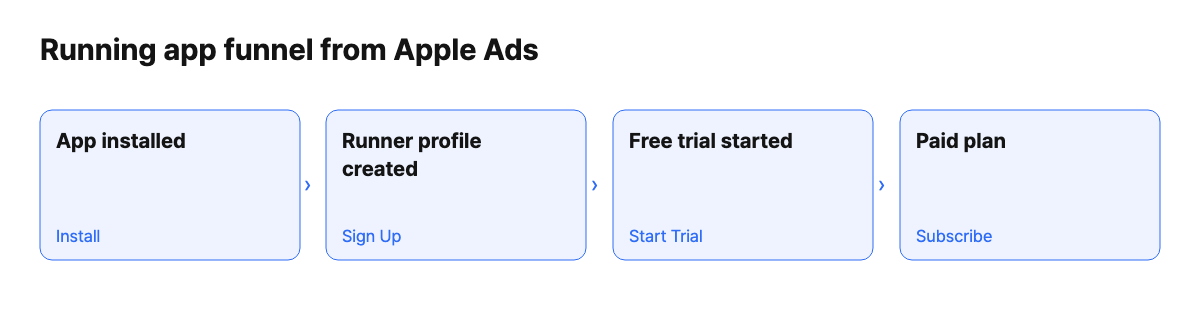
So the events that matter sit far apart in time. Install happens today. Start Trial may come after a first run or a first plan. Subscribe follows. Unsubscribe can arrive much later and tell you more about race timing than about ad quality.
Many runners train with a watch, and they judge an app by how well it fits their gear. That decision happens after install, on the first real run, so an attribution tool that ends at install misses it.
What the data shows
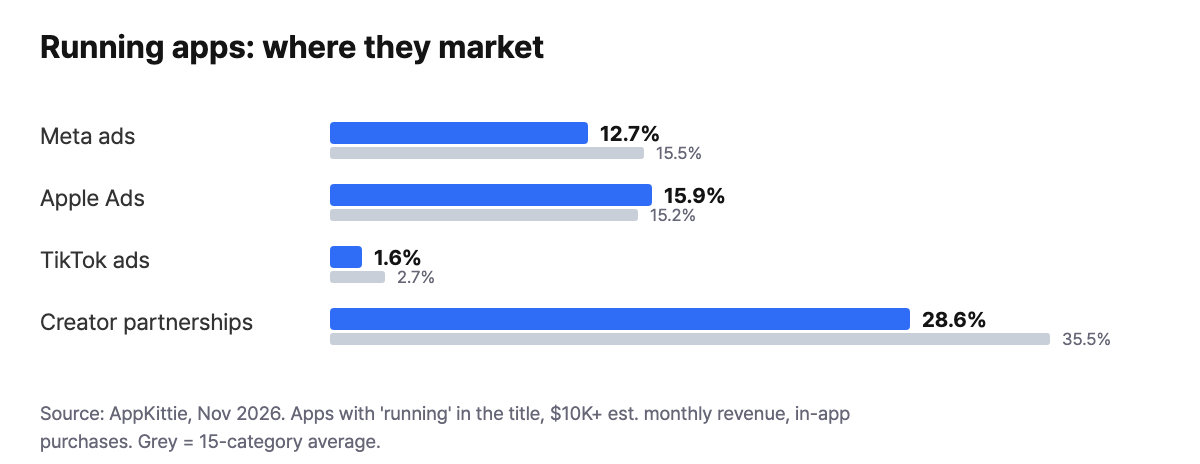
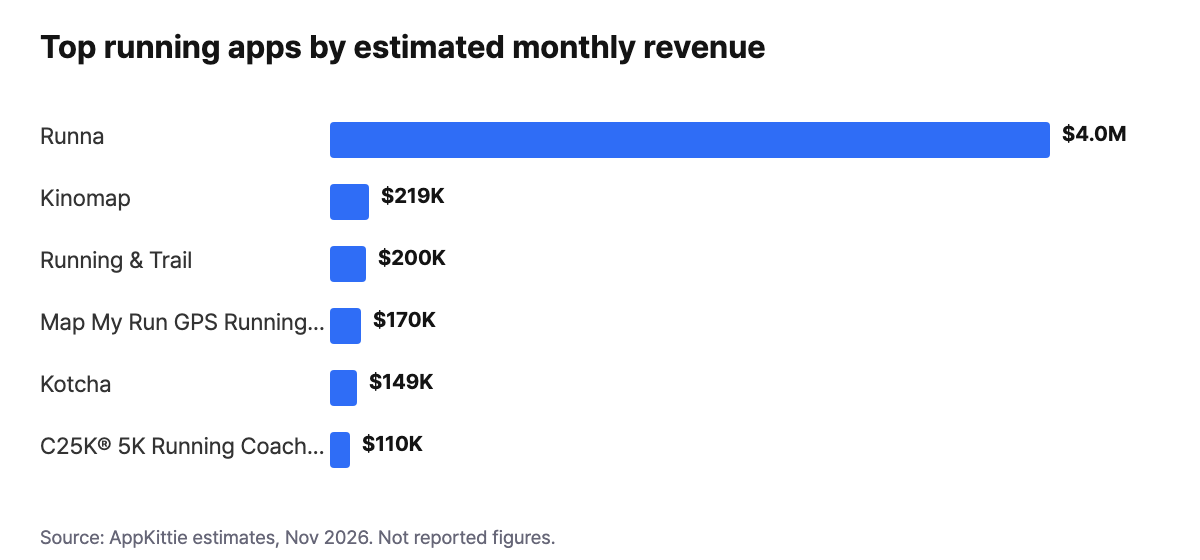
Of 63 apps matched by title, with $10K+ estimated monthly revenue and in-app purchases (AppKittie, November 2026), 10 show Apple Ads. That is 15.9%, barely above the 15.2% average across 15 categories, so treat it as a thin signal. The revenue chart shows estimates from a small sample of 37 apps, where Runna ($4M) is far ahead of everyone else.
How to choose
- Post-install coverage. Installs alone will not separate a plan buyer from a casual logger. Confirm that in-app events tie back to Apple Ads.
- Reporting detail. Ask each vendor what Apple Ads detail you will see, then confirm it with your own account during a trial.
- Reach across platforms. Apple Ads is iOS only. If half your plan is Android, you want one view of both, and not two separate tools.
- Long subscription memory. A runner may renew for many months. Check how each tool credits a renewal to the original source.
- Custom product pages. A 5K beginner and a marathon runner want different store pages. Core supports custom product pages (CPP) and custom store listings (CSL).
- Self-serve setup. A solo developer should be able to start without a sales call. The table below shows who allows that.
Want to see how Best apple search ads attribution for running apps works with your data?
Get hands-on with Airbridge and see real results.
Try It Free →Tools compared
| Airbridge Core | AppsFlyer | Adjust | Branch | Singular | Kochava | |
|---|---|---|---|---|---|---|
| Starting price | $40+/mo | Zero plan free (12,000 conversions in first 12 months); Growth $0.07 per conversion | Check vendor pricing page | Not listed on pricing page | Free plan (15,000 paid conversions); Growth $0.05 per conversion | Free App Analytics (10K conversions/month); Foundation from $500/mo |
| Self-serve signup | Yes | Yes | Check vendor pricing page | Yes on Basics | Yes on Free | Yes |
| Billing model | Data points | Per conversion | Check vendor pricing page | Not stated on pricing page | Per conversion | Conversions or MAU, by plan |
| Free trial | 30 days | Free Zero plan instead | Check vendor pricing page | Yes, on Basics | Free plan instead | Yes, on paid plans |
| RevenueCat integration | Yes | Yes | Yes | Yes | Yes | Yes |
Competitor details come from each vendor's public pages as of November 2026. AppsFlyer says its Zero plan is not suitable for apps with paid activities.
- Singular may suit a developer who wants self-serve on a Free plan, then conversion billing at $0.05 on Growth.
- AppsFlyer may suit a developer who accepts $0.07 per conversion on Growth, since its Zero plan is not suitable for paid activities.
- Kochava may suit a team that wants self-serve signup and can choose between conversion and MAU billing by plan.
- Branch may suit a developer happy to start self-serve on Basics, though its price is not listed.
- Adjust may suit a team that does not mind checking the vendor page for signup and pricing terms.
- Airbridge Core may suit a developer who wants self-serve signup and data point billing at $40+/mo after 30 days.
How to set this up in Airbridge
- Sign up for the trial without a card or a sales call. Read how the free trial works first if you want the details.
- Add the SDK to your iOS and Android builds. That takes about 5 minutes for a basic install, and Airbridge has SDKs for 8 mobile platforms.
- Connect Apple Ads. Installs and in-app events are attributed to Apple Ads at campaign and keyword level, so "5K" searches and "marathon plan" searches stay apart. To see names and not only IDs, you need the Campaign Management API, which requires an Apple Ads Advanced account with the Account Admin role.
- Send standard events only. Use Install, Sign Up, Start Trial, Subscribe, and Unsubscribe. If you use RevenueCat, Adapty, or Superwall, connect it so subscription events arrive.
- Build the path in the Funnel report, then use the Retention report with Subscribe as the Return Event. That shows whether Apple Ads runners stay past their first goal. The install to subscription funnel guide covers the setup.
What Airbridge Core does not do here
- Paid coverage stops at four channels. Core covers Meta Ads, Google Ads, Apple Ads, and TikTok for Business. If you also buy on other networks, Growth covers 330+ channels, or you can look at another vendor.
- No custom events. "First run logged," "plan created," and "race date set" are the moments running apps care about most. Core stops at the standard set, so a team that needs those signals should look elsewhere or talk to sales about Growth.
- No raw data export. Core exports reports to Sheets or CSV. A team that wants raw event data in its own warehouse needs Growth or another vendor.
- Not all Apple Ads detail arrives. On Apple Ads Basic you get no names and no cost sync, so you upload cost by CSV. Data Apple marks "Low Volume" never arrives, which can hide a small race search. Search Match keywords appear only in Apple Ads. Users who refuse ATT get lower attribution priority.
FAQ
Do I need an MMP if I only run Apple Ads?
Not always. An MMP (mobile measurement partner) earns its cost when you run more than one channel, or when you want ad results tied to subscription revenue. With one channel and a light budget, you can wait. Add one when you start a second channel, because that is when each ad platform's own numbers stop adding up to a single view.
Can I see revenue from runners who subscribe months after the install?
Yes. Pick Subscribe as the Revenue Event in the Revenue Report. It credits each revenue event to the most recent Start Event with no attribution window. Actuals is stricter and counts only events inside the window, so the two reports can differ for long plans.
Can I measure a run club or coach partnership next to Apple Ads?
Yes. Create a tracking link for the club or coach and share it in their channels. Tracking links work for any non-ad source, and clicks and impressions on them do not count as data points. Installs and other events from those users do count, because each event your app sends is one data point.

Ready to transform your mobile growth?
Learn how Airbridge helps leading brands measure and optimize every touchpoint.
“Airbridge understands the essence of what it has to offer as an MMP. Its objective, transparent, and accurate performance analysis allows marketers to realize the true impact of their efforts.”