Best Apple Search Ads Attribution for Meditation App
On this page
For a meditation app, Apple Ads attribution should connect a person searching the App Store to the trial they start and the plan they keep. Look for a tool that takes subscription events from your paywall stack, places Apple Ads beside your other channels, and lets you read retention over months. Airbridge makes one of the tools compared below, so treat it as one option among several.
What meditation apps need from Apple Ads
Apple Ads meets people at a useful moment. Someone who cannot sleep, or who feels anxious before a big week, opens the App Store and searches for help. That is a different mood from a person scrolling past a social ad. The intent is high, and you pay for it.
What happens next is specific to this app type:
- The first session is the sale. A meditation app often shows its paywall early, and many users decide after one guided session. The time from install to trial can be minutes.
- The real answer comes later. A trial ends, the plan renews or not, and a person who felt calm in week one may stop opening the app in week three. You cannot judge a search campaign on trial starts alone.
- Annual plans change the timing. Many meditation apps push a yearly plan. That gives you one large payment up front, then a long silence until renewal. Cancellation signals during that silence matter more than usage counts.
- Use follows life. Interest tends to rise around New Year goals, stressful seasons, and times when sleep gets worse. Evening use is common. A campaign that looks weak in a quiet month may not be weak at all.
- Habit is the product. The clearest sign of value is a person returning at the same time each day, not a single long session.
Apple Ads also covers only part of your audience. It reaches Apple's stores, so an Android user arrives through another channel. You need one view that holds both.
What the data shows
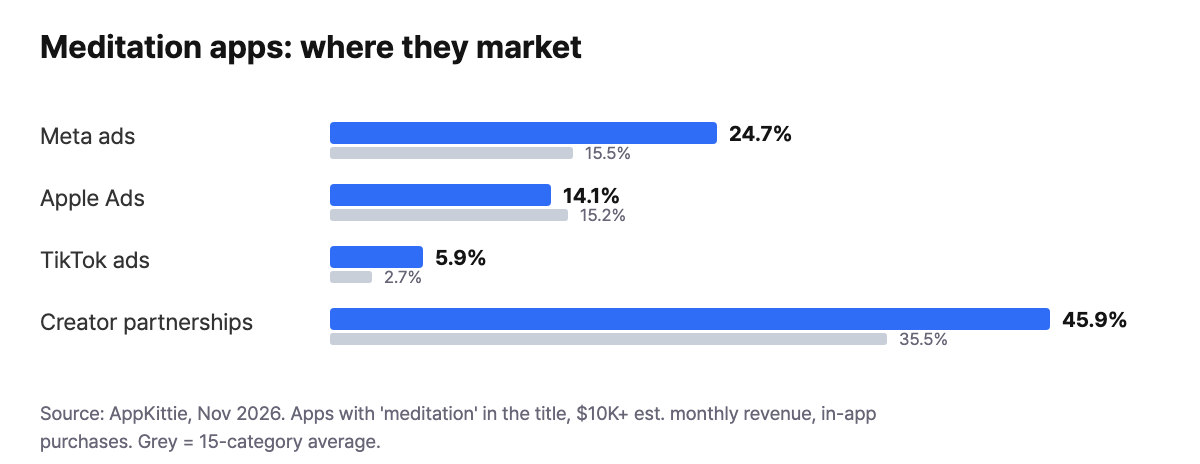
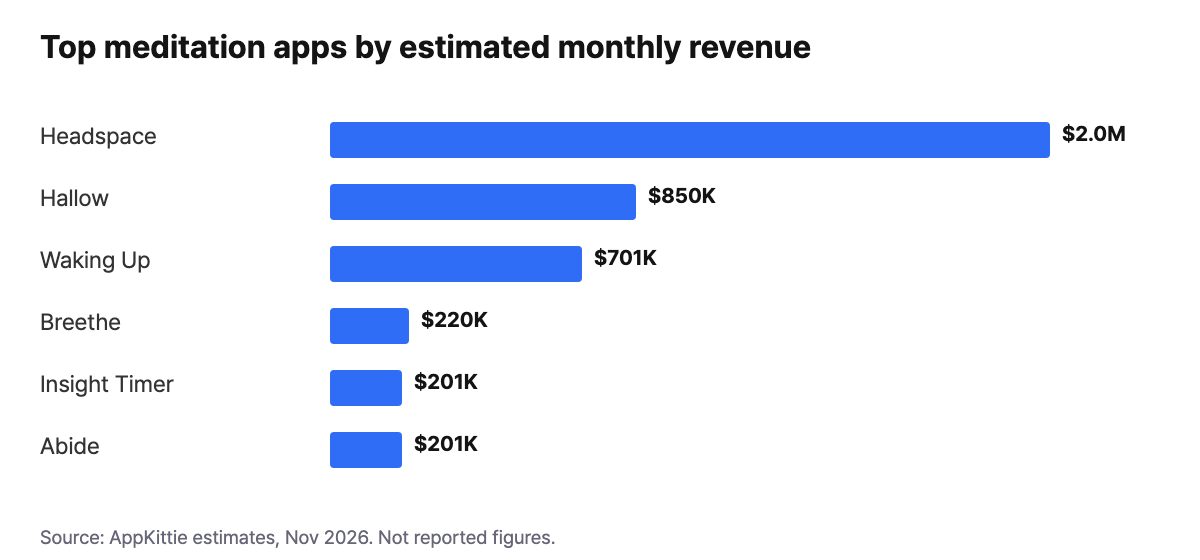
We matched 85 apps with "meditation" in the title, $10K+ estimated monthly revenue, and in-app purchases, using AppKittie data from November 2026. Apple Ads shows up for 14.1% of them (12 apps), close to the 15.2% average across 15 categories, while Meta (24.7%) and creator partnerships (45.9%) run well above average. Revenue figures are estimates, and the title match pulls in prayer apps such as Hallow ($850K) and Abide ($201K), so compare yourself to Headspace ($2M) with care.
How to choose
Apple Ads may not be your only channel, so your tool may need to measure it next to Meta and creators.
- Apple Ads depth. Ask each vendor to show you a live Apple Ads report before you pay. Reporting detail is the first thing to compare, and a demo answers it faster than a feature list.
- Subscription events. Your paywall tool holds the truth on trials and renewals. Check that those events reach your attribution tool. Every tool in the table below lists a RevenueCat integration, so this one will not split the field.
- Retention reading. A meditation app lives on repeat use. Pick a tool that shows retention by channel, not only installs by channel.
- Creator measurement. Creator partnerships are the most common signal in this data. If you work with teachers or sleep creators, you need their links in the same report as your Apple Ads results.
- Price against scale. A paid plan with a low start and a free plan with a conversion cap fail in different ways. Estimate your monthly events and conversions first, then compare.
Want to see how Best apple search ads attribution for meditation apps works with your data?
Get hands-on with Airbridge and see real results.
Try It Free →Tools compared
| Airbridge Core | AppsFlyer | Adjust | Branch | Singular | Kochava | |
|---|---|---|---|---|---|---|
| Starting price | $40+/mo | Zero plan free (12,000 conversions in first 12 months); Growth $0.07 per conversion | Check vendor pricing page | Not listed on pricing page | Free plan (15,000 paid conversions); Growth $0.05 per conversion | Free App Analytics (10K conversions/month); Foundation from $500/mo |
| Self-serve signup | Yes | Yes | Check vendor pricing page | Yes on Basics | Yes on Free | Yes |
| Billing model | Data points | Per conversion | Check vendor pricing page | Not stated on pricing page | Per conversion | Conversions or MAU, by plan |
| Free trial | 30 days | Free Zero plan instead | Check vendor pricing page | Yes, on Basics | Free plan instead | Yes, on paid plans |
| RevenueCat integration | Yes | Yes | Yes | Yes | Yes | Yes |
Competitor details come from each vendor's public pages as of November 2026. AppsFlyer says its Zero plan is not suitable for apps with paid activities.
- Airbridge Core may suit a solo developer who wants to test Apple Ads for a month before paying $40+/mo.
- AppsFlyer may suit an app with few but valuable conversions, since Growth bills $0.07 for each one.
- Adjust may suit a team already talking to vendors, since its pricing page holds the details.
- Branch may suit a team happy to sign up on Basics and ask about price later, as none is listed.
- Singular may suit an app with a modest count of paid conversions, as its free plan covers 15,000.
- Kochava may suit a larger meditation brand with room for Foundation at $500/mo and up.
How to set this up in Airbridge
- Sign up for Core and install the SDK. A basic install takes about 5 minutes, and the trial needs no card.
- Connect Apple Ads. Airbridge then attributes installs and in-app events to Apple Ads by campaign and by keyword, so a "sleep" search and an "anxiety" search can be read apart. To see those names, you need an Apple Ads Advanced account with the Account Admin role, because names come through the Campaign Management API. The SDK alone gives you only IDs. Connect Meta Ads too if you run it.
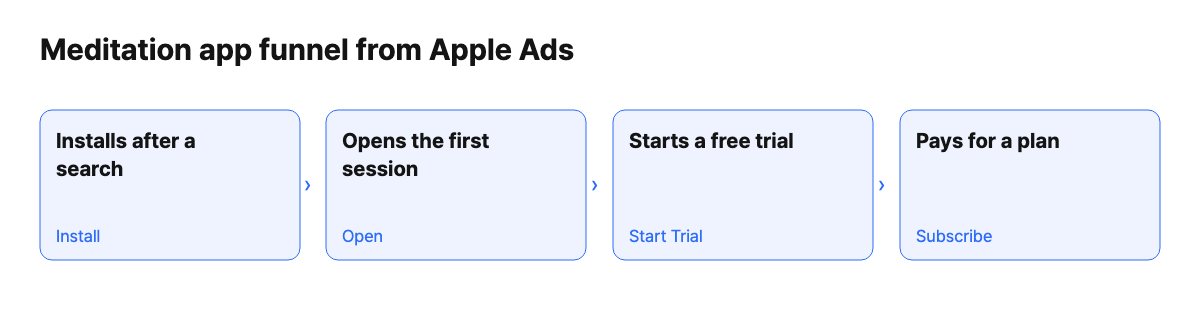
- Connect RevenueCat, Adapty, or Superwall. See how to connect RevenueCat revenue to ads. Trial starts become Start Trial, cancellations become Unsubscribe, and paid events become Subscribe.
- Build a Funnel Report from Install to Start Trial to Subscribe, and split it by channel. This walkthrough covers it.
- Open the Retention Report and set Subscribe as the Return Event. That shows which channels bring people who keep paying.
What Airbridge Core does not do here
- pLTV stops short of the first annual renewal. Predictive LTV runs up to day 180. It lives in the dashboard and never goes to ad networks. For a yearly plan, the renewal you care about sits past that point.
- Standard events only. Core has no custom events, so "finished a session" or "played a sleep story" cannot be tracked. Use Open as your habit signal. First payments, trial conversions, and renewals all arrive as Subscribe.
- Some Apple Ads data stays in Apple Ads. Search Match keywords show only there, which matters if you use it to find new sleep and stress searches. Anything Apple marks "Low Volume" never reaches Airbridge. Apple Ads Basic brings no names and no cost sync, so cost goes in by CSV. Users who refuse ATT get lower attribution priority.
- No uninstall tracking or fraud detection. Both are on Growth. A team that needs them, or needs channels beyond Meta, Google, Apple, and TikTok, should look at Growth or another vendor.
FAQ
Do I need an attribution tool if Apple already reports my ads?
You can run Apple Ads without one. A tool earns its cost when you also run other channels. It puts Apple Ads beside Meta and creator links, and follows each person past the install to trial and subscription.
How long should I wait before judging an Apple Ads test?
Wait until the trials from that test have ended, then look at who stayed. Trial starts tell you about the ad and the store page. Subscribe tells you about the product. Quiet months can mislead you, so compare like with like.
Can Airbridge predict the value of a yearly subscriber?
Partly. Core includes pLTV up to day 180. It is a machine-learning prediction of user lifetime multiplied by average revenue per daily active user. Treat it as an early signal for your own budget decisions. It stays in your dashboard.


Ready to transform your mobile growth?
Learn how Airbridge helps leading brands measure and optimize every touchpoint.
“While working with Airbridge, we have learned that MMM is a crucial attribution model for post-privacy era marketing to predict future performance and optimize the budget.”