Best Push Notification Attribution for Sleep Tracking App

On this page
A sleep tracking app should look for a tool that ties a push tap to what the user does next, such as starting a trial or paying, because a tap on its own proves little. Airbridge makes one of the tools compared below, and on Core this works with conditions: you put a tracking link in the push, treat push as a custom channel, and read standard events only. If you need custom sleep events or uninstall data, Core will not give you those.
What sleep tracking apps need from push notification attribution
Sleep is an odd category for push. The moment you most want to reach someone is the moment you want the phone out of their hand. A reminder at bedtime can help the habit and harm the night. That tension shapes what you should measure.
Sleep apps also tend to send several kinds of message, and each one has a different job:
- Bedtime reminder. Its job is the habit. If it works, the user may put the phone down and go to bed. No tap, no event, and yet the push did its job.
- Morning summary. This often has the strongest pull, since people want to see last night's score.
- Trial ending. This message speaks to money. It is the one most worth tying to Subscribe.
- Win-back. A lapsed user may return for a seasonal reason, such as a clock change or a new baby.
Device settings add noise. Phones have sleep and do-not-disturb modes, so an evening push may wait until morning. A message sent late in the evening can get its tap the next morning, and it may then look like a morning push in your reporting.
Tracking itself creates a second trap. Many sleep apps run overnight and do little during the day. An app open is a weak sign of value here, because a user can get full value from a summary widget or a wearable. Parents using a baby sleep app may open it in the middle of the night out of need, not because of your message.
So the real question is not "did they tap?" It is "did people who tapped this message start a trial or pay more often than the ones who did not get it?" Attribution can answer the first half. The second half needs your own comparison.
What the data shows
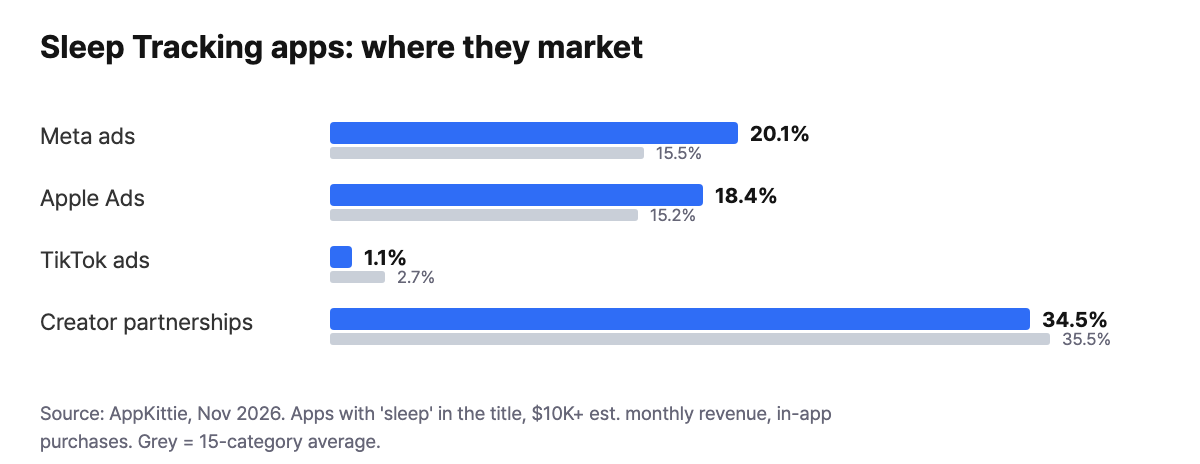
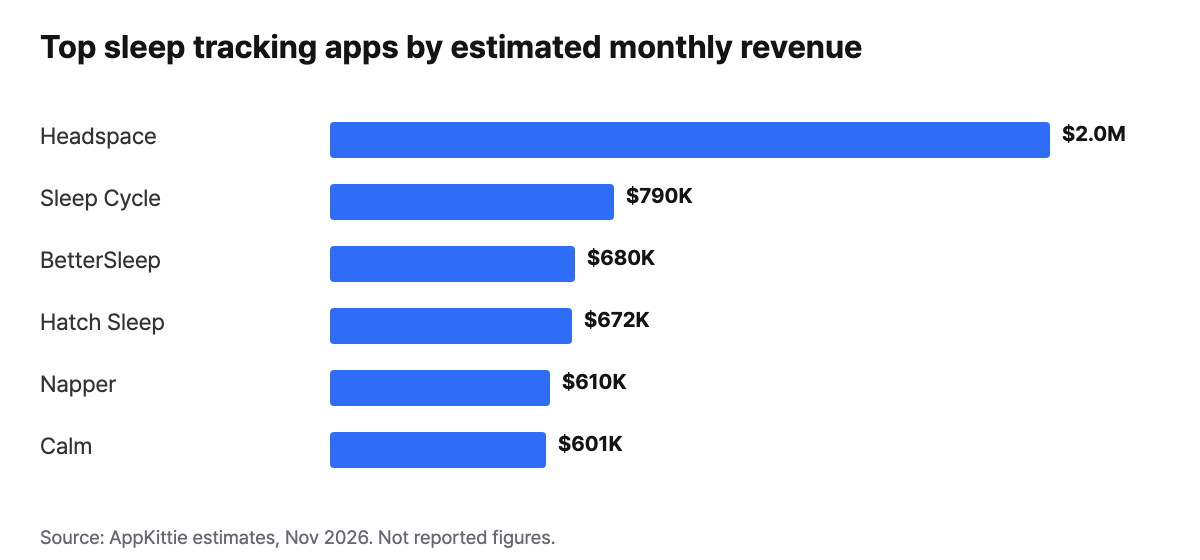
Of 174 apps matched by title, with $10K+ estimated monthly revenue and in-app purchases (AppKittie, November 2026), 35 show Meta ads (20.1%), 32 show Apple Ads (18.4%), 2 show TikTok ads (1.1%), and 60 carry a creator signal (34.5%), which does not prove creator videos. Meta ads and Apple Ads sit above the 15-category averages of 15.5% and 15.2%, so paid users are likely part of what push later has to keep. The revenue chart uses estimates from a small sample of 41 apps, it mixes pure trackers with broader apps such as Headspace ($2M) and Calm ($601K), and none of this data measures push.
How to choose
Use these checks first:
- A link in every push you measure. The tool should work with whatever sends your pushes, through a link and not a special connection.
- One label per message type. Bedtime, morning, and trial-ending pushes should never share a label.
- Events after the tap. A click count is not enough. You want trial and paid events tied to the push.
- A split by platform. Read iOS and Android apart. Results can differ across platforms.
- How billing treats daily use. A nightly habit means many opens. Check what your plan charges for.
- A place for the other half. Sends and deliveries stay in your push tool, so plan to read both side by side.
Want to see how Best push notification attribution for sleep tracking apps works with your data?
Get hands-on with Airbridge and see real results.
Try It Free →Tools compared
| Airbridge Core | AppsFlyer | Adjust | Branch | Singular | Kochava | |
|---|---|---|---|---|---|---|
| Starting price | $40+/mo | Zero plan free (12,000 conversions in first 12 months); Growth $0.07 per conversion | Check vendor pricing page | Not listed on pricing page | Free plan (15,000 paid conversions); Growth $0.05 per conversion | Free App Analytics (10K conversions/month); Foundation from $500/mo |
| Self-serve signup | Yes | Yes | Check vendor pricing page | Yes on Basics | Yes on Free | Yes |
| Billing model | Data points | Per conversion | Check vendor pricing page | Not stated on pricing page | Per conversion | Conversions or MAU, by plan |
| Free trial | 30 days | Free Zero plan instead | Check vendor pricing page | Yes, on Basics | Free plan instead | Yes, on paid plans |
| RevenueCat integration | Yes | Yes | Yes | Yes | Yes | Yes |
Competitor details come from each vendor's public pages as of November 2026. AppsFlyer says its Zero plan is not suitable for apps with paid activities.
The table does not cover push, so ask each vendor how it handles a link inside a notification. Going by billing:
- Singular may suit an app where paid conversions stay under its free plan's 15,000, since it bills per conversion and not per open.
- AppsFlyer may suit an app with no paid activities, given the note on its Zero plan.
- Kochava may suit a team weighing MAU billing against conversions, which varies by plan.
- Branch may suit a team happy to start on Basics and ask for a price.
- Adjust may suit a team that gets a quote before it compares.
- Airbridge Core may suit a team that can live with data point billing, where app opens count as events, and wants a 30-day trial to measure that.
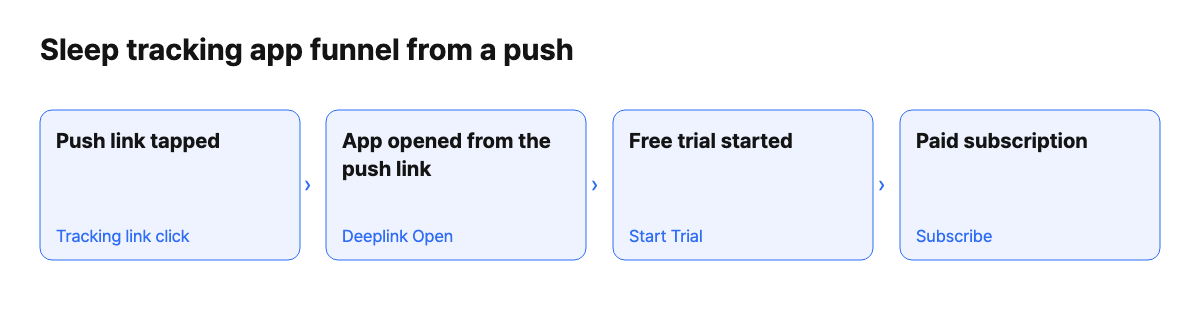
How to set this up in Airbridge
- Start the free trial and do a basic SDK install, which takes about 5 minutes. Set up deep links so a tap lands on the right screen, such as last night's summary.
- Create one tracking link per message type, under a custom channel for push. Keep the spelling the same on every link.
- Paste the tracking link into your push tool as the destination. Do not send a bare custom scheme URL without a tracking link, because measurement becomes unreliable.
- Report trials, payments, and cancellations as the standard events Start Trial, Subscribe, and Unsubscribe. RevenueCat, Adapty, and Superwall all map to them. This guide to the install-to-subscription funnel shows how to lay out those steps.
- Read Deeplink Open and later standard events for each message, one platform at a time.
What Airbridge Core does not do here
- Standard events only. You cannot send "night tracked" or "sleep score viewed." Custom events are on Growth.
- No equal results across platforms. Click to Deeplink Open rates can differ by platform, so a gap between iOS and Android may be measurement and not behavior.
- It only sees the link. A push that works without a tap leaves no trace. Sends and deliveries belong to your push tool.
- No uninstall tracking. Too many bedtime pushes can drive people to delete the app, and you will not see that on Core. Uninstall tracking is on Growth.
If your main question is which sleep behavior predicts paying, or whether your pushes cause deletions, you need Growth or another tool. If you want to know which messages lead to a trial or a paid plan, Core can answer that with the conditions above.
FAQ
Do push taps use up my data points?
Clicks on tracking links do not count. The app open that follows is an app event, and an install, an app open, and a purchase each count as one event. Core includes 500K data points a month, then $0.0001 per additional data point.
Should every push carry a tracking link?
No. Add one where you will act on the result. A plain bedtime reminder with no destination may not need it. A trial-ending message does, because that is where a decision about money sits.
Why do my iOS and Android push numbers differ?
Part of the gap can be real and part can come from how each platform handles the step from tap to deep link. Compare messages within one platform, and do not rank one platform against the other from these numbers.

Ready to transform your mobile growth?
Learn how Airbridge helps leading brands measure and optimize every touchpoint.
“Airbridge understands the essence of what it has to offer as an MMP. Its objective, transparent, and accurate performance analysis allows marketers to realize the true impact of their efforts.”