MMP Pricing for Freemium Apps: How to Choose the Right Model

On this page
MMP pricing for freemium apps: a buyer's guide
Freemium apps have a particular shape: lots of installs, lots of free users, and a small share who pay. That shape matters when you choose a mobile measurement partner (MMP), because many pricing models charge by volume. One freemium founder summed up his frustration: the cost per conversion was "getting out of hand," and "with a freemium model, the unit economics just don't make sense anymore."
The fix isn't always a cheaper tool. It's a pricing model that fits how your app makes money.
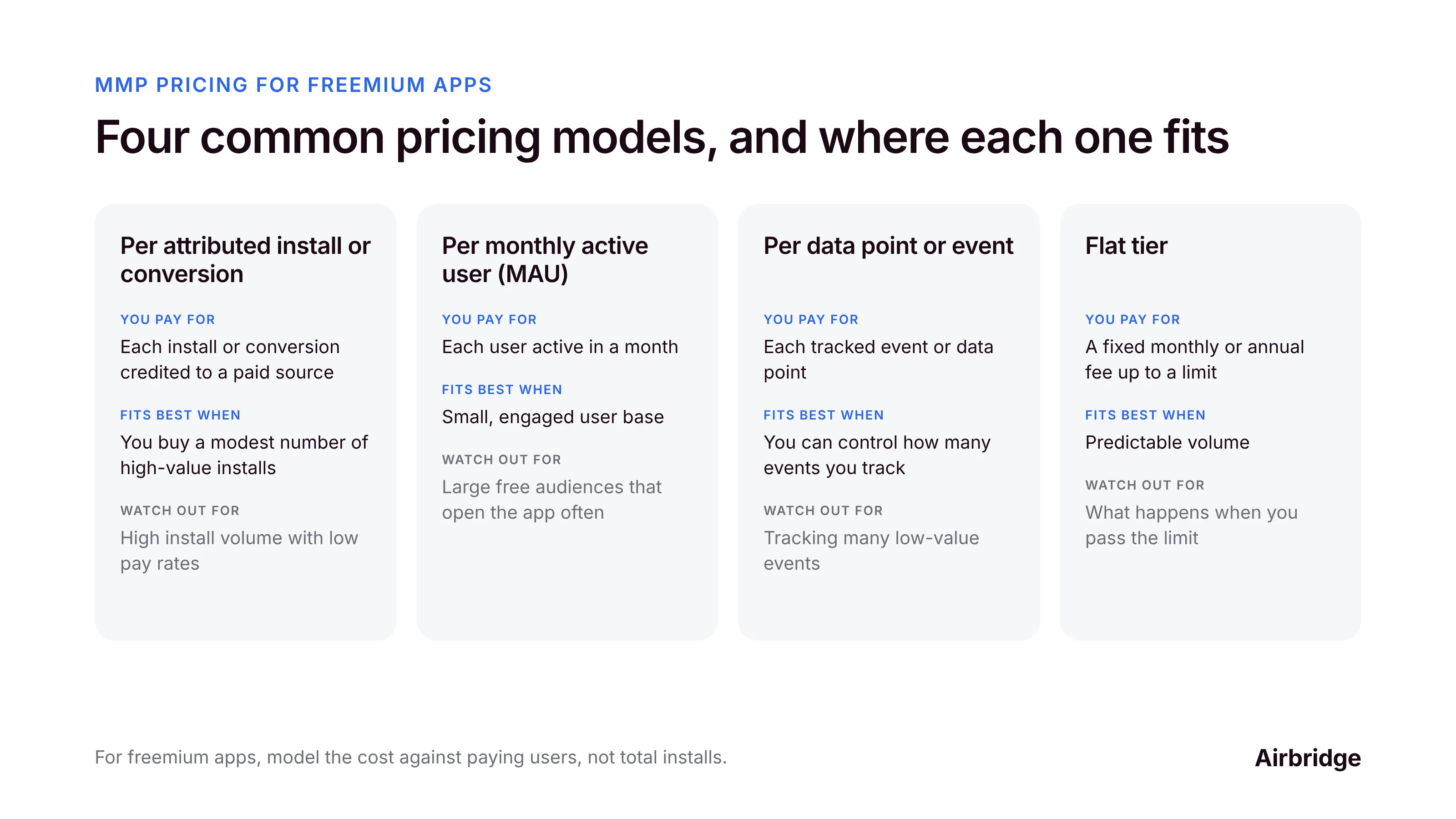
The common pricing models
| Pricing model | You pay for | Fits best when | Watch out for |
|---|---|---|---|
| Per attributed install or conversion | Each install (or other conversion) credited to a paid source | You buy a modest number of high-value installs | High install volume with low pay rates; what counts as a "conversion" |
| Per monthly active user (MAU) | Each user active in a month | Small, engaged user base | Large free audiences that open the app often |
| Per data point or event | Each tracked event or data point | You can control how many events you track | Tracking many low-value events |
| Flat tier | A fixed monthly or annual fee up to a limit | Predictable volume | What happens when you pass the limit |
Most vendors combine these with a base fee, feature tiers and minimum terms.
Why freemium apps feel pricing differently
A freemium app's revenue grows with payers. Many pricing models grow with volume: installs, active users or events. If 2% of installers ever pay, a model that bills every install means 98% of your billable units never bring revenue.
That's not a reason to avoid any model. It's a reason to estimate your costs with your own numbers before deciding.
A simple worksheet
Fill in your own numbers for the next 12 months:
-
Installs per month, split into paid and organic.
-
Monthly active users.
-
Events per user per month you actually need: install, onboarding complete, trial start, purchase, renewal. Skip low-value events.
-
Expected growth. Plan for your best month, not your average.
Then ask each vendor to price the same scenario, and compare total cost per month and cost as a share of revenue.
Want to see how MMP pricing works with your data?
Get hands-on with Airbridge and see real results.
Try It Free →Questions to ask before you sign
-
What exactly is billable? Paid installs only, or organic too? Re-installs? Re-engagements? Web events?
-
What does "conversion" mean in the contract? Ask whether a billable conversion is an install, a engagement" class="glossary-link" title="Re-engagement">re-engagement or an in-app event, and make sure the contract uses the same definition you discussed.
-
What happens when you exceed your plan? Is overage priced per unit, or does it move you to a new tier?
-
Contract length. Monthly or annual? Can you start small and upgrade?
-
Included integrations. Are the ad networks and your subscription platform included, or extra? Not sure you need an MMP next to your subscription platform? Read Do You Need an MMP If You Use RevenueCat?
-
Free tier limits. If there's a free plan, what are the limits, and what happens when you reach them?
Match the model to your stage
-
Pre-scale (under a few thousand paid installs a month): look for low base fees, monthly terms and no long contract.
-
Scaling freemium (high installs, low pay rate): prefer models where cost tracks the events you choose, or where organic installs aren't billed.
-
Mature (steady payer base): negotiate on predictability: annual tiers with clear overage rules.
Buyer's summary
-
MMPs usually price by attributed installs or conversions, monthly active users, data points or events, or fixed tiers.
-
For a freemium app, the key question is what counts as billable, and does it grow faster than your revenue?
-
Model your next 12 months of installs, events and active users, and compare the cost under each model before you sign.
MMP pricing FAQ
How do MMPs price their services?
Common models charge per attributed install or conversion, per monthly active user, per data point or event, or a flat tier, often with a base fee and minimum term.
Which MMP pricing model is best for a freemium app?
Usually one where cost grows with the events that matter to revenue, not with every install or free user. Model your own numbers under each option before deciding.
Are organic installs billable?
It depends on the vendor and plan. Ask directly, and get the answer in writing, since organic volume can be large for freemium apps.
How much should an MMP cost as a share of revenue?
There's no fixed rule. Compare the tool's monthly cost with the decisions it improves, such as moving budget from channels with high cost per subscriber to channels with low cost per subscriber.
Can I switch MMPs later?
Yes, but it takes planning: SDK changes, new links, ad network connections and a period of running both. Choosing a model that scales with you saves a migration later.
Choosing with confidence
For freemium apps, the right MMP is the one whose bill grows with your revenue, not just your installs. Know what's billable, model your next 12 months, and ask the hard contract questions up front.
Airbridge's Core Plan is built for subscription apps: from $40 per month with 500,000 data points and two third-party integrations included, and $0.0001 per extra data point. You can try it free for 30 days.


Ready to transform your mobile growth?
Learn how Airbridge helps leading brands measure and optimize every touchpoint.
“Airbridge understands the essence of what it has to offer as an MMP. Its objective, transparent, and accurate performance analysis allows marketers to realize the true impact of their efforts.”