Do You Need an MMP If You Use RevenueCat? How Subscription and Attribution Tools Fit Together

Do you need an MMP if you already use RevenueCat?
If you run a subscription app, you probably use RevenueCat, Superwall or Adapty. They handle purchases, entitlements, paywalls and revenue charts, and they do it well. So when founders start spending on ads or creators, a fair question comes up: do I also need a mobile measurement partner (MMP)?
The founders we talk to usually answer it the same way. One told us he'd only consider a separate attribution tool "once I'm actually spending enough on acquisition that attribution becomes a real problem." Another put the threshold in one line: "if you scale on multiple network you need mmp, else only analystic is enought."
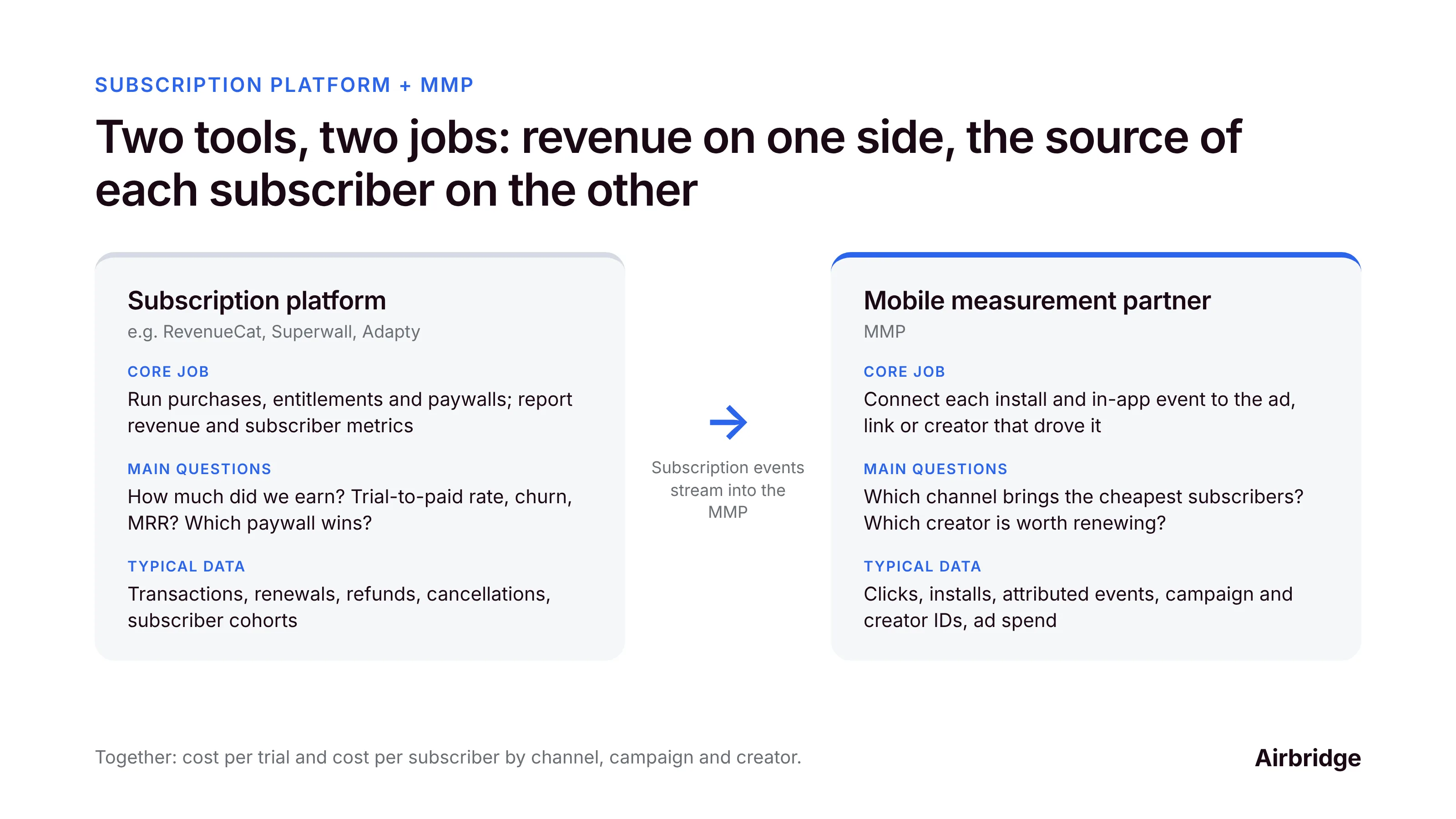
At a glance: what a subscription platform and an MMP are each built for
 install and event to the ad, link or creator that drove it, and subscription events stream into the MMP">
| Subscription platform (RevenueCat, Superwall, Adapty) | Mobile measurement partner (MMP) | |
|---|---|---|
| Core job | Run purchases, entitlements and paywalls; report revenue and subscriber metrics | Connect each install and in-app event to the ad, link or creator that drove it |
| Main questions | How much did we earn? What's our trial-to-paid rate, churn, MRR? Which paywall wins? | Which channel brings the cheapest subscribers? Which creator is worth renewing? |
| Typical data | Transactions, renewals, refunds, cancellations, subscriber cohorts | Clicks, installs, attributed events, campaign and creator IDs, ad spend |
| Works with ad platforms by | Sending revenue events to them through integrations | Sending attributed events to ad networks and pulling cost data into one report |
The two connect. For example, RevenueCat can stream trial conversions, renewals and cancellations to Airbridge, so subscription events land on the campaigns that drove them, including revenue from later renewals.
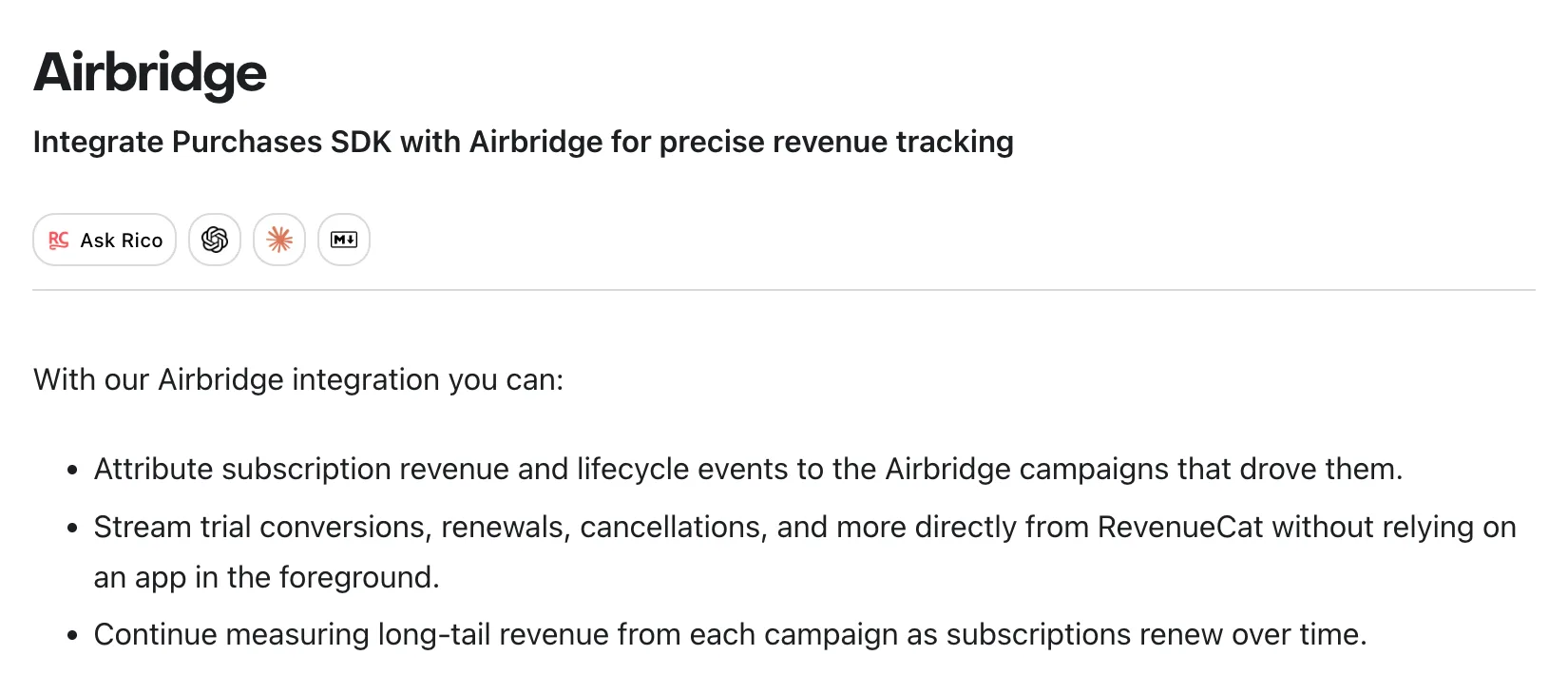
RevenueCat's Airbridge integration sends subscription revenue and lifecycle events to the campaigns that drove them, including renewals over time. Source: RevenueCat documentation
The short version
-
A subscription platform answers "what did we earn, and from whom?"
-
An MMP answers "which campaign, channel or creator brought that person?"
-
They're built for different jobs and work best together: the subscription platform sends trials, renewals and refunds to the MMP, and the MMP ties them to campaigns.
-
You need both once you spend on more than one channel, pay creators, or want ad platforms to optimize for trials instead of installs.
Want to see how Do I need an MMP with RevenueCat works with your data?
Get hands-on with Airbridge and see real results.
Try It Free →5 signs you're ready to add an MMP
You can run your first small tests without one. These are the signs that it's time:
-
You spend on two or more channels. Each ad platform reports its own results. One view across all of them lets you compare Meta, Google, TikTok and Apple Ads side by side.
-
You pay creators or run UGC. Each creator needs their own link, followed all the way to trial and subscription, to compare them on cost per subscriber instead of views.
-
You want ad platforms to optimize for trial starts. An MMP can send clean, attributed trial events to each network, which helps them find people who start trials. We cover this in our post on optimizing for trial starts, not installs.
-
You sell on the web and in the app. People who start on a web page and subscribe in the app need one journey across both.
-
You can't answer "where did our best subscribers come from?" If revenue is growing but you can't say which campaign or creator caused it, every budget decision is a guess.
One founder described what he would actually pay for: "knowing which channel brings users who stay, not just who install." That is the question an MMP plus a subscription platform answers together.
How to set up RevenueCat and an MMP together
-
Keep your subscription platform as the source of truth for revenue. Don't move purchase logic or entitlements.
-
Add the MMP SDK to your app and create tracking links for each campaign and creator.
-
Connect the two. Turn on your subscription platform's integration with the MMP so trials, renewals and refunds flow to attributed campaigns.
-
Connect your ad networks in the MMP to import costs and send back attributed events.
-
Read cost per trial and cost per subscriber by channel, then by campaign and creator.
Common questions about RevenueCat and MMPs
Is RevenueCat an attribution tool?
RevenueCat is a subscription platform. It handles purchases, entitlements and subscription analytics, and it can store attribution data sent from other tools. For campaign- and creator-level attribution across channels, it's commonly connected to an MMP.
Can I use RevenueCat and an MMP together?
Yes. That is the most common setup. RevenueCat sends subscription events, such as trial conversions and renewals, to the MMP, and the MMP ties them to the campaigns and creators that drove each user.
When should a subscription app add an MMP?
When you spend on more than one channel, pay creators, want ad platforms to optimize for trials, or can't tell which campaigns bring paying subscribers.
Do I need an MMP for Apple Ads only?
Not always. If Apple Ads is your only paid channel, Apple's own attribution and your subscription platform can be enough at first. Add an MMP when you add a second channel or start working with creators.
Will an MMP replace my subscription platform?
No. They do different jobs. Keep your subscription platform for purchases, paywalls and revenue, and use the MMP to connect that revenue to where users came from.
How to decide
Your subscription platform tells you what you earn. An MMP tells you where those earnings came from. You don't need both on day one, but once you spend on several channels or pay creators, the two together are what turn "revenue went up" into "this campaign brought our cheapest subscribers."
Airbridge connects with RevenueCat, Adapty and Superwall, so trials, payments, renewals and refunds land on the campaigns and creators that drove them. The Core Plan is built for subscription apps, and you can try it free for 30 days, then from $40 per month.


Ready to transform your mobile growth?
Learn how Airbridge helps leading brands measure and optimize every touchpoint.