View Spikes vs. Trial Spikes: How to Measure Creator Posts Without an MMP

Can you measure creator posts without an MMP?
Many small subscription app teams measure creators the same way. They watch the post go live, then look for a bump in downloads or sales. When we asked one team how they credit creators, the answer was honest: "You cannot tell. Try to match view spikes with download and trial started spikes." Another team runs one creator at a time and tracks "the increase in sales from average from that period of time."
That method is called spike-matching, or lift analysis. It is free, needs no SDK, and catches people who never tap a link. It can also mislead you if you skip a few basics.
One creator post, seven days: a spike-matching example
An app has a baseline of 20 trial starts a day. A creator posts on Monday. Here are the seven days after the post:
| Day | Trial starts | Baseline | Lift |
|---|---|---|---|
| Mon | 41 | 20 | 21 |
| Tue | 33 | 20 | 13 |
| Wed | 26 | 20 | 6 |
| Thu | 23 | 20 | 3 |
| Fri | 21 | 20 | 1 |
| Sat | 22 | 20 | 2 |
| Sun | 20 | 20 | 0 |
| Total | 186 | 140 | 46 |
Numbers are illustrative.
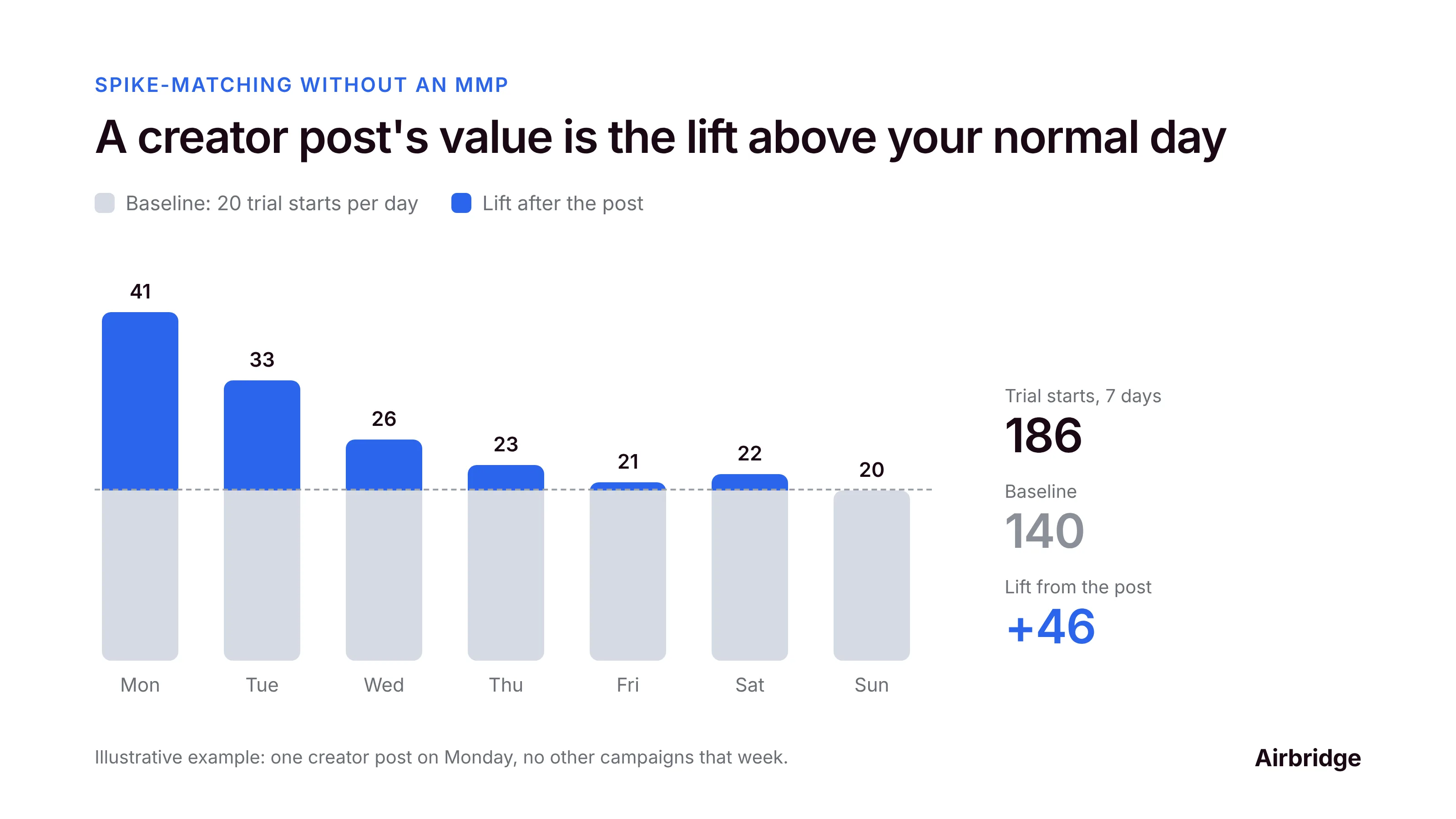
The post brought an estimated 46 extra trials. If the creator was paid $230, that is about $5 per trial. Once those trials end, apply your trial-to-paid rate to estimate cost per subscriber.
How spike-matching works
The idea is simple. If a creator's post brought new users, you should see more of them in the days after the post than you would have seen anyway.
-
Baseline: what a normal day looks like without the creator.
-
Window: the days after the post when you expect its effect.
-
Lift: the difference between the window and the baseline.
Lift = trial starts in the window − (baseline trial starts per day × days in the window)
That lift is your estimate of what the post brought in, including people who searched the App Store instead of tapping a link.
Step 1: Set a baseline you can trust
Use the average of the last two to four weeks, by day of the week if your app has a weekly pattern. Many subscription apps see different numbers on weekends than on weekdays.
Leave out days that were unusual: a featuring in the App Store, a price change, a launch post, or a paid campaign starting or stopping. If you compare against a spike, every post looks like a failure.
Step 2: Read trial starts, not downloads
Downloads are noisy. They move with store rankings, seasonality and curious visitors. Trial starts are closer to what you pay creators for, and they are less likely to move by accident.
If your app has no trial, use the first purchase or a key activation step, such as finishing onboarding. Read subscriptions once the trials from the window have ended.
Step 3: Give each post its own window
A seven-day window catches most of a short-form video's effect while keeping the read clean. Space creator posts at least three to four days apart, and ideally a full week, so the windows don't overlap.
Write down for each post: the creator, the date and time, the platform, the views at day 7, and what you paid.
Want to see how Measure creator posts without an MMP works with your data?
Get hands-on with Airbridge and see real results.
Try It Free →When spike-matching goes wrong
Spike-matching is an estimate, not a count. It gets shaky in four situations:
-
Overlapping posts. When two creators post in the same week, you can see the lift but not who caused it.
-
Long-tail videos. Some videos keep getting views for weeks. A seven-day window undercounts them, and their tail blurs into the next creator's window.
-
Other changes at the same time. A paid campaign, a price change or a store feature can create a spike no creator caused.
-
Small numbers. If your baseline is 3 trials a day, a lift of 2 could be chance. Look for bigger, repeated effects before you decide.
As one founder told us after we walked through this: "Matching spikes works well when one video clearly takes off." The trouble starts when it doesn't.
How to make the estimate sharper
You don't need an MMP to improve on raw spikes. Add two cheap signals:
-
A link per creator. Even if few people tap it, every tap is an exact count you can compare with the lift. App Store Connect campaign links and UTM-tagged Google Play links are free.
-
One onboarding question. A one-tap "Where did you hear about us?" with your creators listed by name tells you who the searchers came from.
When the link, the survey and the lift all point the same way, you can trust the read. We explain how the three fit together in Creator Attribution for Apps: How to Credit Installs When Viewers Skip the Link.
Key takeaways
-
Spike-matching estimates what a creator post brought by comparing results after the post with your normal baseline.
-
It works when you set a baseline before the post, read trial starts, not downloads, and give each post its own window of about seven days.
-
It breaks when creators post in the same week, when a video keeps pulling installs for weeks, or when something else changes at the same time.
Spike-matching FAQ
Can I measure influencer campaigns without an MMP?
Yes, roughly. Compare trial starts in the seven days after each post with your normal baseline, and add a link per creator and an onboarding survey. You get an estimate, not an exact count per creator.
What is a good baseline for creator lift analysis?
The average daily trial starts over the previous two to four weeks, by day of the week if your numbers follow a weekly pattern. Leave out unusual days like store features or launches.
How long should the window be after a creator post?
Seven days works for most short-form video. Use a longer window, such as 30 days, for YouTube videos and podcasts, which keep getting views for longer.
Why shouldn't I use downloads for lift analysis?
Downloads move with many things besides creators, such as store rankings and seasonality. Trial starts are closer to what you pay creators for, so the lift is easier to trust.
What should I do if two creators post in the same week?
You can only read their combined lift. Next time, space posts at least three to four days apart, and use a link per creator and an onboarding survey to split the credit.
Where to go from here
Spike-matching is a fair way to start measuring creators without extra tools. Set a baseline, read trial starts, give each post its own week, and be careful when posts overlap or numbers are small.
When you're ready for exact numbers on top of the estimate, Airbridge gives each creator their own tracking link and shows installs, trial starts, subscriptions and revenue per creator in one dashboard, across iOS and Android. The Core Plan is built for subscription apps, and you can try it free for 30 days, then from $40 per month.

Ready to transform your mobile growth?
Learn how Airbridge helps leading brands measure and optimize every touchpoint.