Promo Codes Undercount Your Creators: How to Track Creator Codes Fairly


Creator promo code tracking: the short answer
Giving every creator their own promo code is one of the most common ways subscription apps track influencer campaigns. It is simple, creators understand it, and the numbers look precise: 42 redemptions for one creator, 7 for another.
The trouble is what those numbers leave out. As one founder put it in an Indie Hackers discussion: "Codes only catching people who remember them is the real problem." Another team told us they track creators with a code at checkout, but added: "if people decide not to, you could get shorted." A founder on X summed it up: "promo codes undercount because most people who convert from a video never type one in."
TL;DR: A promo code only counts people who remember it, have a reason to type it, and type it in the right place. Codes also leak to coupon sites, which credits the wrong creator. Treat code redemptions as one signal, not the scoreboard. Pair each creator's code with their own tracking link and a one-tap "Where did you hear about us?" question in onboarding, then compare creators on trials and subscribers from all three.
Three ways promo codes miscount creators
Promo codes fail in three predictable ways. Two make good creators look worse. One makes some creators look better than they are.
1. Forgotten: people who never type the code
Most creator content is watched in a feed. A viewer sees the app, remembers the name, and installs it days later from App Store or Google Play search. By then, the code is long gone from their mind. They still become a subscriber. The creator gets no credit.
This gap is biggest for short-form video, where the code is said once or shown for a few seconds.
2. Skipped: people with no reason to type it
A code only gets typed when it unlocks something. If your app offers a free trial to everyone, a code that also gives a free trial adds nothing, so many people skip it. If the code field sits on a settings screen or at checkout, people who start a trial may never see it.
In both cases, the creator brought the user, but the code never shows up.
3. Leaked: codes that travel without the creator
Public codes spread. They get posted on coupon and deal sites, shared in group chats, and found by people who search "[app name] promo code" before subscribing. Those people would often have subscribed anyway, yet each redemption is credited to the creator whose code leaked.
As one founder put it, codes "leak to deal sites so the creator who gets scraped hardest looks best." A leaked code can make an average creator look like your best one, and can quietly cost you full-price revenue.
What this does to your creator rankings
Put the three together and code-only rankings get distorted in both directions:
| What happens | Effect on the creator's code count | Who it misleads you about |
|---|---|---|
| Viewers forget the code | Too low | Creators whose audiences search the store |
| Viewers have no reason to type it | Too low | Creators driving trial users |
| The code leaks to coupon sites | Too high | Creators with widely shared codes |
What promo codes are still good for
None of this means you should drop codes. They do things links can't:
-
They give viewers a reason to act now. An extra week of trial or a first-month discount turns "maybe later" into a download.
-
They work where links can't. A creator can say a code out loud in a video, a podcast or a livestream.
-
They are easy for creators to understand. Many creators expect a code and like being able to see their own redemptions.
Both app stores support subscription codes natively, so you don't need to build your own system:
| App Store (Apple) | Google Play | |
|---|---|---|
| Code types | One-time-use codes and custom codes (for example, SPRINGPROMO) | One-time-use codes and custom codes |
| Where custom codes are redeemed | Through a redemption URL or inside your app | Inside your app |
| What a subscription code can offer | A free or discounted period you set up as an offer | A free trial of 3 to 90 days |
| Good fit for creators | One custom code per creator, with its own offer reference name | One custom code per creator |
A practical tip: on the App Store, each offer has a reference name that identifies its sales in Sales and Trends reports. If you set up one offer per creator, you can see redemptions creator by creator.
The point is not that codes are bad. It's that a code count is only the part of a creator's impact that typed something.
Code + link + one question: a setup that counts every creator fairly
The fix is not a better code. It's giving each creator three ways to be counted, so the people who forget the code still show up somewhere.
-
Give each creator a code, a link and a name. Create one custom code per creator, one tracking link per creator, and add the creator's name to your onboarding survey. All three should point to the same creator ID in your sheet.
-
Make the code worth typing. Tie it to something people can't get without it, such as a longer trial or a first-month discount. If the code adds nothing, most people won't bother.
-
Ask for the code where people actually are. Put the code field in onboarding, not only at checkout or in settings. One founder suggested making it part of the flow: "if you gamify it in your app people will fill it out and attribution becomes easier."
-
Add one onboarding question. A single-tap "Where did you hear about us?" with your creators listed by name catches people who searched the store and never typed the code.
-
Put the link where it can be tapped. Ask creators to place their link in their bio or an Instagram Story link sticker. The link credits every person who taps all the way to trial and subscription.
-
Limit leaks. Set a redemption cap and an end date on each custom code. Watch for red flags: redemptions weeks after the creator's last post, or from countries the creator doesn't reach. When a code leaks, retire it and issue a new one.
With this setup, the code becomes one of three signals instead of the only one. We explain how links and the onboarding question work together in Creator Attribution for Apps: How to Credit Installs When Viewers Skip the Link.
Want to see how Creator promo code tracking works with your data?
Get hands-on with Airbridge and see real results.
Try It Free →How to read the numbers per creator
Once you have three signals, read them side by side. Here is an illustrative example from three creators, 14 days after each post:
| Creator | Code redemptions | Link trials | Survey mentions | What's going on |
|---|---|---|---|---|
| Creator A | 38 | 6 | 9 | Redemptions keep coming weeks after the post: the code likely leaked |
| Creator B | 5 | 21 | 34 | The audience taps and searches but rarely types codes |
| Creator C | 12 | 10 | 13 | All three signals agree |
Numbers are illustrative.
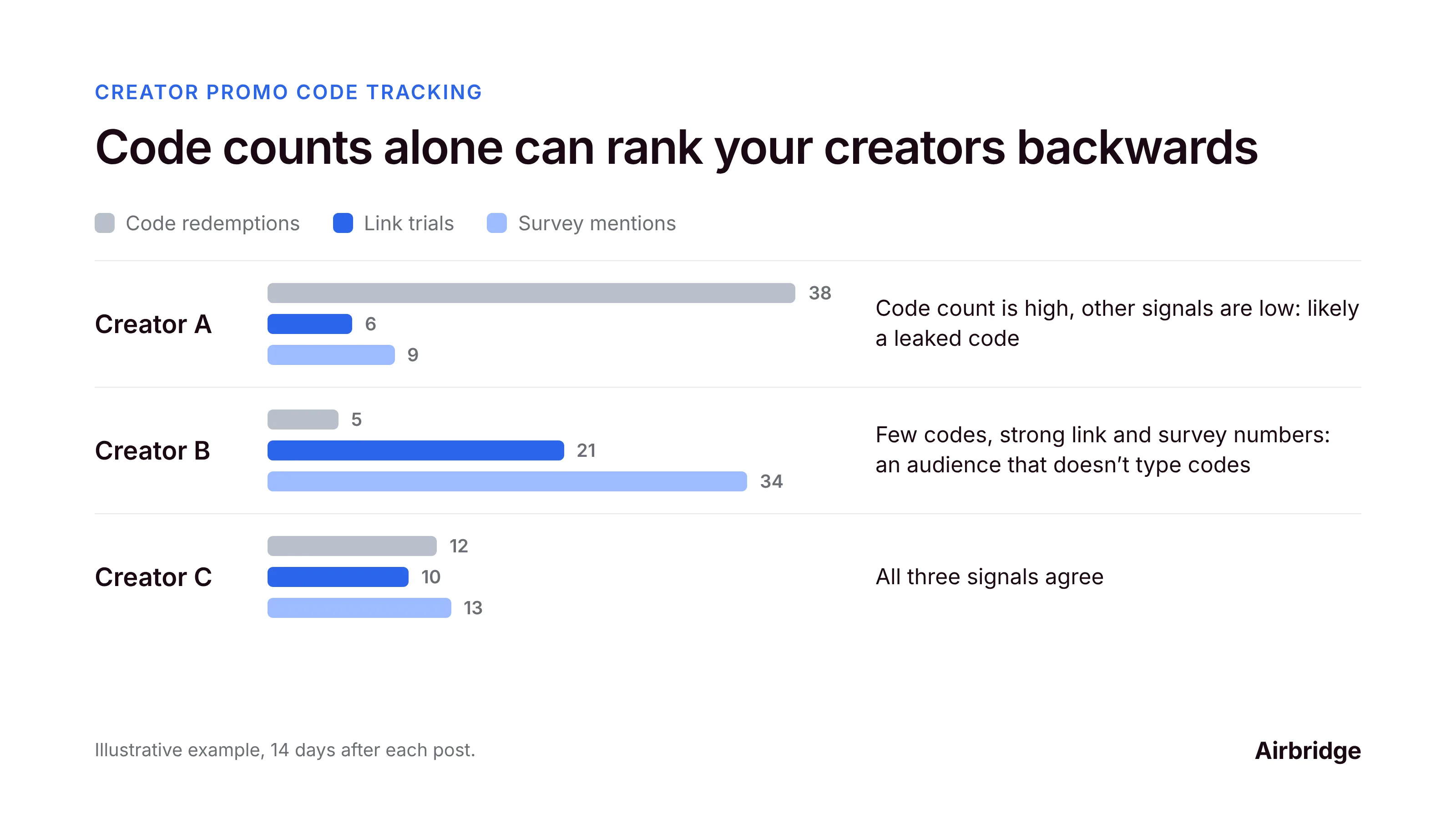
Ranked by codes alone, Creator A is the clear winner and Creator B looks like a dud. Ranked by all three signals, Creator B brings the most new users, and much of Creator A's count may be people who found the code on a coupon site.
A few rules make the comparison fair:
-
When signals disagree, look for the reason. High codes with low links and low survey mentions usually means a leak. Low codes with strong links and survey mentions usually means an audience that doesn't type codes.
-
Don't add the three numbers together. The same person can tap the link, mention the creator in the survey and type the code. Use the strongest consistent signal per creator, and treat the others as checks.
-
Judge every creator over the same window. A creator read at day 14 will always look better than one read at day 3.
-
Finish with cost per subscriber. Divide what you paid each creator by the subscribers you can credit to them. We walk through this in Paying Creators on CPM? Track Cost per Subscriber, Not Just Views.
FAQ
Are promo codes a reliable way to track influencer campaigns for apps?
Not on their own. Promo codes only count people who remember the code, have a reason to type it, and type it in the right place. They also leak to coupon sites. Use codes alongside a tracking link per creator and an onboarding survey.
Why do creator promo codes undercount installs and subscribers?
Many viewers install days later from App Store or Google Play search and forget the code. Others start a free trial that doesn't need a code. In both cases, the creator brought the user but gets no credit.
How do I stop influencer promo codes from leaking to coupon sites?
You can't stop it completely, but you can limit the damage. Set a redemption cap and an end date on each custom code, watch for redemptions long after the creator's post, and retire leaked codes. Judge creators on links and survey answers too, not codes alone.
Should I use App Store offer codes or my own in-app codes for creators?
App Store and Google Play offer codes handle the discount or free period and the redemption flow for you. Your own in-app codes give you more control over what the code unlocks and where it's entered. Either works, as long as each creator gets their own code.
Can a creator use both a promo code and a tracking link?
Yes, and they should. The link credits everyone who taps it, through trial and subscription. The code catches people who saw the video somewhere a link can't be tapped, such as a podcast or livestream.
How do I compare creators if some have high code redemptions and low link clicks?
Look for the reason. High codes with few link trials and few survey mentions often points to a leaked code. Low codes with strong link and survey numbers usually means an audience that doesn't type codes. Compare creators on cost per subscriber over the same time window.
The bottom line
Promo codes are a good way to give viewers a reason to act and a poor way to keep score. They miss people who forget or skip the code, and they over-credit creators whose codes leak.
Keep the codes, but don't judge creators on them alone. Give every creator a code, a link and a spot in your onboarding survey, read the three side by side, and make renewal decisions on cost per subscriber.
If you'd like the link side done for you, Airbridge gives each creator their own tracking link and shows installs, trial starts, subscriptions and revenue per creator in one dashboard, across iOS and Android. The Core Plan is built for subscription apps, and you can try it free for 30 days, then from $40 per month.

Ready to transform your mobile growth?
Learn how Airbridge helps leading brands measure and optimize every touchpoint.