Paying Creators on CPM? Track Cost per Subscriber, Not Just Views

Creator CPM vs. cost per subscriber: the short answer
Paying creators per view is popular for a good reason. It is simple, it is fair to the creator, and views are easy to verify. Many subscription apps start with a small flat fee plus a CPM, for example $10 per video plus $1 per 1,000 views.
The problem shows up at renewal time. In October 2026, we asked more than 70 subscription apps that work with creators how they measure them. The most common answer was views. One founder replied in two words: "typically views." Another founder told us, "mostly views, since I am not getting into creator-specific links at the moment."
Views tell you how far a video traveled. They don't tell you how many people started a trial, or how many paid.
TL;DR: CPM is a fine way to pay creators, but a poor way to judge them. Before you renew a creator, compare them on two numbers:
-
Cost per trial = what you paid the creator ÷ trials credited to them
-
Cost per subscriber = what you paid the creator ÷ paying subscribers credited to them
These numbers often rank creators very differently from views. The creator with the most views can easily be your most expensive source of subscribers.
Why views and subscribers drift apart
If every view converted at the same rate, paying on views would be the same as paying on results. In practice, the path from a view to a paying subscriber has several steps, and creators differ at every one.
-
Audience fit. A video can go viral with people who will never need your app. A smaller creator in your niche often reaches people who already have the problem you solve.
-
Format and intent. An entertaining video gets shared. A video that shows the app solving a real problem gets installs. The two don't always overlap.
-
Trial-to-paid quality. Some audiences start trials out of curiosity and cancel. Others start fewer trials but convert to paid at a much higher rate.
-
Audience geography. Views from regions where you don't sell well, or where prices are lower, count the same in CPM but bring less revenue.
-
Inflated views. CPM rewards reach, so it also rewards recycled or low-quality reach. A creator who reposts across accounts can raise views without raising installs.
One founder, looking back on a video that reached 69,000 views, put it this way: "Views are not an audience. People watched the video, not me." That is the gap CPM can't see.
The metric to use instead: cost per subscriber
Here is an illustrative example. An app pays three creators the same deal: $50 per video plus $1 CPM. After 14 days, it checks trials and paid subscribers credited to each creator.
| Creator | Views | Paid ($50 + $1 CPM) | Trials | Paid subscribers | Cost per trial | Cost per subscriber |
|---|---|---|---|---|---|---|
| Creator A | 400,000 | $450 | 40 | 12 | $11.25 | $37.50 |
| Creator B | 120,000 | $170 | 60 | 24 | $2.83 | $7.08 |
| Creator C | 60,000 | $110 | 12 | 3 | $9.17 | $36.67 |
Numbers are illustrative.
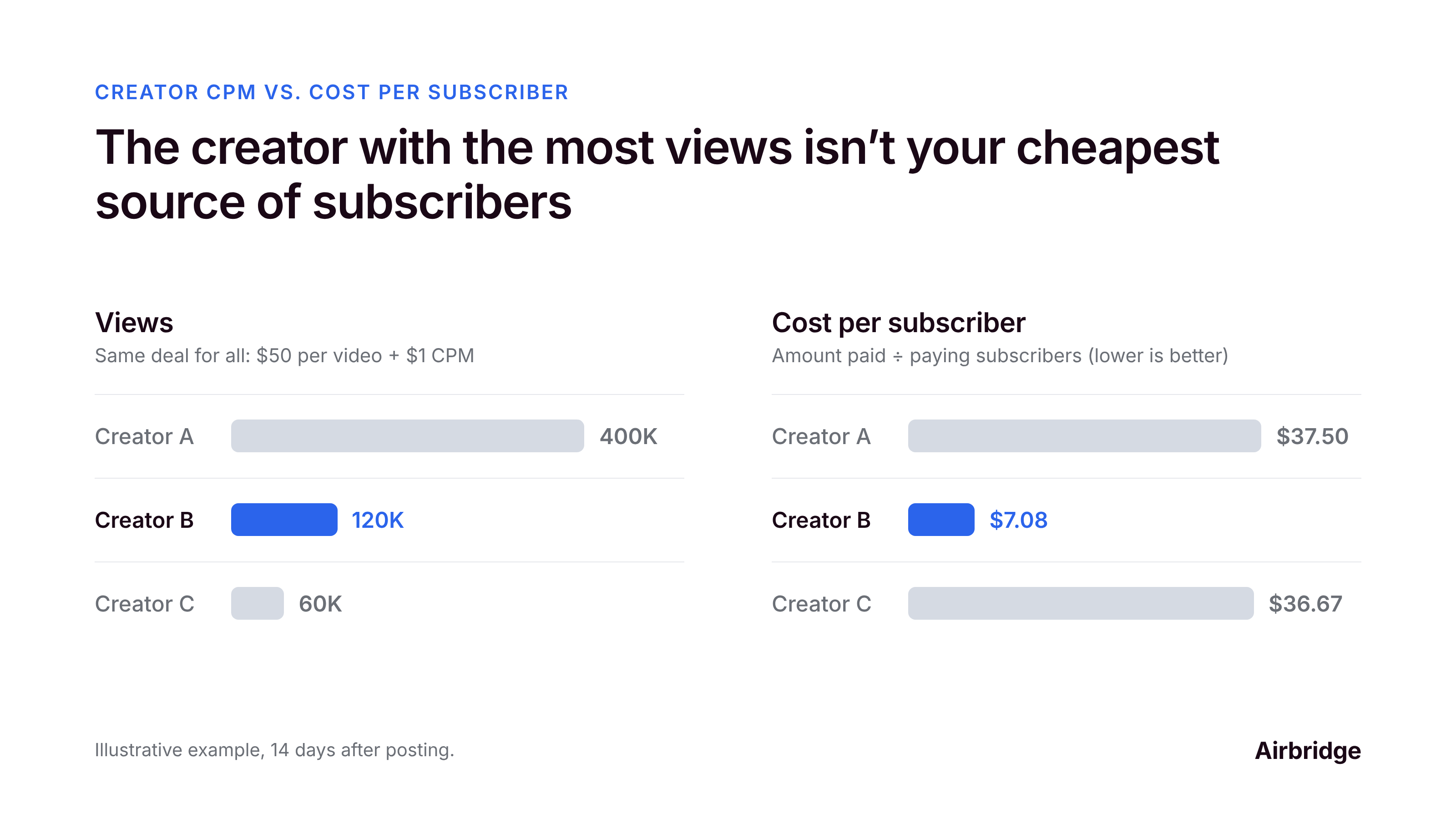
On views, Creator A looks like the star, with more than three times Creator B's reach. On cost per subscriber, Creator B is more than five times cheaper. Creator A and Creator C cost about the same per subscriber, even though A had almost seven times the views.
Now add what a subscriber is worth to you. Say an average subscriber brings $30 in net revenue in their first year. Creator B pays back many times over. Creators A and C lose money on every subscriber at today's deal.
That changes the renewal decision completely:
-
Creator B: renew, and offer more videos or a higher rate to keep them.
-
Creator A: renegotiate. Lower the CPM, cap it, or move part of the fee to a bonus per subscriber.
-
Creator C: pause, or test one more video with a different format before deciding.
Cost per trial is your early signal, available within days. Cost per subscriber is your final answer, available once trials end.
Want to see how Cost per subscriber works with your data?
Get hands-on with Airbridge and see real results.
Try It Free →How to get trials and subscribers per creator
Cost per subscriber needs one input CPM deals don't give you: how many trials and subscribers each creator brought. Here is how to get it without a big setup.
-
Give every creator their own tracking link. Put it in their bio or an Instagram Story link sticker, since links in TikTok, Instagram and YouTube Shorts captions and comments aren't clickable. A mobile measurement partner (MMP) link follows each person who taps through install, trial start and subscription, so you get exact numbers for that audience.
-
Ask one onboarding question. A single-tap "Where did you hear about us?" with your creators listed by name catches viewers who searched the App Store instead of tapping.
-
Space creator posts a few days apart. Then compare trial starts in the 7 days after each post with your normal baseline to estimate what links and the survey missed.
-
Log it in one weekly sheet. For each creator: amount paid, views, link trials, link subscribers, survey mentions, and trial lift over baseline.
Many short-form viewers search the store instead of tapping, so the link alone will undercount every creator. That's fine for comparison, as long as you treat the link as the exact part and the survey and lift as the estimate. We cover this in detail in Creator Attribution for Apps: How to Credit Installs When Viewers Skip the Link.
One rule matters more than the tools: judge every creator over the same window. A creator measured at day 14 will always look better than one measured at day 3.
Renewal rules: keep, renegotiate or drop
Once you have cost per subscriber for each creator, set a target before you look at the names. A simple target is the most you can pay for a subscriber and still break even in the first year. Then sort every creator into one of three groups.
| Result vs. your target | Decision | What to change in the deal |
|---|---|---|
| Cost per subscriber well below target | Keep and grow | Book more videos, lock in the current rate, give them more creative freedom |
| Cost per subscriber near or above target, but trials look healthy | Renegotiate | Lower or cap the CPM, or move part of the fee into a bonus per trial or subscriber |
| High cost per trial and few subscribers after two posts | Drop or pause | Thank them, and test a different creator in the same niche |
A few habits make these rules hold up:
-
Give each creator at least two posts before deciding. One video can flop or pop for reasons that have nothing to do with the creator.
-
Cap CPM payouts. A cap protects you when a video goes viral with the wrong audience.
-
Consider a hybrid deal. A small flat fee plus CPM plus a bonus per subscriber keeps the creator's income predictable and ties part of it to the result you care about.
-
Share the numbers with your best creators. Creators who see which formats bring subscribers tend to make more of them.
FAQ
What is a good CPM for UGC creators?
There is no single good CPM, because CPM only prices views. A $1 CPM can be expensive if the audience never subscribes, and a $10 CPM can be cheap if it does. Set your limit on cost per subscriber, then work backward to the CPM you can afford for each creator.
How do I calculate cost per subscriber for a creator?
Divide the total you paid the creator by the number of paying subscribers credited to them. Count subscribers from link tracking, onboarding survey answers and the lift above your baseline in the same time window.
Is cost per trial or cost per subscriber more important?
Cost per subscriber is the final measure of value. Cost per trial is the early signal you can read within a week, before trials convert. Use cost per trial to spot problems early and cost per subscriber to make renewal decisions.
Should I stop paying creators per view?
Not necessarily. CPM is simple and creators like it. Keep paying on views if it works for you, but cap it, and decide renewals on cost per subscriber. A hybrid deal with a per-subscriber bonus is a good middle ground.
How many posts should I test before dropping a creator?
At least two posts over the same time window. A single video can underperform for reasons outside the creator's control, such as timing or what else was trending that week.
Why does a viral creator video bring so few subscribers?
Viral reach often goes beyond the creator's core audience to people who don't need your app. Views rise fast, but installs, trials and subscriptions don't follow at the same rate.
The bottom line
CPM is a good way to pay creators and a poor way to judge them. Views measure reach. Your business runs on subscribers.
Before every renewal, put each creator's cost per trial and cost per subscriber next to their views. Keep the creators who bring subscribers cheaply, renegotiate the ones who bring reach without results, and give your budget to the formats that convert.
If you'd like those numbers without building the tracking yourself, Airbridge gives each creator their own link and shows installs, trial starts, subscriptions and revenue per creator in one dashboard, across iOS and Android. The Core Plan is built for subscription apps, and you can try it free for 30 days, then from $40 per month.

Ready to transform your mobile growth?
Learn how Airbridge helps leading brands measure and optimize every touchpoint.