Best Meta Attribution for Sleep Tracking App

On this page
Look for a tool that follows a Meta click past the install to the trial start and the paid subscription that comes days later. Sleep apps prove their value slowly, so a tool that stops at the install will mislead you. Airbridge makes one of the tools compared here, so weigh this page with that in mind.
What sleep tracking apps need from Meta
A sleep app runs on an odd clock. Many people install it in bed, then get nothing useful until the next morning. The first result is one night of data. A trend takes several nights. So the install tells Meta almost nothing about who will pay.
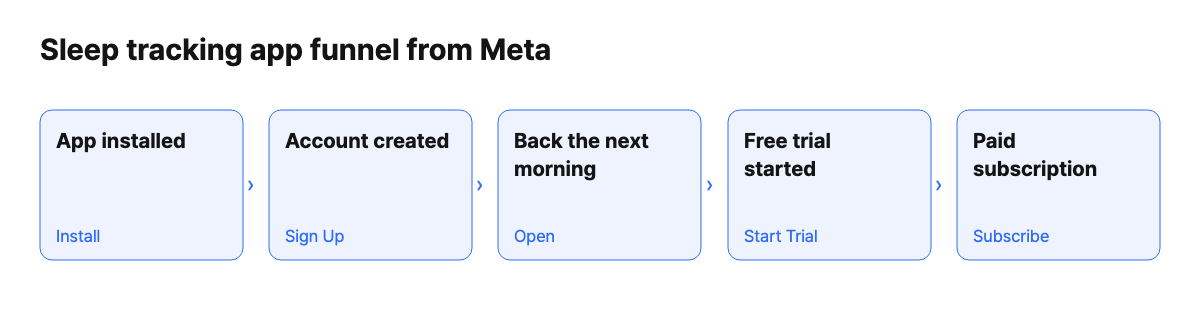
That gap decides which events matter. A typical path is install, sign up, trial start, a few nights of use, then a paid subscription or a cancellation. Meta's delivery learns from the signals it receives. If it only sees installs, it looks for more people who install. You want it to see trial starts, and you want your own reports to show who kept paying.
The audience is also split, and each group buys for a different reason:
- Adults tracking their own sleep. They want a score and a trend, as in Sleep Cycle or RISE.
- Parents. Napper is a baby sleep tracker. The parent pays, and the baby is the subject of the data.
- People who want to fall asleep faster. Sounds lead here, as in BetterSleep and Endel.
- Device owners. Hatch Sleep sits beside a physical product, so the app may not be the first purchase.
These groups also leave for different reasons. A parent may cancel once the baby sleeps through the night. An adult may cancel once a habit sticks. Neither is a failed campaign, so read cancellations by campaign and not only in total.
Demand moves with the calendar too. Clock changes and new-year habit goals can shift who clicks, so compare like periods before you judge a campaign.
What the data shows
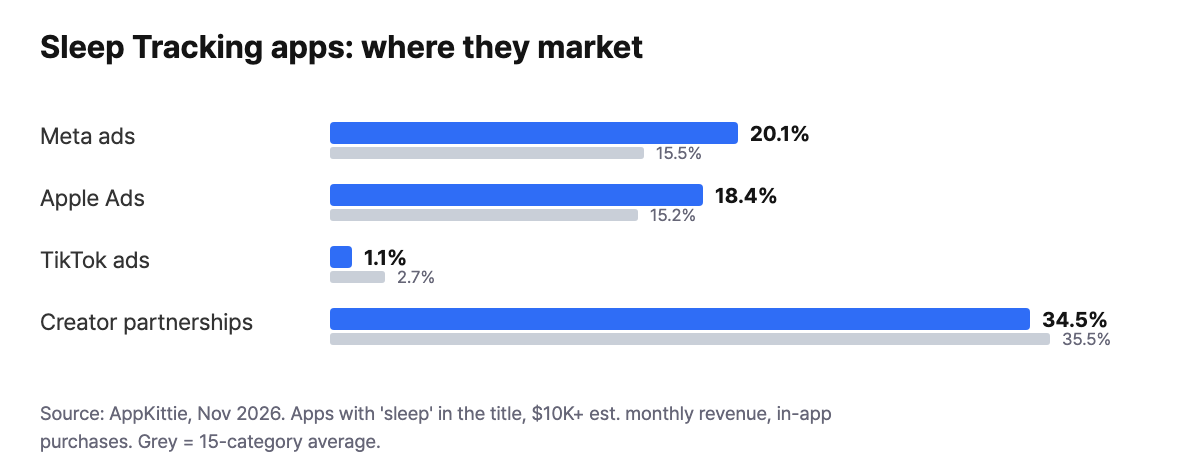
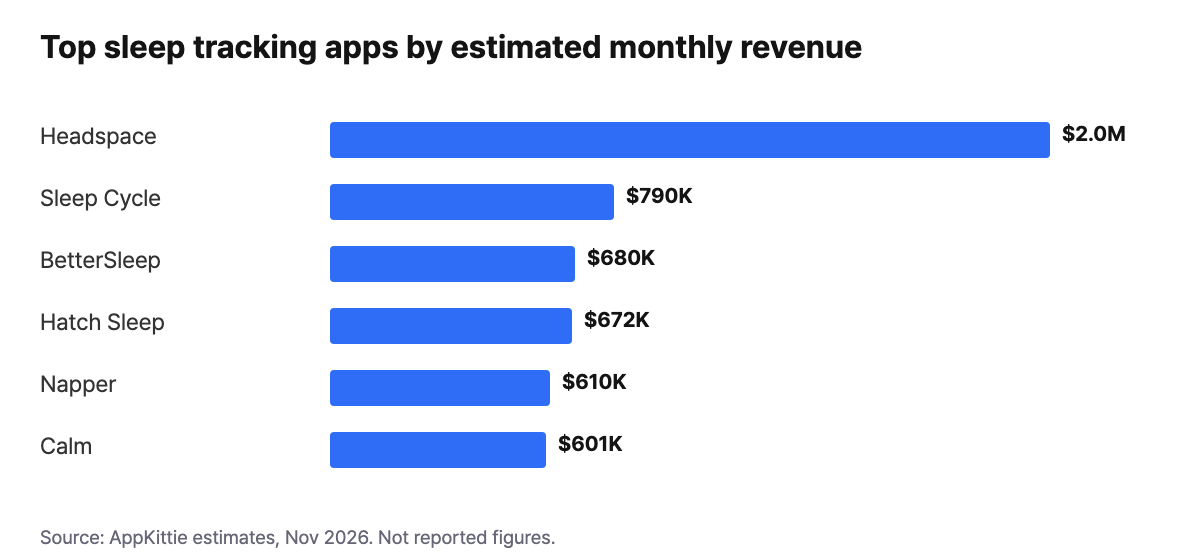
Of 174 apps matched by title, with $10K+ estimated monthly revenue and in-app purchases (AppKittie, November 2026), 35 show Meta ads. That is 20.1%, above the 15.5% average across 15 categories, while the creator signal at 34.5% sits close to its 35.5% average and does not prove a creator campaign. The revenue chart shows estimates from a small sample of 41 apps, and title matching pulls in meditation brands like Headspace ($2M) and Calm ($601K), so Sleep Cycle ($790K) and Napper ($610K) are the closer peers.
How to choose
| What to check | Why it matters for a sleep app |
|---|---|
| Events after the install | The buying decision comes after several nights, not on install day. |
| Lookback window control | A bedtime ad click and a next-day install should still connect. |
| How events reach Meta | Ask whether the tool uses a mobile postback or a Conversions API, and on which plan. |
| Reporting that matches your split | Parents and adult trackers need separate campaigns and separate reads. |
| iOS reporting | If your users lean toward iPhone, you need SKAN reporting you can read. |
| Billing on your real volume | A nightly app can send many events. Compare event billing with conversion billing. |
Want to see how Best meta attribution for sleep tracking apps works with your data?
Get hands-on with Airbridge and see real results.
Try It Free →Tools compared
| Airbridge Core | AppsFlyer | Adjust | Branch | Singular | Kochava | |
|---|---|---|---|---|---|---|
| Starting price | $40+/mo | Zero plan free (12,000 conversions in first 12 months); Growth $0.07 per conversion | Check vendor pricing page | Not listed on pricing page | Free plan (15,000 paid conversions); Growth $0.05 per conversion | Free App Analytics (10K conversions/month); Foundation from $500/mo |
| Self-serve signup | Yes | Yes | Check vendor pricing page | Yes on Basics | Yes on Free | Yes |
| Billing model | Data points | Per conversion | Check vendor pricing page | Not stated on pricing page | Per conversion | Conversions or MAU, by plan |
| Free trial | 30 days | Free Zero plan instead | Check vendor pricing page | Yes, on Basics | Free plan instead | Yes, on paid plans |
| RevenueCat integration | Yes | Yes | Yes | Yes | Yes | Yes |
Competitor details come from each vendor's public pages as of November 2026. AppsFlyer says its Zero plan is not suitable for apps with paid activities.
Where each one may fit a sleep app:
- AppsFlyer may suit a team ready for $0.07 per conversion on Growth, since it says its Zero plan is not suitable for apps with paid activities.
- Adjust may suit a team willing to get terms directly, since this table has no public price for it.
- Branch may suit a team that wants a free trial on Basics and can ask for pricing, which is not listed.
- Singular may suit a team that wants to start on a free plan with 15,000 paid conversions, then pay $0.05 per conversion.
- Kochava may suit a team that wants Free App Analytics first, with Foundation from $500/mo later.
- Airbridge Core may suit a team that prefers a 30-day trial, then $40+/mo billed on data points.
How to set this up in Airbridge
- Open a trial with no card, then add the SDK. Plan on about 5 minutes for a basic install. This setup guide walks through it.
- Connect Meta Ads and your subscription tool. RevenueCat, Adapty, and Superwall are supported. A trial start maps to Start Trial, and a first purchase, trial conversion, or renewal maps to Subscribe. See how to connect RevenueCat revenue to ads.
- Send standard events only: Install, Sign Up, Start Trial, Subscribe, and Unsubscribe. Add Open if you want to see who came back the next morning.
- Turn on the mobile app postback to Meta. Set up the SKAN conversion value manager for iOS.
- Read the Revenue Report with Subscribe as the Revenue Event, then check Actuals. The Revenue Report credits each revenue event to the most recent Start Event with no attribution window. Actuals counts only events inside the window, so a slow trial can look smaller there.
What Airbridge Core does not do here
- No Conversions API. CAPI is on Growth only. Core sends mobile app postbacks to Meta. If your Meta plan depends on server events, look at Growth or another vendor.
- No custom events. You cannot send "first night tracked" or "sleep score viewed." Core uses standard events only, so a team that wants Meta to learn from a sleep-specific moment should pick something else.
- Subscribe covers three moments. A first purchase, a trial conversion, and a renewal all arrive as Subscribe. Core has no dedicated refund event, so a refund only shows up if it triggers a cancellation.
- No creative-level cost. Cost data reaches campaign or ad group level. If you test many sleep creatives, you will still read creative results inside Meta.
FAQ
Will Airbridge still credit Meta if the trial starts days after the click?
It depends on the report. The click lookback sets how long after a click an install can still match it. It defaults to 7 days on device ID and 1 day on probabilistic matching, and you can adjust it from 0 minutes to 30 days. Once the install matches, read the Revenue Report and Actuals together, since only Actuals limits later events to the window.
What does Signal Hold (beta) do for a sleep app?
Signal Hold, currently in beta, is a Meta Ads feature on every plan. It suppresses events. It does not create new ones, so it cannot build a "kept using the app for a week" signal for you.
Can I compare baby sleep and adult sleep audiences?
Yes, if you split them into separate campaigns. Filters and GroupBy are on Core, and cost reaches campaign or ad group level. If one campaign mixes both groups, no report can pull them apart later. A blended campaign also hides the fact that each group cancels for its own reason.
Ready to transform your mobile growth?
Learn how Airbridge helps leading brands measure and optimize every touchpoint.
“While working with Airbridge, we have learned that MMM is a crucial attribution model for post-privacy era marketing to predict future performance and optimize the budget.”