Best LTV Prediction for Language Learning App

On this page
For a language learning app, look for LTV prediction whose time window covers your real plan lengths, and be clear about where the prediction can go. A prediction that stops before an annual renewal, or that stays in a dashboard, can still help, but only with budget decisions you make by hand. Airbridge makes one of the tools compared here, and its predictive LTV (pLTV) runs up to day 180 and is never sent to ad networks.
What language learning apps need from LTV prediction
Learners arrive with a deadline or a dream. Some have a trip coming up. Some have an exam or a move abroad. Others made a New Year promise. The first group may leave on purpose once the goal passes. The last group may pay for a year and stop opening the app by spring. Same install, very different value.
Annual plans make prediction harder here. Many apps in this category push yearly plans, and the cash arrives on day one. A yearly payer has shown commitment, but the real test sits at the first renewal, a year later. A monthly learner gives you a signal each month. Mixing the two in one average hides what you need to know.
Costs also matter now. Several apps in this data sell AI tutors and speaking practice. Those features cost money each time a learner uses them. Two users with equal revenue can leave very different margins, and revenue LTV will not show that. Keep a rough cost per active user next to any prediction.
Free tiers add another layer. Some language apps earn from ads as well as plans. If yours does, count ad revenue, or free users will look worthless on paper.
What the data shows
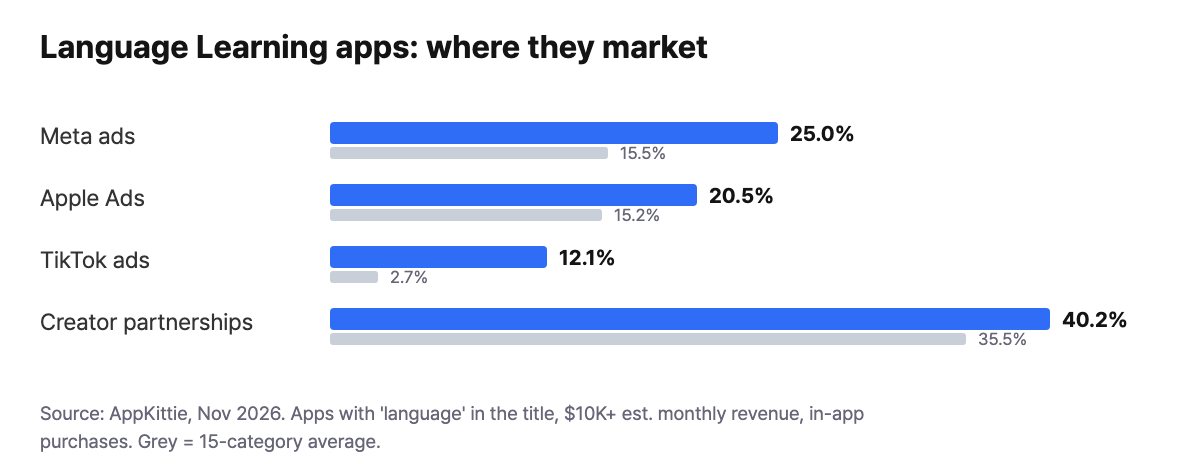
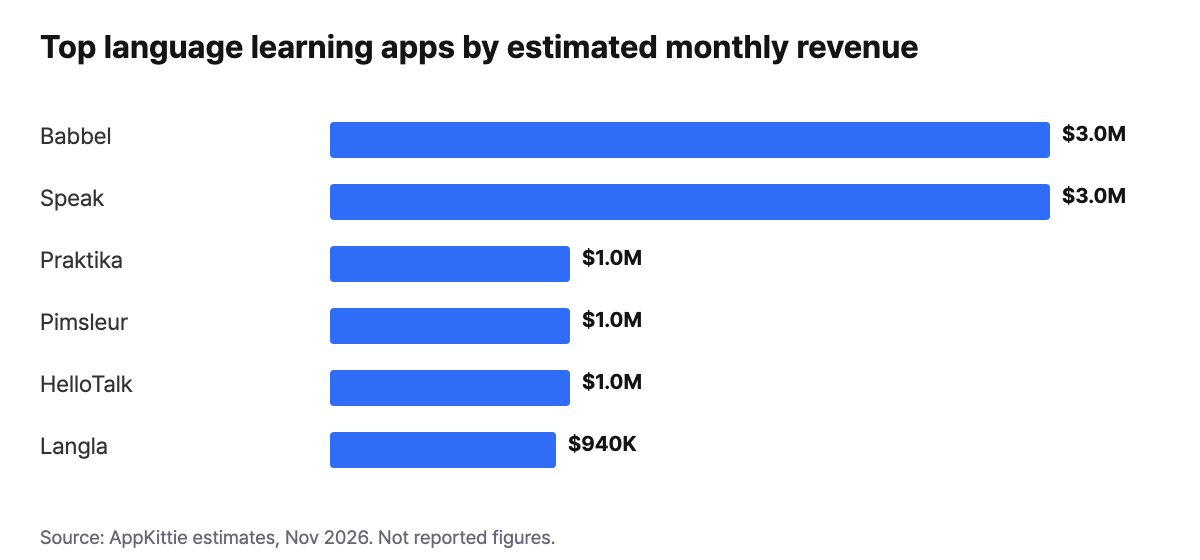
We matched 132 apps with "language" in the title in AppKittie in November 2026, each with $10K+ estimated monthly revenue and in-app purchases, and they run above the average on all four signals: Meta ads 25.0%, Apple Ads 20.5%, TikTok ads 12.1%, and creator flags 40.2%. More channels make LTV comparison more valuable, though a creator flag shows a link, not a budget. Babbel and Speak lead at an estimated $3M a month, and Langla, released in April 2026, already sits at an estimated $940K, so a young app can scale before it has any long payment history to model from.
How to choose
- Horizon against plan length. Line up the prediction window with your plans. A window of 180 days covers several monthly renewals and no annual one.
- What the model predicts. Ask for the method. Some models multiply parts, such as lifetime and daily revenue. Know which part moves when your plan mix changes.
- Where the number goes. A dashboard figure informs your budget. A figure sent to ad networks changes their bidding. These are very different products.
- Revenue inputs. Check that subscription revenue, and ad revenue if you have it, reach the tool.
- A way to check it. You should be able to compare a prediction with what users actually paid later.
Want to see how Best ltv prediction for language learning apps works with your data?
Get hands-on with Airbridge and see real results.
Try It Free →Tools compared
| Airbridge Core | AppsFlyer | Adjust | Branch | Singular | Kochava | |
|---|---|---|---|---|---|---|
| Starting price | $40+/mo | Zero plan free (12,000 conversions in first 12 months); Growth $0.07 per conversion | Check vendor pricing page | Not listed on pricing page | Free plan (15,000 paid conversions); Growth $0.05 per conversion | Free App Analytics (10K conversions/month); Foundation from $500/mo |
| Self-serve signup | Yes | Yes | Check vendor pricing page | Yes on Basics | Yes on Free | Yes |
| Billing model | Data points | Per conversion | Check vendor pricing page | Not stated on pricing page | Per conversion | Conversions or MAU, by plan |
| Free trial | 30 days | Free Zero plan instead | Check vendor pricing page | Yes, on Basics | Free plan instead | Yes, on paid plans |
| RevenueCat integration | Yes | Yes | Yes | Yes | Yes | Yes |
Competitor details come from each vendor's public pages as of November 2026. AppsFlyer says its Zero plan is not suitable for apps with paid activities.
- AppsFlyer offers the Zero plan with 12,000 conversions in the first 12 months, which may suit an app with no paid activities yet, then $0.07 per conversion on Growth.
- Adjust lists no price here, so start at its pricing page.
- Branch may suit a team that wants to try Basics through self-serve signup, once it has asked about the unlisted price.
- Singular may suit a learner app that likes per-conversion billing, with 15,000 paid conversions on the free plan.
- Kochava offers Free App Analytics at 10K conversions a month, and its paid Foundation plan from $500/mo may suit a larger budget.
- Airbridge Core may suit a small team that wants a 30-day free trial and $40+/mo billed on data points, and can act on a dashboard number.
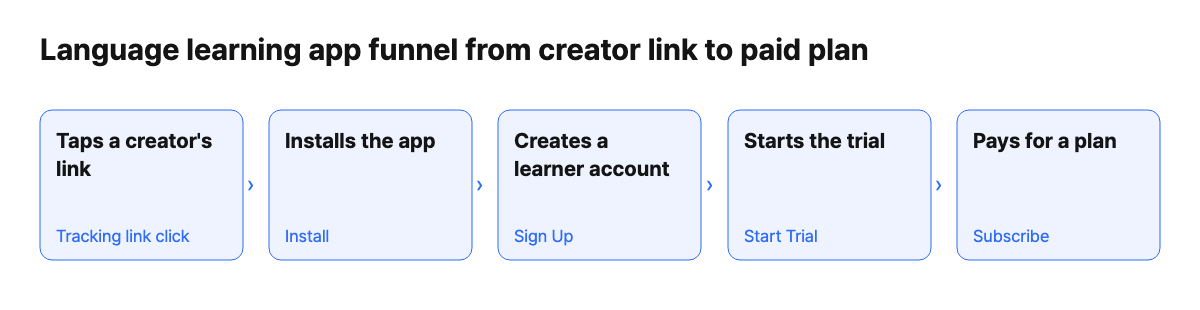
How to set this up in Airbridge
- Start the free trial and do a basic SDK install, which takes about 5 minutes. No sales call is needed.
- Connect the channels you pay for, such as Meta Ads, Apple Ads, TikTok for Business, and Google App campaigns (formerly UAC). Use tracking links for creator campaigns.
- Send Install, Sign Up, Start Trial, and Subscribe as standard events, and connect RevenueCat or another subscription tool. In the Revenue Report, pick Subscribe as the Revenue Event.
- Read pLTV by channel in the Revenue Report. Set Start Event to Install (App), GroupBy to Channel, and granularity to Daily, with a period of 1 to 180 days. Revenue events with value must be collected. The date range must start at least 3 days ago, and 13 or more days is recommended, so a new campaign needs a short wait. pROAS and CAC also need cost data. Write down the budget change the numbers suggest, then move that budget yourself in each ad platform.
- Come back later and compare the prediction with Subscribe revenue. The Revenue Report credits each revenue event to the most recent Start Event with no attribution window, so late renewals still count.
What Airbridge Core does not do here
- It stops at day 180. An annual plan renews after that, so pLTV cannot show a yearly learner's first renewal. Judge annual cohorts on real renewals.
- It stays in the dashboard. pLTV is never sent to ad networks, so it cannot steer bidding on Meta or Google. If value-based bidding on predictions is your goal, you need another approach.
- No custom events. Lesson finished and streak kept cannot reach Airbridge on Core.
- No raw data export. A team that wants to train its own model on event data should look at Growth.
FAQ
How does Airbridge calculate pLTV?
It uses machine learning to predict user lifetime, then multiplies that by ARPDAU, which is average revenue per daily active user. It is a prediction built from two parts, so check it against real revenue before you trust it with a large budget.
Should small apps use LTV prediction at all?
Not always. If you spend little and most users choose one plan, real revenue by channel may answer your question. pLTV also needs at least 30 users in the group, so a thin channel will not qualify yet. Prediction helps most when you must decide before renewals arrive, for example when a new channel is eating budget this month.
Can I read annual and monthly learners together?
You can, but the result misleads. A yearly payment arrives all at once, while monthly revenue builds over time. Read them apart when you can, and judge each against its own renewal date.


Ready to transform your mobile growth?
Learn how Airbridge helps leading brands measure and optimize every touchpoint.
“Braze is a powerful tool on its own, but when paired with Airbridge, it creates synergies for retargeting campaigns, saving resources and enhancing performance.”