Best Google UAC Attribution for Online Education App
On this page
For an online education app, look for attribution that links Google App campaigns (formerly UAC) to paying learners, not just installs, and that is clear about how deep its Google reporting goes. Free lessons bring in many people who never pay, so install counts alone will mislead you. Airbridge makes one of the tools compared here, and its Core Plan includes Google Ads as one of four ad channels.
What online education apps need from Google App campaigns
Google App campaigns run on automation. You supply assets and a goal, and Google decides where the ads run. You have few levers, so the event you measure and send back carries more weight than it would in a manual campaign. If install is the only signal, the campaign learns to find people who install.
That is a real risk for education apps, because the free tier is often generous. A learner can spend weeks on free lessons without paying. Some never pay, and some pay for one exam and leave. An install-based view treats them all as equal wins.
Demand follows deadlines. Exam dates, school terms, and new year goals bring people in waves. A language learner preparing for a move behaves differently from a student cramming for a test next month. A campaign that looks efficient in one wave can fade in the next, so judge it across a full cycle.
Payment models also vary more than in most subscription categories. Some apps sell a monthly or annual subscription. Others sell a single course, or a mix of both. Your tracking has to handle a recurring subscription and a one-time course sale side by side, or the channel that sells courses will look weak.
Many courses also get researched on a laptop before anyone opens the app. If you run web campaigns as well, decide early how those visits connect to the app.
What the data shows
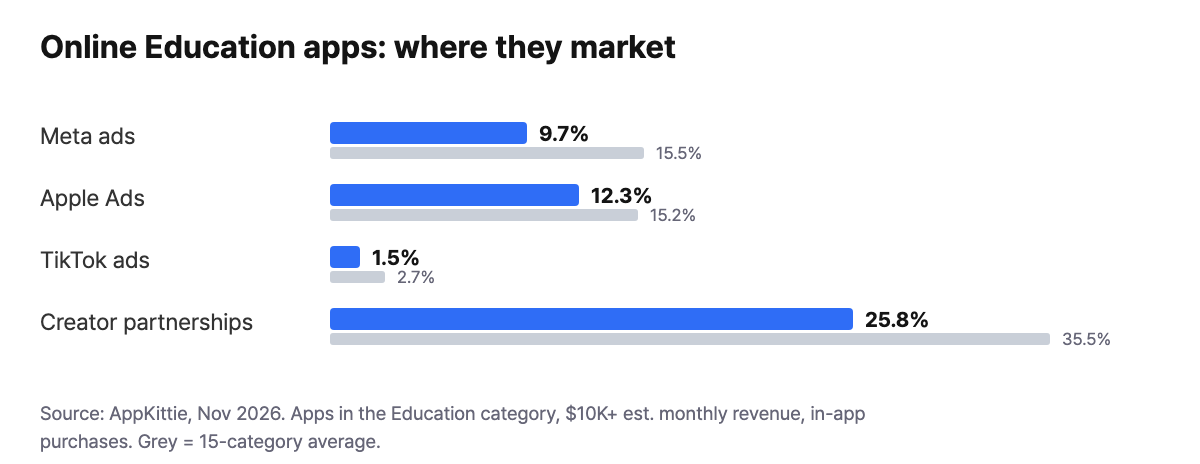
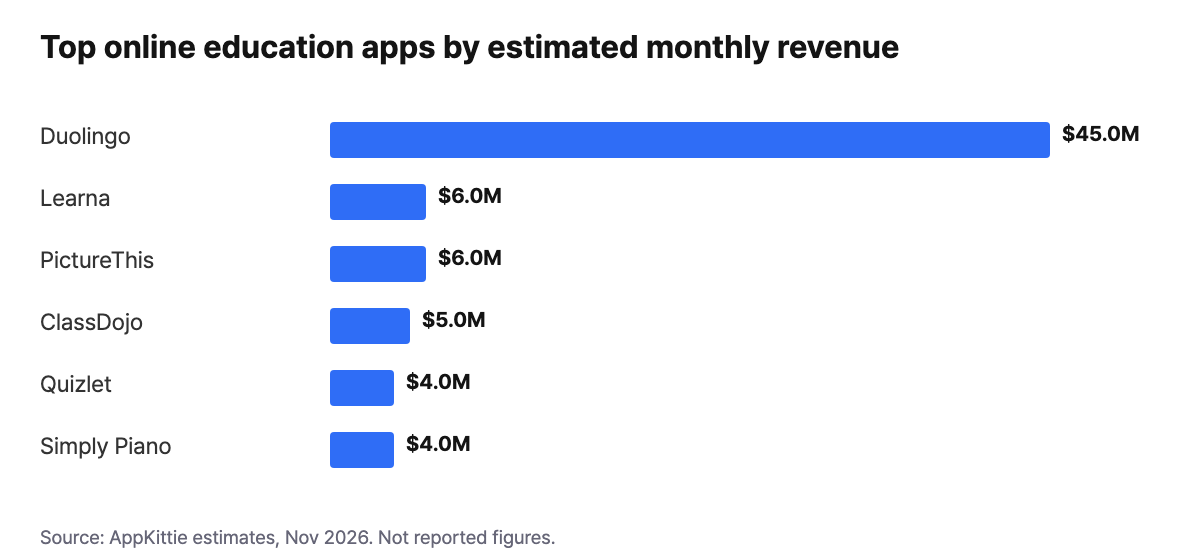
The chart has no Google row, so it cannot tell you how many of these apps run Google App campaigns, and any guess would be invented. It covers about 3,200 apps matched by category, with $10K+ estimated monthly revenue and in-app purchases, from AppKittie in November 2026, and all four channels shown sit below the 15-category average, with Apple Ads at 12.3% and Meta ads at 9.7%. Revenue figures are estimates, and the Education category is broad: Duolingo: Learn Languages leads at $45M, while PictureThis - Plant Identifier at $6M is not a course app at all.
How to choose
- Revenue link. Can you trace a Google install to a trial, a subscription, and a course sale?
- Postback. Can you send in-app events back to Google, so the campaign learns from more than installs?
- Cost depth. Know whether cost arrives by campaign, by ad group, or by asset. Google automation limits what any tool can show, so ask for specifics.
- One-time sales. Single course purchases need a path of their own if your subscription tool does not pass them on.
- Billing under heavy use. Keen learners open the app daily. Data point billing counts each open as one event. Per conversion billing uses a different unit. Model both against your own usage.
- iOS coverage. Apple's privacy rules limit what any tool sees per user, so check SKAN support if you buy iOS installs through Google.
Want to see how Best google uac attribution for online education apps works with your data?
Get hands-on with Airbridge and see real results.
Try It Free →Tools compared
| Airbridge Core | AppsFlyer | Adjust | Branch | Singular | Kochava | |
|---|---|---|---|---|---|---|
| Starting price | $40+/mo | Zero plan free (12,000 conversions in first 12 months); Growth $0.07 per conversion | Check vendor pricing page | Not listed on pricing page | Free plan (15,000 paid conversions); Growth $0.05 per conversion | Free App Analytics (10K conversions/month); Foundation from $500/mo |
| Self-serve signup | Yes | Yes | Check vendor pricing page | Yes on Basics | Yes on Free | Yes |
| Billing model | Data points | Per conversion | Check vendor pricing page | Not stated on pricing page | Per conversion | Conversions or MAU, by plan |
| Free trial | 30 days | Free Zero plan instead | Check vendor pricing page | Yes, on Basics | Free plan instead | Yes, on paid plans |
| RevenueCat integration | Yes | Yes | Yes | Yes | Yes | Yes |
Competitor details come from each vendor's public pages as of November 2026. AppsFlyer says its Zero plan is not suitable for apps with paid activities.
- AppsFlyer may suit an app ready for Growth at $0.07 per conversion, since it says its Zero plan is not suitable for apps with paid activities.
- Adjust may suit a team comfortable getting its pricing and trial terms directly from the vendor's page.
- Singular may suit a team that wants 15,000 paid conversions on a free plan before paying per conversion.
- Airbridge Core may suit a small team with Google among a few channels, at $40+/mo after a 30-day trial.
- Kochava may suit a team that wants MAU or conversion billing depending on plan, from free App Analytics up to Foundation from $500/mo.
- Branch may suit a team that wants a self-serve trial on Basics and will ask about cost.
How to set this up in Airbridge
- Open a 30-day free trial, then add the SDK to your app. Plan on about 5 minutes for a basic install.
- Connect Google Ads. Cost arrives at campaign or ad group level. Performance Max stays at campaign level. Campaign name and ID always show, while ad group names show only for ACi, ACe, and ACpre, Google's install, engagement, and pre-registration types.
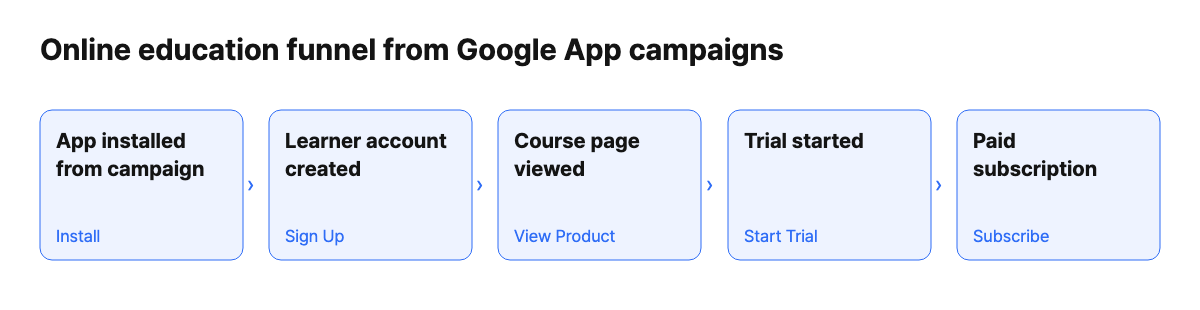
- Send standard events: Sign Up, View Product for a course page, and Purchase or Order Complete for a single course. Connect RevenueCat so Start Trial and Subscribe arrive on their own.
- Register your Link ID, then turn on mobile app postback to Google Ads, and send the event closest to real revenue that still has enough volume.
- Use a Funnel report to see where each campaign loses people, then compare revenue in the Revenue Report.
What Airbridge Core does not do here
- No creative names or creative-level cost. Airbridge does not receive creative names, and cost stops at campaign or ad group. For asset questions, use Google's own reporting.
- No learning events. Lesson finished or quiz passed would be custom events, which are Growth only. You cannot report on them or send them to Google from Core.
- No raw data export or Conversions API. Both are on the Growth Plan. If your setup depends on either, Core will not fit.
- Four ad channels only. Core covers Meta Ads, Google Ads, Apple Ads, and TikTok for Business. If you also buy from other networks, look at Growth or another vendor. Fraud detection is Growth only too, so choose that route if it is a must.
FAQ
Is UAC the same as Google App campaigns?
Yes. Universal App Campaigns is the old name, and many people still search for it. Google App campaigns is what you will see in Google Ads today. Either way, you are looking for the same reporting.
Can I see which ad asset drove a subscription?
Not on Core. Creative names are not provided and cost stops at campaign or ad group level, so asset-level return is out of reach. Campaign names always show, so you can still compare campaigns, which is often the decision a small team actually faces.
Does Core measure Google web campaigns too?
Core supports web campaigns on Google Ads, and the Core Web SDK covers web-to-app tracking only. It suits a page that sends people into the app. It is not full web analytics for your course site.


Ready to transform your mobile growth?
Learn how Airbridge helps leading brands measure and optimize every touchpoint.
“Braze is a powerful tool on its own, but when paired with Airbridge, it creates synergies for retargeting campaigns, saving resources and enhancing performance.”