What to Do After a User Rejects Your Paywall: A 4-Layer Recovery Strategy

Benchmark data from the RevenueCat State of Subscription Apps 2025 and Adapty State of In-App Subscriptions 2026 show that median free-to-paid conversion rates sit at 2.2% for freemium models and 12.1% for hard paywalls — meaning more than 9 in 10 users who see a paywall will not convert on the first view. That pattern holds across app categories, pricing models, and onboarding flows.
The real problem is not the low conversion rate. It is what happens next. For most subscription apps, the answer is nothing. The user taps the close button, the paywall disappears, and the moment is gone. That silence after a paywall rejection is where a significant share of potential subscription revenue walks out the door.
Key Takeaways
-
Most users reject the first paywall view. A post-paywall recovery strategy is as important as the paywall itself. Most teams have one but not the other.
-
The dismiss is not always a final "no." Data from the Adapty State of In-App Subscriptions 2026 shows that 55.5% of all eventual subscribers did not convert on Day 0, meaning most conversions require more than one touchpoint.
-
Exit offers recover conversions by presenting a lower-commitment alternative before the user leaves the screen. A Superwall study across 18 apps and approximately 500,000 users found that exit offers shown at the moment of abandonment accounted for 17% of total revenue.
-
The best exit offer is a different format, not just a lower price. Monthly after an annual pitch, or a lifetime option after a subscription, reframes the decision rather than discounting the same one.
-
iOS exit offers carry App Store rejection risk under Apple Guidelines 5.6 and 3.1.2. Test on Android first, where no similar rejection patterns have been reported.
Why Paywall Rejection Is a Revenue Problem, Not a Value Problem
1. The Dismiss Is a Timing Signal, Not a Final No
The paywall dismiss has a specific meaning in the data. The Adapty State of In-App Subscriptions 2026, based on 16,000+ apps representing $3 billion in subscription revenue, shows that 44.5% of all subscription purchases happen on Day 0. The remaining 55.5% of purchases occur on later days. That gap represents users who saw the app, felt interest, and chose not to commit immediately.
Some of those users left permanently. But a meaningful share was not saying "I don't want this." They were saying "not right now," distracted, uncertain about value, or not ready to commit to a full-year plan after 90 seconds with an app.
The paywall dismiss and the final decision to never subscribe are not the same event. Treating them identically forfeits the conversions a different offer or different timing would have captured.
2. The Recovery Window Is Measured in Minutes
The window to recover a dismissed paywall is measured in minutes, not days. A user who just closed your paywall is still in the app, still in the session, still processing the decision. That is as close to conversion intent as you will find outside the paywall moment itself.
Send the first push notification within the first hour of exit. Waiting until the next morning means reaching a user whose decision context has largely dissolved.
3. Most Apps Do Nothing After a Dismiss
The majority of subscription apps have no designed response to a paywall dismiss. No exit offer. No push notification within the session. No follow-up sequence. The user exits the paywall, the app continues in its default state, and the conversion opportunity closes.
Most teams instrument the dismiss event but never wire it to a downstream action. Apps that build a structured post-paywall recovery strategy treat the dismiss as the beginning of a secondary funnel, not the end of the primary one. What to show after a paywall decline is a question worth planning for before it happens.
The 4-Layer Post-Paywall Recovery Strategy
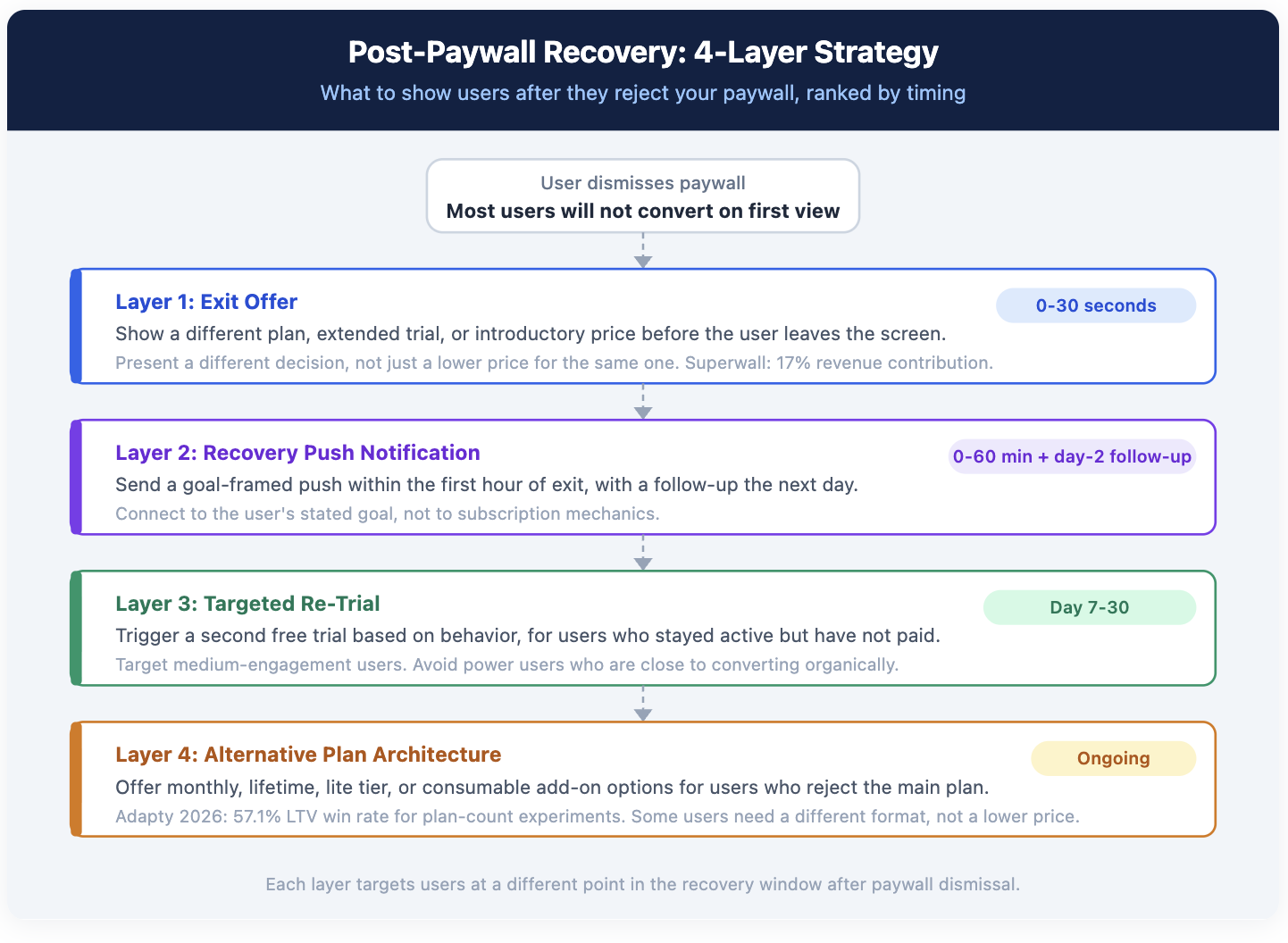
A complete recovery strategy works in sequence. Each layer targets users at a different point in the recovery window.
1. Layer 1: Show an Exit Offer at the Moment of Dismiss (0-30 Seconds)
An exit offer fires on dismiss, swapping the closing paywall for an alternative before the user leaves the screen. Throughout this article, "exit offer" refers to any secondary offer shown at the moment of paywall dismissal.
Exit offers are standard in e-commerce to reduce cart abandonment, and they translate directly to subscription apps. RevenueCat added native exit offer support to their Paywall Builder in December 2025, allowing implementation without code changes: select an alternative offering in the dashboard, and the exit offer appears on dismiss automatically.
Effective exit offer formats:
-
Plan format switch: If your primary paywall leads with annual, the exit offer shows monthly. This captures users who were interested but not ready to commit for a full year.
-
Extended trial: A user who dismissed a 7-day trial may convert on a 14-day version. More runway to feel value before the billing decision.
-
Introductory price: A discounted first period reduces perceived risk for price-sensitive users without permanently lowering the full-price offering.
The core principle: present a different decision, not just a lower price for the same decision. A user who dismissed a $49.99/year offer is not necessarily waiting for $39.99/year. They may need monthly billing, a longer trial, or a one-time option.
> Case study: Superwall Transaction Abandon Paywalls (August 2024)
18 apps, ~500,000 users. Users who started a payment transaction but did not complete it were shown a discounted exit offer at the moment of abandonment.
Exit offer users drove 17% of total revenue across the cohort.
Their refund rate was 3.3%, compared to 6.8% for users not shown an exit offer.
The lower refund rate rules out accidental conversion. These users converted because the exit offer matched what they were actually willing to pay.
2. Layer 2: Send a Recovery Push Notification Within 24 Hours
When a user exits the app after dismissing the paywall, a recovery push is the next opportunity. Timing is the primary variable.
Send the first push within the first hour of exit. That context — the app recently open, the paywall seen, the decision not yet finalized — decays quickly.
What works in recovery pushes:
-
Connect to the user's stated goal, not the subscription mechanics. "Your goal: [X]. Here's what's still waiting."
-
For trial-first apps: "Your free trial is reserved until [time]" creates a specific actionable deadline without being manipulative.
-
Send a second push the next day if the first goes unanswered. Users who were simply distracted during the first push often convert on the follow-up. The next-day message captures a meaningful segment that the same-day push misses.
For a deeper look at structuring these sequences, see push notification strategy for subscription apps.
3. Layer 3: Run a Targeted Re-Trial Between Day 7 and Day 30
Users who continue using the app without converting, returning weekly, completing workflows, engaging with features, represent a specific segment: they have found value but have not crossed the payment threshold.
The mid-lifecycle re-trial is a targeted second trial offer, triggered by behavior rather than a fixed calendar:
-
"You've completed 20 sessions. Try the full version free for 7 days."
-
Triggered after a user engages with a premium-locked feature for the third time.
-
Offered to users who started a trial, let it expire, and continued using the free version.
For users who have already spent time in the app, a second trial offer operates differently than the first. RevenueCat has documented freemium-to-trial conversion lifting from 0.4% to 4.5% when trial offers are reintroduced to established free users — a ratio that reflects habit-grounded consideration rather than first-time evaluation.
Targeting matters. Re-trials offered to highly engaged users who are close to converting organically can cannibalize full-price revenue. Target medium-engagement users: active, but not power users.
4. Layer 4: Build an Alternative Plan Architecture
Some users will not say yes to your main offering, but they would say yes to something else. If your paywall flow only offers one plan at one price, you are making a single bet on every user.
| Alternative | What It Solves | Best For |
|---|---|---|
| Monthly after annual lead | Commitment hesitation | Annual-first paywalls |
| Lifetime option | Recurring payment resistance | Users who reject subscriptions on principle |
| Lite tier | Price sensitivity | High-engagement users with low willingness to pay |
| Consumable add-on | "I don't need everything" | Feature-heavy apps where users want one capability |
Plan-count experiments are among the highest-performing paywall tests available. Adapty's 2026 report shows a 57.1% LTV win rate for apps that run plan-count experiments, with three-option paywalls cited as optimal. Weekly plans convert 1.7x-7.4x better than annual plans at equivalent price points.
> Case study: Party Game App: Paywall Simplification (RevenueCat / Paywalls.Design, March 2025)
The app's primary paywall offered three plans: annual, monthly, and weekly. The redesign removed monthly from the main screen, kept it under "View All Plans," and reduced the primary choice to two options.
Install-to-trial conversions increased by 31%.> > - Revenue lifted by 64%.
Fewer choices, clearly framed, outperformed the original layout across the same user base.
Want to see how Paywall works with your data?
Get hands-on with Airbridge and see real results.
Try It Free →How to Design a Post-Paywall Second Offer That Converts
1. Match the Exit Offer to the User's Objection, Not to Your Margin
Three users dismiss a paywall for three different reasons: price sensitivity, insufficient value conviction, and timing ("not right now"). A blanket discount treats all three identically and is the right answer only for the price-sensitive group.
A single-question micro-survey inserted between the dismiss tap and the exit routes each user to the appropriate response:
"What stopped you from subscribing today?"
Price is too high
Not sure it's right for me yet
I'll come back later
Something else
Price concern routes to a monthly or discounted exit offer. Uncertainty routes to an extended trial. "Later" routes to a timed push rather than an immediate exit offer. This post-paywall recovery strategy for exit offers converts better than any single blanket approach because it matches the response to the actual hesitation.
2. Use a Lifetime Plan as an Exit Offer
A lifetime subscription as an exit offer exploits a specific dynamic: some users do not resist paying, they resist committing to a recurring charge. A one-time lifetime option reframes the entire decision.
The user is no longer evaluating "should I subscribe?" They are evaluating "is this worth $X one time?" For a specific segment, that framing converts where a subscription offer does not.
Present the lifetime option as an exit offer, not the primary paywall offering. Placing it front-and-center trains users to skip the primary offer and wait for the lifetime option. This approach aligns with the broader paywall conversion structural decisions that shape how users process pricing.
3. iOS vs. Android: The Exit Offer Compliance Risk You Need to Know
Exit offers on Android have no known compliance issues. Test freely.
iOS is different. Apple has rejected apps for showing exit offers under Guideline 5.6 (Developer Code of Conduct) and, in 2026, increasingly under Guideline 3.1.2 (Subscriptions), citing "manipulative practices" around in-app purchases. The guidelines do not explicitly forbid exit offers, but enforcement has been inconsistent and has shifted in 2026 toward stricter subscription-specific review, as documented by Adapty and the RevenueCat Engineering Blog.
The practical path: test exit offers on Android first. Measure the lift in conversion and revenue. If the result is meaningful, assess iOS implementation with accurate performance data in hand.
One hard rule: do not remotely enable or disable exit offers after App Review approval on iOS. This violates the Apple Developer Program License Agreement directly and risks termination of the developer account.
How to Measure Post-Paywall Recovery Rate
1. The Three Metrics That Matter
Recovery rate is the percentage of users who dismissed the primary paywall and then converted within a defined window (7 days, 30 days). Segment this by acquisition channel. Users from paid campaigns often have meaningfully different recovery rates than organic users. Understanding which lifecycle stage each user cohort sits in sharpens this analysis.
Exit offer conversion rate measures, among users who saw the exit offer, how many converted. Track this separately from the primary paywall rate to preserve a clean signal on both.
Push timing performance by bucket breaks recovery push analysis into windows: 0-60 min, 1-6 hrs, 6-24 hrs, 24-48 hrs. Recovery push data from experimenting teams consistently shows the earliest bucket outperforming later windows. The gap between a push sent within the first hour and one sent the next day is not subtle.
2. How to Detect Exit Offer Cannibalization
Exit offers can reduce primary paywall conversions if users learn that dismissing always produces a better deal. Track this by comparing full-price conversion rates across cohorts that received exit offers versus those that did not.
If exit offer availability is pulling down primary conversions: introduce a short delay before the exit offer appears, or limit exit offers to users who spent a minimum time on the paywall, indicating genuine consideration. The goal is to recover hesitant users, not to teach all users that the first offer is a decoy.
Adapty's 2026 report found that apps running structured experiments on monetization earn up to 40x more revenue than those that do not test. The post-paywall recovery layer is one of the highest-leverage experiments available because the traffic is already engaged, it just needs a better response.
For a primer on the onboarding steps that set up the paywall moment correctly in the first place, that context improves how the recovery layer performs downstream.
Build the Post-Paywall Recovery Layer Before You Optimize the Primary Paywall
Most teams A/B test paywall headlines weekly and never measure recovery rate at all.
The users who dismissed the paywall are not gone. They are users whose specific hesitation has not been addressed yet. The apps recovering meaningful revenue from this group have built the layered sequence above.
Build the recovery layer first. Then optimize the primary paywall. Most teams have that order reversed, and the sequence matters.


Ready to transform your mobile growth?
Learn how Airbridge helps leading brands measure and optimize every touchpoint.