When to Start Lifecycle Marketing for Your App (and When It's Too Early)

Many subscription apps build lifecycle marketing campaigns before they are ready. Weeks go into email sequences, push automations, and win-back flows for a user base whose core behavior has not stabilized yet. The result is a polished system pointed at the wrong problem.
The apps that get lifecycle marketing right do not launch the most complete program. They start at the right moment. That moment is more specific than most guides acknowledge.
Key Takeaways
-
Lifecycle marketing amplifies what already works. If your trial conversion or onboarding is broken, campaigns will not fix it. They will surface the problem faster, but the fix still requires product work.
-
Three prerequisites matter before anything else. A stable conversion funnel, enough users to generate signal, and a churn pattern you can actually name.
-
The highest-ROI work happens in the first 48 hours, not in win-back. Most subscriptions happen in this window. Users who convert later retain better when they are guided there.
-
Starting too early wastes the effort. A win-back campaign for 50 churned users returns 1 to 2 reactivations at typical 2 to 5% reactivation rates. The same effort applied to onboarding 500 trial users returns measurable lift.
-
One stage. One problem. One experiment. A lifecycle program does not need to be a 15-message system on day one.
What Is Lifecycle Marketing for Apps?
Before deciding when to start, it helps to be precise about what you are committing to.
The same message sent to a brand-new trial user and a three-month subscriber performs very differently, because these users have completely different relationships with your product. Lifecycle campaigns close that gap by reaching each person based on where they actually are.
1. The Four Lifecycle Stages: Potential, Active, Drifting, and Churned
Every subscription app user moves through four stages: Potential (installed, has not subscribed), Active (paying and engaged), Drifting (paying but usage is declining), and Churned (cancelled or lapsed). Each stage needs a different goal and a different message.
Treating all four stages as one is the most common segmentation failure. A discount sent to an engaged subscriber trains price-sensitivity. A engagement" class="glossary-link" title="Re-engagement">re-engagement tip sent to a power user signals you are not paying attention. Stage is the variable that determines message, timing, and channel.
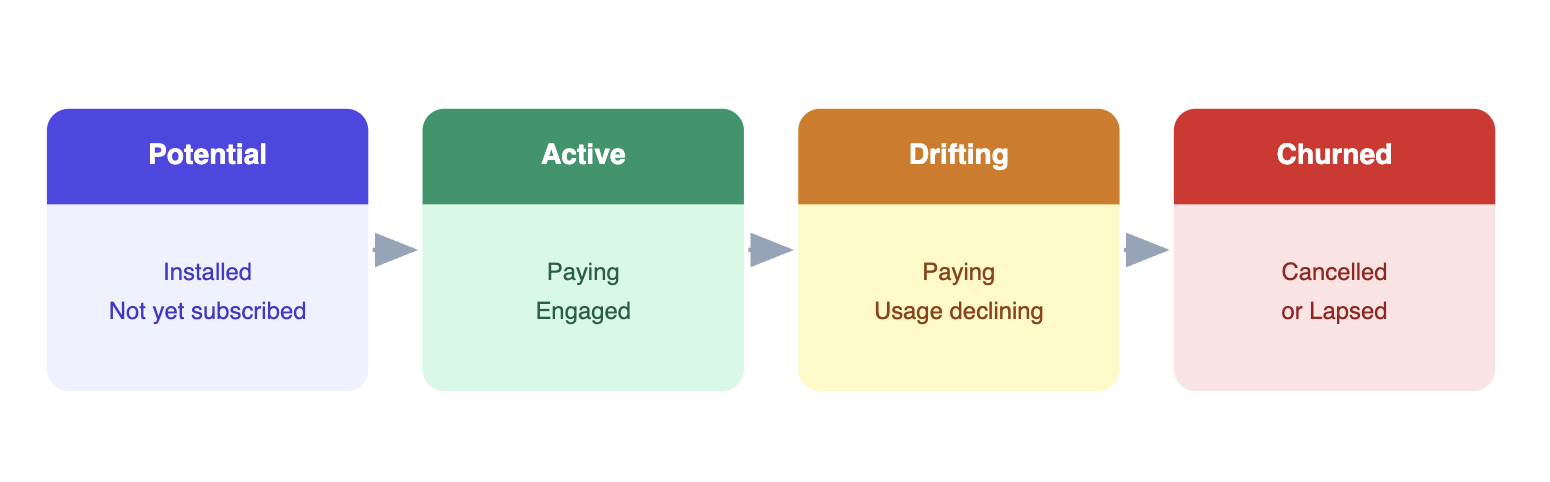
The four stages every subscription app user moves through, each requiring a different message
2. The Three Lifecycle Channels: Push, Email, and In-App
Lifecycle campaigns run across push notifications, email, and in-app messages. Most early-stage apps have access to all three from day one. The constraint is not the channels. It is whether you have enough behavioral signal to use them well.
3 Signs You Are Starting Lifecycle Marketing Too Early
There is no universal rule for when lifecycle marketing is premature. But three specific signals tell you the foundation is not ready yet.
1. Your Trial-to-Paid Conversion Rate Is Below 34.8%
Across more than 75,000 subscription apps, the median trial-to-paid conversion rate is 34.8% (RevenueCat State of Subscription Apps 2025). If your rate is significantly below that, particularly below 20%, the problem almost certainly lives in your onboarding or paywall, not in what happens after the trial expires.
Adding a trial-expiry nudge to a 15% converting funnel is treating a symptom. Users who are not seeing enough product value during the trial will not be persuaded to pay by a follow-up email. Lifecycle campaigns can tip marginal decisions, but they cannot manufacture the perceived value the product failed to deliver. Lifecycle marketing has a ceiling, and that ceiling is set by the conversion foundation underneath it. Fix the funnel first.
2. You Cannot Name Your Top Churn Reason
Before you build retention campaigns, you need to know what you are retaining against. According to Google Play cancellation data in the RevenueCat State of Subscription Apps 2025 analysis, the most common churn driver is "not enough usage," accounting for 37.2% of cancellations. The second most common reason is cost-related, at 34.6%. These two problems require completely different responses.
"Not enough usage" is an engagement and onboarding problem: users are not forming habits or extracting consistent value. Cost-related churn is a pricing and perceived value problem: users understand the product but do not believe the price is justified. Lifecycle campaigns built without knowing which of these you are fighting will target the wrong audience with the wrong message. Run an exit survey via your subscription platform. App Store Connect exposes cancellation reasons through Subscription Events API; Google Play Console shows them under Cancellation Survey. Identify one pattern before building anything.
3. Your User Base Is Too Small to Segment by Behavior
Segmentation is the mechanism that separates lifecycle campaigns from a mass blast. Sending the same push notification to everyone who installed three days ago, regardless of what they have done in your app, is not lifecycle marketing. It is broadcast messaging with a trigger delay.
Meaningful segmentation requires behavioral data: did the user complete onboarding? Start a trial? Reach the core feature? If your analytics are not tracking those milestones today, building these flows is premature. Build the measurement layer first.
Want to see how Lifecycle marketing works with your data?
Get hands-on with Airbridge and see real results.
Try It Free →3 Signs Your App Is Ready for Lifecycle Marketing
If the warning signs above do not apply, here are the three conditions that indicate genuine readiness.
| Signal | What "Ready" Looks Like |
|---|---|
| Conversion funnel stability | Trial-to-paid rate consistent for at least four weeks; you can explain the trajectory |
| Sufficient user volume | Enough monthly trial starts for experiments to return signal within weeks, not months |
| Named churn pattern | One specific, observed pattern you can write a campaign hypothesis around |
All three together create the foundation lifecycle programs need to amplify. If any one is missing, the program will measure the wrong things or move too slowly to generate actionable signal.
How to Start Lifecycle Marketing: Where to Begin
Assuming you have met the prerequisites, the right starting point is almost never where most apps begin.
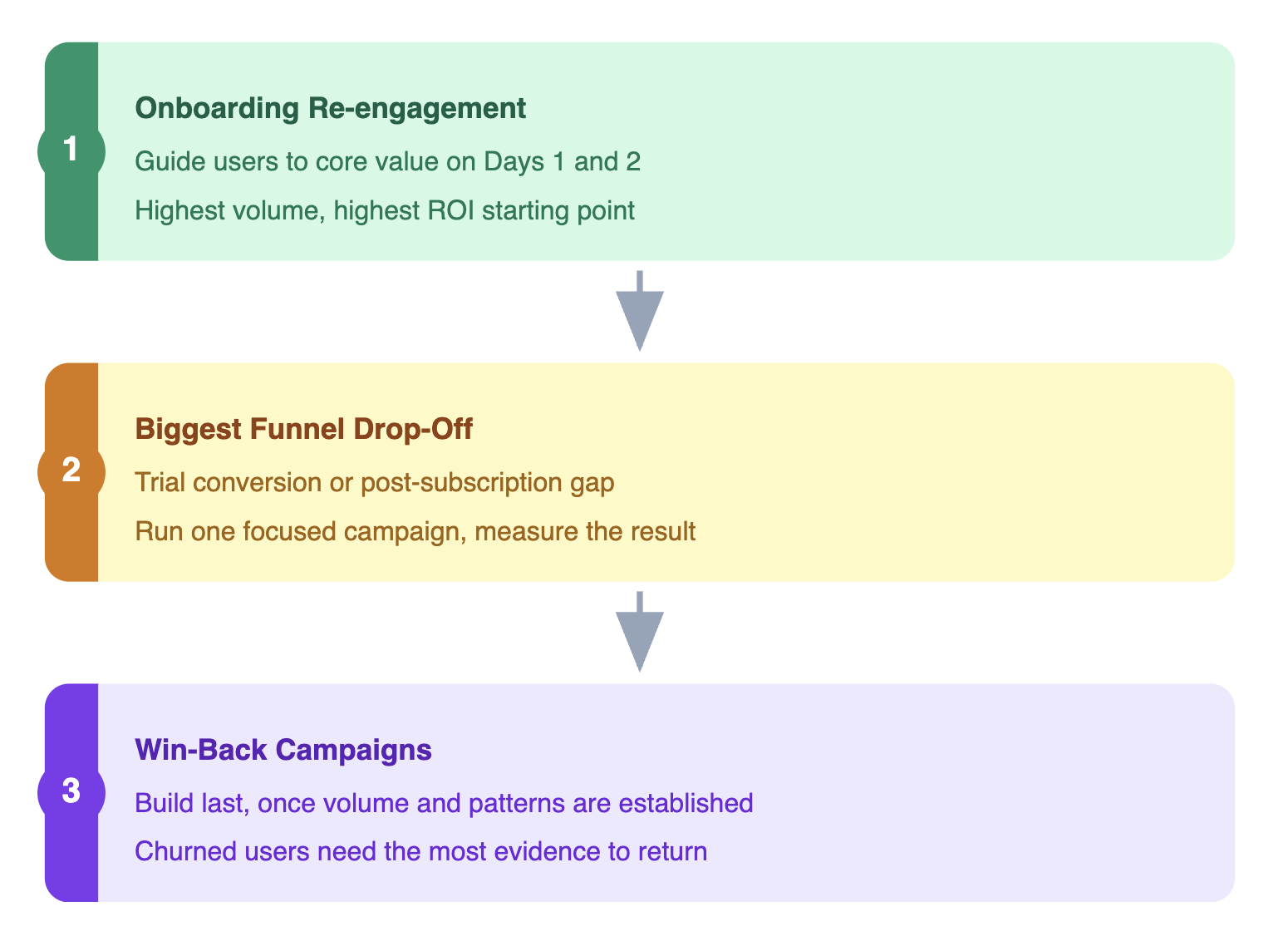
Start where users are still reachable, not at the end of the funnel
1. Start With Onboarding Re-engagement Before Win-Back
Win-back campaigns feel urgent because churned users are visible. But the economics do not favor starting there. Win-back reactivation rates typically sit at 2 to 5% for apps without a strong prior relationship, compared to 30% or more for nudges reaching users who are still in-trial and evaluating. A churned user who already decided to leave requires significant new evidence to return.
According to RevenueCat's lifecycle marketing research, most subscriptions happen within the first 24 to 48 hours after a trial starts. More broadly, RevenueCat's 2026 subscription benchmarks show that 80 to 90% of all trials begin on Day 0 of install, making the early onboarding window the highest-volume, lowest-competition moment in your funnel. A Day 1 and Day 2 push focused on guiding users to the core value moment is lightweight to build and addresses the most recoverable opportunity. Win-back is the last lifecycle investment, not the first.
2. Find the Biggest Drop in Your Subscription Funnel
Look at your funnel from install to active subscriber and find the step with the sharpest fall-off. If 60% of trial starts happen but only 25% convert, your opportunity is in the trial-to-paid stage. If conversion is healthy but nearly 30% of new annual subscribers cancel in their first month, as shown in the RevenueCat subscription cohort data, the post-subscription gap is your priority.
The largest drop is where a single well-targeted campaign will have the most visible impact. Starting there gives you a clear before-and-after measurement and concrete proof of ROI to justify building the next stage.
3. Run One Lifecycle Experiment at a Time
The apps that build successful lifecycle programs do not launch a 12-email sequence in the first sprint. They run one experiment: one email, one push, one in-app message. They measure it, then build the next one. Start small: one stage, one problem, one experiment. The 15-message sequence gets built over six months of iteration, not deployed in week one.
Treating lifecycle as a system to "launch" is what creates the trap of starting too early. Think of it as ongoing experimentation. Each experiment informs the next campaign. The RevenueCat subscription app growth stack guide covers how mature teams build this iteration loop over time.
Start at the Right Stage, Not the Right Tool
Lifecycle marketing is worth doing. But the return depends heavily on when you start and where you start within it.
Apps that move too early spend months building on an unstable foundation. Apps that delay too long leave recoverable revenue sitting in leaky funnels. Open your analytics. Find the step with the largest drop. Start there.

Ready to transform your mobile growth?
Learn how Airbridge helps leading brands measure and optimize every touchpoint.