How to Track Influencer App Installs with Deeplinks (Not Promo Codes)

You gave an influencer a promo code. The campaign ran for three weeks. Your dashboard shows 180 redemptions. During that same window, organic installs climbed by 1,400.
Without an influencer deeplink on that campaign, you cannot connect a single one of those 1,400 installs to the creator. You do not know if any of them started a trial, subscribed, or renewed. For budget decisions, the campaign produced 180 visible conversions and a spike you cannot explain.
Key Takeaways
-
Promo codes only capture users who enter the code. Most influencer-driven installs come from users who watched the content, searched the app name directly, and installed without touching a code.
-
An influencer deeplink is a trackable URL that survives the App Store redirect. Unlike a standard link, it preserves attribution data from the tap all the way through to the install.
-
deep linking">Deferred deep linking handles new users automatically. The link records the tap, routes the user to the App Store, and matches the eventual install on first app open. This works up to 30 days after the original tap, depending on your attribution platform's configured deferred window.
-
The right attribution window for influencer campaigns is 14-30 days, not 7. Influencer content drives delayed conversions that standard paid-ad windows miss entirely.
-
Installs are not the conversion metric that drives budget decisions. Among 75,000+ subscription apps, the gap between median (34.8%) and top-performing (45.7%) trial-to-paid conversion shows that install quality, not volume, determines revenue. (RevenueCat, State of Subscription Apps 2025)
Why Promo Codes Fail to Track Most Influencer-Driven App Installs
1. TikTok and Instagram Users Watch, Then Search, Not Click
On TikTok and Instagram, users rarely tap links. The typical pattern: watch content, decide to try the app, close the platform, open the App Store, search the name. The link in bio is never touched. The install happens, and it is logged as organic with no connection to the creator who drove it.
This is not a fringe edge case. Platform design limits outbound clicks. TikTok restricts clickable links in organic posts to the bio (universally available since late 2023). Instagram does not allow clickable links in feed captions or Reels descriptions, though Story link stickers do allow taps and have been available to all accounts since October 2021. For standard feed and Reels content on both platforms, watch-then-search is still the primary conversion path.
2. Most Viewers Skip the Code, Even When They Convert
When a creator says "use code TRAINER20 for 20% off," some viewers enter it. More do not. They forgot the code. They installed two days later. For subscription apps where the trial is free, the incentive to type a code is low.
The redemptions you see represent motivated users who completed an extra manual step. The installs you do not see include users who converted without friction. Those are often your best users: low-friction converters who did not need a discount to act.
3. Promo Codes Never Show Subscription Conversion per Creator
Even if codes captured every install, they would still miss the metric that drives influencer budget decisions: subscription conversion per creator.
Among 75,000+ subscription apps analyzed, the median trial-to-paid conversion rate is 34.8%. Apps running 17-32 day trials reach 45.7%. An influencer driving 500 installs with a 5% trial rate and 15% trial-to-paid is less valuable than a micro-influencer driving 150 installs with a 35% trial rate and 42% trial-to-paid. Promo codes give you zero visibility into this comparison. An influencer deeplink is what closes that gap.
What Is an Influencer Deeplink and How Does It Work?
A deeplink is a URL that tells a mobile device exactly where to send a user: which app to open, and which screen or experience to land on. When built through an attribution platform, it also carries attribution data that survives the App Store redirect.
Standard App Store URLs break attribution at the redirect. UTM parameters appended to a link are stripped the moment the user leaves your link domain and enters the App Store. By the time the install happens, the source data is gone.
Apple's App Tracking Transparency added a constraint: the IDFA-based deterministic matching attribution platforms historically used now requires user opt-in, and most iOS users do not opt in. Probabilistic and clipboard-based matching fill the gap, but with lower precision than pre-ATT IDFA matching.
An influencer deeplink solves both problems through a mechanism called deferred deep linking.
1. How Deferred Deep Linking Carries Attribution Through the App Store
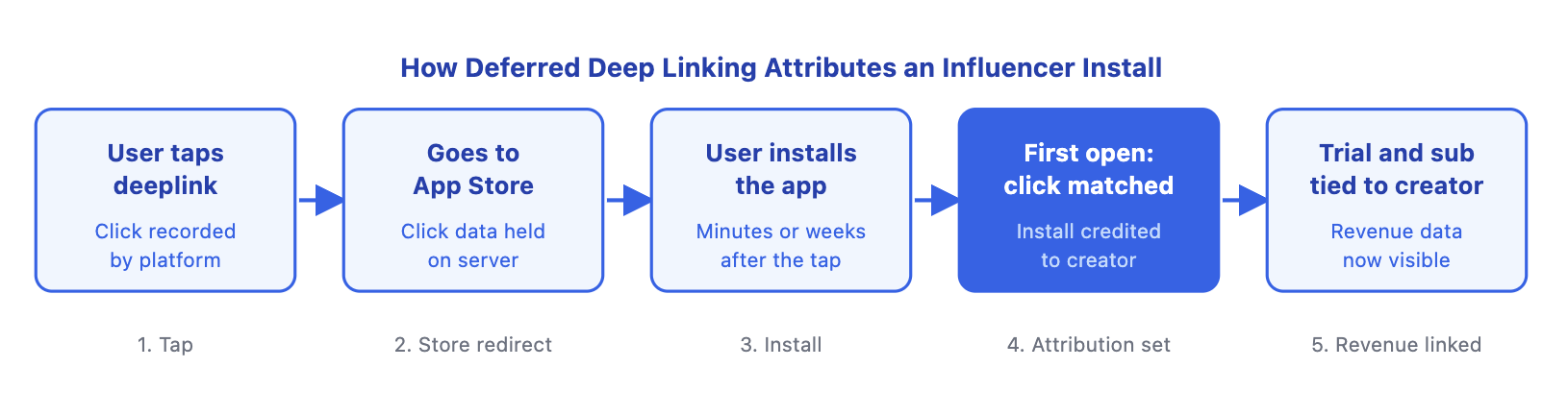
When a user taps the influencer's deeplink, the attribution platform records the event: which influencer, which campaign, a device fingerprint, and a timestamp. The user is redirected to the App Store and installs. On first open, the app queries the attribution platform. The platform matches the first open to the earlier tap and assigns credit.
The App Store is not a dead end. It is a handoff. The delay between tap and first open can span hours or weeks. Deferred deep linking bridges that gap.
2. Side-by-Side: What Deeplinks Track vs. What Promo Codes Track
| Signal | Promo Code | Influencer Deeplink |
|---|---|---|
| Tap registered | No | Yes |
| Install attributed (click-through) | No | Yes |
| Install attributed (search-direct) | Yes (if code entered) | No (needs code fallback) |
| Trial start by influencer | No | Yes |
| Subscription conversion by influencer | No | Yes (with billing integration) |
| Delayed conversion, up to 30 days | Yes | Yes (with extended window) |
Neither method captures everything. The strongest influencer attribution setup uses both: deeplinks for click-through users, promo codes as a fallback for search-direct installs.
Want to see how Track influencer app installs works with your data?
Get hands-on with Airbridge and see real results.
Try It Free →How to Set Up Influencer Deeplinks: A Step-by-Step Guide
1. Create One Unique Link per Creator, Not One per Campaign
In your mobile attribution platform, create a unique influencer deeplink for each creator. Do not reuse campaign-level links across multiple influencers.
Per-creator links let you:
-
Compare subscription conversion rates by individual creator
-
Identify traffic quality problems (high click count, low install rate signals)
-
Scale or pause specific partnerships based on actual revenue data, not install volume
Include in the link parameters: influencer handle, campaign name, content format (video, bio link, story), and campaign date range.
2. Set Your Attribution Window to 14-30 Days for Influencer Traffic
Many attribution platforms default to 7 days post-click for paid ad campaigns, using attribution windows built for fast-deciding ad audiences. Influencer content works on a different timeline.
A creator posts a 20-minute product walkthrough. Some viewers install the same day. Others return to the video two weeks later. Others forward it to a friend who installs three weeks after the original post. A 7-day window systematically undercounts influencer-driven installs by treating all delayed conversions as organic.
Configure 14-30 day windows for influencer-sourced links (most attribution platforms support extended windows; verify your platform's default and adjust before the campaign goes live). Confirm how your platform handles post-window installs: they should be classified as organic, not incorrectly attributed to an older campaign.
3. Add Link Placement Instructions to Your Influencer Brief
Do not assume creators know how attribution links work. Include in the brief:
-
The unique deeplink URL (shortened by your platform, not by a third-party shortener that strips parameters)
-
Exact placement: bio link for TikTok and Instagram, description link plus QR code for YouTube
-
What to avoid: running the link through an additional shortener removes the attribution parameters
For YouTube specifically, a QR code version of the same deeplink is important. Viewers watching on a TV screen use QR codes to navigate to the App Store, not description links.
4. Embed a Promo Code as a Parameter for No-Click Installs
Deeplinks can carry parameters that pre-fill fields in your app after install. If your onboarding includes a promo code step, pass the influencer's code as a link parameter. After install, the app reads the parameter and fills the code field automatically.
The result: click-through users get attributed via the link. Users who searched directly and installed without clicking can still enter the code manually. Both paths produce attribution data, and the user does not need to remember a code they saw in a video three days ago.
Deeplink vs. Promo Code: Which Attribution Method to Use on Each Platform
| Platform | Primary Method | Fallback |
|---|---|---|
| TikTok | Deeplink in bio | Promo code (verbal mention) |
| Deeplink in bio or Story link | Promo code | |
| YouTube | Deeplink in description + QR code | Promo code (verbal mention) |
| Podcast | Promo code (verbal) | Deeplink in show notes |
| Newsletter or email | Deeplink (direct click) | Promo code |
On audio platforms, the promo code carries more weight because listeners do not interact with links during playback. On short-form video, the deeplink in bio is primary. On YouTube, both the description link and QR code matter depending on whether the viewer is on mobile or a TV screen.
Alongside both methods, measure organic lift: record average daily organic installs for 30 days before the campaign and compare to the campaign period. The delta estimates the share of influencer-driven installs that neither the link nor the code captured.
How to Measure Subscription Conversion by Influencer, Not Just Installs
1. Why Install Volume Is a Misleading Signal for Influencer Spend
Install count is a reporting metric. Subscription conversion per influencer is the budget metric.
The difference is substantial. Here is the same budget evaluated two ways:
| Metric | Macro-Influencer (600K followers) | Micro-Influencer (45K followers) |
|---|---|---|
| Installs | 1,200 | 200 |
| Trial starts | 24 (2% trial rate) | 70 (35% trial rate) |
| Trial-to-paid conversion | 40% | 40% |
| Subscribers generated | ~10 | ~28 |
| Subscribers per 100 installs | 0.8 | 14 |
Without subscription-level data, the macro campaign looks 6x more productive by install volume. With it, the micro-influencer shows a 17x higher subscriber rate per install.
2. The Comparison That Changes Which Influencer You Scale
Trial quality compounds over the subscription lifecycle. A full trial experience boosts first renewal rates by up to 60% across subscription app categories (Adapty, State of In-App Subscriptions 2026).
An influencer who drives high trial-start rates is not just generating installs. That influencer is feeding your highest-LTV subscriber cohort.
3. Two Rates to Track per Creator
To evaluate any influencer campaign at the subscription level, track two rates per creator:
-
Trial start rate (trial starts / installs): Shows which audience is genuinely interested in the product, not just curious enough to download.
-
Trial-to-paid conversion rate: Shows which audience actually commits to a subscription after experiencing the product.
A high trial start rate with a low trial-to-paid rate signals an interest gap: the audience is curious but the product is not delivering enough value in the trial period. A low trial start rate with a high trial-to-paid rate signals an intent gap: the onboarding is not capturing enough users at the paywall.
4. Three Components You Need Connected for Full-Funnel Visibility
When you track influencer app installs with deeplink instead of promo code, you capture the click-through path from tap to install. To see subscription conversion by creator, three components must be aligned:
-
Unique deeplinks per influencer generating per-creator install attribution
-
Post-install event tracking firing on trial start, subscription, and cancellation
-
Billing integration routing subscription events back to the attributed install source
Without all three connected, the install and the subscription remain in separate datasets, and the budget question stays unanswerable.
Promo Codes and Deeplinks Work Best Together, Not in Competition
Promo codes and deeplinks are both necessary. Codes capture the no-click, search-direct conversions that are invisible to link-based attribution. Deeplinks capture the click-through path and carry it into the subscription funnel.
The useful question is not "which influencer drove more installs." It is "whose audience converts to paying subscribers." That answer requires connecting the tap to the trial, through the App Store, and into the billing system. Deeplinks are the infrastructure that makes the connection possible.

Ready to transform your mobile growth?
Learn how Airbridge helps leading brands measure and optimize every touchpoint.