Push Notification Strategy for Subscription Apps: A Practical Retention Playbook

A push notification strategy for subscription apps works when it is built around user lifecycle stages, not broadcast schedules. The push notifications that reduce churn are behavioral, timed to in-app activity, and specific to where each user is in their journey from install to active subscriber.
You send push notifications, but your open rate is low, and you cannot tell whether any of it is keeping subscribers around.
That is a strategy problem, not a copy problem. Push notifications can increase 90-day app retention by up to 190%, according to Airship's benchmark study of 63 million users across 1,500 apps. But that lift only materializes when notifications are built around lifecycle stages and behavioral triggers. When they are not, the same channel that could re-engage a drifting subscriber instead pushes 40% of users to permanently disable push permissions from your app.
Key Takeaways
-
"Not enough usage" is the leading reason subscribers cancel. It accounts for 37.2% of cancellations across 75,000+ apps analyzed by RevenueCat. Push notifications that drive usage directly address the root cause of churn.
-
Low open rates signal a targeting problem, not a content problem. Personalized push notifications generate up to 4x higher open rates than generic broadcast messages, per Airship's analysis of 50 billion push notifications.
-
The first 90 days are your highest-leverage window. Apps that send relevant pushes in the first 90 days see retention rates nearly 3x higher than apps that send none, per the same Airship benchmark.
-
Frequency has a hard ceiling. Sending 2 to 5 pushes per week causes 40%+ of users to disable push permissions entirely, per Business of Apps.
-
Lifecycle stage determines what to send. A trial user on Day 5 and a 4-month subscriber who has not opened in 10 days are different audiences with entirely different needs.
Why Push Notification Open Rates Stay Low (Even When You Are Already Sending)
The average open rate is 4.6% on Android and 3.4% on iOS, per Business of Apps citing Airship data. If your numbers are below those benchmarks, the problem is rarely the message. It is the audience, the timing, or the absence of a lifecycle goal.
1. Every user receives the same message
Most subscription apps start with a single push template sent to every user on a fixed schedule. That works when your user base is small and everyone is at a similar lifecycle stage. It breaks down the moment users diverge: some are mid-trial, some are active 6-month subscribers, and some have not opened the app in two weeks.
A notification re-engaging a fitness subscriber who missed five workouts is a different message from one targeting a user who stalled during onboarding. The copy is not the variable. The audience is.
2. Sending too often destroys the channel
One push per week causes 10% of users to disable push permissions. Two to five per week causes 40%+ to disable them, per Business of Apps.
Once users turn off notifications, that channel is gone. Most teams respond to low engagement by sending more. That accelerates the problem. The correct response is fewer, better-targeted messages triggered by behavior rather than a schedule.
3. No lifecycle stage means no strategy
Every push that moves a retention metric has a specific job at a specific moment in the user journey. A push to a trial user on Day 12 has a fundamentally different goal from one to a subscriber who has gone quiet. Without that distinction built into your system, you are treating unlike users identically.
The Four Push Types That Actually Reduce Churn
Not all pushes affect retention equally. These four types have a direct, measurable connection to subscriber behavior.
1. Exit-intent pushes (Day 0)
When a new user finishes onboarding and exits without converting, they are at peak intent. Send a push within minutes of that exit, targeted to what they did not complete: reached the paywall but did not convert, finished setup but skipped a key feature, or created an account without adding any content.
Timing aligns with active intent. You are not interrupting their day — you are reaching them at the exact moment the decision is still open.
Example: "Your free trial is ready. Tap to start — it takes 30 seconds."
2. Trial expiry notification sequences
Users who start a trial convert at a median rate of 34.8%, with top-performing apps reaching 51.5% and above, according to RevenueCat's State of Subscription Apps 2025. The gap between median and top performers is largely driven by how well the trial lifecycle is managed.
A three-touchpoint structure works for most trial windows:
| Trial Length | Push 1 | Push 2 | Push 3 |
|---|---|---|---|
| 7-day trial | Day 3: feature they have not tried | Day 6: 24-hour warning | Day 7: value recap |
| 14-day trial | Day 7: value reinforcement | Day 12: 48-hour warning | Day 14: last day |
| 30-day trial | Day 15: habit check-in | Day 27: 72-hour warning | Day 30: last day |
Push 1 should surface a premium feature the user has not explored. Push 2 and Push 3 should focus on specific value and conversion, not generic countdown messaging.
Day 6 example (7-day trial): "24 hours left on your trial. Here's what you will lose access to tomorrow."
3. Usage-triggered engagement notifications
The leading churn reason across subscription apps is "not enough usage," accounting for 37.2% of cancellations in RevenueCat's analysis of 75,000+ apps. A push tied to a behavioral inactivity threshold directly addresses this.
A fitness app user who has not logged a workout in five days is drifting. A language app user who broke their daily streak is at risk. A meditation app user who has not opened in nine days is close to canceling. These are behavioral signals. Tie your triggers to them, not to a send schedule.
Timing matters as much as the trigger itself. Morning for wellness and fitness apps. Evening for entertainment. Post-work for productivity tools. According to Pushwoosh, sending at a user's peak activity window delivers up to 50% higher open rates than off-peak sends.
Example: "You are 1 workout away from your 7-day streak. Log it now."
4. Re-engagement notifications for drifting subscribers
Drifting subscribers are still paying. They have gone quiet, but they have not canceled. They are more valuable to re-engage than churned users because the relationship is still active and no acquisition cost is required.
The window is narrow. After 2-3 weeks of inactivity, re-engagement becomes significantly harder. The push should answer one question for the user: where to pick up. Not "we miss you." Not a generic discount. A specific reference to where they were when they last used the product.
"You were on Chapter 4 of Atomic Habits. Pick up where you left off?" performs better than "It's been a while. Come back." One is specific and actionable. The other is noise.
Want to see how Push notification strategy for subscription apps works with your data?
Get hands-on with Airbridge and see real results.
Try It Free →What Good Strategy Looks Like: Two Case Studies
The four push types above are not theoretical. The apps that have built them well have left detailed records of what happened when they did. Here are two documented examples.
Case Study 1: Duolingo
Duolingo's strategy is one of the most extensively documented examples of behavioral triggering at scale.
The core of their approach was the streak-saver notification: a push sent when a user with an active learning streak was about to lose it because they had not completed a lesson that day. The message was specific, time-sensitive, and tied to the exact behavioral event that mattered to that user.
Notification optimization specifically drove a 21% increase in current user retention rate (CURR) and a 40%+ reduction in daily churn among their best users, documented by former CPO Jorge Mazal in Lenny's Newsletter. These gains were one part of a broader product portfolio — alongside leaderboards, streaks, and content investments — that helped grow DAU 4.5x over four years.
Critically, Duolingo established one foundational rule: protect the opt-in list. They tested carefully rather than aggressively, knowing that burning the notification channel through over-sending would cost more than any short-term lift would gain.
Case Study 2: Blinkist
Blinkist, the book summary subscription app, ran into a common problem: users were starting trials without understanding what they were agreeing to, which led to complaints and early cancellations.
Their solution was to rebuild the opt-in experience around transparency. Before prompting users to allow notifications, Blinkist showed exactly what they would receive: what type of notifications, at what frequency, and what each one was designed to help with.
Push opt-in jumped from 6% to 74%, a 1,200% increase, documented in a Growth Design case study and confirmed via Purchasely. The broader paywall transparency redesign — which included the new opt-in flow and a pre-trial-end reminder push — drove +23% trial sign-ups and +4% trial retention. Transparency about the notification experience built enough trust to improve conversion at the paywall itself.
How to Map Pushes to Your User Lifecycle Stage
Knowing which push types exist is half the problem. The other half is knowing which one to send to which user, and when. That answer comes from lifecycle stage.
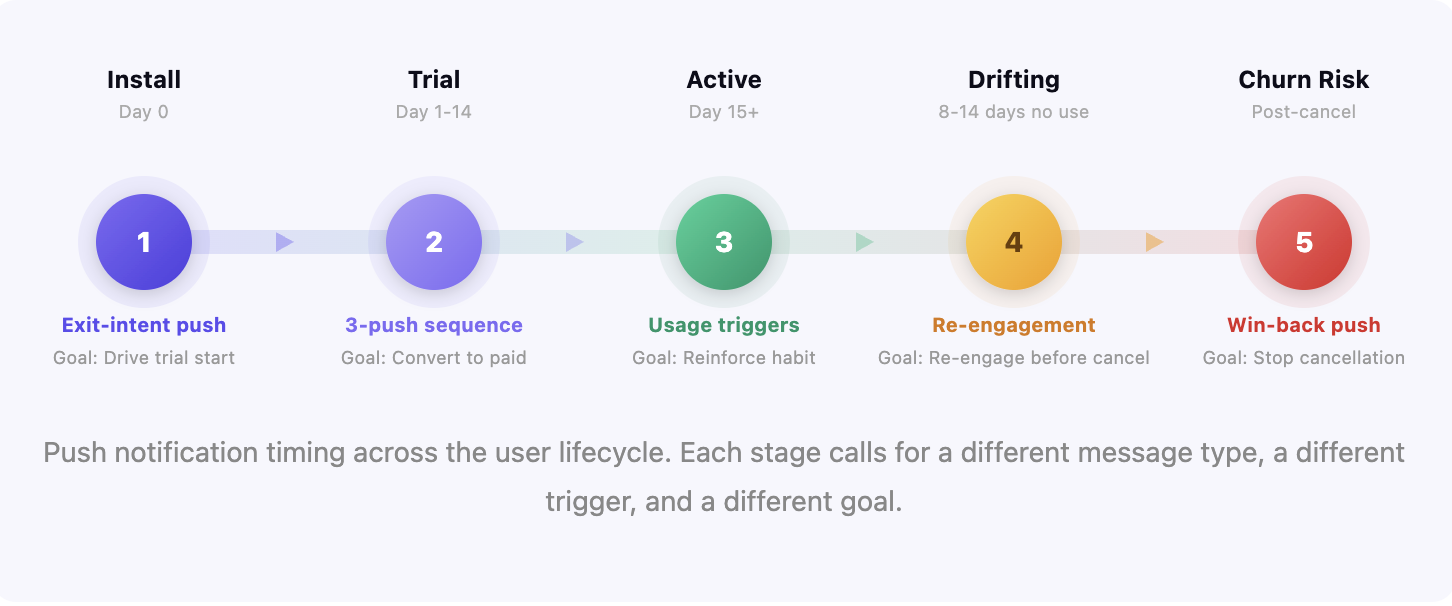
Start with one stage, not all of them. Pick the highest-churn moment in your funnel. For most subscription apps, that is the trial-to-paid transition.
Segmentation, Timing, and Frequency: The Mechanics of Higher Open Rates
The lifecycle map tells you what to send at each stage. These three mechanics determine how to send it in a way that users actually open and act on.
1. Segment by behavior, not demographics
The most actionable segmentation for pushes uses behavioral signals: session frequency, features used, lifecycle stage, and days since last open.
Apps using behavioral segmentation see up to 10x higher engagement than those running broadcast campaigns, per Adapty's research. Four segments that work across most subscription apps:
-
Highly active (last open: 1-3 days): Deepen usage, surface underused premium features.
-
Moderately active (last open: 4-7 days): Habit reinforcement tied to their specific content.
-
At risk (last open: 8-14 days): Re-engagement with a specific hook back to their last session.
-
Dormant (last open: 15+ days): Targeted offer, calibrated for users who have genuinely disengaged.
2. Time pushes to user activity patterns, not the calendar
Use time-of-last-open as your starting proxy. A user who consistently opens at 7 AM should receive their push around 7 AM, not 2 PM. Layer your app's natural use-case cadence on top: morning for fitness, evening for entertainment, post-work for productivity.
3. Cap frequency to protect your opt-in list
Set platform-level caps and enforce them:
-
Maximum 1 push per day per user, across all push types combined.
-
No pushes between 10 PM and 7 AM in the user's local time zone.
-
Hard limit: no more than 5 pushes in any 7-day window for any single user.
Build coordination logic into your push setup that checks what a user has already received before triggering the next message. A user should not receive an exit-intent push, a trial expiry warning, and a re-engagement message within the same 24-hour window.
How to Measure Whether Your Pushes Are Reducing Churn
Open rate tells you about the message. It does not tell you about the subscription.
The test that matters: split your users into those who received and acted on a specific push type versus those who did not, then compare their 30-day subscription retention. If the open cohort retains at a 5+ percentage point higher rate, the push is contributing to retention. If the gap is smaller, the message is generating clicks without changing subscriber behavior.
Three metrics to track alongside open rate:
-
In-app action after push: High open rate with zero follow-through means the push generated a click but did not re-engage the user with the product.
-
30-day subscription status, pushed versus non-pushed: This is the actual churn connection test.
-
Push opt-in rate trend: A declining opt-in rate week-over-week signals frequency or relevance problems before they surface in cancellation data.
One benchmark worth knowing: if your monthly subscriber 30-day retention is below 17.5%, the median across 75,000+ apps in RevenueCat's analysis, frequency and segmentation are the first levers to audit.
Start With One Trigger, Then Scale
If you are currently running one push template to all users, the highest-leverage move is not writing a better template. It is building one behavioral trigger.
Pick the highest-churn moment in your funnel. Build a single triggered push for that specific moment. Measure whether the cohort that receives it retains at a higher rate than those who do not. Once you have evidence that one behavioral push works, build the next one.

Ready to transform your mobile growth?
Learn how Airbridge helps leading brands measure and optimize every touchpoint.