Faith App Marketing: How Bible and Prayer Apps Can Track Creator and Church Campaigns


On this page
Faith app marketing runs on trust, not ad clicks
Faith-based apps grow differently from most subscription apps. People often discover a Bible, prayer or devotional app through someone they trust: a worship leader on Instagram, a creator who shares their morning prayer routine, a pastor who mentions it on Sunday, or a friend in their small group.
That makes creator and community partnerships a natural fit, and many faith apps now run UGC campaigns, ambassador programs and church partnerships. Measuring them is harder. When we asked one devotional app how they know which creators bring subscribers, the answer was kind and honest: "simple answer: we don't know :) but as a tiny company we just try to grow it in some way."
Where faith app users come from
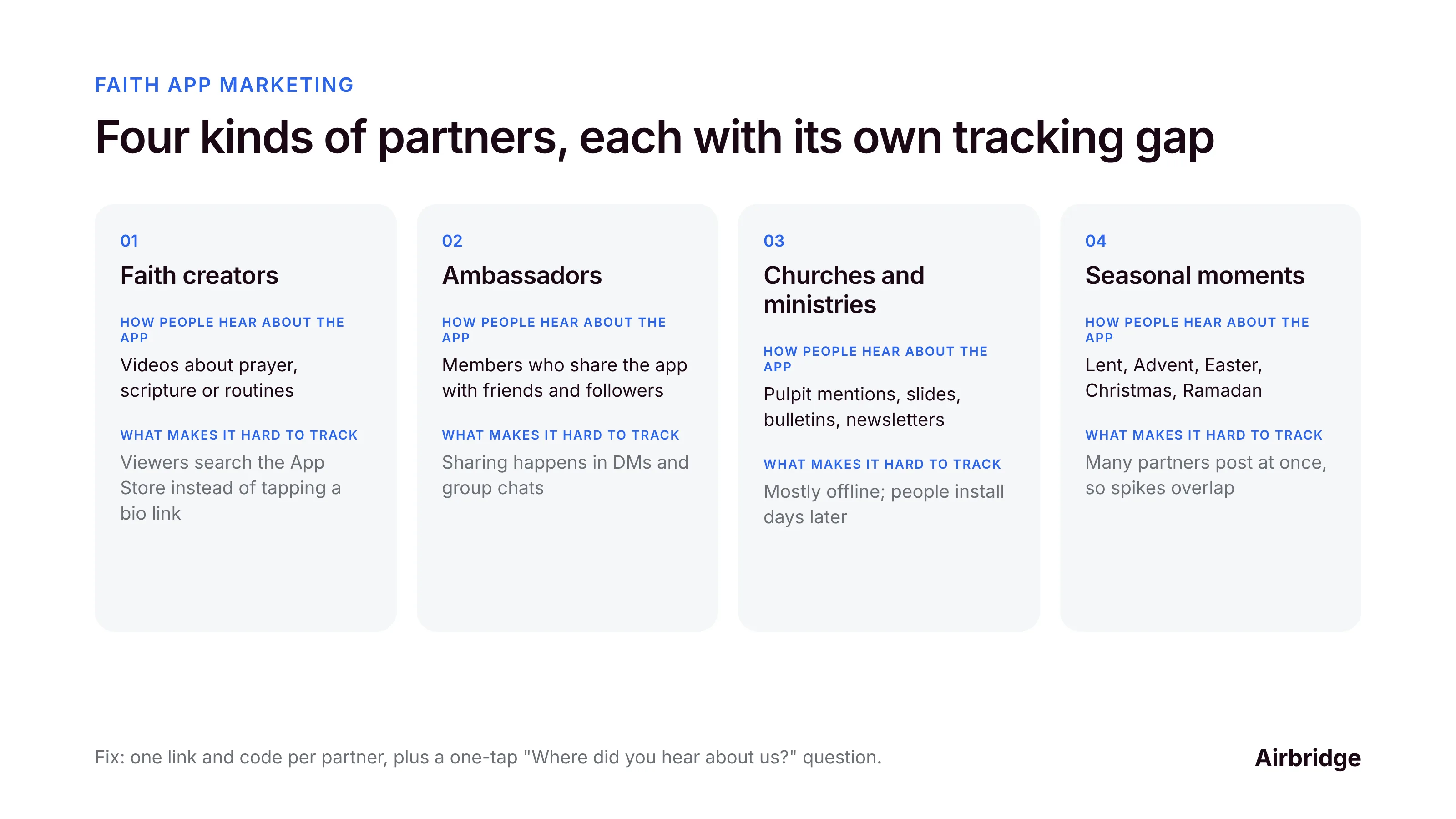
Most faith apps see four kinds of partners:
| Partner | How people hear about the app | What makes it hard to track |
|---|---|---|
| Faith creators | Instagram, TikTok and YouTube videos about prayer, scripture or routines | Viewers search the App Store instead of tapping a bio link |
| Ambassadors | Members who share the app with friends and followers | Sharing happens in DMs and group chats |
| Churches and ministries | Mentions from the pulpit, slides, bulletins, newsletters | Mostly offline, people install days later |
| Seasonal moments | Lent, Advent, Easter, Christmas, Ramadan | Many partners post at once, so spikes overlap |
Each one needs a slightly different way to be counted.
Give every partner a way to be counted
-
Creators: one tracking link per creator for their bio or an Instagram Story link sticker, since links in captions and comments aren't clickable on most short-form platforms.
-
Ambassadors: one personal link per ambassador they can paste into messages and group chats. Links shared in messaging apps can be tapped.
-
Churches: one QR code per church, made from its own tracking link, for slides, bulletins and printed cards. A QR code turns an offline mention into a tap.
-
Everyone: one onboarding question that lists your partner types and, where it makes sense, partner names.
If you use promo codes, give each partner their own, but treat code counts as one signal. Many people forget to type them. We explain why in our post on creator promo code tracking.
Ask one gentle question
A one-tap "How did you find us?" in onboarding catches people who heard about you in person or searched the store after a video. Keep the options short:
-
My church or ministry
-
A friend or family member
-
Instagram, TikTok or YouTube
-
[Creator names during active campaigns]
-
App Store search
-
Something else
Make it optional, and place it after the first value moment, such as the first verse of the day, so it doesn't slow anyone down.
Want to see how Faith app marketing works with your data?
Get hands-on with Airbridge and see real results.
Try It Free →Read results in the right windows
-
Creator posts: trial starts in the 7 days after the post, compared with your normal baseline.
-
Church mentions: a longer window of about 14 days, since people often install later in the week or after the next service.
-
Seasonal campaigns: compare against the same season last year if you can, because overall interest rises at Lent, Advent or Ramadan regardless of any partner.
Then compare partners on cost per trial and cost per subscriber, not views or likes.
Handle faith data with care
Knowing someone uses a faith app can reveal their religious beliefs. Under the EU's General Data Protection Regulation, religious beliefs are a special category of personal data with stricter rules. Good practice for any faith app:
-
Collect only what you need to measure campaigns, such as the link or partner a user came from.
-
Don't send sensitive in-app details, such as prayer topics or journal entries, to ad platforms or analytics tools.
-
Explain clearly in your privacy policy what you measure and why.
This isn't legal advice. Check your own obligations with a privacy professional.
Recap
-
Give every creator, ambassador and church its own tracking link or QR code.
-
Add one gentle onboarding question, such as "How did you find us?", with options like "My church" and creator names.
-
Read trial starts in the week after each post or service mention.
-
Because faith is sensitive personal data, collect only what you need.
Questions faith app teams ask
How do Bible and prayer apps track influencer campaigns?
Give each creator a tracking link for their bio or Story, add an onboarding question with creator names, and compare trial starts in the week after each post with your baseline.
How can a faith app track church partnerships?
Give each church its own QR code built from a tracking link, and add a "My church or ministry" option to your onboarding question. Read results over a two-week window after each mention.
Are promo codes a good way to track faith creators?
They help, but they undercount. Many people forget the code or install later from search. Use codes together with links and an onboarding question.
When do faith apps see seasonal spikes?
Often around Lent, Easter, Advent and Christmas for Christian apps, and Ramadan for Muslim apps. Compare against the same season last year so you don't credit a partner for seasonal demand.
Is it safe to send faith app data to ad platforms?
Send only what campaigns need, such as installs and trial starts. Don't share sensitive details like prayer topics, and review your privacy obligations, since religious beliefs are sensitive data in many regions.
Final thoughts
Faith apps grow through trusted voices: creators, ambassadors and churches. Give each one its own link or QR code, ask one gentle question, read results in the right window, and treat your users' faith with the care it deserves.
Airbridge gives each creator, ambassador and church its own tracking link or QR code and shows installs, trial starts, subscriptions and revenue per partner in one dashboard, across iOS and Android. The Core Plan is built for subscription apps, and you can try it free for 30 days, then from $40 per month.

Ready to transform your mobile growth?
Learn how Airbridge helps leading brands measure and optimize every touchpoint.
“While working with Airbridge, we have learned that MMM is a crucial attribution model for post-privacy era marketing to predict future performance and optimize the budget.”