Paying Creators a Revenue Share: How to Track Subscription Commissions Fairly

On this page
How creator revenue share works for subscription apps
Paying creators per view rewards reach. Paying them a share of subscription revenue rewards results. That's why more subscription apps are moving creators and affiliates to commissions. One app we spoke with already pays per sign-up, "so long as we believed they were legitimate users with complete profiles." Others have built their own affiliate tracking from scratch.
Revenue share sounds simple. In practice, it depends on two things: knowing which creator brought each subscriber, and writing down clear rules for what you pay.
A quick example: 20% of what?
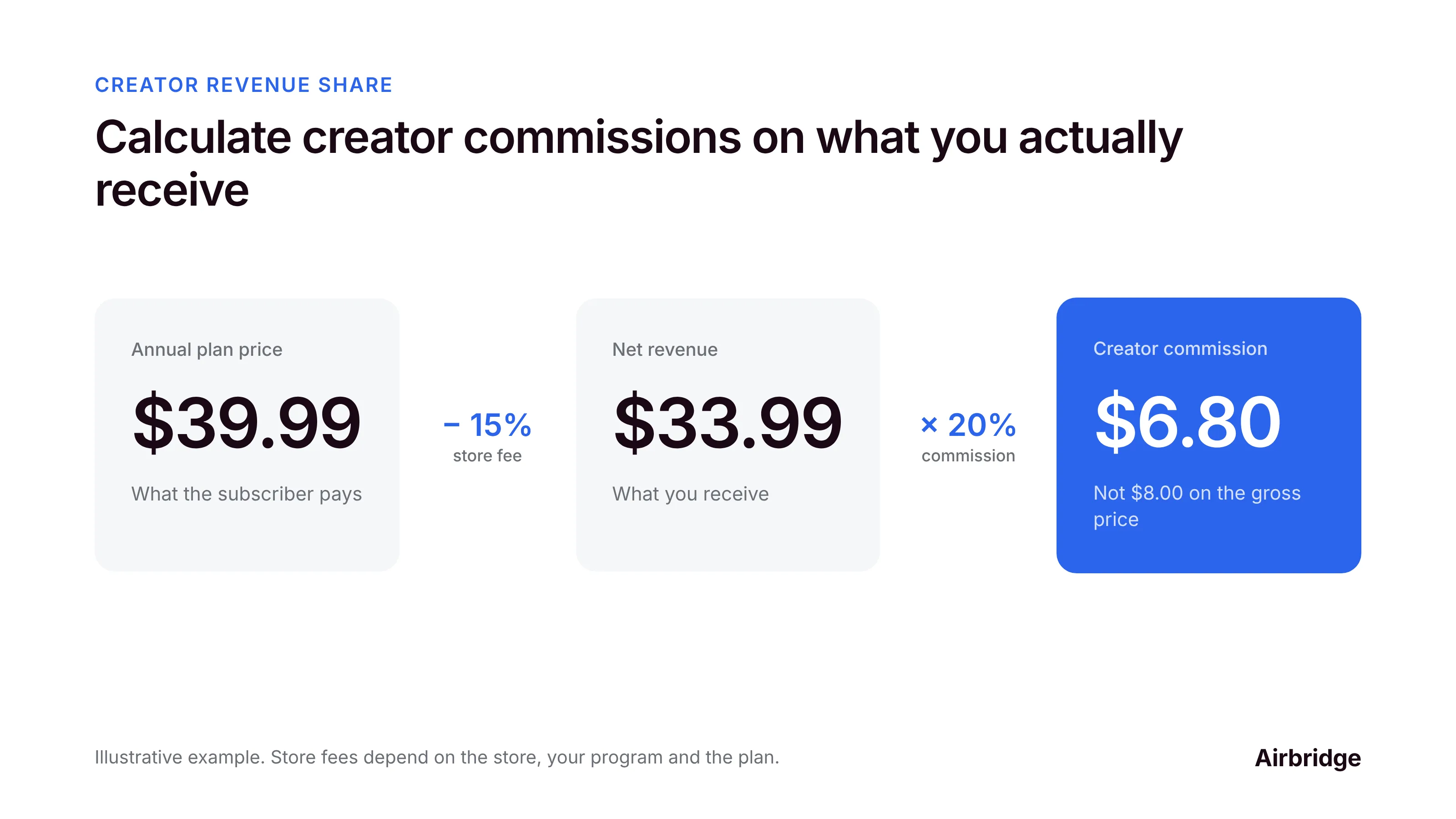
A $39.99 annual plan doesn't put $39.99 in your account. With a 15% store fee, you receive about $33.99, so a 20% commission on net revenue comes to about $6.80, not $8.00. Step 4 below covers how to set this up.
Step 1: Credit each subscriber to one creator
Commissions need user-level credit. Use two signals together:
-
A tracking link per creator in their bio or Story link sticker, which follows each person who taps through install, trial and subscription.
-
A personal code per creator, entered in onboarding, for people who saw the video and searched the store instead.
Decide what happens when both apply: for example, the link wins if the person tapped it within 7 days, otherwise the code. Write it down. Disputes usually come from unwritten rules.
Codes alone undercount and can leak to coupon sites, which we cover in our post on creator promo code tracking.
Step 2: Decide what earns commission
| Decision | Common options | What to consider |
|---|---|---|
| Which payments | First payment only; first year; lifetime | Lifetime is generous but grows your liability |
| Which plans | All plans; annual only | Annual plans pay more up front |
| Rate | Flat fee per subscriber; % of revenue | A flat fee is simpler; % scales with price |
| Base amount | Gross price; net after store fees | Net protects your margin |
| Free trials | No commission until the first payment | Paying on trials invites low-quality traffic |
A common, simple starting point: a percentage of net revenue for the first 12 months of each subscriber, paid monthly.
Step 3: Handle refunds and hold periods
Subscribers can request refunds, and some payments fail. Protect yourself:
-
Hold commissions for 30 to 60 days after each payment before paying out.
-
Reverse commissions on refunded or charged-back payments within that window.
-
Pay on confirmed revenue from your subscription platform, not on in-app events.
Want to see how Creator revenue share subscription app works with your data?
Get hands-on with Airbridge and see real results.
Try It Free →Step 4: Calculate on net revenue
Stores take a fee on in-app purchases and subscriptions, and the rate depends on the store, your program and the plan. Calculate commissions on what you actually receive. For example, on a $39.99 annual plan with a 15% store fee, a 20% commission on net revenue is about $6.80, not $8.00.
Step 5: Share a monthly report
Creators trust programs they can see. Each month, send each creator: link taps, installs, trials, paying subscribers, refunds, net revenue and commission earned. Transparent numbers also help creators make more of what works.
Step 6: Watch for abuse
-
Codes appearing on coupon sites.
-
Spikes of subscribers from countries the creator doesn't reach.
-
Many subscriptions that cancel or refund right after the first payment.
The hold period and refund reversals handle most of it. For the rest, reserve the right to review in your creator agreement.
Before you sign a revenue share deal
-
Credit each subscriber to one creator using a tracking link plus a code.
-
Set clear rules for which payments earn commission, for how long, and on what amount (net of store fees and refunds).
-
Hold payouts until the refund window passes.
-
Share a simple monthly report with each creator.
Revenue share FAQ
How do I pay creators a percentage of subscription revenue?
Credit each subscriber to one creator with a tracking link and a code, calculate commission on net revenue for the payments your rules cover, hold payouts through the refund window, and pay monthly with a report.
Should creator commissions be on gross or net revenue?
Net revenue, after store fees and refunds, is safer for your margin and easier to defend. State it clearly in the agreement.
How long should creators earn commission on a subscriber?
Many programs pay for the first year of each subscriber. Lifetime commissions are more generous but grow your long-term costs.
Should I pay commission on free trials?
Usually not. Paying on trials rewards volume, not quality. Pay from the first confirmed payment.
Can I combine a flat fee with a revenue share?
Yes. A small flat fee per video plus a revenue share is a common hybrid. It keeps creator income predictable and ties part of it to results.
Fair for both sides
Revenue share aligns creators with what you care about: paying subscribers. Make it fair with clear attribution, written rules, net-revenue math, a hold period and an honest monthly report.
Airbridge gives each creator their own tracking link and shows installs, trials, subscriptions, renewals and refunds per creator, so commission reports start from the same numbers you trust. The Core Plan is built for subscription apps, and you can try it free for 30 days, then from $40 per month.

Ready to transform your mobile growth?
Learn how Airbridge helps leading brands measure and optimize every touchpoint.
“We went with them because their tech is better. It's best-in-class, for sure, but the real difference for us was the people.”