Best TikTok Ads Attribution for Mental Health App
On this page
A mental health app testing TikTok needs attribution for app campaigns, a clean way to measure creators, and a short event list that never names a person's condition. Airbridge makes one of the tools compared here. Treat TikTok as a test for this category, because none of the 18 apps in our data show TikTok ads.
What mental health apps need from TikTok Ads
TikTok reaches people who were not looking for help. That is its appeal and its risk. A video about burnout can land with someone who has never tried a wellness app, and it can also land with someone having a very bad day. What your ad promises matters more here than in most categories. Before you test, read TikTok's current ad rules for health topics.
A few traits set this app type apart:
- Usage comes in waves. People often arrive during a hard stretch and drift away when life improves. A user who leaves after two good months may be a success story, not a failure. Read churn with that in mind.
- Trust comes before payment. Someone sharing private feelings with an app wants to feel safe first. That can stretch the time between install and trial, so judge TikTok on more than the first day.
- Creators carry the message. A person telling their own story often lands better than a polished ad. That means many of your TikTok results may come from creator posts, not from TikTok Ads at all.
- Sensitive data needs restraint. Your funnel needs to know that someone started a trial. It does not need to know why. Keep symptoms, moods, and journal content out of event names and event data.
- Some revenue skips the store. A few apps also sell through employers or care partners. Those sales will not show in a consumer ad funnel.
What the data shows
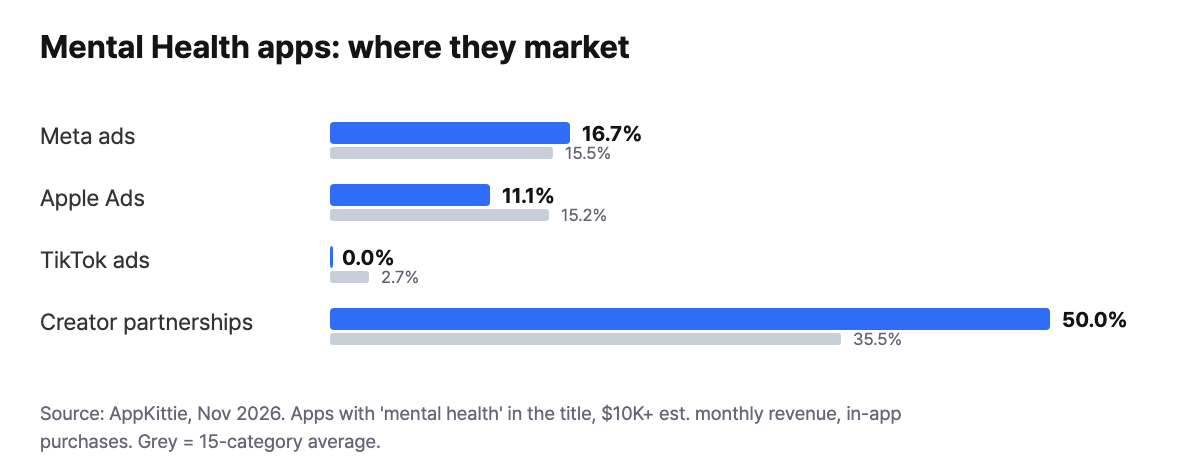
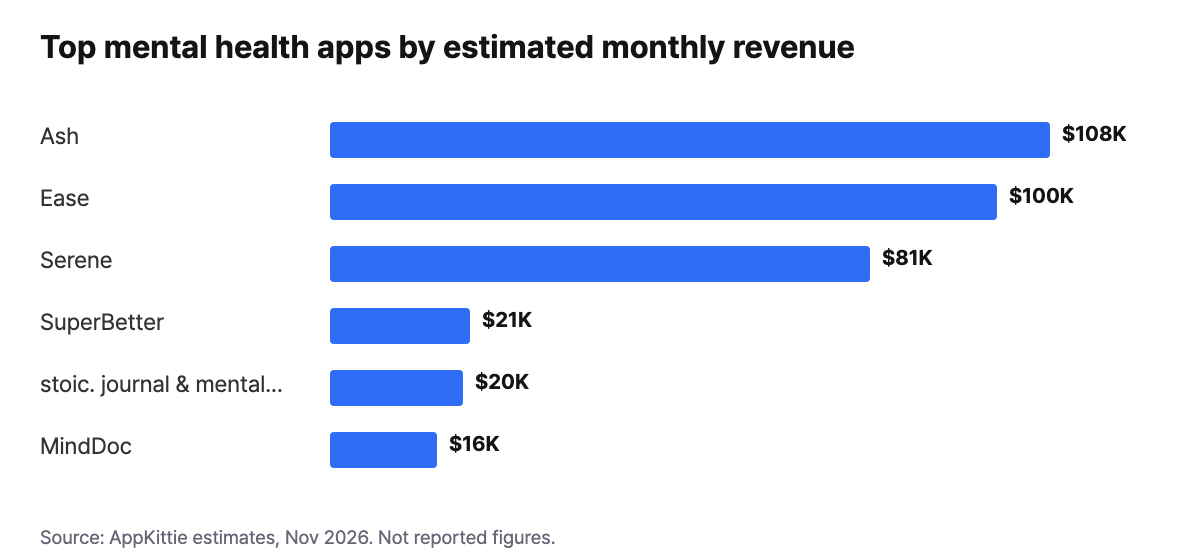
This is a very small set: 18 apps with "mental health" in the title, $10K+ estimated monthly revenue, and in-app purchases, from AppKittie in November 2026. None of them show TikTok ads (0.0%, against a 2.7% average across 15 categories), while 9 show creator partnerships (50.0%) and 3 show Meta (16.7%). Estimated revenue tops out at $108K for Ash and falls to $21K by the fourth app, so 18 apps can suggest a gap on TikTok but cannot prove the channel works or fails.
How to choose
- Campaign type first. Decide if your TikTok ads will send people to the app or to a website. Web campaigns can need a Conversions API, and not every plan includes one. Ask about this before you compare prices.
- Creator and paid in one place. The creator flag sits well above TikTok ads here, though it does not prove creator videos. Your tool should show both side by side, including creator cost.
- Event control. You choose what your app sends. Pick a tool that works well with a small set of generic events, and review its data handling with your own counsel.
- Cost at small scale. A first TikTok test may bring few conversions. Compare what each tool charges for a low-volume month, since free conversion plans and low flat starts behave differently.
- Creative reading. TikTok results swing by video. Ask how deep cost data goes, because a tool that stops above the video level leaves that read to TikTok's own dashboard.
Want to see how Best tiktok ads attribution for mental health apps works with your data?
Get hands-on with Airbridge and see real results.
Try It Free →Tools compared
| Airbridge Core | AppsFlyer | Adjust | Branch | Singular | Kochava | |
|---|---|---|---|---|---|---|
| Starting price | $40+/mo | Zero plan free (12,000 conversions in first 12 months); Growth $0.07 per conversion | Check vendor pricing page | Not listed on pricing page | Free plan (15,000 paid conversions); Growth $0.05 per conversion | Free App Analytics (10K conversions/month); Foundation from $500/mo |
| Self-serve signup | Yes | Yes | Check vendor pricing page | Yes on Basics | Yes on Free | Yes |
| Billing model | Data points | Per conversion | Check vendor pricing page | Not stated on pricing page | Per conversion | Conversions or MAU, by plan |
| Free trial | 30 days | Free Zero plan instead | Check vendor pricing page | Yes, on Basics | Free plan instead | Yes, on paid plans |
| RevenueCat integration | Yes | Yes | Yes | Yes | Yes | Yes |
Competitor details come from each vendor's public pages as of November 2026. AppsFlyer says its Zero plan is not suitable for apps with paid activities.
- Airbridge Core may suit an app running a time-boxed TikTok test, as the 30-day trial can cover the first round.
- AppsFlyer may suit a team that would rather pay per conversion, even if that makes a successful month cost more.
- Adjust may suit a team that can check its pricing page, since no starting figure appears here.
- Branch may suit a small team that wants a Basics trial, with price still to confirm.
- Singular may suit a low-volume test, as its free plan runs up to 15,000 paid conversions.
- Kochava may suit a team that only needs App Analytics for now, within 10K conversions a month.
How to set this up in Airbridge
- Start Core with no card and no sales call, and install the SDK. A basic install takes about 5 minutes.
- Connect TikTok for Business and run app campaigns.
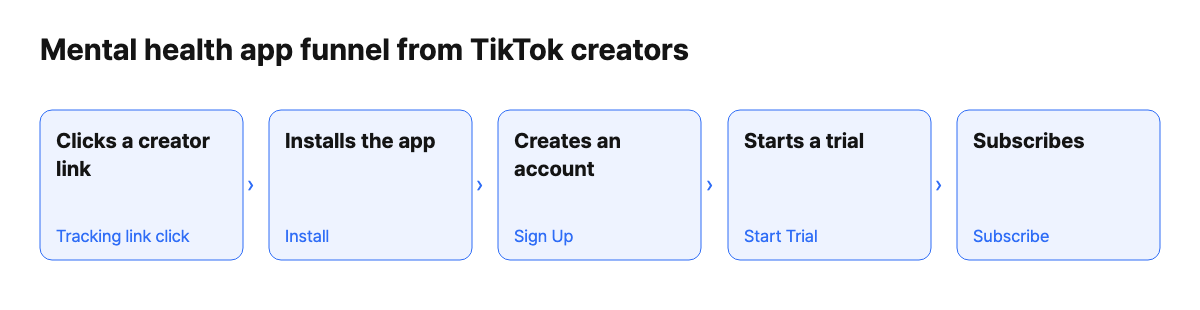
- Give each creator a tracking link. Then use CSV Cost Data Upload with the creator in the campaign column, so Actuals shows cost and cost per install (CPI) for each creator. This creator tracking guide has the details.
- Send only standard events, such as Install, Sign Up, Start Trial, and Subscribe. If you use RevenueCat, see how to connect its revenue to ads.
- Compare TikTok Ads and creators in the Funnel Report before you scale either one.
What Airbridge Core does not do here
- TikTok web campaigns. In practice they need Conversions API, and CAPI is on Growth only. Plan on app campaigns with Core, and treat TikTok web-to-app as limited. If your funnel starts on a web quiz, pick something else.
- Creative-level cost. Cost data reaches campaign or ad group level. For a single video's cost, use TikTok's own dashboard.
- Custom events. Core has none. A mood check-in or first journal entry cannot be a funnel step, which also keeps those topics out of your attribution data.
- Health privacy review. Airbridge makes no claim on this page about health privacy law, and this is not legal advice. If your app handles regulated health data or sits inside care delivery, take any SDK decision to your counsel first.
FAQ
Should a mental health app run TikTok ads at all?
The data cannot answer that. Eighteen apps is too few, and none of them show TikTok ads. A small test is reasonable if your ad rules are clear and your promise is honest. Set your stop rule before you start, based on subscribers and not installs.
Can I measure TikTok creators without running TikTok Ads?
Yes. A creator tracking link works for any non-ad source. Clicks and impressions on those links do not count as data points, though the install and later events do. Paid TikTok campaigns are a separate connection.
What should I keep out of my event data?
Keep out anything that describes a person's state: diagnoses, moods, journal text, or quiz answers. Standard events such as Start Trial and Subscribe tell you what you need for attribution without any of it. Your privacy policy and your counsel should cover the rest.

Ready to transform your mobile growth?
Learn how Airbridge helps leading brands measure and optimize every touchpoint.
“Airbridge understands the essence of what it has to offer as an MMP. Its objective, transparent, and accurate performance analysis allows marketers to realize the true impact of their efforts.”