Best Google UAC Attribution for Language Learning App
On this page
For a language learning app on Google App campaigns (formerly UAC), look for a tool that shows who pays, not just who installs, on both iOS and Android and across countries. Google's automation will chase whatever signal you give it, so the tool has to return post-install events and let you read results by campaign. Airbridge is one of the vendors in the comparison below.
What language learning apps need from Google App campaigns
Google App campaigns give you little manual control. You supply a budget, a target, and creative assets, and Google decides where the ads run. That makes your conversion signal the main lever you own. If the goal is installs, you will get installs. For a language app, an install is close to meaningless, because downloading a course is easy and speaking a new language is hard.
The first lessons are where most of the truth shows up. A learner opens the app full of motivation, finishes a lesson or two, and then either builds a daily habit or drifts away. Subscribe decisions tend to follow that early streak or a trial, and many paying users choose longer plans because they know the goal takes months.
Three things set this category apart from other subscription apps:
- The audience is global. People learn English in one market and Spanish or Korean in another. The same app can see very different install costs and very different willingness to pay by country. A blended result hides that.
- Android matters. In many of the markets where language learners are, Android is the main platform. You need Android and iOS in one view.
- Motivation has dates. New-year goals, school terms, exam deadlines, a move abroad, and a planned trip all drive demand. Some learners subscribe with a clear end date, then leave once they pass the test or come home.
Every one of these points to the same risk. A campaign can look great on installs in a low-price market and produce almost no subscription revenue.
What the data shows
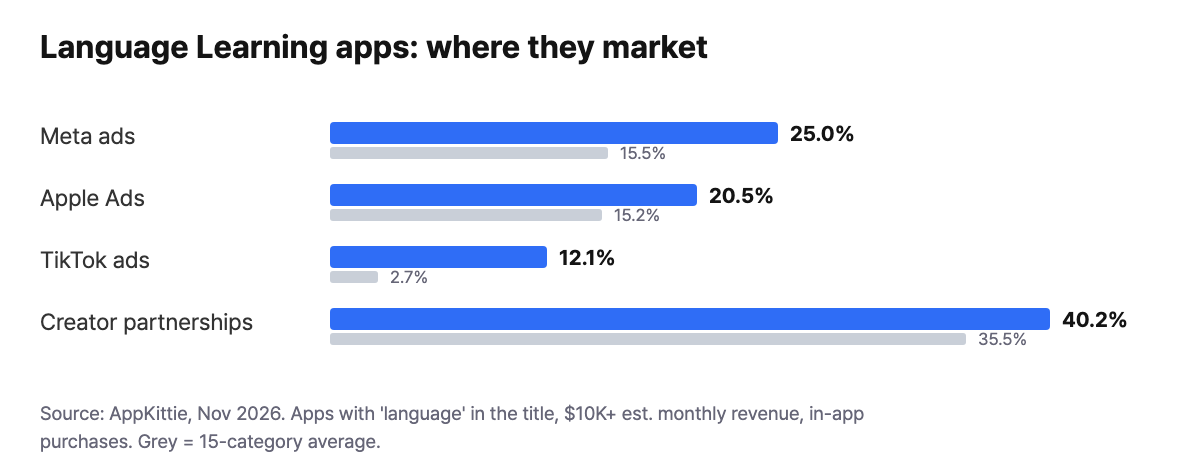
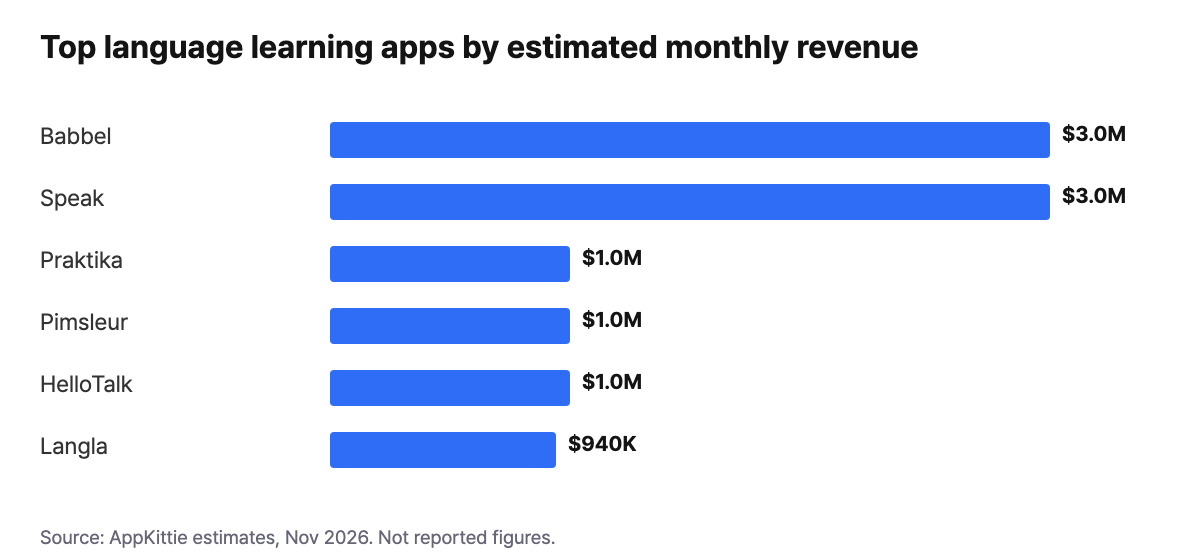
This dataset has no Google Ads signal, so the charts cannot tell you how many language apps run Google App campaigns. Of 132 apps matched by title, with $10K+ estimated monthly revenue and in-app purchases (AppKittie, November 2026), 33 show Meta ads (25.0%), 27 show Apple Ads (20.5%), and 16 show TikTok ads (12.1%, against a 15-category average of 2.7%), so assume your Google traffic will sit next to other paid channels. The revenue chart shows estimates from a small sample of 39 apps. It leaves out downloads, but the same data shows the install problem: Langla has an estimated 4M downloads and $940K, while Pimsleur has 85K downloads and $1M.
How to choose
| What to check | Why it matters for a language app |
|---|---|
| Post-install events | Google needs a signal stronger than installs, and so do your own reports. |
| iOS and Android in one place | Your learners are on both. Two reports means two answers. |
| Cost detail | Check how far cost data reaches. You need at least campaign level to judge spend. |
| Cross-channel view | Language apps tend to mix channels, so Google results need context. |
| Billing at high install volume | Cheap installs can mean many events. Compare event and conversion billing with your numbers. |
Want to see how Best google uac attribution for language learning apps works with your data?
Get hands-on with Airbridge and see real results.
Try It Free →Tools compared
| Airbridge Core | AppsFlyer | Adjust | Branch | Singular | Kochava | |
|---|---|---|---|---|---|---|
| Starting price | $40+/mo | Zero plan free (12,000 conversions in first 12 months); Growth $0.07 per conversion | Check vendor pricing page | Not listed on pricing page | Free plan (15,000 paid conversions); Growth $0.05 per conversion | Free App Analytics (10K conversions/month); Foundation from $500/mo |
| Self-serve signup | Yes | Yes | Check vendor pricing page | Yes on Basics | Yes on Free | Yes |
| Billing model | Data points | Per conversion | Check vendor pricing page | Not stated on pricing page | Per conversion | Conversions or MAU, by plan |
| Free trial | 30 days | Free Zero plan instead | Check vendor pricing page | Yes, on Basics | Free plan instead | Yes, on paid plans |
| RevenueCat integration | Yes | Yes | Yes | Yes | Yes | Yes |
Competitor details come from each vendor's public pages as of November 2026. AppsFlyer says its Zero plan is not suitable for apps with paid activities.
How they line up on billing:
- Kochava may suit a team that wants billing tied to conversions or MAU by plan, and can start on Free App Analytics at 10K conversions a month.
- Singular may suit a team that wants per-conversion billing at $0.05 on Growth after a free plan.
- AppsFlyer may suit a team that wants per-conversion billing at $0.07 on Growth, since its Zero plan is not suitable for paid activities.
- Adjust may suit a team happy to confirm billing terms on the vendor page, since they are not shown here.
- Branch may suit a team that can get a quote, because the pricing page states neither price nor billing model.
- Airbridge Core may suit a team that wants data point billing, with 500K included and $0.0001 for each one after that.
How to set this up in Airbridge
- Begin the trial and add the SDK to both platforms. Expect about 5 minutes for a basic install.
- Connect Google Ads so cost data flows in. Name one campaign per country group. Campaign name and ID always show, so that naming lets a campaign report answer the country question.
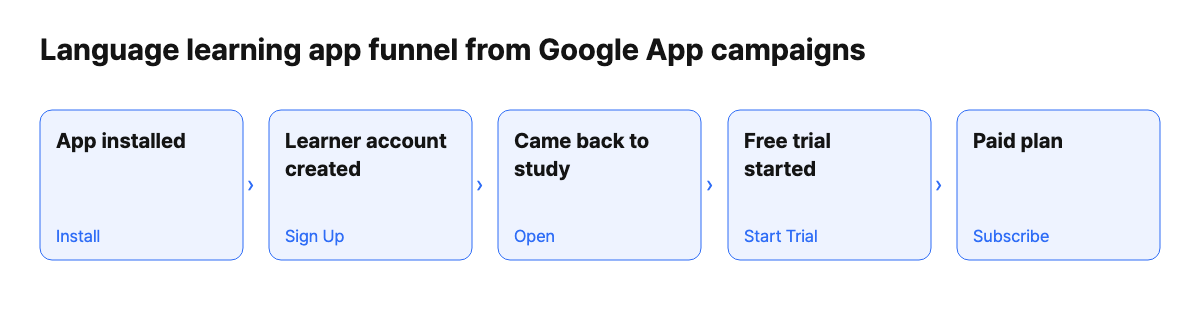
- Send standard events: Install, Sign Up, Start Trial, Subscribe, and Unsubscribe. Lesson events are not standard, so they stay out on Core. To bring in subscription revenue, read how to connect RevenueCat revenue to ads.
- Register your Link ID, then turn on the mobile app postback to Google Ads. Give App campaigns a post-install event to work with and not only installs.
- Read Actuals for cost and events across channels, then the install to subscription funnel in the Funnel report. In the Revenue Report, pick Subscribe as the Revenue Event.
What Airbridge Core does not do here
- No creative names or creative-level cost. Cost stops at campaign or ad group level, and Performance Max is campaign level only. Ad group names appear only for ACi, ACe, and ACpre campaigns (install, engagement, and pre-registration). App campaigns lean on assets, so you will still read asset results inside Google Ads.
- No custom events. "Lesson completed" and "streak started" are the early signals language apps want most. The standard set does not include them, so if your plan depends on sending those to Google, look at Growth or another vendor.
- No fraud detection. Fraud tools are on Growth only. If you run wide across low-cost markets and worry about invalid installs, Core does not cover that. Pick a plan that does.
- Web learning is out of scope. The Core Web SDK is for web-to-app tracking only. If many learners study in a browser, Core will not measure that activity.
FAQ
Can I send predicted LTV to Google to improve App campaigns?
No. Predicted LTV on Core goes up to day 180, and it is for the dashboard only. It is never sent to ad networks. It helps you decide which channel to fund. It multiplies a machine-learning prediction of user lifetime by ARPDAU, so it will not replace the events you send to Google.
How do I compare Google with Meta, Apple Ads, and TikTok?
Connect all four. Cost aggregation on Core covers those four channels, and Actuals puts them side by side. Keep the attribution window the same while you compare. Otherwise you will read a difference in settings as a difference in channels.
Why would high download counts not mean high revenue?
Downloads measure interest, and a language app attracts a lot of it. Paying takes a habit. In this data, Praktika has 360K estimated downloads and $1M, and Speak has 220K and $3M. Those are estimates, so read them as direction only. That spread is why a post-install event matters more than an install target.

Ready to transform your mobile growth?
Learn how Airbridge helps leading brands measure and optimize every touchpoint.
“We went with them because their tech is better. It's best-in-class, for sure, but the real difference for us was the people.”