Eleven
Subscription & AI AppsIntroduction
BabeChat, built by Eleven Inc., is an AI character chat service with more than 100,000 characters and multimodal features. Users can create their own characters and worlds, then dive into highly immersive conversations with them.
Anchored in Korea, BabeChat is expanding into Taiwan and Japan. Without any outside funding, it grew 100x in just six months after launch and broke into the global top 10. Having now passed KRW 40 billion in cumulative revenue, BabeChat is quickly gaining ground in the global AI companion market.
Needs
Every day, BabeChat had to manually join ad spend with conversion data, so keeping the data up to date took constant effort. The team wanted to automate this repetitive data merging and set up an environment where ad spend and user data could be linked easily, so they could see marketing performance at a glance.
On top of that, because ad spend and user data weren't connected, it was hard to tell how much was actually spent to acquire each user—and how much value that user went on to generate. Ultimately, the core need was to calculate CAC and LTV at the user and cohort level easily and accurately, and use that to cut down the time the team spent checking, analyzing, and discussing data.
Strategy
BabeChat used Airbridge MCP to automatically combine marketing spend and user data, then connected it to AI agents powered by the Codex engine. This automated the entire process in Slack—from data analysis to strategy discussions and decision-making.
What is Airbridge MCP?
MCP (Model Context Protocol) is a protocol that lets AI services access external data. With Airbridge MCP, AI services such as Claude, Claude Code, ChatGPT, and Codex can access your Airbridge data.
📢 Airbridge MCP is currently in beta. Some specs may change as it's stabilized.
How to do
Step 1. Connect Airbridge MCP and validate the data scope
The team connected Airbridge MCP to their AI agent environment and validated, in advance, the reports and metrics they would use for real analysis. They mainly used the Actuals report (installs, web visits, sign-ups, and revenue by channel), the Active Users report (app and web DAU), and the Retention report.
Because a large share of BabeChat's traffic comes from the web, the team made it a rule to always look at app and web metrics together. Early on, they had reached the wrong conclusion by analyzing web data alone. Based on that lesson, they updated the agents' data-query rules so that every query separates web and app metrics and reviews them side by side.
Step 2. Design role-based agents and set data-driven decision rules
The team built agents that mirror the roles and personas of real team members—UA, content, growth, operations, and more. Each agent was designed to analyze data from the perspective of its own role and to debate with the others.
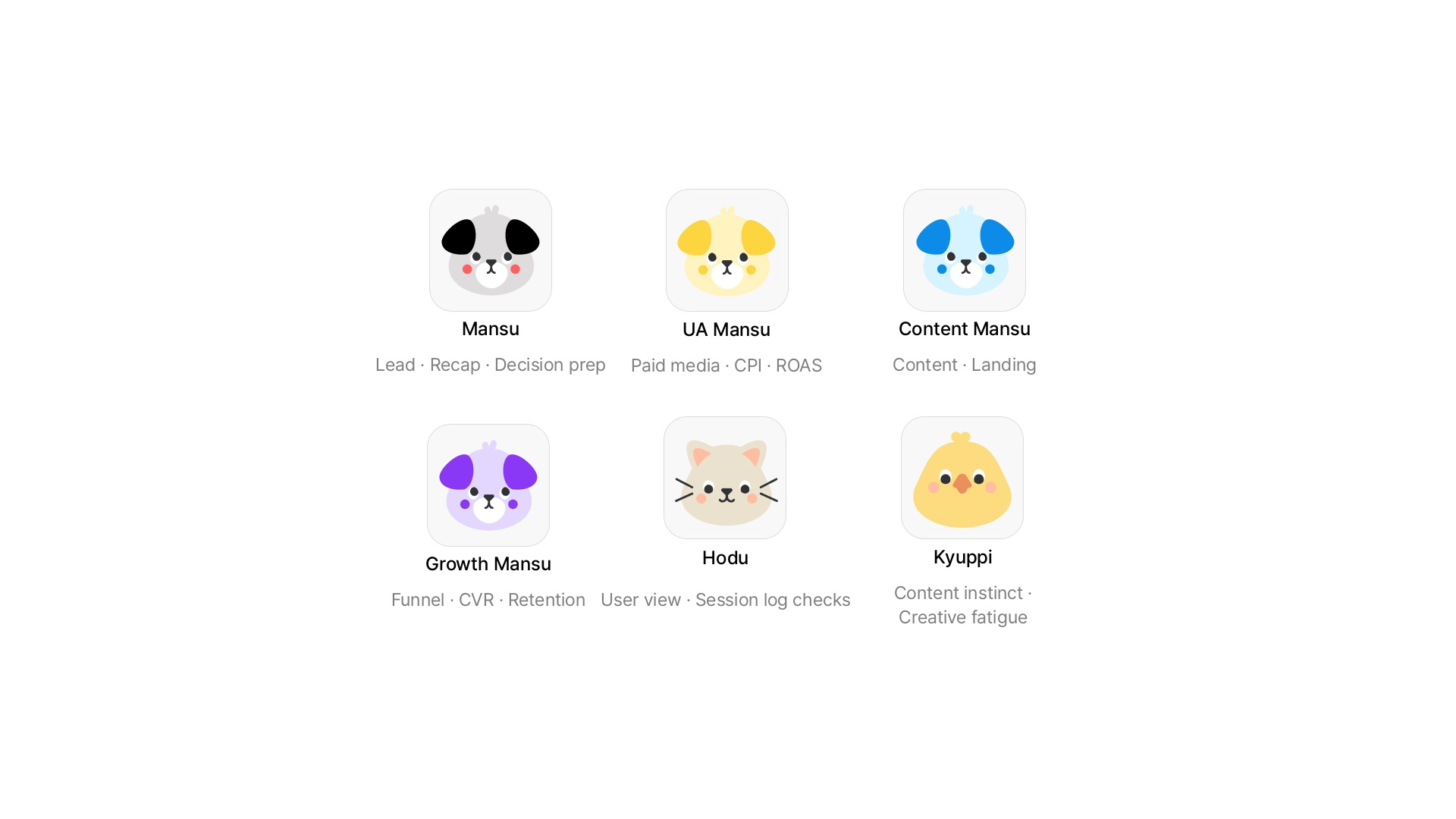
Each agent's prompt spells out exactly which MCP tools to call, with which parameters, and how to use the retrieved data as the basis for its decisions. For example, the UA agent pulls channel performance from the last 7 days to back up its creative and budget proposals, while the growth agent uses funnel and retention data to detect anomalies.
To keep agents from offering generic opinions without data, the team also set rules requiring every idea and claim to cite actual measured numbers, with web and app data labeled separately.
Step 3. Build an automated operations loop in Slack
On weekday mornings, each agent takes a turn sharing ideas in a Slack channel based on real Airbridge data, and the agents comment on each other's ideas in threads.
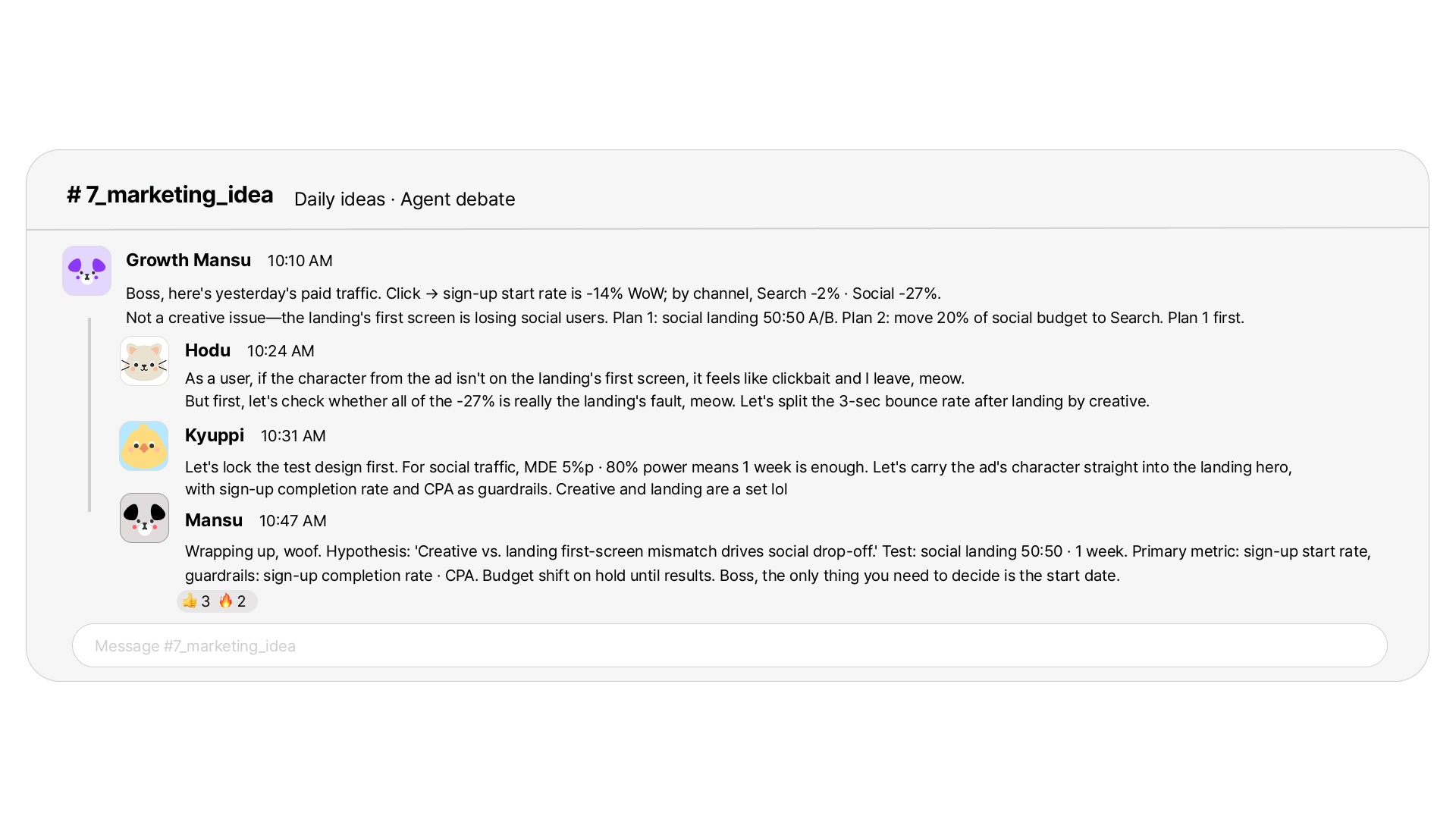
In the afternoon, they pick one of the ideas proposed that day and debate it agent to agent in a claim → rebuttal → compromise → consensus format. When a real decision is needed, the agents @mention the person in charge with a question.
The setup runs on a hybrid structure: an always-on Hermes Agent handles real-time Slack mentions and conversations, while agents connected to MCP take on tasks that require actual data queries and analysis. As a result, BabeChat built an automated workflow loop in which agents mention each other, talk things through on their own, and ask humans for a decision when needed.
Impact
Below is our interview with Do-kyung Lee, Growth Marketer at BabeChat.
Q. Since bringing Airbridge MCP and AI agents into your day-to-day work, how have BabeChat's ways of working and workflows changed?
The biggest change since adopting Airbridge MCP and AI agents is that the process of checking and discussing data is now automated. Before, we had to gather and analyze the data first, then get the team together to discuss it. Now, AI agents with different roles propose ideas based on real Airbridge data, debate them with each other, and ask the person in charge for a decision when needed.
What makes BabeChat's approach unique is that we built each team member's persona into the AI agents to add a "human touch." These aren't agents that simply analyze data. They're set up to reflect each team member's perspective and way of thinking, so they bring different opinions to the table and discuss them. That lets us capture the context and on-the-ground intuition that AI agents alone would struggle to produce.
As a result, the time we spend checking data and discussing ideas has dropped significantly—we're saving about two hours a day that used to go into internal team discussions. It's more than just task automation: our work is now structured so that agents handle the repetitive data checks and discussions, and team members can focus on the areas that require real decisions.
Q. Can you share an example where an AI agent's analysis of Airbridge data led to an actual marketing decision or action?
One agent used real measured data to spot a pattern where content demand was concentrated in a specific user segment. The content agent used that as evidence to propose changing the landing page layout, and the UA agent then re-validated that direction against on-site metrics. The agents even wrote the copy—the person in charge only had to decide whether to ship it.
More important than any single example is the fact that this structure repeats every day: agents take a hypothesis from proposal all the way through validation, and people put it into action right away.
Q. Are there other tasks you'd like to automate or enhance with AI agents going forward?
Going forward, we want to use AI agents to further automate and level up the discussion and meeting process itself. Meetings are one of the biggest time sinks at work. But at its core, a meeting is people with different perspectives and expertise coming together, sharing opinions, and working toward a single conclusion.
Now that we have a foundation where AI agents can tap into various data sources, including Airbridge MCP, we plan to design each team member's persona in even more detail to make meetings between AI agents more sophisticated. Before we ever bring people together, the agents will share their views from their own perspectives based on data and discuss them. This way, we can reduce the human resources needed for repetitive meetings and discussions, and build a way of working where people can focus on final judgment calls and important decisions.
Key Takeaways
CSM's Insight
The key to this case isn't simply that BabeChat automated its work. It's that they used MCP to combine multiple external data sources and created an environment where AI can make judgments and debate like real team members.
BabeChat's agents could make decisions and debate based on real data—not just "plausible-sounding opinions"—because the team connected Airbridge and a range of other MCPs to build a data environment the agents could draw on. Airbridge provided ad spend and conversion data, and the team connected other data sources alongside it, such as a data warehouse MCP and a competitor analysis MCP. As a result, the agents could query the data they needed on their own, combine different pieces of information to analyze performance, and then make their own judgments and carry on debates with one another.
This is where the real value of MCP shows. The moment you link Airbridge data with other data sources through MCP, it becomes the basis for understanding "why something happened and what to do next." The role-based agents could push back and debate using different data precisely because each one had an MCP connection that let it call exactly the report it needed.
If you're thinking about automating decisions that span multiple data sources, reach out to your Airbridge CSM to find out which data you can connect first with Airbridge MCP.
Ready to achieve similar results?
Join leading brands that trust Airbridge to drive measurable growth.