How to Choose Between Free Trial and Freemium With Data

56% of new subscription apps earn less than $1,000 in their first year. Only 9% break $100,000. The gap between the two groups starts with one of the earliest decisions you make: how you structure your first offer.
The wrong monetization model doesn't just cost conversions. It changes how fast you learn what works, how quickly revenue comes in, and whether your onboarding actually drives upgrades.
This guide walks you through the decision, the setup, and the mistakes that kill early subscription revenue. If you're new to app marketing, your subscription offer is one of the first things to get right.
Key Takeaways
-
Free trials convert 5-10x higher than freemium. The median trial-to-paid rate is 34.8% across 75,000+ apps, while freemium sits at 2-5%. For most new apps, trials are the faster path to revenue.
-
Trial length matters less than you think. Trials from 5 to 32 days show roughly equal conversion (44-46% median). Pick based on time-to-value, not competitor defaults.
-
Freemium works when your market is massive and value compounds over time. If you need scale before monetization makes sense, freemium is the play.
-
Your first offer should be simple. One model, one or two plans. Learn before you optimize.
-
82% of trial starts happen on Day 0. Your first-session onboarding determines almost everything about conversion.
Understand What Each Model Actually Does
Before you pick a model, understand what each one optimizes for. Free trials and freemium look similar from the outside (both start with "free") but they create different conversion dynamics. (For a quick definitions overview, see our freemium vs free trial FAQ.)
1. How free trials create urgency
A free trial gives users full access for a fixed window. When time runs out, they pay or lose access.
This creates a built-in decision point. The user knows the clock is ticking, which compresses the evaluation period and forces a yes-or-no choice.
Among 75,000+ subscription apps analyzed, the median trial-to-paid conversion rate is 34.8%. Health & Fitness apps hit 39.9%. Travel apps reach 48.7%.
The tradeoff: urgency can also create anxiety. Users worried about forgetting to cancel may avoid starting a trial entirely. That's why trial start rate (not just trial-to-paid rate) is a critical metric.
2. How freemium creates a long tail
Freemium gives users a limited version of your app permanently. No countdown, no deadline. Certain features, content, or capacity are locked behind a paid plan.
The economics are a volume play. Freemium free-to-paid conversion is approximately 2-5% for most products, with a median around 2.1%. You need a massive top of funnel to generate meaningful revenue. Categories like social, entertainment, and utility apps tend to see the strongest freemium performance because their user bases are large enough to make low conversion rates viable.
But freemium captures users that trials miss. About 23% of freemium conversions happen six or more weeks after download. These are users who would never start a timed trial but gradually hit a limit, see the value, and upgrade on their own schedule. The typical upgrade trigger is a capacity constraint: running out of storage, hitting a usage cap, or needing a feature that only appears after sustained engagement.
3. The conversion gap in numbers
| Metric | Free Trial | Freemium |
|---|---|---|
| Median conversion to paid | 34.8% (trial-to-paid) | 2-5% (free-to-paid) |
| Time to revenue signal | Days to weeks | Weeks to months |
| Late conversions (6+ weeks) | Low | 23% of total conversions |
| Best-fit scenario | Defined vertical, fast value delivery | Massive TAM, value compounds over weeks |
The numbers favor trials for speed and efficiency. Freemium wins on patience and scale. Your choice depends on which game you're playing.
Decide Which Model Fits Your App
1. Answer three questions before you choose
Before touching App Store Connect or Google Play Console, answer these:
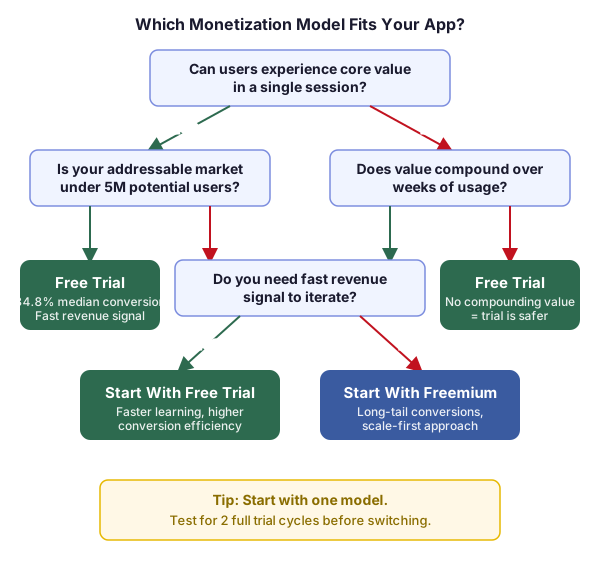
How fast can a new user experience core value? If your app delivers a meaningful outcome in a single session (a completed workout, a generated meal plan, a language lesson), a free trial works. If value builds over weeks of accumulated data or habits, freemium may fit better.
How large is your addressable market? Freemium economics require massive volume. If you're targeting a specific vertical with a defined audience, free trials are more efficient.
What's the user's primary fear at the paywall? If it's "Will this work for me?" a trial removes that fear. If it's "I don't want to commit yet" freemium lets them stay without pressure.
2. When free trials win
Free trials are the better starting point for most new subscription apps:
-
Faster revenue signal. You learn within days whether users convert, not months.
-
Higher conversion efficiency. Hard paywall apps convert at 12.1% download-to-paid versus freemium at 2.2%.
-
Clearer onboarding feedback. Trial start rate and trial-to-paid rate tell you exactly where the funnel breaks.
-
Better for defined verticals. Fitness, health, education, and productivity apps with clear outcomes see strong trial performance.
Data from 16,000+ apps shows that in Health & Fitness and Education, free trials boost lifetime value (LTV). Trial experience alone boosts first renewal by up to 60%.
3. When freemium makes sense
Freemium is not the wrong choice; it's the wrong default choice for most new apps. It makes sense when:
-
Value compounds over time. Collaboration tools, habit trackers, and data-accumulation apps need time to prove their worth.
-
Your market is massive. Consumer apps targeting millions of potential users can sustain low conversion rates.
-
Virality is a growth lever. Free users who invite others create a distribution engine that paid-only models can't match.
-
Your product competes on distribution, not conversion speed. Think Spotify or Duolingo.
Tettra, a B2B knowledge management tool, tripled its upgrade rate and sustained 70%+ monthly retention after switching from a 15-day trial to freemium (source). This is a B2B example, but the principle applies to mobile apps too: if your product's value builds over weeks of accumulated usage, putting a clock on it can be counterproductive.
Start measuring what matters — for free
Airbridge Core Plan gives growing teams real attribution, deep linking, and audience tools at no cost.
Start Free for 30 Days →Set Up Your Trial or Freemium Offer Step by Step
1. Pick your plan structure
Start simple. One model, one or two plans. You can always add complexity later. Launching with three tiers, a free plan, and a trial simultaneously creates noise that makes it impossible to learn what's working.
For your first offer:
-
If trial: Weekly + trial is the highest-performing combination. Trial-inclusive paywalls convert at 64.5% versus visual or text-only paywalls at 44.4%.
-
If freemium: Gate one clear feature set. Don't scatter limitations across the app. Users should understand instantly what they get free and what requires payment.
Use a mid-tier decoy plan to make your target plan look more attractive. If you're offering monthly and annual, add a quarterly option priced to make annual the obvious choice. Across subscription apps studied, 90%+ of users don't convert on the first paywall view. A well-structured plan comparison gives them a reason to reconsider.
2. Choose your trial length
The data here is counterintuitive. Trials from 5 to 32 days show roughly equal median conversion at 44-46%. The difference is not length but whether users experience core value before the trial ends.
Practical guidance:
-
3-7 days: Best for apps with immediate value (fitness workouts, meal plans, meditation sessions). Shorter trials also mean faster revenue.
-
14 days: The safe middle ground. Works for most apps.
-
30 days: Only if your app requires weeks of data accumulation or habit building before the value is clear.
The trend is toward shorter. 46.5% of trials are now 4 days or less. Adding a free trial to a weekly subscription raised 12-month LTV from $7.40 to $54.50, showing that short trial + weekly plan is a high-performing combination.
Don't copy your competitor's trial length. Match it to your time-to-value.
3. Decide opt-in vs opt-out
This single decision changes your conversion rate more than almost any other variable.
-
Opt-out trials (credit card required upfront): 48.8% trial-to-paid conversion
-
Opt-in trials (no credit card required): 18.2% trial-to-paid conversion
Opt-out converts higher because users who enter payment details are more committed. But opt-out also carries a higher refund rate. Hard paywall apps see 5.8% refunds versus 3.4% for freemium.
For most new apps, start with opt-out. The conversion advantage outweighs the slightly higher refund rate. You can always test opt-in later if trial start rates are too low.
Both Apple and Google have specific implementation requirements for introductory offers. Review Apple's subscription offer documentation and Google Play's subscription setup before building.
4. Design your first paywall
Your paywall is where the decision happens.
Onboarding + trial setup achieves 1.78% install-to-paid conversion, the highest of any paywall configuration measured across 16,000+ apps.
Paywall design principles:
-
Show the trial prominently. "Start your 7-day free trial" should be the primary call to action, not buried below plan options.
-
Display price per day or per week, not just the annual total. $0.27/day feels different from $99/year.
-
Include social proof or outcome data if you have it. "Join 50,000 users" or "Average user completes 4 workouts per week."
-
Offer a second chance. Most users skip the first paywall. Trigger a second one after the user experiences a key feature, with a different price or format.
For a deeper comparison of paywall strategies, see our hard vs soft paywall guide.
Avoid the Three Mistakes That Kill Early Subscription Revenue
1. Copying competitor trial length without testing
Your competitor's 7-day trial was probably not tested either. They copied someone else.
Trial length should match your app's time-to-value, not your category's default. If users get value in one session, a 3-day trial may outperform a 14-day trial. Plan and trial duration changes are the most effective experiments for LTV improvement, more effective than price changes alone.
2. Offering too many plan options at launch
Three tiers, a free plan, and a trial is a recipe for confusion and slow learning. You can't tell what's working when five variables change at once.
Start with one model and one or two plans. Learn what converts. Then add complexity.
3. Ignoring Day 0 onboarding
82% of trial starts happen on Day 0. If your onboarding doesn't surface the trial within the first session, most users will never see it.
Top-performing apps (P90) achieve a 20.3% trial start rate versus a 6.2% median. The gap is almost entirely explained by first-session onboarding quality. If your trial start rate is low, the problem is not your offer; it's that users never reach the offer.
Build your onboarding to do three things: demonstrate value, build intent, and present the trial before the session ends. For a complete onboarding framework, see how to begin marketing a subscription app.
Test, Learn, and Iterate
1. What to measure in your first 30 days
Track these four metrics from day one:
| Metric | What it tells you | Benchmark |
|---|---|---|
| Trial start rate | Is your onboarding working? | 6.2% median, 20.3% P90 |
| Trial-to-paid conversion | Is your offer compelling? | H&F 39.9%, Travel 48.7%, All 34.8% |
| Day 0 conversion rate | Is first-session urgency working? | 44.5% of all purchases happen Day 0 |
| Refund rate | Are you attracting the right users? | 3.4% (freemium) to 5.8% (hard paywall) |
If trial start rate is low, fix onboarding. If trial-to-paid is low, reconsider trial length or offer. If Day 0 conversion is low, your paywall timing or design needs work.
2. When to switch models
Switching from trial to freemium or vice versa is a significant change. Do it based on data, not instinct.
Consider switching to freemium if: Users consistently engage after the trial ends but don't convert. Your retention post-trial-expiry is high but paid conversion is low. Your market is larger than you initially targeted.
Consider switching to trial if: Freemium users engage but never upgrade. Your free-to-paid conversion is below 2%. You need faster revenue signal to fund growth.
3. How experimentation compounds revenue
Most founders treat their first offer as permanent. It shouldn't be.
Price experiments show a 28% conversion improvement probability but a 46% LTV improvement probability. Small, systematic changes to plan structure, trial length, and pricing compound over time.
Run one experiment at a time. Measure for at least two full trial cycles before calling a winner. Document what you learn. The apps that break $100K in their first year are not the ones that guessed right on day one; they're the ones that iterated fastest.
Start With One Offer and Get It Right
For most new subscription apps, start with a free trial. The conversion data is stronger, the revenue signal comes faster, and the feedback loop is cleaner.
If your app relies on habit formation or has a massive addressable market, freemium may be the better bet, but test that assumption with data, not instinct. Pick one model, launch, and let your users tell you what to change.


Ready to see what Core Plan can do?
Free attribution, deep linking, and audience tools — built for teams that are ready to grow.