Google I/O 2026: 5 measurement shifts every app marketer needs to revisit

Google I/O 2026 and Google Marketing Live 2026 took place in Mountain View, California, on May 19-20. From search, payments, and discovery to ad automation and subscription models, the events touched nearly every domain where marketing meets AI. In the keynote, CEO Sundar Pichai formally announced the agentic Gemini era.
We picked five announcements that app marketers should watch. In each one, AI agents slot themselves between users and your app, changing what your measured signals actually mean. So if Google is building a new AI paradigm, what should app marketers prepare for?
“We're firmly in our agentic Gemini era. I'm excited to see how it will unlock new ways to accelerate our mission and transform our products to be radically more helpful, for everyone everywhere.”— Sundar Pichai, CEO of Google and Alphabet
🎥 Watch: Google I/O 2026 keynote in 35 minutes (YouTube)
Key takeaways
-
Ask Play and the Gemini app (900 million monthly users) now handle app discovery directly, scattering acquisition paths outside the Play Store.
-
AI Max and AI Brief hand campaign execution to AI. What marketers still own: signal quality and brand guidelines.
-
Universal Cart and AP2 close transactions inside Google, so first-party app conversion data underreports commerce performance.
-
Google Play's payment grace period extended to 60 days, shifting the LTV baseline for subscription apps. Bidding and budget models trained on last year's data need recalibration.
-
88% of AI Mode queries end without an external click. The measurement question shifts from clicks to incremental revenue.
Ask Play and the Gemini app are recommending apps directly
Google says its Play Store AI Q&A already answers 95% of user queries. On top of that, Ask Play adds a conversational discovery layer, and the Gemini app, now past 900 million monthly users, has started recommending apps directly on Android and the web (Android Developers Blog · blog.google, Google I/O 2026, 2026).
“We're entering the era of Search agents, where you can easily create, customize and manage multiple AI agents for your many tasks, right in Search.” — Google official announcement, Search at Google I/O 2026

🎥 Watch: Google — Ask Play (YouTube)
👉 More detail: Android Developers Blog: What's new in Google Play at I/O 2026.
1. Discovery now flows through four channels, and ASO is shifting to intent
Play Store search is no longer the single entry point. At the same event, Google said Engage SDK reaches 30 million+ users monthly and drove a 45% YoY increase in app opens (Android Developers Blog, 2026).
The Gemini app, Ask Play, and Engage SDK slots all run on semantic recommendation rather than keyword matching. Add Play Store search itself, and you get four entry points. If you only watch the Play Store referrer, all four flow in as the same "organic" bucket, so you'll need to break them out as a quarterly task.
ASO is moving from keyword coverage to semantic coverage (ASO World, Google Play May 2026 Updates, 2026). Rewrite app descriptions and screenshot copy around use cases, and inventory which scenarios you serve through dynamic metadata slots: In-App Events, Promotional Content, and Custom Store Listings. Layer this on top of your ASO fundamentals.
2. Separate agent traffic from human traffic
Gemini Spark is a personal AI agent that runs 24/7 on Google Cloud virtual machines. It integrates with Gmail, Google Docs, and Slides, and extends to third-party tools like Canva, OpenTable, and Instacart via MCP (Model Context Protocol, the standard for AI agents to call external tools) (Google Cloud announcement, 2026).
The measurement issue: when an agent calls your app on behalf of a user, that session shows up as DAU (daily active users), but it makes no sense to retarget with push or ads. If you don't split automated and human traffic, retention cohorts inflate, and any LTV (lifetime value) model running on top of them operates on a broken baseline.
👉 Full architecture and workflow: Google Cloud announcement — Innovations from Google I/O 2026.
AI Max for Apps and AI Brief: more automation, less marketer visibility
At Google Marketing Live 2026, Google announced AI agents that can build app deep links in "minutes, not days." Google also unveiled AI Brief: marketers describe brand voice, audience, and guidelines in a single natural-language prompt, and the AI generates ads within those bounds.
The center of gravity in campaign operations is moving from execution to signal design.
🎥 Watch: Google — AI Max for Apps (YouTube)
👉 More detail: Gemini Omni Flash official announcement — Google blog.
1. Campaign controls shrink to a single natural-language line
Faster deep link generation means you can produce dozens of A/B variants overnight. The weekly creative meeting goes away, replaced by a review meeting that audits whether auto-generated variants stay inside your brand tone and measurement signals. If you don't predefine how to group 100 creatives for review, the time saved by automation gets eaten back by review overhead.
This isn't just AI Brief. Performance Max and Google App Campaigns are moving in the same direction. Once AI Max for Apps lands, AI will generate the ad creatives directly, and the data quality you control will determine nearly all of your campaign performance.
2. Signal design and brand tone are the last guardrails
Auto-generated creative now extends to images and video. Newly announced Gemini Omni Flash generates video from a single line of natural language, swaps backgrounds, and personalizes digital avatars per viewer.
Google Pics, powered by Nano Banana, handles object segmentation, text editing, and multilingual translation in one pass. Type what you want, and the AI produces text, video, and image variants together.
Creative production time is about to collapse. In that environment, signals decide outcomes. If your definitions for conversion value, interest signals, and high-value users are vague when you hand AI automation broad authority, the AI's idea of a "good user" could land on a low-business-value cohort.
Brand tone follows the same logic. A single sentence in AI Brief shapes ad copy and recommended images, so leaving brand guidelines in marketers' heads makes the input drift every time, and your ad consistency falls apart. This isn't a copywriting problem, it's a system problem.
Universal Cart: half the commerce app funnel now happens inside Google
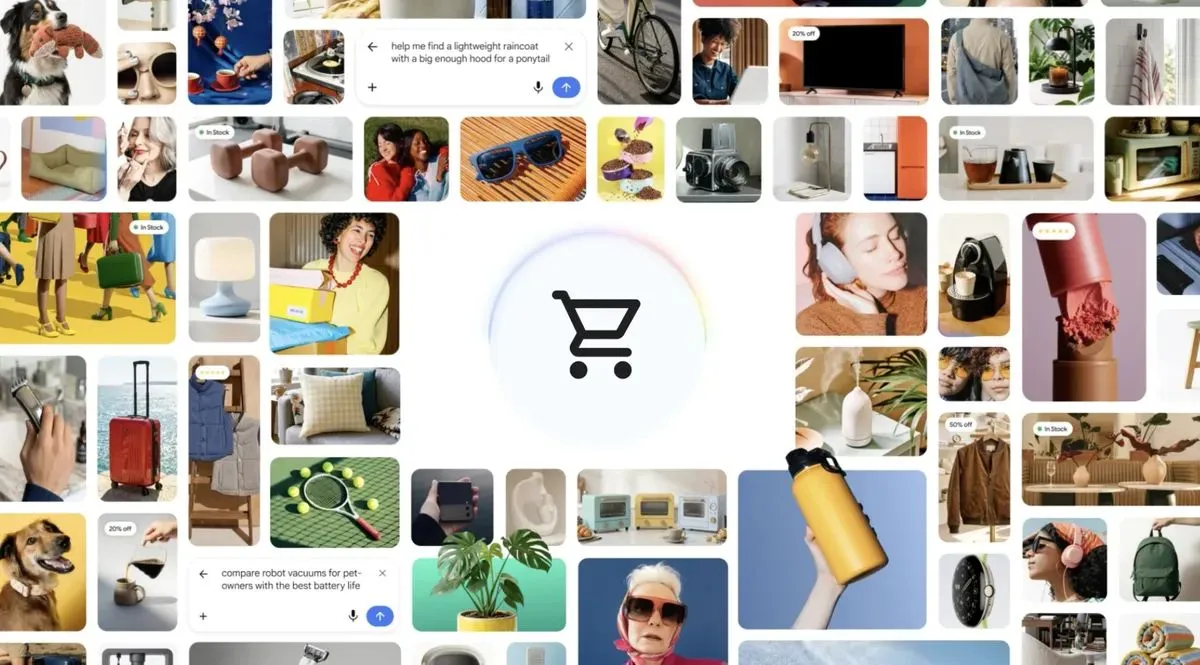
Universal Cart is a shopping hub where users add to cart and complete checkout across Search, Gemini, YouTube, and Gmail. Major global retailers, including Nike, Walmart, and Shopify merchants, are launch partners.
Google hasn't announced regional launch timing yet, but Universal Commerce Protocol (UCP) is expanding to Canada, Australia, and the UK, with YouTube, hotel booking, and local food delivery categories on the roadmap.
👉 More detail: Google Shopping's Universal Cart announcement.
1. When checkout happens outside your app, audit the SKU feed first
UCP is an open standard that ties merchant, payment, and ad data together. With Agent Payments Protocol (AP2) layered on top, agents can transact on a user's behalf, a "Human Not Present" payment where no human authorizes each transaction directly.
For example: when a user says "Find me a running shoe under $300 and buy it," Gemini selects the product and completes checkout. But when the transaction happens outside your app's SDK, your first-party data alone can't verify whether ad impressions or clicks drove that revenue.
For agents to pick your product, the Merchant Center feed (the Google Shopping product catalog) is table stakes. On top of that, you need Content API to sync price, inventory, and promotions in real time, plus the merchant metadata UCP requires. So you'll need to track quarterly what percentage of your SKUs sit in "Eligible" status. If you don't, no amount of ad spend will fix the mismatch between your data and ad performance.
2. You need a join key between agent transactions and first-party data
When an agent transacts, the signals that show up in your data are limited to order ID, payment amount, and shipping address. If you don't tie those to the ad or content exposure that influenced them, and to the same user's prior in-app behavior, your ad ROI will read lower than reality.
In Airbridge, joining the same user's in-app activity requires a cross-channel attribution setup. Based on this announcement, agree with your data team on candidate join keys (common identifiers that connect Google order data to your first-party user data) and document them now. A year from now, your attribution gaps will be smaller and your data accuracy higher.
Want to see how Google I/O 2026 works with your data?
Get hands-on with Airbridge and see real results.
Try It Free →Google Play's 60-day payment grace period rewrites the subscription LTV baseline
As of December 1, 2025, Google Play extended its default account hold (the grace period that keeps a subscriber's account active when payment fails) from 30 to 60 days (auto-calculated). Plans previously set to 30 days were auto-migrated.
Google reported in the same announcement that, among top developers, involuntary churn dropped up to 18% and total churn fell 9%. Given AI bidding automation and LTV models share the same baseline, a single policy line can throw off the entire measurement system's accuracy.
👉 LTV impact analysis: RevenueCat: Play Billing Library 9.0 breakdown.
1. As the retention curve climbs, LTV models underestimate accordingly
Compare Q4 2025 and Q1 2026 retention curves and you'll see the curve rise naturally. But this isn't a marketing or product win, it's the policy change. If you don't separate the two and conclude "retention is up, push UA budget," you'll spend against an inflated efficiency reading.
The subscription predictive LTV (pLTV) model is typically calculated as retention curve × ARPU (average revenue per user). A model trained on the 30-day grace curve will systematically underestimate LTV in the 60-day environment.
For instance: if your LTV reading is 15% below reality, automated bidding under the same ROAS target will set conservative bids, and channel and creative evaluation drift by the same margin. The model won't auto-adjust to policy shifts, so you need to retrain the LTV model yourself.
2. Manage pre- and post-policy cohorts separately
A first step: add a December 1 toggle in your BI dashboard and run v1 and v2 LTV models in parallel. Then document, with reasoning, which model feeds bidding automation each quarter. That way, the next quarterly review doesn't relitigate the same decision.
AI Mode at 1 billion: the next attribution question is incrementality
AI Mode crossed 1 billion monthly users one year after launch, and 88% of AI Mode queries end without an external click (Google I/O 2026 keynote · Digital Applied Zero-Click Search Statistics 2026, 2026). At the same event, Google's total AI processing went from 480 trillion tokens monthly last year to 3.2 quadrillion this year, a 7x jump in a single year.
AI is no longer a layer bolted onto search. It's the search infrastructure itself.
“Search has become less about individual queries and feels more like an ongoing conversation, giving you deeper insights and connecting you with the vastness of the web.” — Sundar Pichai, CEO of Google and Alphabet
🎥 Watch: Sundar Pichai I/O 2026 Keynote — AI Mode segment (4:13~) (YouTube)
👉 More detail: Google blog: Search at Google I/O 2026.
1. In a 60% zero-click environment, the next question is incrementality
64.82% of all Google searches now end without a click (Zero-Click Search Statistics 2026, 2026). An Ahrefs field study from the same period found that for searches where AI Overviews (the AI-answer cards at the top of results) appeared, zero-click rates rose from 54% to 72%, and organic clicks dropped 38% (Search Engine Journal, Ahrefs field study, 2026).
Evaluating channels purely on click counts means missing real exposure. The question marketers ask has to shift. Instead of "where did this converting click come from?" the question becomes "how much revenue would I lose if I turned this channel off?" — that is, incrementality.
In line with that, 46.9% of U.S. marketers said they plan to invest more in marketing mix modeling (MMM) over the next year, and 36.2% in incrementality (eMarketer 2026 Measurement Trends Report, 2026).
The lightest entry point: a holdout test. Turn one channel off in a single region for 1-2 weeks, measure the revenue change, and you'll have a baseline to correct your click attribution against. See our bias-free incrementality test design for retargeting and engagement" class="glossary-link" title="Re-engagement">re-engagement.
2. Measure your brand mentions inside AI answers
Zero-click also means AI answers are a new exposure surface. When AI Mode or Gemini mentions your brand in an answer, awareness happens without a click. The measurement domain for this exposure is GEO (Generative Engine Optimization).
Take 50-100 representative category queries, run them quarterly across AI Mode, Gemini, and ChatGPT, and log your brand's mention frequency, position, and citation type (summary, link, image). Then compare against competitor mentions to calculate share of voice. A quarterly automated script is enough.
Where does your measurement stack stand in the AI-agent era?
Each of the five shifts forces a re-check on a different part of the measurement stack: discovery (Ask Play, Gemini), campaign signals (AI Max, AI Brief), commerce attribution (Universal Cart, AP2), subscription cohorts (60-day grace), and post-click measurement (AI Mode, incrementality, GEO). Picking one to address won't be enough — the stack as a whole needs review.
A diagnostic: can your measurement stack answer the five shifts?
-
Acquisition path breakdown. Can you separate organic installs into Play Store search, Ask Play, Gemini recommendations, Engage SDK, and others? → With only Play Store referrer, all four flow in as the same "organic" bucket.
-
Signal documentation. Are your campaign's conversion values, high-value user definitions, and brand guidelines documented and updated quarterly? → AI Brief and AI Max are only as good as the input signal quality.
-
SKU eligibility tracking. Do you check quarterly what percentage of your SKUs sit in "Eligible" status in the Merchant Center feed? → In Universal Cart, AI agents only pick from products properly registered in the feed.
-
Cohort separation. Are you separating pre- and post-December 1, 2025 cohorts when reading LTV and retention curves? → December 1, 2025 is the day Google Play's grace period extended to 60 days. Mixing the cohorts blurs policy effects with marketing effects.
-
Post-click validation. In the last 12 months, have you validated marketing impact outside click attribution (holdout tests, conversion lift)? → In a zero-click environment, click counts alone can't reveal real channel impact.
Two or more "no" answers mean your measurement stack should be a quarterly priority. One "no": build a remediation plan within the quarter. None? Then in the next quarter, push your priorities into newer domains like GEO measurement.
Closing thoughts
Each announcement looks different on its own, but pull back a step and they point to the same place. Visibility into what users do before they reach your app is shrinking on the first-party side, and the measurement unit itself is shifting from "clicks" to "intent and incrementality."
Before adopting a new solution, lay out your measurement stack and start from the weakest of the five shifts. That's where your next quarter's OKR begins.
References
-
Sundar Pichai. "Google I/O 2026 keynote". blog.google, 2026.
-
Android Developers Blog. "I/O 2026: What's new in Google Play". 2026.
-
Google. "Innovations from Google I/O 2026 on Google Cloud". 2026.
-
Google. "Gemini Omni Flash announcement". 2026.
-
Google. "Google Workspace I/O 2026 update (incl. Google Pics)". 2026.
-
Google. "Google Shopping's Universal Cart announcement". 2026.
-
Google. "Search at Google I/O 2026". 2026.
-
RevenueCat. "Play Billing Library 9.0 breakdown". 2026.
-
Nobori AI. "Google AI Mode zero-click rate, 100M users". 2026.
-
Digital Applied. "Zero-Click Search Statistics 2026 Complete Data". 2026.
-
eMarketer. "MMM, Incrementality, Other Measurement Trends that Will Define 2026". 2026.

Ready to transform your mobile growth?
Learn how Airbridge helps leading brands measure and optimize every touchpoint.