The MMP Support Trap: Fast Answers During Sales, Silence After the Contract

You submitted a support ticket on Monday about a trial-to-subscription attribution discrepancy. It is now Thursday. The response links to a generic help center article about SDK event configuration that does not address the specific RevenueCat integration issue you described.
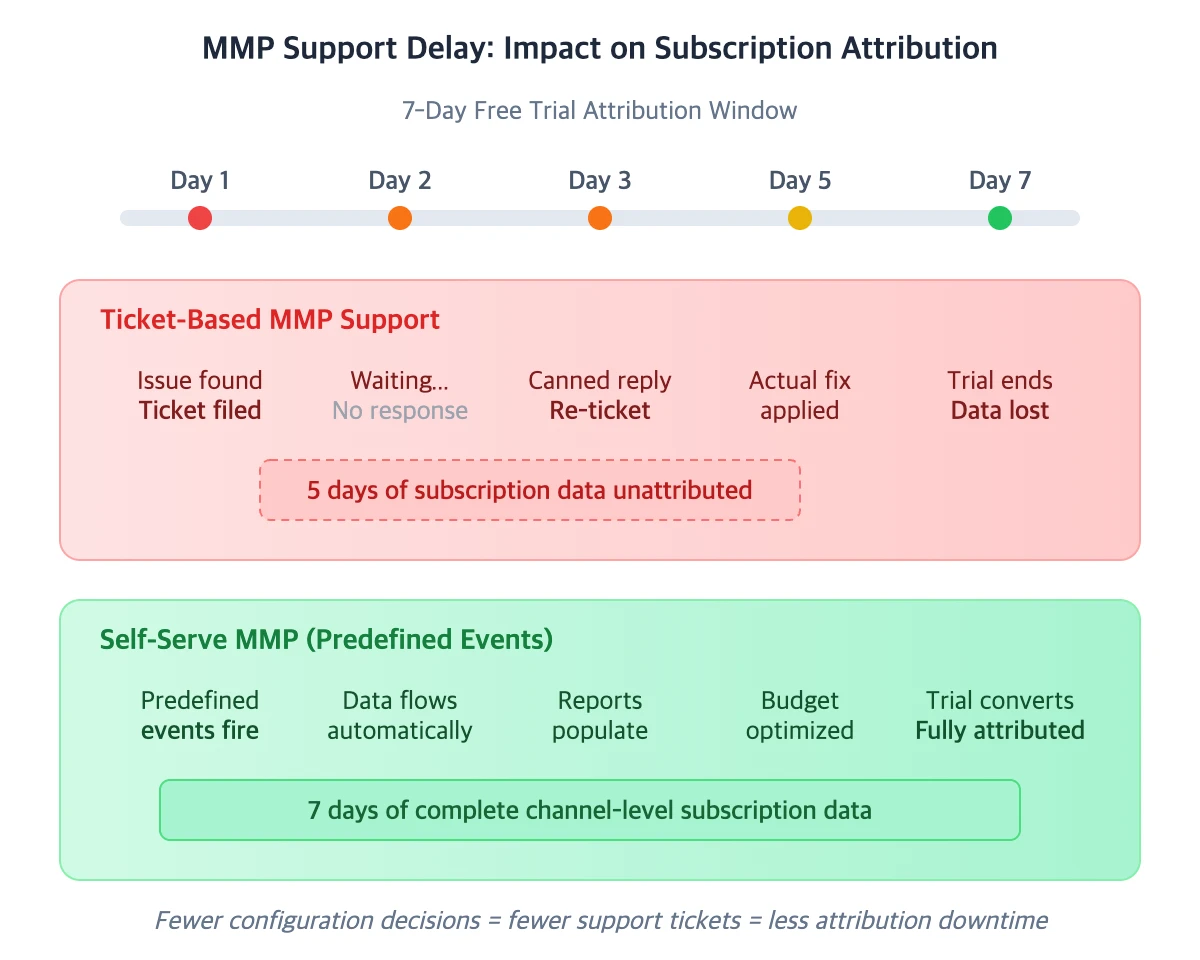
For subscription app teams running paid UA, a 3-5 day support delay is not just frustrating. It is 3-5 days of ad spend allocated based on incomplete or broken attribution data. When your Mobile Measurement Partner (MMP) cannot answer a specific question about subscription funnel tracking, budget decisions default to guesswork.
Key Takeaways
-
MMP customer support quality often degrades after contract signing. The sales-stage responsiveness that convinced you to sign does not predict the post-sale support experience.
-
Canned ticket responses cost more time than silence. A generic answer to a specific integration question forces a second ticket, a re-explanation, and another 2-3 day wait.
-
Support delays translate directly to misallocated ad spend. Every day a subscription attribution issue goes unresolved is a day of budget decisions based on incomplete signals.
-
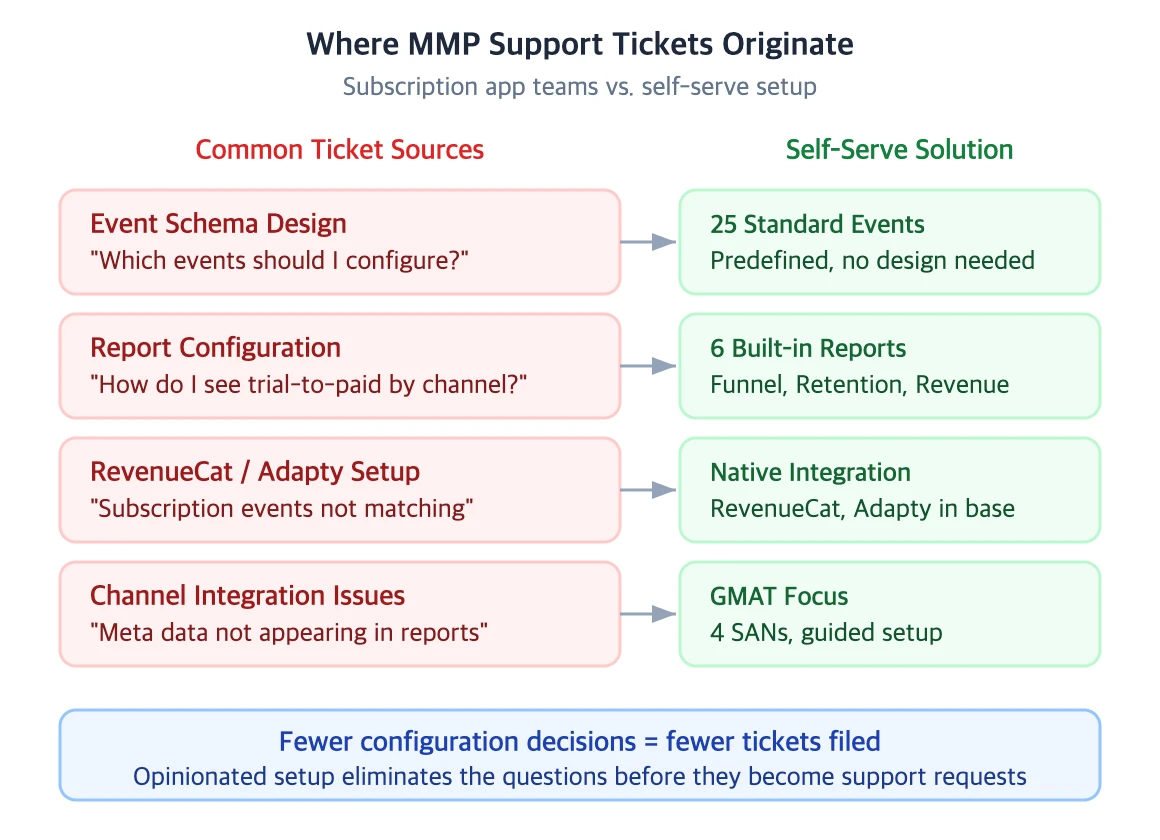
The structural problem is dependency on human support for routine questions. Most MMP support requests involve report configuration, event verification, or integration setup that should not require a ticket.
-
Airbridge Core Plan reduces support dependency with an opinionated, self-serve setup. With 25 predefined standard events and subscription-focused onboarding, routine questions are eliminated before they become tickets.
Why MMP Customer Support Fails Subscription App Teams
The frustration with MMP customer support is not random. It follows a structural pattern that affects subscription app teams more than other verticals.
1. The Sales-to-Support Gap
During the evaluation phase, MMP vendors are responsive. Sales engineers answer technical questions within hours. Demo environments are configured to your exact use case. Onboarding calls happen on schedule.
Then the contract closes. The sales engineer moves to the next prospect. Your day-to-day questions go to a general ticket queue. According to G2 reviews comparing major MMPs, enterprise customers with dedicated account managers report satisfactory support, while smaller teams frequently cite slow responses and difficulty resolving specific issues.
For early-stage subscription app teams, this gap is particularly acute. You are typically on the lowest pricing tier, which means you do not qualify for a dedicated Customer Success Manager (CSM). Your support channel is ticket-based, with response times measured in days, not hours.
ICP interviews with subscription app growth marketers confirm this pattern. Teams consistently report that their MMP's basic plan has no CSM, and that integration documentation is insufficient for subscription-specific setups. The result: teams that need the most hands-on help are the ones least likely to receive it.
2. Why Subscription Apps Suffer More from Support Delays
Generic mobile apps can tolerate a 3-day support delay without major consequences. Subscription apps cannot.
The subscription funnel has a narrow attribution window. If your app offers a 7-day free trial, the events that matter most for attribution and LTV happen within days of install: trial start, subscription activation, and first renewal. A support delay during this window means an entire cohort's trial-to-paid data may be misattributed or missing entirely.
| Scenario | Support Delay | Attribution Impact |
|---|---|---|
| SDK event not firing for Subscribe | 3 days | 3 days of subscriptions unattributed to any channel |
| RevenueCat integration mismatch | 5 days | Revenue data missing from Funnel and Revenue reports |
| SKAN conversion value misconfigured | 4 days | iOS campaign optimization signals degraded for 4+ days |
The cost is not frustration. The cost is budget decisions based on incomplete data. If you cannot see which channels drive subscriptions for an entire week, you are either pausing campaigns and losing momentum, or continuing to spend based on outdated signals.
3. The Hidden Cost of Canned Responses
A slow response is bad. A canned response is worse.
When a support team replies to a specific subscription attribution question with a link to a generic help center article, the real cost is the second cycle. You re-explain the issue, provide additional context, resubmit the ticket, and wait another 2-3 days. Two response cycles at 3 days each means nearly a week of unresolved attribution gaps.
For subscription apps running paid acquisition across multiple channels, this compounds. Each day of missing channel-level subscription data is a day where budget allocation cannot be optimized.
Consider a health and fitness app running a January campaign during the New Year's resolution spike. Trial sign-ups are 3x the normal rate. A RevenueCat integration issue means subscription events are not reaching the MMP. The support ticket gets a canned response on day 2.
By the time the issue is resolved on day 6, the January spike has passed and six days of the highest-converting cohort of the year has no channel-level subscription attribution. The team cannot determine whether Meta, Google, or Apple Search Ads drove the subscribers who will generate the highest LTV.
This is not a hypothetical edge case. Seasonal conversion spikes in health and fitness apps create narrow windows where attribution accuracy matters most. Support delays during these windows have outsized budget consequences.
Start measuring what matters — for free
Airbridge Core Plan gives growing teams real attribution, deep linking, and audience tools at no cost.
Start Free for 30 Days →How to Fix the MMP Support Problem
Practical Steps to Reduce Support Dependency
Before evaluating new tools, there are steps any team can take to minimize the damage from slow MMP support:
-
Document every integration detail during onboarding. Capture SDK version, event naming conventions, and integration configuration while the onboarding team is still responsive. This becomes your self-serve reference when support slows down.
-
Test attribution events before launching campaigns. Use test consoles and sandbox environments to verify that trial start, subscribe, and revenue events fire correctly. Catching issues before spend begins eliminates the most urgent support tickets.
-
Set up monitoring for critical subscription events. Build simple daily checks for key event counts (installs, trial starts, subscriptions). If numbers drop suddenly, you catch the issue in hours rather than discovering it days later in a weekly report.
-
Request escalation paths upfront. During contract negotiation, ask for the specific process to escalate urgent attribution issues. Knowing the escalation path saves days when a critical SDK issue surfaces.
How Airbridge Core Plan Addresses the Support Problem
The most effective way to reduce MMP support dependency is to eliminate the questions that generate tickets in the first place. Airbridge Core Plan is built around this principle.
Opinionated setup reduces configuration questions. Core Plan uses 25 predefined standard events optimized for the subscription funnel: Install, Sign-up, Start Trial, Subscribe, Unsubscribe, and Order Complete. Event naming decisions, schema design choices, and parameter configurations that generate support tickets with enterprise MMPs are predefined. The difference versus custom events: event names and parameters are predefined by Airbridge, reducing schema design work.
Subscription-focused onboarding eliminates integration ambiguity. Instead of general-purpose MMP onboarding that covers dozens of use cases, Core Plan's onboarding path is built specifically for subscription apps running paid UA on Meta, Google, Apple Search Ads, and TikTok (GMAT channels). This focused scope means fewer configuration options that can go wrong.
Built-in reports surface subscription signals without custom setup. Core Plan includes 6 built-in reports (Actuals, Trend, Active User, Funnel, Retention, Revenue) that cover the subscription funnel out of the box. Report configuration issues that generate support tickets with enterprise MMPs are handled by default.
| Support Friction Point | Enterprise MMP | Airbridge Core Plan |
|---|---|---|
| Event schema design | Custom event design, frequent tickets | 25 subscription-optimized standard events |
| Report configuration | Requires setup guidance | 6 built-in reports, pre-configured |
| Channel integration | Multiple networks, varied setup | GMAT focus (4 SANs, 80-90% of spend) |
| Billing platform integration | Native (included in higher tiers) | Native (RevenueCat, Adapty in base) |
| Pricing model | Annual contract, CSM gated by tier | Pay-as-you-go, 15K free installs |
Intentional limitations that reduce complexity. Core Plan does not support custom events, limits third-party integrations to 2, and focuses on GMAT channels only. These are not missing features. They are design decisions that remove the configuration surface area where support tickets originate.
RevenueCat and Adapty integration included in the base offering. Subscription revenue platforms are where the most support-intensive integration issues originate. Enterprise MMPs typically include these integrations in higher-tier plans. Core Plan includes RevenueCat and Adapty integration at the base tier, reducing the most common source of subscription-specific support friction.
Pay-as-you-go pricing with 15K free attributed installs. For teams spending $5,000-$20,000 per month on paid UA, enterprise MMP contracts of $2,000-$5,000/month are disproportionate. Core Plan's pricing model ($0.05/install after the free tier) aligns cost with actual usage, and pay-as-you-go means no annual lock-in if the tool does not meet expectations.
The question for subscription app teams is whether the support model matches the team's operational reality. If you are a 3-person growth team without a dedicated analytics engineer, a self-serve attribution tool that eliminates routine support tickets is more valuable than a dedicated CSM you never receive.
FAQ: MMP Customer Support for Subscription Apps
How long should MMP support take to resolve a subscription attribution issue?
For critical attribution issues affecting live campaigns, resolution within 24 hours is the baseline expectation. For configuration questions, same-day responses keep the team moving. If your MMP consistently takes 3-5 days to respond to specific technical questions, the support model is not built for subscription app velocity.
What should subscription app teams evaluate about MMP support before signing a contract?
Ask three questions: What is the average response time for technical support tickets (not sales inquiries)? Do teams at your pricing tier receive a dedicated CSM or ticket-based support? What percentage of support requests are resolved in the first response versus requiring escalation? The answers reveal whether the vendor's support model matches your team's needs. Comparing MMP options on support quality is as important as comparing features.
When should a subscription app team switch MMPs because of support quality?
If support delays have caused measurable attribution gaps more than twice in a quarter, or if routine configuration questions consistently require 3+ days for resolution, the support model is structurally misaligned with your team's needs. Evaluate whether a self-serve MMP with predefined subscription events would eliminate the questions generating those tickets. Switching costs are real, but so is the compounding cost of broken attribution data.
The Attribution Data You Cannot See Is Budget You Cannot Optimize
Every subscription app team running paid acquisition faces a choice: depend on a support queue for answers about your own data, or use a tool that surfaces those answers without a ticket.
The cost of slow MMP customer support is not measured in frustration. It is measured in days of ad spend allocated without complete attribution signals. For subscription apps scaling paid UA, those days compound.
Start Free with Airbridge Core Plan and see which channels drive trial-to-subscription conversions, starting with 15K free attributed installs.

Ready to see what Core Plan can do?
Free attribution, deep linking, and audience tools — built for teams that are ready to grow.