MMP Pricing Goes Up. Support Quality Goes Down. Something Has to Give.

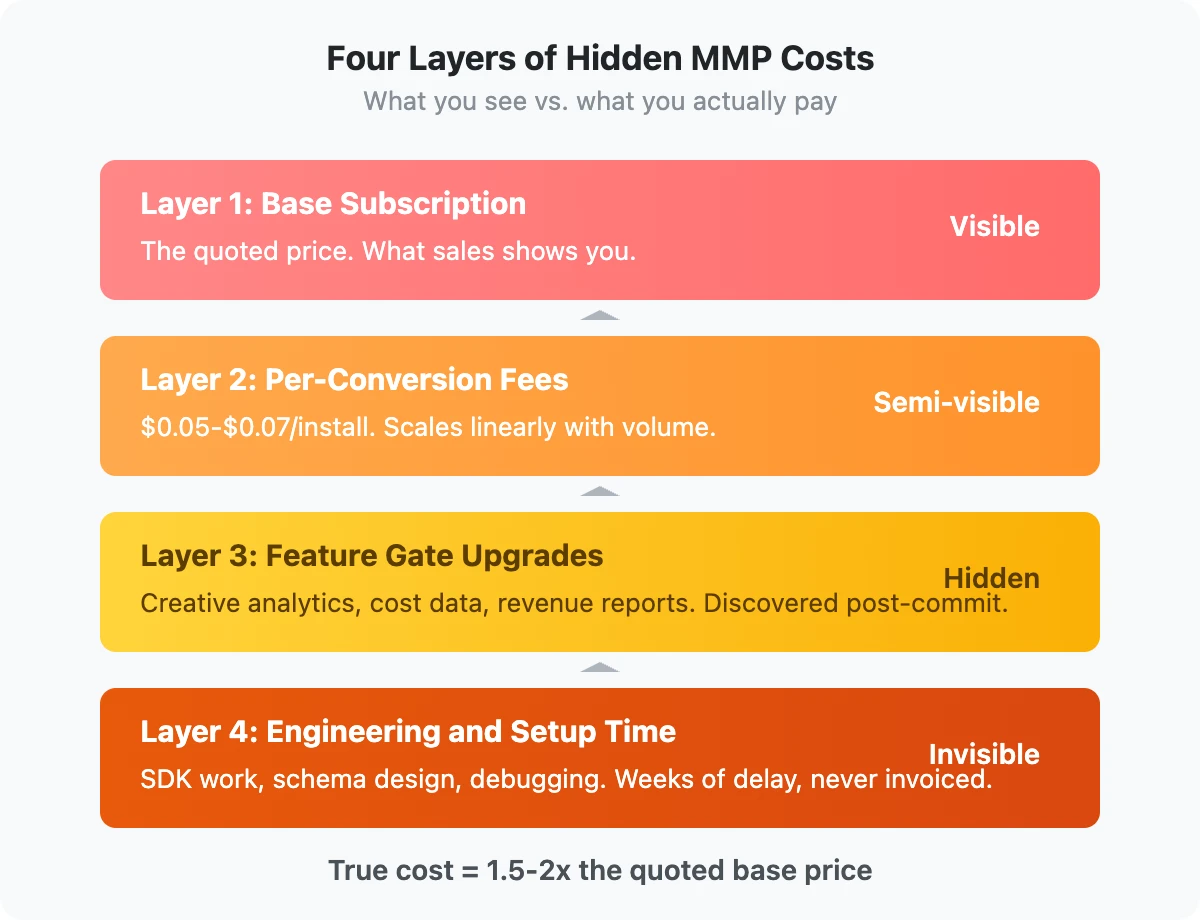
A fitness app running 50,000 monthly installs across Meta and Google Ads signs up for an enterprise Mobile Measurement Partner (MMP) on what looks like a reasonable plan. Six months later, the attribution bill has doubled. Per-conversion fees scaled with volume. Creative analytics required an upgrade. Revenue attribution was locked behind a premium tier.
For subscription apps spending $5,000 to $20,000 per month on paid acquisition, MMP costs that quietly climb to $3,500 to $7,000 per month represent a direct hit to unit economics. The MMP that was supposed to help you measure ROI is now actively eroding it.
Key Takeaways
-
MMP per-conversion fees scale faster than subscription revenue. A $0.05 to $0.07 per-install fee compounds quickly when trial-to-paid conversion rates sit at 35 to 40%, meaning most installs never generate revenue.
-
Feature gates force upgrades at the worst time. Creative analytics, cost aggregation, and revenue attribution are often locked behind premium tiers, so teams discover the real price only after committing.
-
Health and fitness apps face seasonal cost spikes. January resolution surges can double MMP bills at the exact moment ad budgets are already elevated.
-
Hidden operational costs do not appear on the invoice. Engineering time lost to poor documentation, missing support, and complex integrations adds weeks of delay.
-
Airbridge Core Plan uses transparent pay-as-you-go pricing. 15K free attributed installs, $0.05 per install after, with subscription analytics included in the base offering.
The Real Cost of MMP Pricing for Subscription Apps
MMP pricing models were designed for gaming and e-commerce apps with high average revenue per user (ARPU) and immediate purchase events. Subscription apps operate differently. Revenue comes weeks or months after the install, conversion rates are lower, and the metrics that matter most (trial-to-paid rate, LTV, churn by channel) require analytics that enterprise MMPs often reserve for higher tiers.
This structural mismatch means subscription app teams consistently pay more than they expected, and more than they should.
1. Per-Conversion Fees That Scale Against You
Enterprise MMPs typically charge $0.05 to $0.07 per attributed conversion. For a subscription app at 50,000 monthly installs, that translates to $30,000 to $42,000 per year in attribution fees alone.
The problem is what happens on the revenue side. According to RevenueCat's State of Subscription Apps report, the median trial-to-paid conversion rate across subscription apps is 34.8% (RevenueCat, State of Subscription Apps 2025). For health and fitness apps specifically, only about 2.7% of downloads convert to paid subscribers within 35 days.
That means the vast majority of installs you pay to attribute never generate subscription revenue. The MMP fee is a fixed cost per install, but the revenue per install is a fraction of that fee for most users.
| Cost Component | 50K Monthly Installs | 100K Monthly Installs |
|---|---|---|
| MMP fees at $0.07/install | $42,000/year | $84,000/year |
| Median D60 revenue per install (H&F) | $0.63 | $0.63 |
| Annual revenue from those installs | ~$378,000 | ~$756,000 |
| MMP cost as % of revenue | ~11% | ~11% |
When your attribution tool costs 10% or more of the revenue it measures, the ROI math stops working for early-stage teams.
2. Feature Gates and Forced Upgrades
The base price is rarely the final price. Enterprise MMPs gate the features subscription app teams need most behind premium tiers or add-on packages:
-
Creative analytics (which ads drive subscribers, not just installs) often requires an advanced tier (e.g., AppsFlyer locks Creative Optimization behind the ROI360 tier)
-
Cost data aggregation across channels may require a separate premium product
-
Revenue attribution by channel requires additional integrations or higher-tier access
-
Customer support and dedicated CSM are stripped from lower-priced plans
The pattern is consistent: teams sign up for what appears to be an affordable entry plan, then discover that the metrics they actually need for subscription revenue optimization require an upgrade that doubles or triples the cost.
This forced upgrade path creates a lock-in effect. By the time a team realizes the true cost, they have already invested engineering time in SDK integration, event configuration, and dashboard setup.
3. The Compounding Cost Problem for Health and Fitness Apps
Health and fitness subscription apps face a unique version of this problem. Subscription churn in fitness apps follows seasonal patterns tied to New Year resolutions, summer preparation, and back-to-school cycles.
January and February typically bring 2 to 3x install volume spikes as users sign up for fitness goals. Per-conversion MMP pricing means the attribution bill surges at the same time as:
-
Ad spend increases to capture seasonal demand
-
Trial volume rises, but trial-to-paid conversion rates often drop during high-volume periods
-
Engineering and marketing teams are stretched thin
The result is a triple cost burden: higher ad spend + higher MMP fees + lower conversion quality. According to industry data, Health and Fitness apps have a median Cost per Install (CPI) of $5.78 on iOS (RevenueCat, State of Subscription Apps 2025). Adding $0.07 per install in MMP fees pushes the effective CPI to $5.85. At a per-install level, 1.2% seems minor, but for a fitness app running a January campaign that generates 100,000 installs, the MMP fee alone for that month is $7,000. For a team already operating on thin margins between Cost per Subscription and LTV, that margin erosion adds up fast.
Start measuring what matters — for free
Airbridge Core Plan gives growing teams real attribution, deep linking, and audience tools at no cost.
Start Free for 30 Days →How to Reduce MMP Costs Without Losing Attribution
1. Audit Your Current MMP Spend
Before making any tool switch, quantify what you are actually paying:
-
Calculate your true cost per attributed install. Include base fees, per-conversion charges, add-on products, and overage penalties. Most teams underestimate by 30 to 50% because they only count the base subscription.
-
Map which features you use versus which features you pay for. Many subscription apps pay for fraud detection, raw data export, and dozens of ad network integrations they never use.
-
Measure your MMP cost as a percentage of attributed revenue. If it exceeds 5% of the subscription revenue your MMP helps measure, the ROI case weakens.
-
Track engineering time spent on MMP maintenance. SDK updates, event schema changes, and debugging attribution discrepancies consume hours that do not appear on the MMP invoice.
2. How Airbridge Core Plan Eliminates MMP Pricing Surprises
Airbridge Core Plan was built specifically for early-stage subscription app teams who need clear attribution signals without enterprise pricing complexity. The pricing model directly addresses the three cost traps described above.
Transparent pricing with no feature gates:
-
15,000 free attributed installs per month, covering early-stage teams entirely
-
$0.05 per install after the free tier, with no annual contract
-
All subscription analytics included in the base offering: funnel reports, retention analysis, revenue attribution, active user tracking
-
No premium tiers for creative data or cost aggregation
Subscription-optimized feature set:
| Capability | Enterprise MMP | Airbridge Core Plan |
|---|---|---|
| Minimum contract | Annual, $10K+ | Pay-as-you-go, 15K free |
| Subscription funnel tracking | Available (may require add-on) | Built-in (Install, Start Trial, Subscribe) |
| Revenue attribution | Higher-tier feature | Included in base |
| Billing platform integration | Native (included in higher tiers) | Native (RevenueCat, Adapty in base) |
| Creative analytics | Locked behind premium tier | Included in base |
| Ad channel coverage | All networks | GMAT: Meta, Google, Apple Search Ads, TikTok |
| Third-party integrations | Unlimited | Max 2 (e.g., Amplitude + RevenueCat) |
| Custom events | Yes | No (25 standard subscription events by design) |
Core Plan supports 25 standard events optimized for the subscription funnel, including Start Trial, Subscribe, and Unsubscribe. Custom events are intentionally excluded to keep setup focused and fast. For teams that need custom events, additional ad networks, or raw data export, Airbridge Growth Plan provides the full analytics stack.
The four Self-Attributing Networks (SANs) supported by Core Plan (Meta, Google, Apple Search Ads, TikTok) typically represent 80 to 90% of early-stage paid acquisition spend. Combined with RevenueCat integration, this provides a complete view of which channels drive subscribers, not just installs.
How the cost math changes with Core Plan:
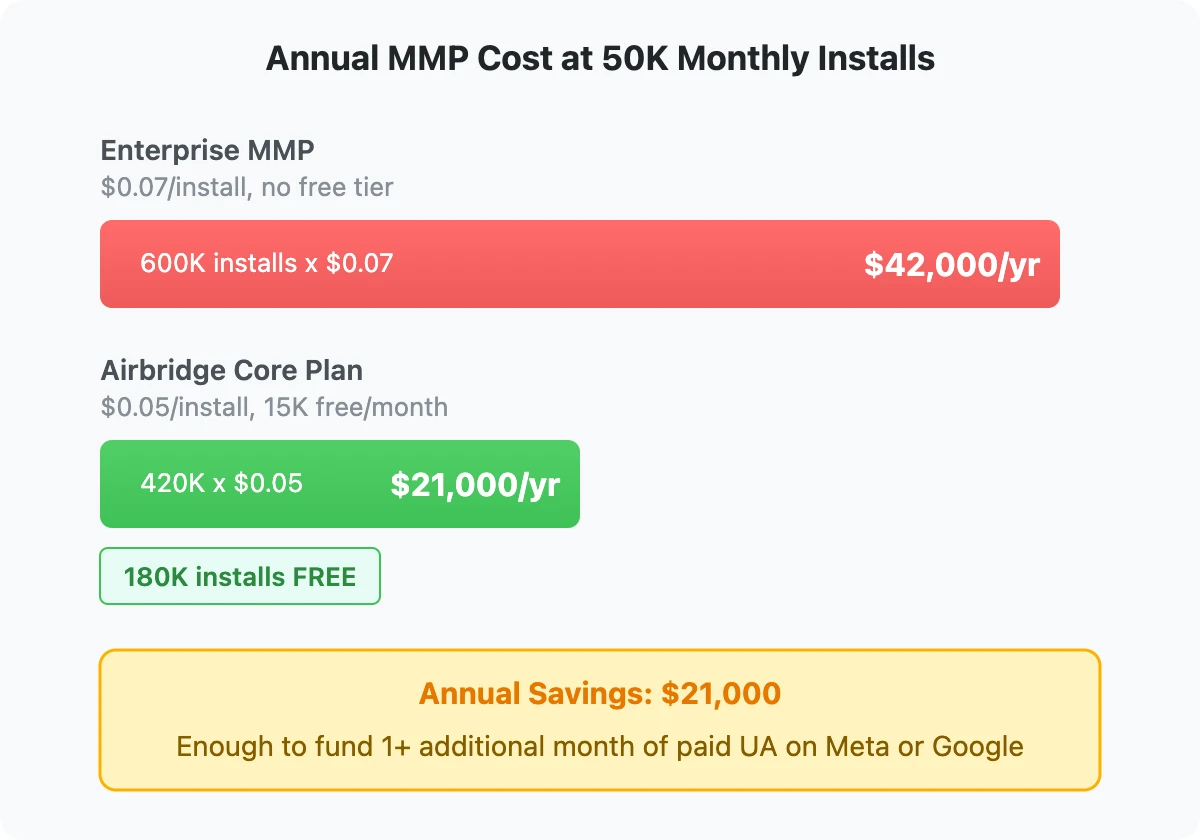
A subscription app running 50,000 monthly installs on Core Plan would pay $1,750 per month, or $21,000 per year. Compare that to $42,000 to $84,000 per year with an enterprise MMP at $0.07 per install with no free tier. The savings cover an additional month of ad spend on Meta or Google, and early-stage teams can validate their paid acquisition strategy with full attribution visibility before spending anything on measurement.
FAQ: MMP Pricing and Hidden Costs
How do I calculate the true cost of my current MMP?
Add your base subscription, per-conversion fees, add-on products (fraud detection, cost data, premium support), and estimated engineering hours for setup and maintenance. Most teams find the true annual cost is 1.5 to 2x the quoted base price.
When should a subscription app switch MMPs?
Consider switching when your MMP cost exceeds 5% of the subscription revenue it helps measure, when you are paying for features designed for gaming or e-commerce that you do not use, or when essential subscription metrics (trial-to-paid by channel, renewal attribution) require a tier upgrade you cannot justify.
What subscription analytics does Core Plan include that enterprise MMPs charge extra for?
Core Plan includes funnel analysis (install to trial to subscription conversion), retention reporting by acquisition channel, and revenue attribution. These reports are in the base offering. Enterprise MMPs may require premium tiers or add-on products for equivalent subscription analytics.
Stop Paying More for Attribution Than You Spend on Growing
Every dollar that goes to hidden MMP fees is a dollar not spent on the campaigns that actually drive subscribers. For subscription app teams, attribution should clarify where to invest, not become another line item that erodes margins.
Start free with Airbridge Core Plan and see which channels drive your subscriptions, starting with 15K free attributed installs and no annual contract.



Ready to see what Core Plan can do?
Free attribution, deep linking, and audience tools — built for teams that are ready to grow.