MMP for Subscription Apps: How to Fix Broken Attribution and LTV in 2026
A Meta campaign delivers 4,200 installs. Google Ads claims 2,800. Your MMP (Mobile Measurement Partner) attributes 1,100 trial starts and 310 first subscriptions across both channels. So far, so good.
Then month two arrives. RevenueCat shows 58 billing failures, 41 refunds, and a 22% involuntary churn rate. Your MMP shows none of it at the channel level. The 310 subscribers who looked like revenue are quietly shrinking, but your attribution system cannot tell you which campaign acquired the users who churned and which acquired the ones who renewed.
Key Takeaways
- Most MMPs stop attributing after the first subscription payment. Renewals, billing failures, refunds, and cancellations happen server-side and never connect back to the acquisition channel.
- This blind spot distorts LTV-by-channel calculations. A channel that looks efficient by cost per subscription (CPS) may carry a 15% billing failure rate by month three, but your attribution data will never reveal it.
- Half of all subscription churn is involuntary. Failed payments from expired cards and bank declines account for a large share of lost subscribers, yet most attribution systems cannot surface this at the channel level.
- Fixing the gap requires server-to-server (S2S) integration between your billing platform and your MMP. Device-side SDKs depend on app opens to sync subscription state, creating latency and missed events.
- Airbridge Core Plan connects RevenueCat and Adapty data to channel-level attribution. This closes the post-payment blind spot for subscription apps running paid UA on Meta, Google, Apple Search Ads, and TikTok.
The Subscription App Tracking Blind Spot: Where Attribution Breaks
Most MMPs are engineered for install attribution. They answer one question well: which channel drove this install? For subscription apps with 7-to-14-day free trials, they also capture trial starts and first payments. But after that initial conversion, the subscription lifecycle continues while the MMP goes silent.
1. Why MMPs Lose Signal After the First Payment
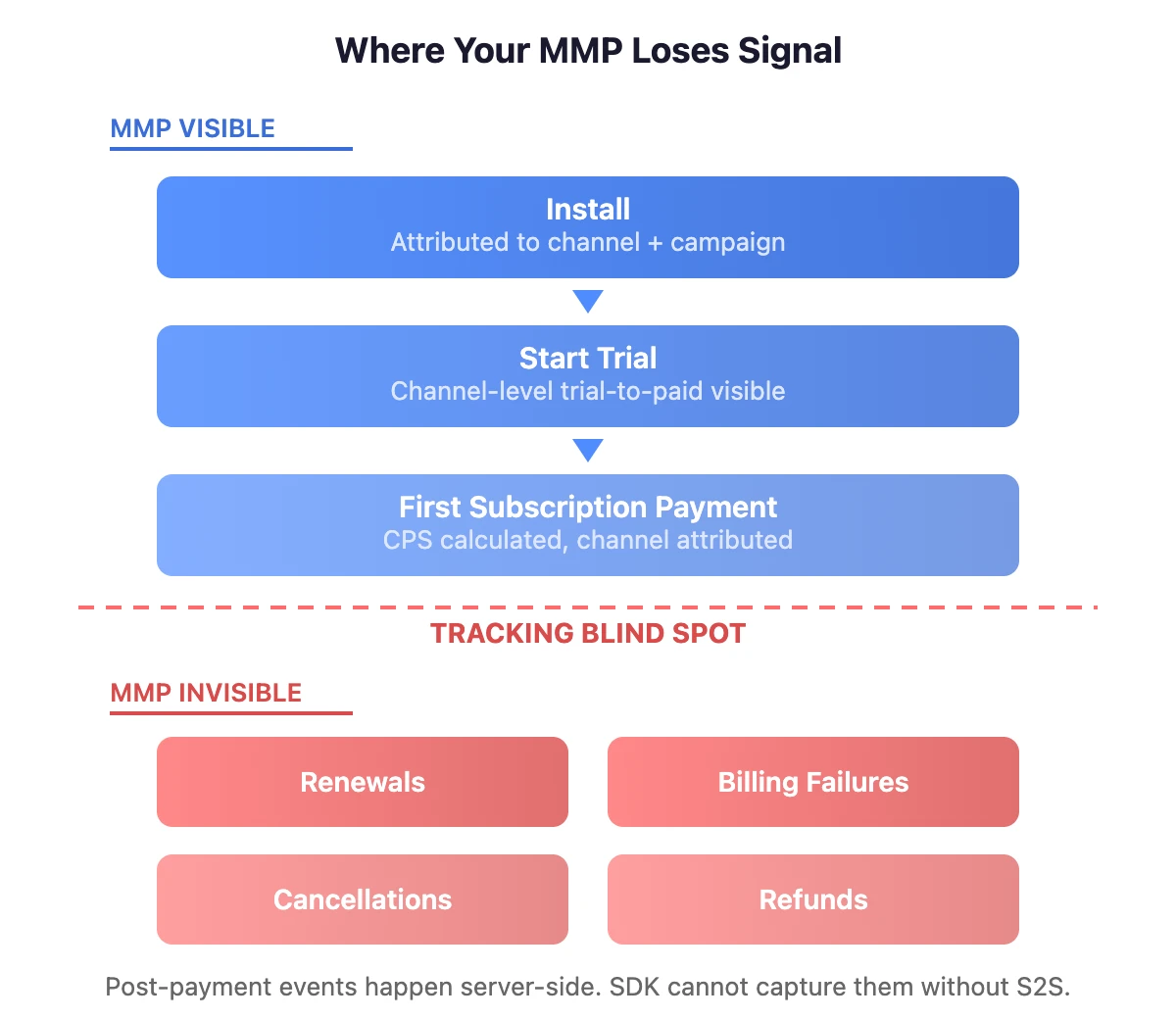
Subscription billing events are processed server-side by Apple and Google. Renewals, billing failures, grace period entries, and cancellations all happen outside the app. A device-side SDK can only detect subscription state changes when the user opens the app and triggers a sync. If a user's card declines at month three but they never reopen the app, your MMP has no record of that billing failure.
This creates a structural gap. Everything below the first payment line is invisible to your attribution system:
- Renewal confirmations (month 2, 3, 4...)
- Billing failures and grace period entries
- Voluntary cancellations and refund events
- Subscription downgrades or plan changes
The problem is not that your MMP is broken. It is that MMPs were designed for install attribution, and subscription revenue is a post-install lifecycle event that depends on server-side billing infrastructure, not on the device-side SDK.
2. How This Compounds for Health and Fitness Apps
Health and fitness subscription apps face a vertical-specific version of this problem. Seasonal acquisition spikes in January (New Year's resolutions) produce high trial volumes, but by March, churn accelerates as motivation fades. Without post-payment attribution, a growth team running January campaigns cannot distinguish between channels that acquired committed subscribers and channels that acquired seasonal users who cancel within 60 days.
According to RevenueCat's State of Subscription Apps 2025, the median trial-to-paid conversion rate for Health and Fitness apps is 39.9%. But that conversion rate only captures the first payment. The real question is which channels produce subscribers who stay past the first renewal, and most attribution systems cannot answer it.
The same report shows that nearly 30% of annual subscribers cancel within the first month. For fitness apps that acquire heavily in January, this means a large share of "successful" conversions from winter campaigns may churn before the second billing cycle. If your attribution stops at the first payment, your January ROAS looks strong while your actual subscriber retention tells a different story.
3. The Cost of Flying Blind on Channel LTV
When your MMP cannot track post-payment events at the channel level, your LTV calculations are built on incomplete data. Billing platforms like RevenueCat show you the totals. Your MMP shows you the channels. But no system shows you both, unless you connect them.
The result: budget decisions based on CPS alone systematically favor channels that produce high first-payment volume over channels that produce subscribers who renew.
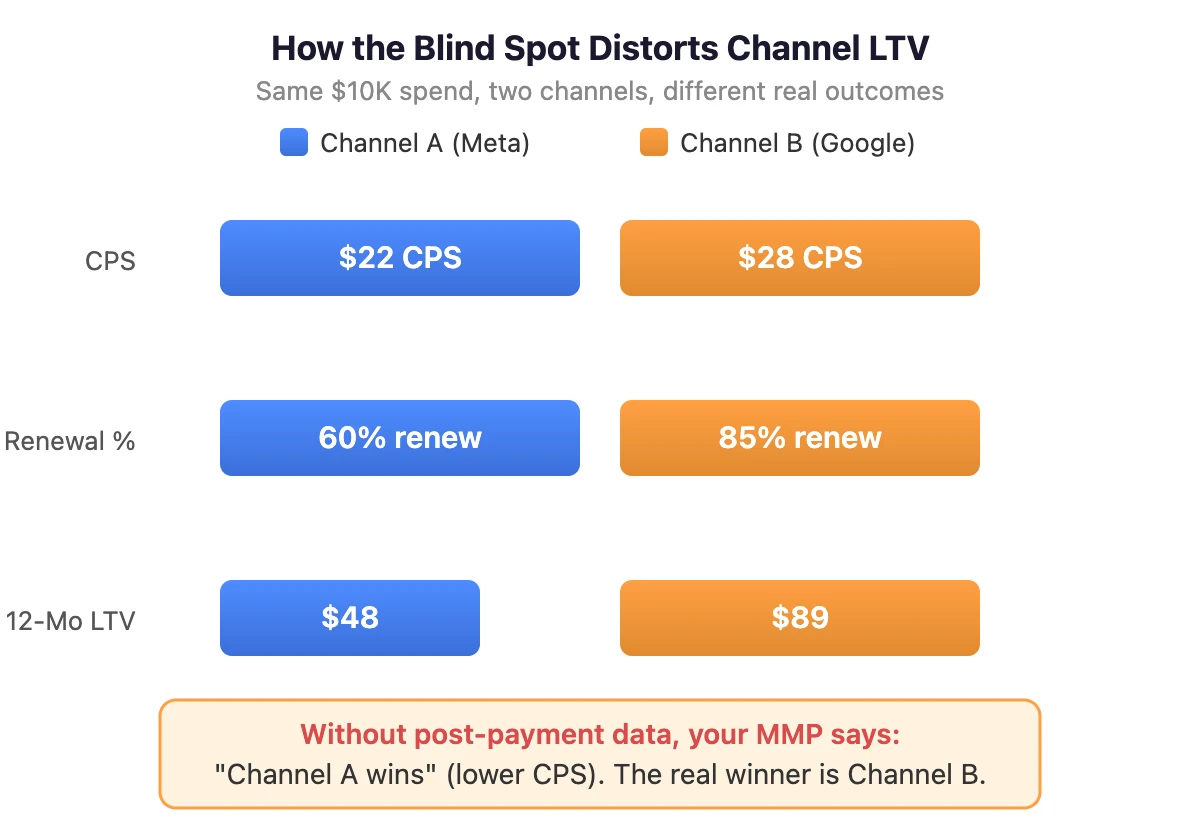
Consider two channels, both spending $10,000 per month:
| Metric | Channel A (Meta) | Channel B (Google) |
|---|---|---|
| CPS | $22 | $28 |
| First subscribers | 454 | 357 |
| Renewal rate (month 3) | 60% | 85% |
| Active subscribers (month 3) | 272 | 303 |
| 12-month projected LTV | $48 | $89 |
Without post-payment attribution, your MMP tells you Channel A wins because it has a lower CPS. The real winner is Channel B, which produces subscribers who stay and renew. But that signal only becomes visible when renewal and billing failure data flows back into your attribution system.
If you run paid acquisition for a subscription app, this is not a theoretical problem. Every month without channel-level renewal data is a month of budget flowing toward the wrong channels.
Start measuring what matters — for free
Airbridge Core Plan gives growing teams real attribution, deep linking, and audience tools at no cost.
Start Free for 30 Days →How to Fix Subscription Tracking Gaps
Practical Steps Any Team Can Take Today
Before investing in new tooling, growth teams can reduce the tracking blind spot with these actions:
- Align attribution windows across all ad platforms. Mismatched windows between Meta (7-day click), Google (30-day click), and your MMP create false discrepancies before the blind spot even begins.
- Export RevenueCat or Adapty cohort data manually. Match monthly subscription cohorts against your MMP's install cohorts by date to approximate channel-level renewal rates.
- Tag campaigns with consistent naming conventions. When you do connect billing data to attribution, clean naming makes the join possible. Inconsistent names break the match.
- Track billing failure rates in RevenueCat by install date. Even without channel attribution, you can spot whether recent cohorts have worse billing failure rates than older ones.
- Build a simple spreadsheet reconciliation. Export monthly data from your MMP (installs and trials by channel) and from RevenueCat (subscribers and churned by cohort date). The overlap gives rough channel-level retention visibility.
These steps give partial visibility. But they are manual, lagging, and cannot replace real-time channel-level subscription attribution.
How Airbridge Core Plan Closes the Post-Payment Blind Spot
Airbridge Core Plan is built to answer one question for subscription apps: "Are paid users converting into subscriptions, and which channels are driving value?"
Unlike enterprise MMPs that treat subscription tracking as an add-on locked behind higher pricing tiers, Core Plan includes RevenueCat and Adapty integrations in the base offering. This means subscription lifecycle events flow into the same attribution system that tracks installs and trials, closing the gap between acquisition data and revenue data.
What Core Plan tracks across the subscription funnel:
- Install and Sign-up attributed to channel and campaign
- Start Trial with channel-level trial-to-paid visibility
- Subscribe with revenue attributed to the originating ad
- Unsubscribe and lifecycle transitions
Core Plan supports 25 standard events optimized for the subscription funnel. These use predefined event names (Start Trial, Subscribe, Unsubscribe), reducing the schema design work that slows setup with enterprise tools. Customers still need to log these events in their app code, but the predefined names and parameters eliminate event naming decisions.
Channel coverage: Core Plan integrates with Meta Ads, Google Ads, Apple Search Ads, and TikTok for Business. These four Self-Attributing Networks (SANs) represent 80-90% of early-stage paid acquisition spend.
| Capability | Enterprise MMP | Airbridge Core Plan |
|---|---|---|
| Billing platform integration | Native (included in higher tiers) | Native (included in base) |
| Subscription funnel events | Predefined + custom events | 25 subscription-optimized standard events |
| Channel coverage | All networks supported | GMAT (Meta, Google, Apple, TikTok) |
| Minimum contract | Annual, $10K+ | Pay-as-you-go, 15K free installs |
| Setup guidance | General-purpose | Subscription-app focused |
| Third-party integrations | Unlimited | Maximum 2 (e.g., RevenueCat + Amplitude) |
Core Plan does not support custom events or non-SAN ad networks. This is intentional. For subscription apps running paid UA on major channels, standard events cover the full funnel without schema planning. Teams needing custom events, raw data exports, or agency access can upgrade to Airbridge's Growth Plan as their operations mature.
Reports that surface subscription blind spots:
Core Plan includes six built-in reports: Actuals, Trend, Active User, Funnel, Retention, and Revenue. The Funnel report visualizes the install-to-trial-to-subscription path by channel. The Retention report shows cohort retention by acquisition source, revealing which channels produce subscribers who stay past the first renewal. The Revenue report attributes subscription revenue to the campaign that drove the original install.
Together, these reports answer the question that the subscription app tracking blind spot hides: which channels produce subscribers who renew, and which channels produce subscribers who churn?
FAQ: Subscription App Tracking and Attribution
How do billing failures affect subscription app LTV calculations?
Billing failures cause involuntary churn, where subscribers lose access not because they chose to cancel, but because a payment failed. When your MMP cannot attribute billing failures to specific channels, your LTV-by-channel numbers overcount active subscribers. The result is inflated LTV estimates for channels with higher involuntary churn rates, leading to misallocated budget.
What is the difference between SDK-based and S2S subscription tracking?
SDK-based tracking requires an app session to sync, which means subscriptions processed while the app is closed are not captured in real time. S2S (server-to-server) integration transmits subscription events directly from the billing platform to the attribution system, regardless of app state. For subscription apps, S2S is the reliable path to post-payment attribution.
When should a subscription app upgrade from Core Plan to Growth Plan?
Core Plan is designed for teams running paid UA on Meta, Google, Apple Search Ads, and TikTok with a subscription-based revenue model. Teams typically upgrade to Growth Plan when they need custom event tracking, more than two third-party integrations, raw data exports to a data warehouse, or support for additional ad networks beyond GMAT.
The Revenue You Cannot Attribute Is Revenue You Cannot Scale
Every month without channel-level subscription attribution is a month of budget decisions built on partial data. The channels that produce your highest-LTV subscribers may be underfunded, while the channels that produce high first-payment volume but poor renewal rates absorb your budget increases.
Start Free with Airbridge Core Plan and connect your RevenueCat or Adapty data to channel-level attribution, starting with 15K free attributed installs.

Ready to see what Core Plan can do?
Free attribution, deep linking, and audience tools — built for teams that are ready to grow.