Why Painkiller Apps Convert 9x More: 4 Questions to Diagnose

A painkiller app achieved a 37% App Store conversion-rate" class="glossary-link" title="Conversion Rate">conversion rate. A vitamin app in the same category hit 4%. That is a 9x gap — driven entirely by how much users needed the product, not how well it was built. (Pocketworks, 2024)
This distinction — painkiller vs. vitamin — is the strongest predictor of what users will pay for your app. It shapes your app pricing strategy, your paywall model, and whether "too expensive" feedback means you have a pricing problem or a positioning problem.
A painkiller app solves an urgent, painful problem users will pay to fix immediately. A vitamin app offers a nice-to-have improvement users can live without. This distinction should drive every pricing decision you make.
Key Takeaways
-
Painkiller apps convert at 5-9x the rate of vitamin apps. The gap comes from motivation, not product quality or design.
-
Willingness to pay is driven by urgency, not usage frequency. A fertility tracker used once daily has enormous WTP; a weather app used five times daily has almost none.
-
The same app can be a painkiller for one audience and a vitamin for another. Pricing strategy should target the painkiller segment.
-
Painkiller apps should charge more, not less. Vitamin apps should give more away, not charge less.
-
"Too expensive" is rarely a pricing problem. It is usually an activation problem, an audience problem, or a value clarity problem.
What Is a Painkiller App vs. a Vitamin App?
The framework has three categories:
-
Painkiller: Solves an urgent, painful problem. Users actively seek a solution and will pay to make the pain stop.
-
Vitamin: Offers a nice-to-have improvement. Users might enjoy it, but they can live without it.
-
Medicine: Addresses a regulated or mandated need (compliance apps, tax filing). Users must comply regardless of preference. This article focuses on the painkiller-vitamin distinction — the one most app founders actually face.
The category your app falls into determines four things:
| Dimension | Painkiller | Vitamin |
|---|---|---|
| Motivation | High urgency — users need this now | Aspirational — users want this eventually |
| Activation speed | Immediate action | Delayed, habit-dependent |
| Willingness to pay | High | Low to moderate |
| Retention | Need-driven (sticky) | Habit-dependent (fragile) |
Most apps are not purely one or the other — the same app can be a painkiller for one audience and a vitamin for another. (More on this in the dual-audience section below.)
Understanding painkiller vs vitamin app pricing starts with knowing which category your app falls into — and for which audience. Price for the segment that needs you most.
How Much Does It Actually Affect Your App Pricing?
The data gaps are not subtle.
Conversion rates:
| Metric | Painkiller-type apps | Vitamin-type apps | Gap |
|---|---|---|---|
| App Store conversion | 37% | 4% | 9x |
| Hard paywall Day-35 conversion | 12.1–21.7% | 2.2–4.5% (freemium) | ~5.5x |
Lifetime value:
| Metric | Painkiller-type apps | Vitamin-type apps | Gap |
|---|---|---|---|
| Hard paywall LTV | $49.30 | $24.24 (freemium) | 2x |
| High-priced apps LTV | $55.21 | $8.00 (low-priced) | 7x |
| Health & Fitness Y1 LTV (median) | $27.21 | — | P90: $86.35 |
Health & Fitness — the category most aligned with painkiller positioning — shows the highest install lifetime value (LTV) across all app categories. Entertainment — the most vitamin-like category — shows the lowest. The gap between top and bottom categories is 2x. (Adapty, State of In-App Subscriptions 2026)
When users need your product, they pay more, stay longer, and forgive more friction. When they do not, no amount of paywall optimization closes the gap.
How Do You Know Which One Your App Is?
Most founders answer this intuitively and get it wrong. The common mistake is using usage frequency as a proxy for willingness to pay. Frequency is a weak predictor. A weather app gets checked five times a day. A fertility tracking app gets checked once. The fertility app has dramatically higher WTP because the stakes are higher.
Use these four questions instead. Score each 1–5.
1. How urgent is the problem?
1 = "Nice improvement to their day" | 5 = "Urgent daily pain they actively try to solve"
2. What happens if they do not solve it?
1 = "Nothing meaningful changes" | 5 = "Real consequences — health, financial, emotional"
3. How much emotional relief does solving it provide?
1 = "Mild satisfaction" | 5 = "Significant relief or transformation"
4. How painful are the alternatives?
1 = "Easy free alternatives exist" | 5 = "Alternatives are expensive, slow, or frustrating"
Score interpretation:
-
16–20: Painkiller. You have pricing power. Lean into it.
-
10–15: Vitamin leaning painkiller. You have pricing power with the right audience segment.
-
4–9: Vitamin. You need a volume strategy or a positioning shift.
The score does not just tell you what to charge. It tells you whether your value proposition can support a paywall at all.
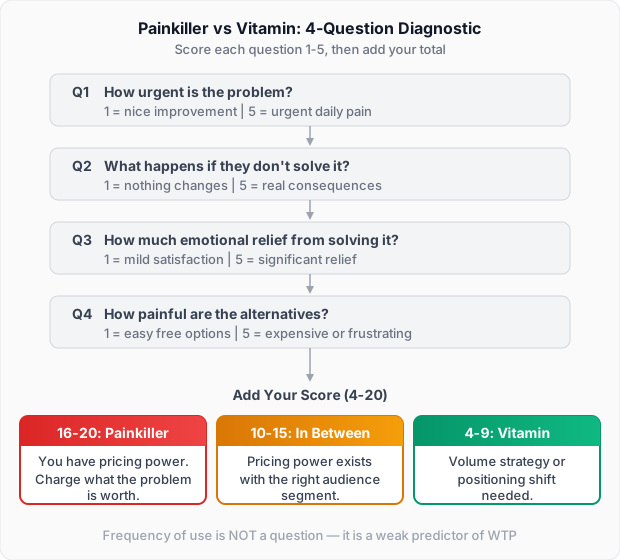
Use this self-scoring test before setting your price. The right model depends on your product's urgency level, not industry convention.
What If the Same App Is a Painkiller for Some Users and a Vitamin for Others?
Most apps serve both audiences. A calorie tracking app is a painkiller for someone diagnosed with diabetes — they need it to manage a medical condition. It is a vitamin for someone casually interested in eating healthier. A fitness app just starting out can be a painkiller for someone recovering from injury and a vitamin for someone who thinks they should exercise more.
The winning strategy is to position, market, and price for the painkiller segment — even if the vitamin segment is larger.
This affects three things:
-
Ad targeting. Run ads to the audience with the most urgent problem. "Recover from knee injury at home" converts better than "Get fit this year."
-
Paywall copy. Emotional job framing outperforms feature-list framing. "Find calm in 5 minutes" outperformed "Access 500+ meditations" in a real paywall test. Painkiller language focuses on outcome and relief, not feature count.
-
Price point. Do not drop to $4.99 to capture the vitamin segment when your painkiller segment pays $9.99. Full-price subscribers retain significantly better than discount cohorts — price acts as a commitment filter.
Start measuring what matters — for free
Airbridge Core Plan gives growing teams real attribution, deep linking, and audience tools at no cost.
Start Free for 30 Days →How Should Painkiller Apps Price Differently from Vitamin Apps?
Two tracks. Different logic for each.
Painkiller track:
-
Hard paywall or short free trial — high motivation overcomes friction
-
Higher price points — users with urgent problems tolerate and even expect higher prices
-
Annual plan emphasis — painkiller users commit because they know they need this long-term
-
Outcome-framed copy — "Stop waking up at 3am" not "Sleep tracking with AI insights"
Vitamin track:
-
Freemium or soft paywall — low motivation means you need a free tier to build the habit first
-
Lower entry price — reduce the decision weight since there is no urgency pushing them forward
-
Habit-building free tier — the free experience must create enough value that upgrading feels natural
-
Feature expansion upsell — once the habit exists, gate the advanced version
Real examples show these tracks in action:
| App | Category | Pricing | Why it works |
|---|---|---|---|
| Headspace | Painkiller (anxiety/sleep) | $69.99/year | Users pay for relief from a daily problem |
| Noom | Painkiller (weight loss) | $59/month | High stakes + accountability justifies premium |
| Duolingo | Vitamin (casual learning) | Free + $6.99/month | Massive free tier, habit-first, premium optional |
| MyFitnessPal | Vitamin (casual tracking) | Free + $19.99/year | Broad free tier converts a fraction at low cost |
Here is the counterintuitive part: when motivation is high, higher prices often convert well. When motivation is low, no price feels right. This is why painkiller apps can charge premium prices while vitamin apps struggle even at low price points.
When users say "too expensive," it is rarely about the number on the screen. It is one of three things: an activation problem (the user has not experienced your core value yet), an audience problem (you are targeting the vitamin segment instead of the painkiller segment), or a value clarity problem (your paywall does not communicate the outcome clearly enough).
Painkiller users already earmark budget for the problem category. They are not creating new spending — they are replacing an existing solution. Vitamin users must create a new budget line, which is psychologically harder. (Entrepreneur)
If you are setting a price for the first time, these ranges are typical starting points:
| App type | Painkiller pricing | Vitamin pricing |
|---|---|---|
| Health & Fitness | $39.99–$79.99/year | Free + $19.99–$29.99/year |
| Productivity | $4.99–$9.99/month | Free + $2.99–$4.99/month |
| AI tools | $9.99–$19.99/month | Free tier + credits |
| Utility | $4.99–$14.99 one-time | Free with ads |
These are starting points, not ceilings. It is easier to lower prices than raise them.
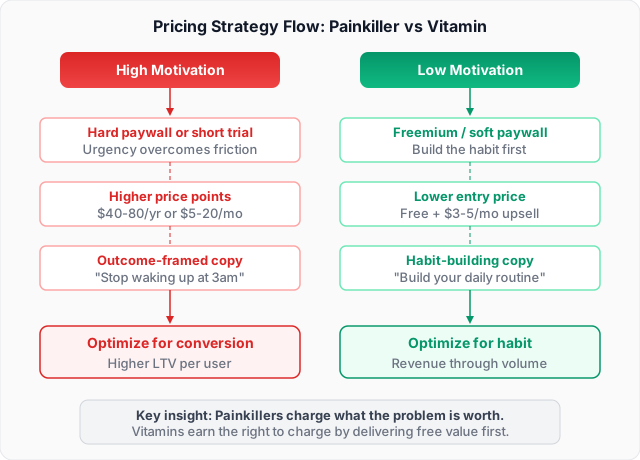
Painkiller apps optimize for conversion. Vitamin apps optimize for habit formation. The strategy diverges at the model level.
Can You Turn a Vitamin App Into a Painkiller?
You cannot change the product category. But you can change which audience you target and how you frame the problem.
Three levers:
-
Narrow the audience. Stop marketing to everyone who "might" use your app. Find the segment where your app solves a real, urgent problem. A generic habit tracker is a vitamin. A habit tracker for people in addiction recovery is a painkiller. Same product, different audience, different pricing power.
-
Add urgency and stakes. Streaks, accountability partners, progress tracking with consequences. These do not change the product category, but they raise the emotional cost of not using the app. Duolingo's streak mechanic turns casual language learning into something users feel compelled to maintain.
-
Reframe the value proposition from features to consequences. "Track your calories" is a vitamin. "Know exactly what is stalling your weight loss" is a painkiller. The feature is identical. The framing changes the perceived urgency.
One caution: if core motivation is low, increasing trust or reducing friction will not compensate. Conversion is a function of Motivation x (Trust / Friction) — when motivation is near zero, the other variables cannot make up for it. Fix the audience and the framing before optimizing the funnel.
To track how pricing changes affect your key numbers, start with the app marketing metrics that actually matter for subscription apps. For deeper funnel visibility, set up subscription event tracking from day one.
Quick Answers to Common Pricing Doubts
Q1. Is a vitamin app always a bad business?
No, but it requires scale. Vitamin apps need millions of free users to make a 2–3% conversion rate work — Spotify is the textbook example. If your TAM is under 10 million potential users, a vitamin positioning makes profitability very difficult. The alternative is to find the niche audience where the product is actually a painkiller and price for them.
Q2. Should vitamin apps avoid subscriptions entirely?
No, but lead with a generous free tier that builds the habit first. Once users are engaged, offer an annual plan upsell rather than a monthly gate. Annual plans reduce decision frequency and increase commitment. Earning the right to charge by delivering free value first is the key — not blocking access upfront.
Q3. How do I test whether my app is a painkiller before launch?
Run a landing page test. Describe the problem your app solves, show a price, and measure "sign up for early access" conversion. If conversion exceeds 5% with a stated price, you likely have painkiller-level motivation. You can also survey your target audience: "If this product disappeared tomorrow, how disappointed would you be?" A rate of 40%+ saying "very disappointed" is a strong painkiller signal.
Price What You Solve, Not What You Build
The features you ship do not determine what users will pay. The problem you solve does. Every pricing decision — paywall type, price point, trial length, discount strategy — flows from one question: does your user need this, or just want it?
Score your app with the four-question diagnostic. If you are a painkiller, charge what the problem is worth. If you are a vitamin, find the audience segment where you become a painkiller — or build a volume model that does not depend on high willingness to pay.
The founders who get pricing right are not the ones with the best features. They are the ones who understand what they are really selling: relief from a problem, not access to a product.


Ready to see what Core Plan can do?
Free attribution, deep linking, and audience tools — built for teams that are ready to grow.