Subscription or One-Time Purchase? How to Pick the Right Model for Your App

The right app monetization model depends on how your users experience value — not on what the top charts suggest.
Most apps default to subscriptions without asking whether their product actually delivers recurring value. Then they spend months fighting churn without realizing the model itself is the problem.
Choosing the wrong revenue model doesn't just cap your earnings. It shapes your entire product roadmap, your paywall design, and how users perceive your value. Among 75,000+ subscription apps analyzed, the top 10% capture 94-97% of all subscription revenue. The gap starts before you build a paywall, before you run your first ad. If you're still figuring out the basics of how to begin marketing a subscription app, your monetization model is one of the first decisions to lock in.
Key Takeaways
-
Not every app should be a subscription. If your product solves a problem once or gets used sporadically, a one-time purchase may outperform. Match your model to how users experience value, not to industry defaults.
-
Hard paywalls convert at 12.1% vs freemium's 2.2% — but refund rates are 1.7x higher. Every model has tradeoffs. The numbers should guide your decision, not industry defaults.
-
Yearly plans retain 2.5x better than monthly. Median 12-month retention is 44.1% for annual vs 17.5% for monthly. Plan structure matters as much as model choice.
-
Pricing experiments raise LTV by 46% on average. Picking a model is the start, not the finish.
-
Hybrid models are gaining share. One-time purchases, consumables, and lifetime plans grew from 6.4% to 10.3% of plan type share between 2023 and 2025.
The Question Most Apps Skip Before Building Their Paywall
There's a reason most monetization advice starts with "just go subscription." Only 4% of mobile apps use subscription models, but they account for 45.4% of total app revenue globally. (RevenueCat, State of Subscription Apps 2025) The math looks obvious.
But obvious math hides a deeper question: does your app deliver value continuously, or does it solve a bounded problem?
A meditation app that users open daily delivers ongoing value. A subscription makes sense. A photo editing app that users open once a week to apply a filter delivers value in bursts. Forcing a subscription on that usage pattern creates friction — users feel they're paying for something they rarely use.
The real diagnostic is not "can I charge monthly?" It's "will users feel they're getting monthly value?" When the answer is no, users churn fast.
This question matters more than paywall design, trial length, or pricing tier. Get the model wrong, and every optimization after it fights an uphill battle.
What 'Subscription' and 'One-Time Purchase' Actually Mean for Your Revenue
Before choosing, understand what each model optimizes for.
Subscriptions create recurring revenue. Users pay weekly, monthly, or annually for continued access. Revenue compounds as your user base grows, and predictable cash flow lets you invest in product improvement. Subscription revenues reached $79.5 billion in 2025, with iOS responsible for 73%. (Business of Apps, App Revenue Data 2026)
One-time purchases generate immediate returns. Users pay once and own the feature or content permanently. Revenue scales linearly with volume — no compounding, but no churn either. Apple supports several models here: non-consumable purchases (permanent unlocks), consumables (credits, tokens), and non-renewing subscriptions. (Apple Developer: In-App Purchase Types)
The revenue landscape is more concentrated than most founders expect. 56% of new apps earn less than $1,000 in their first year. Only 9% break $100K. The market is getting more crowded — 31% more new apps launched in 2025 vs 2024, but median monthly revenue dropped 22% year-over-year from $627 to $492. (Adapty, State of In-App Subscriptions 2026)
Meanwhile, the subscription-or-nothing assumption is weakening. One-time purchases, consumables, and lifetime subscriptions grew from 6.4% to 10.3% of plan type share between 2023 and 2025. The market is diversifying.
| Model | Revenue Pattern | Compounding | Best When |
|---|---|---|---|
| Subscription (monthly/annual) | Recurring, predictable | Yes — grows with retention | Value is continuous, habitual usage |
| One-time purchase | Immediate, one-shot | No — linear with volume | Bounded use case, clear deliverable |
| Consumable (credits/tokens) | Variable, usage-based | Partial — repeat purchases | AI tools, generation-based apps |
| Lifetime subscription | Upfront lump sum | No — but higher per-user | Trust-sensitive users, commitment anxiety |
There's also a platform incentive to consider. Apple takes a 30% commission on all in-app purchases — but drops to 15% for subscriptions after the first year. (Apple Developer: Auto-Renewable Subscriptions) One-time purchases stay at 30% forever. For apps where users stick around, this 15-point commission difference compounds into a meaningful revenue advantage over time.
Which Pricing Model Fits Your App? 4 Questions to Decide
Instead of defaulting to what competitors do, answer four questions about your product.
1. How often does the user need this?
Daily or near-daily usage signals subscription fit. If users open your app 4-5 times per week, they're deriving ongoing value. Fitness apps, meditation apps, language learning — these are natural subscription products.
If usage is sporadic or event-driven — a tax calculator, a resume builder, a photo enhancer — subscriptions create friction. Users resent paying in months they don't use the app.
2. How long will they use it?
Subscriptions reward long retention windows. Yearly plans deliver median 44.1% 12-month retention vs 17.5% for monthly and just 3.4% for weekly. If your product's natural usage arc is 2-3 months (a workout program, a course), you're fighting churn by design.
One-time purchases sidestep retention entirely. The user pays once, and you don't need to re-earn their commitment every month.
If you're unsure where to start on pricing, here are typical ranges across categories:
| App Type | Common Model | Typical Price Range |
|---|---|---|
| Fitness / Meditation | Annual subscription | $39.99-$79.99/year |
| Productivity / Notes | Monthly or annual | $4.99-$9.99/month |
| Photo / Video editing | One-time or lifetime | $4.99-$29.99 |
| AI tools (GPT wrappers) | Sub + credits hybrid | $9.99/month + $0.01-$0.05/generation |
| Utility (scanner, converter) | One-time purchase | $2.99-$9.99 |
These are starting points, not ceilings. Remember: it's easier to lower prices than raise them.
3. Is value continuous or bounded?
This is the most important question. Continuous value means the app keeps delivering new outcomes over time — new workouts, new content, new data insights. Bounded value means the problem gets solved once — file converted, background removed, document formatted.
Subscriptions work for continuous value. One-time purchases work for bounded value. Mismatching these creates the "subscription fatigue" that a growing share of consumers report experiencing.
4. Does willingness to pay come from urgency or frequency?
Emotional jobs monetize better than functional jobs. The strongest predictors of willingness to pay are urgency, consequences of not solving, emotional relief, and pain of alternatives — not frequency of use.
A fertility tracking app used once a day has enormous willingness to pay because the stakes are high. A weather app used five times a day has low willingness to pay because alternatives are free and consequences of switching are minimal.
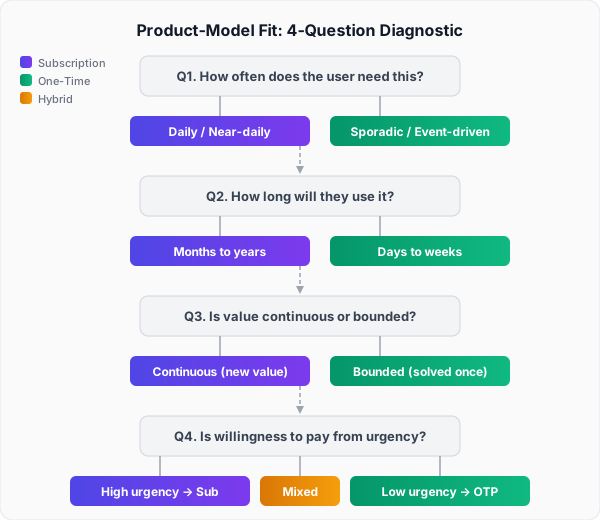
Use this diagnostic before committing to a model. The right answer depends on your product's value pattern, not industry convention.
Start measuring what matters — for free
Airbridge Core Plan gives growing teams real attribution, deep linking, and audience tools at no cost.
Start Free for 30 Days →The Numbers Behind Subscription vs. One-Time Purchase Apps
Here's what the data shows about conversion, retention, and lifetime value (LTV) across models. Note: paywall type (hard, soft, freemium) is a separate decision from revenue model. A hard paywall can gate a subscription or a one-time purchase. The benchmarks below compare paywall approaches, which tend to correlate with model choice.
1. Hard Paywalls Convert at 5.5x the Rate of Freemium
Hard paywall apps convert at D35 median 12.1% download-to-paid vs freemium's 2.2% — a 5.5x difference. But hard paywall refund rates (5.8%) run 1.7x higher than freemium (3.4%). Hard paywalls force a fast decision; some of those decisions reverse.
For apps weighing which paywall to pair with their model, see our guide on hard paywall vs soft paywall.
2. The 7x LTV Gap Between High-Priced and Low-Priced Apps
| Segment | Y1 LTV per Payer (Median) | Y1 LTV per Payer (P90) |
|---|---|---|
| Health & Fitness overall | $27.21 | $86.35 |
| Hard paywall | $49.30 | — |
| Freemium | $24.24 | — |
| High-priced apps | $55.21 | — |
| Low-priced apps | $8.00 | — |
Hard paywall delivers $49.30 median Y1 LTV vs freemium's $24.24 — roughly double. High-priced apps earn 7x more than low-priced apps in Y1 LTV. This isn't about charging more for the sake of it. Apps that price higher tend to deliver (and communicate) more value.
3. Why Yearly Plans Retain 2.5x Better Than Monthly
| Plan Duration | 12-Month Retention (Median) | Share of Apps Using |
|---|---|---|
| Yearly | 44.1% | 67% (H&F) |
| Monthly | 17.5% | — |
| Weekly | 3.4% | 55.6% (global) |
Yearly plans retain 2.5x better than monthly after 12 months. In Health & Fitness, 67% of apps offer yearly plans. Globally, weekly plans dominate at 55.6% — but their retention is extremely low. Weekly works for fast revenue but creates a revolving door.
4. The experimentation multiplier
Pricing experiments raise LTV by 46% even though they only improve conversion rate 28% of the time. Hard paywall delivers 21% higher LTV than soft paywall. And growth teams that run experiments earn up to 40x more revenue than those that don't.
The takeaway: your first model choice matters, but your willingness to iterate matters more. For tracking how pricing changes affect your app marketing metrics, measure conversion and LTV from day one.
5. How Model Choice Affects Your Ad Budget Payback
If you're planning to run paid ads, model choice directly shapes how fast you recover your acquisition cost.
Subscription example: You spend $5 CPI on Meta. Your app charges $9.99/month. A subscriber who stays 4 months generates $40 in revenue (minus Apple's 30% cut in year 1 = $28 net). You break even around month 2-3. But if they churn after the free trial, you recover $0.
One-time purchase example: Same $5 CPI. Your app charges $4.99 one-time. After Apple's 30% cut, you net $3.49 per paying user — which doesn't cover the acquisition cost unless your install-to-purchase conversion rate is high enough to offset unpaid installs.
| Subscription ($9.99/mo) | One-Time Purchase ($4.99) | |
|---|---|---|
| CPI | $5.00 | $5.00 |
| Net revenue per payer | $28.00 (4-month retention) | $3.49 |
| Breakeven | Month 2-3 | Needs 60%+ conversion rate |
| Risk | Churn before breakeven | Low per-user margin |
This is why subscription apps can afford higher CPIs — they recover cost over time. One-time purchase apps need either very high conversion rates or very low acquisition costs to make paid UA work.
When One-Time Purchase Is the Right Answer
Subscriptions get the spotlight, but one-time purchases solve real problems that subscriptions create.
1. When commitment anxiety is your biggest conversion blocker
A significant share of consumers report subscription fatigue. Some users will pay $30 once but will never agree to $5/month. A lifetime purchase or one-time unlock captures revenue that subscriptions leave on the table.
Lifetime purchases reduce friction by removing commitment anxiety. The tradeoff is capped upside — you can't compound revenue from a single-payment user. But for early-stage apps that need cash flow now, capturing $30 today beats hoping for $5/month over six months.
2. When your app solves a bounded problem
Photo editors, document converters, audio enhancers, single-purpose utilities — these deliver value in a single interaction. A subscription model asks users to pay perpetually for something they use intermittently.
Apple's guidelines reinforce this: if you change your existing app to a subscription-based model, you cannot remove functionality that existing purchasers already paid for. (Apple App Store Review Guidelines) If your app's core value is a one-time transformation, a one-time price is honest and sustainable.
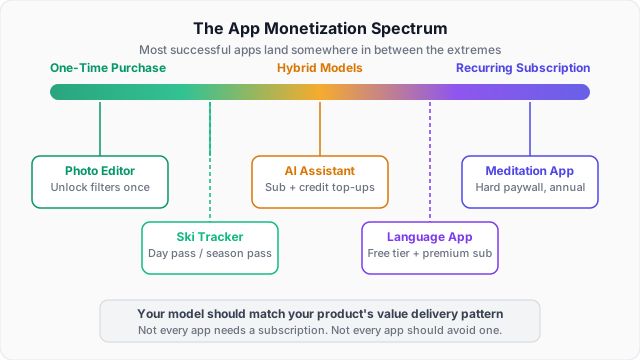
Revenue models exist on a spectrum. Pure subscription and pure one-time purchase are the extremes. Most successful apps land somewhere in between.
Using Both Models Without Confusing Users
You don't have to choose one model forever. The most effective monetization strategies layer models thoughtfully.
1. Lifetime as a second offer after decline
Some users hesitate at recurring pricing but are comfortable with a one-time payment. Offering a lifetime purchase as a second offer — shown only after a user declines the subscription — captures value that would otherwise be lost. This works without cannibalization when positioned correctly: the lifetime option appears only at the moment of rejection, not alongside the subscription.
2. Subscription plus consumables (the hybrid model)
AI apps pioneered this: a monthly subscription covers base access, and consumable credits handle heavy usage. Users get predictability (flat monthly cost for normal use) plus flexibility (buy more when they need it).
This model works when usage is variable but ongoing. If some sessions require 10x the compute of others, a flat subscription either overcharges light users or undercharges heavy ones. Consumables solve this.
3. The rule of clarity
Whatever combination you use, users should understand their options in under 5 seconds. If your paywall requires a paragraph of explanation, you've added too much complexity. Start with one model, learn what works, then layer. For how to think about this in the context of growing your subscription app, simplicity in early monetization preserves your ability to iterate.
Common Mistakes When Choosing Your Monetization Model
1. Choosing freemium without the scale to support it
Freemium requires massive volume. At a 2.2% conversion rate, you need roughly 4,500 downloads to generate 100 paying users. Hard paywall at 12.1% needs only 825 downloads for the same 100 conversions.
For early-stage apps with limited ad spend, freemium is a slow bleed. Free users also give misleading feedback — their expectations differ from paying users. The features they request may not align with what drives revenue.
2. Interpreting "too expensive" literally
"Too expensive" usually means unclear value, poor activation, or wrong audience — not wrong pricing. When users say your app costs too much, the real problem is usually that they haven't experienced enough value to justify the price.
Start slightly higher than you think is right. Lowering prices is easier than raising them, especially on the App Store where a price increase above 50% triggers additional review friction. Lowering a price is a promotion. Raising it is a penalty.
3. Offering free trials when they attract the wrong users
Trials aren't universally better. In Productivity apps, direct purchasers have an LTV of $55.45 vs trial users at $40.13. In Lifestyle, trial users are 27% less valuable than direct purchasers.
Trials help when value is experiential and trust is a blocker. They hurt when they attract low-intent users who start trials with no intention of paying. If your conversion data shows high trial starts but low trial-to-paid rates, the trial itself may be the problem. For deeper analysis, make sure you're measuring trial quality, not just trial quantity — our guide on subscription app event tracking covers how.
Your First Model Is a Hypothesis, Not a Life Sentence
Nobody gets monetization perfect on day one. The founders who win are the ones who pick a model that fits their product's value pattern, ship it, and start learning from real paying users.
Your first 50-100 paying users will tell you more about your pricing than any benchmark report. If they churn fast, the model may be wrong. If they ask for a lifetime option, commitment anxiety is real. If they never convert from free, you may need a paywall.
Start with one model. Measure what happens. Then adjust. If you're ready to move from model choice to your first ad channel, that's the next decision.

Ready to see what Core Plan can do?
Free attribution, deep linking, and audience tools — built for teams that are ready to grow.